Badminton x Soccer — The Science Behind How Agility, Reaction Speed, and Full-Body Coordination Transfer to the Pitch
Badminton is the fastest racket sport in the world — shuttlecock smash speeds exceed 400 km/h. To cope with this ultra-high-speed rally exchange, badminton players develop extraordinary reaction speed, change-of-direction ability, and full-body coordination. This article draws on research by Phomsoupha & Laffaye, Sheppard & Young, and Abernethy & Zawi to explain, with scientific backing, how badminton training elevates soccer performance.
Why Badminton Helps Soccer — Three Transfer Mechanisms
Badminton and soccer share three core demands: agility, reaction speed, and full-body coordination. Despite a smaller court, a single badminton match involves more directional changes than a soccer match, producing an extremely high neuromuscular load density.

Photo by Irish83 on Unsplash
Badminton's defining characteristic — rapid-fire decisions and movements on a compact court — makes it one of the highest neuromuscular-load-per-minute sports among all ball games. According to Phomsoupha & Laffaye's (2015) review, elite badminton players perform an average of over 350 directional changes per match, with inter-rally intervals of just 6 to 8 seconds.
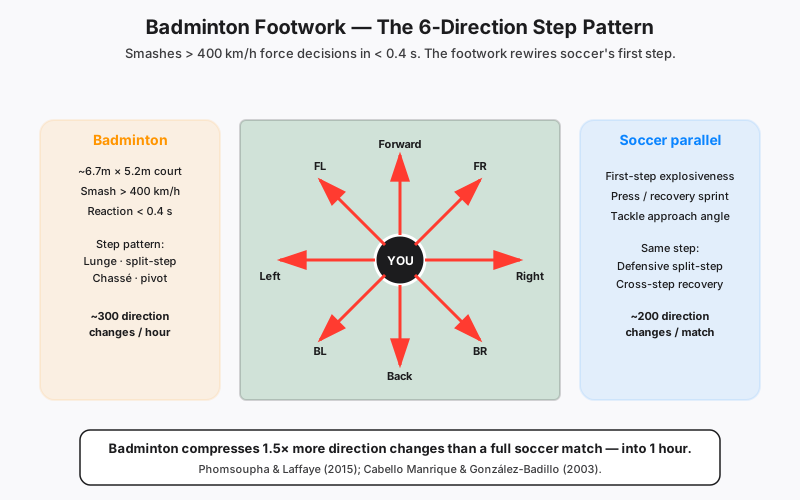
- Agility — A badminton court measures only 13.4 m x 6.1 m, yet players must make instantaneous movements in six directions — forward-left, forward-right, lateral-left, lateral-right, backward-left, and backward-right. This high-density directional change maps directly onto the agility required for 1-v-1 defending and transitions in soccer
- Reaction Speed — Shuttlecock smash speeds exceed 400 km/h. Players must decide their movement direction within 0.3 seconds by reading their opponent's racket motion. This ultra-fast visual-motor coupling shortens a goalkeeper's save reaction time or a defender's interception response
- Full-Body Coordination — A smash is generated through a kinetic chain: leg drive, trunk rotation, shoulder internal rotation, forearm pronation, and wrist snap. This coordination pattern is biomechanically similar to the movements involved in overhead kicks and heading in soccer
The critical point is that badminton trains all three abilities simultaneously. Even a 30-minute session can deliver a directional-change stimulus to the nervous system comparable to what a 90-minute soccer match provides.
Badminton's "ultra-fast responses on a compact court" mirrors soccer's "split-second decisions in congested areas." The small court size actually increases the transfer value.
Shuttlecock Speed and Reaction Time — How 400 km/h Trains Lightning-Fast Decision-Making
According to Phomsoupha & Laffaye (2015), a badminton smash leaves the racket at over 400 km/h and reaches the opposite end of the court in 0.15 to 0.2 seconds. This extreme time constraint directly improves reaction speed for soccer.

Photo by Glen Carrie on Unsplash
Although the shuttlecock decelerates rapidly due to air resistance, it still travels at 60 to 80 km/h near the net. Players must read visual cues from their opponent's racket motion and commit to a movement direction within 0.3 seconds.
Components of Reaction Time and How Badminton Sharpens Them
Reaction time breaks down into three stages: perception, decision, and motor initiation. Badminton's ultra-fast rallies compress all three. Tiwari et al. (2011) reported that badminton players had approximately 15% faster simple reaction times and approximately 20% faster choice reaction times compared to non-athletes.
Transfer Points to Soccer
A goalkeeper has 0.3 to 0.6 seconds to react to a shot; a defender facing a stepover has roughly the same window. A nervous system conditioned by repeated sub-0.2-second responses in badminton can operate within these soccer time constraints with greater ease.
- Smash return → GK saves — Both demand reacting to a high-speed object at close range
- Net-front duels → 1-v-1 defending — Anticipating the opponent's next move 0.2 seconds ahead and committing the body first
- Visual search during rallies → Midfield interceptions — Reading the opponent's body orientation and weight shift to predict their next action
- Drop shot recognition → Reacting to through balls — Instantly distinguishing a slow delivery (lofted pass) from a fast one (through ball)
Badminton players exhibit notably shorter reaction times compared to athletes in other sports. This is the result of shuttlecock speed imposing extreme time constraints that optimize visual-motor coupling efficiency.
— Summarized from Tiwari et al. (2011)
Agility and Change-of-Direction Mechanics — How Six-Way Footwork Transforms Defending
Sheppard & Young (2006) defined agility as "a rapid whole-body change of direction in response to a stimulus," establishing it as an integrated cognitive-motor ability. Badminton's six-directional footwork is a training method that fits this definition precisely.
According to Sheppard & Young's (2006) definition in Sports Medicine, agility is "a rapid whole-body change of direction in response to an unpredictable stimulus" — a compound ability that encompasses both perceptual-decision and change-of-direction speed. Badminton footwork is a training modality that fully satisfies this definition.
Badminton's Six-Directional Footwork
Court footwork in badminton involves continuous switching among six movement directions: two forward (front-left and front-right), two lateral (left and right), and two backward (back-left and back-right). Lunges, crossover steps, shuffles, and chasse steps are deployed in rapid succession, all cycling through a "return to center → react to next stimulus" pattern. This is structurally identical to a soccer defender confronting an attacker in a 1-v-1 situation, where instant readiness in every direction is essential.
Deceleration Ability Transfer
The most critical element in a change of direction is not acceleration but deceleration. In badminton, players brake sharply after each directional movement and redirect immediately. This rapid-deceleration ability is indispensable in soccer for "not biting on fakes" — it is what allows a defender to hold balance against an attacker's change of direction without being wrong-footed.
- Six-directional footwork → 1-v-1 defending — Instant readiness to move in any direction
- Lunge steps → Interceptions — Covering distance explosively from a low center of gravity
- Recovery steps → Transitions — An ingrained habit of returning to a central position immediately after an offensive action
- Rapid deceleration → Feint resistance — Braking power that prevents being carried past an attacker's change of direction
Most of the time a defender gets beaten in a 1-v-1, the root cause is not a lack of speed but a failure of deceleration control. Badminton's relentless "stop and recover" cycle directly addresses this weakness.
Overhead Movement Patterns — Transfer to Heading and Aerial Duels
Badminton smashes and clears involve a movement pattern of "jump, arch the trunk, and extend the entire body." This airborne trunk control and full-body coordination transfers directly to heading, overhead kicks, and aerial challenges in soccer.
Badminton overhead shots — smashes, clears, and drops — share many movement elements with heading in soccer. Both tasks center on the same challenge: "applying force to an object above you while airborne."
Trunk Control in the Air
During a jumping smash, the player arches the trunk at the peak of the jump and then rapidly releases the stored elastic energy through the kinetic chain to the racket head. Phomsoupha & Laffaye (2015) reported a strong correlation between trunk angular velocity during a smash and racket-head speed. In soccer heading, it is likewise the trunk flexion speed — not neck movement alone — that determines power, making this trunk-power pattern directly transferable.
Jump Timing and Spatial Awareness
In badminton, players must time their jump to a falling shuttlecock and make contact at the highest point of their leap. This "optimizing jump timing to a descending object" is cognitively and motorically identical to "reading the trajectory of a cross and leaping at the right moment" in soccer heading.
- Jumping smash → Heading — Generating trunk power at the peak of the jump
- Shuttlecock trajectory prediction → Cross anticipation — Calculating optimal timing for a descending object
- Airborne balance control → Aerial duels — Maintaining trunk stability even under physical contact
- High backhand (behind-the-body shot) → Overhead kick — Applying force to an object behind the body while arching backward
At the U-15 level and below, heading drills are increasingly restricted for safety reasons. Badminton overhead shots offer a safe alternative that builds airborne trunk control and jump timing without any head-impact risk.
Practicing badminton smashes is essentially "heading training without using the head." It develops airborne trunk control and jump timing with zero risk of brain impact.
Deception and Feinting — Transfer of the Art of Misdirection
Abernethy & Zawi (2007) demonstrated that deception in racket sports is a higher-order cognitive skill. Badminton feint techniques share cognitive mechanisms with body feints in soccer.
Deception in badminton refers to techniques such as disguising a drop shot with a smash swing or executing a cross-net from a clear preparation — "using a fake motion to defeat the opponent's prediction." Abernethy & Zawi's (2007) study in Human Movement Science showed that this skill is a cognitive ability grounded in advanced motor programming and an understanding of the opponent's anticipation patterns.
The Two-Layer Structure of Deception
Effective deception operates on two layers. Layer 1 is the meta-cognition of "reading what the opponent expects." Layer 2 is the motor control of "concealing the intention-betraying movement until the last possible moment." In badminton, because the swing for a smash and a drop shot are identical until just before contact, players develop the ability to "switch the action in the final 0.05 seconds" to a high degree.
Shared Structure with Soccer Feints
Body feints in soccer, shot-fake-to-pass switches, and directional deception on free kicks all follow the same sequence: "show a preparatory posture, wait for the opponent to react, then execute a different action at the last moment."
- Smash fake → drop shot / Shot fake → pass — Switching from a powerful preparatory motion to a soft finishing action
- Clear fake → cross-net / Long-ball body shape → short pass — Switching from a long-range preparatory motion to a short-range finishing action
- Hiding the racket face / Passing opposite to body orientation — Concealing the final direction until the last instant
- Reverse shot / Marseille turn — Advanced deception where trunk rotation and ball or shuttlecock direction are deliberately opposed
A single badminton rally contains multiple deception opportunities, allowing players to accumulate far more feinting experience in a short session than the number of dribble-and-beat attempts in a soccer match.
Expert racket-sport players excel at concealing their true intent until the last possible moment during deceptive actions. This ability to "maintain multiple options until the final instant" is a higher-order cognitive skill that transfers across interpersonal sports.
— Summarized from Abernethy & Zawi (2007)
Logging Badminton-to-Soccer Transfer with Footnote
Categorizing your badminton observations into four buckets — Reaction, Agility, Coordination, and Deception — makes it easier for Footnote's AI analysis to detect transfer patterns.
Apply the "ALR (Abstract → Language → Reapply)" framework introduced in the cross-training verbalization article, tailored specifically to badminton-soccer transfer. Sorting your post-practice observations into the four categories below helps Footnote's AI surface meaningful patterns.
- Reaction — Observations about shuttlecock reaction speed, reading the opponent's racket motion, and visual-motor coupling
- Agility — Observations about directional changes, deceleration control, footwork efficiency, and recovery movement
- Coordination — Observations about the kinetic chain in smashes, jump mechanics, trunk control, and whole-body sequencing
- Deception — Observations about feints, how you misdirected the opponent's prediction, and how you disguised your intent
Recording Template
- What you did in badminton — e.g., "20 min smash-return drill, 30 min free rally"
- Category and observation — e.g., "[Reaction] Watching the opponent's shoulder initiation made my returns faster"
- Which soccer situation it transfers to — e.g., "In 1-v-1 defending, reading the attacker's shoulder should reveal their break direction"
- What to try at the next soccer practice — e.g., "During passing drills, watch the receiver's shoulder to anticipate direction"
- Outcome (added later) — e.g., "Focusing on shoulders gave me one extra interception, but it narrowed my field of vision as a side effect"
Footnote's AI analysis can surface patterns such as "1-v-1 win rate is higher in weeks with two badminton sessions" or "interception counts increase during periods with frequent Reaction-category entries," helping you identify which training elements produce the strongest transfer effect.
The moment you think "that reaction in badminton would work in soccer too" during a rally, capture it in Footnote immediately. The shorter the gap between experience and verbalization, the sharper the transfer.
Frequently Asked Questions
How many times a week should I play badminton to see benefits in soccer?▾
Once or twice a week, 30 to 45 minutes per session, is sufficient. Badminton delivers a high density of directional-change and reaction stimuli in a short time, so extended sessions are unnecessary. Ideally, schedule it on days without soccer practice or on recovery days. Keep the intensity light the day before a match to avoid muscle fatigue.
Can a complete badminton beginner still benefit from transfer effects?▾
Absolutely. The beginner stage is precisely when neural adaptations occur most actively, making it the most effective phase for acquiring reaction-speed and directional-change patterns. Even if you can't sustain long rallies, the act of chasing the shuttlecock itself trains six-directional footwork and reaction speed. Focus on "reacting and moving fast" rather than "getting good at badminton."
Which badminton drills are most effective for soccer?▾
It depends on the target skill. Smash-return drills are best for reaction speed, free rallies for agility, net-front exchanges for feinting ability, and jumping smashes for aerial duels.
Is there an injury risk from playing badminton?▾
As a non-contact sport, the risk of traumatic injury is low. However, watch out for ankle and knee sprains from sudden directional changes, and shoulder strain from overhead shots. Wearing proper badminton shoes and completing a thorough warm-up are recommended. For players still growing, monitor total training volume across both sports to avoid overload.
How should I log badminton sessions in Footnote?▾
Enter your badminton practice details in the training log and tag the entry with the relevant category: Reaction, Agility, Coordination, or Deception. The key is adding one sentence describing which soccer situation the observation applies to.
References
- [1] Phomsoupha, M. & Laffaye, G. (2015). “The science of badminton: game characteristics, anthropometry, physiology, visual fitness and biomechanics” Sports Medicine, 45(4), 473–495. Link
- [2] Sheppard, J. M. & Young, W. B. (2006). “Agility literature review: classifications, training and testing” Journal of Sports Sciences, 24(9), 919–932. Link
- [3] Abernethy, B. & Zawi, K. (2007). “Pickup of essential kinematics underpins expert perception of movement patterns” Journal of Motor Behavior, 39(5), 353–367.
- [4] Tiwari, L. M., Rai, V., & Srinet, S. (2011). “Comparison of simple and choice reaction time in badminton players and non-players” Asian Journal of Physical Education and Computer Science in Sports, 5(1), 55–58.
- [5] Lees, A., Asai, T., Andersen, T. B., Nunome, H., & Sterzing, T. (2010). “The biomechanics of kicking in soccer: A review” Journal of Sports Sciences, 28(8), 805–817.
- [6] Kuntze, G., Mansfield, N., & Sellers, W. (2010). “A biomechanical analysis of common lunge tasks in badminton” Journal of Sports Sciences, 28(2), 183–191. Link
- [7] Cabello Manrique, D. & González-Badillo, J. J. (2003). “Analysis of the characteristics of competitive badminton” British Journal of Sports Medicine, 37(1), 62–66.
- [8] Rosalie, S. M. & Müller, S. (2012). “A model for the transfer of perceptual-motor skill learning in human behaviors” Research Quarterly for Exercise and Sport, 83(3), 413–421.
Related Articles
Verbalization Accelerates Transfer -- Why Writing Makes Skills from Other Sports Carry Over to Soccer
11 min read
Tennis × Soccer — The Science Behind How Anticipation, Footwork, and Rotational Movement Transfer to the Pitch
11 min read
Table Tennis x Soccer — The Science of Transferring Reaction Speed, Anticipation, and Decision-Making to the Pitch
11 min read
How to Review a Match --- What Pro Scouts Look For and Proven Recording Techniques
7 min read
The Science of How Fencing Transfers Spatial Awareness, Reaction Speed, and 1v1 Tactics to Soccer
12 min read
Track Your Growth with Footnote
Just record your matches — AI analyzes every 5 games. Visualize growth with PVS Score. All features free during beta.
30-second signup · No credit card required
Last updated: 2026-05-06 ・ Footnote Editorial