The Science Behind Cycling for Soccer: Endurance, Pacing, and Knee Protection
A soccer match is a 90-minute endurance battle, yet running continuously for 90 minutes in training drives up cumulative load on the knees and ankles, raising the risk of overuse injuries. As Hagberg (1990) showed, cycling delivers aerobic adaptations on par with running while reducing knee-joint impact by up to 85%. The rhythm of pedaling teaches pacing instincts, the pedal stroke develops balanced strength across the quadriceps and hamstrings, and a recovery ride the day after a match accelerates regeneration. Cycling is the most rational way to build soccer-specific endurance without the pounding.
Building an Aerobic Base Without Impact — Raising VO2max While Protecting Your Knees
Cycling is a non-weight-bearing aerobic exercise, and the knee-joint load per pedal stroke is roughly 15% of what it is during running. Hagberg’s (1990) review demonstrated that VO2max gains from cycling are equivalent to those from running.

Photo by Tuvalum on Unsplash
The biggest hurdle in building endurance for soccer players is pushing the cardiovascular system hard without wearing out the legs. According to Reilly et al. (2000), elite soccer players have a VO2max in the range of 55–70 mL/kg/min, a figure directly tied to sprinting ability in the second half. Yet boosting cardiovascular fitness through running always courts the risk of patellar tendinopathy or shin splints.
Cycling resolves this contradiction at its root. Biomechanical research by Ericson & Nisell (1986) showed that knee-joint loading during cycling is approximately 15% of that during running. Because there is no need to support body weight and therefore zero landing impact, cycling allows junior and youth players—whose joints are still developing—to train their cardiovascular system while drastically reducing cumulative joint stress.
- Zero joint impact — Pedaling while seated eliminates the landing forces inherent in running. Players can build endurance while avoiding the risk of patellar tendinopathy or Osgood-Schlatter disease
- Precise heart-rate zone control — A bike computer or smartwatch lets you monitor heart rate in real time, making it easy to train at exactly the right intensity from Zone 2 (fat-burning) through Zone 4 (threshold)
- Sustained aerobic stimulus — In running the knees often give out before the lungs do, but on a bike 60–90 minutes of continuous aerobic work is perfectly manageable. This promotes increases in capillary density and mitochondrial function
- Weather-proof option — An indoor trainer lets you maintain a steady training load regardless of rain. This is especially useful for in-season conditioning
The core value of cycling is the ability to push your cardiovascular system without damaging your knees. For youth players still growing and for any player dealing with knee issues, cycling is the optimal alternative to running for endurance training.
Pacing Transfer — Learning to “Design” 90 Minutes Through the Pedals
Long rides on the bike train your ability to hold a steady pace while ramping up output when needed. As Abbiss & Laursen (2008) showed in their pacing research, this ability transfers directly to energy management across a full 90-minute soccer match.

Photo by Ricardo IV Tamayo on Unsplash
A 90-minute soccer match is not a steady-state run; it is intermittent exercise—irregular bursts of high-intensity sprinting layered over low-intensity jogging. According to Bangsbo et al. (2006), the number of high-intensity actions (sprints, accelerations, decelerations) in a single match ranges from 150 to 250. Deciding how to distribute those bursts of output is the essence of pacing, and cycling teaches that skill in a structured way.
How Cycling Pacing Transfers to Soccer
- Developing threshold awareness — Cycling hones the ability to judge by feel how long you can sustain a given pace. Research by Abbiss & Laursen (2008) suggests that this threshold perception transfers across sports
- Learning when to conserve energy — On a long ride you repeatedly face the decision not to go too hard on a hill because it would cost you later. In soccer this translates to not going flat-out in the first half so you can still sprint in the second
- Recognizing recovery pace — After a hard interval on the bike, you consciously drop your cadence. This feel for a “recovery pace” carries over to how you use jogging time to recover between sprints in a match
The science of pacing is taken seriously at the professional level as well. GPS tracking data analysis has shown that the timing and magnitude of output bursts throughout a match have a decisive impact on player performance. The ability cultivated on a bike—sensing how much energy your body has left—forms the foundation for executing pacing strategies instinctively on the pitch.
A cyclist cruising at 30 km/h is constantly calculating: “Can I hold this for another 20 km?” That internal monitoring is identical to the soccer player asking, “With 15 minutes left, can I still sprint?”
— Summarized from pacing research findings
Quadriceps–Hamstring Balance — Preventing Muscle Strains While Boosting Acceleration
Soccer players tend to develop dominant quadriceps because of the kicking motion, and the resulting imbalance in the hamstring-to-quadriceps strength ratio is a leading cause of hamstring strains. Ericson & Nisell (1986) demonstrated biomechanically that cycling recruits the front and back of the thigh in a balanced manner.
Hamstring strains are among the most common injuries in soccer. According to the UEFA injury survey by Ekstrand et al. (2011), hamstring injuries accounted for 37% of all muscle injuries in soccer players, with a high recurrence rate. One major cause is an imbalance between the quadriceps and hamstrings—a low H/Q ratio.
How the Pedal Stroke Restores Muscle Balance
Ericson & Nisell (1986) analyzed muscle activity during pedaling in detail. During the downstroke the quadriceps act as the prime movers, while the upstroke recruits the hamstrings and hip flexors. Using clipless pedals further emphasizes the pulling motion, increasing the stimulus on the hamstrings.
- Downstroke (0–180°) — The quadriceps and gluteus maximus drive knee extension and hip extension. This muscle-activation pattern mirrors the kicking motion and push-off phase of sprinting in soccer
- Upstroke (180–360°) — The hamstrings and hip flexors perform knee flexion and hip flexion. This cyclically recruits the hamstrings, a muscle group that is difficult to train deliberately in soccer
- High-cadence spinning (90–110 rpm) — Low-load, high-turnover pedaling develops muscular endurance and coordination rather than hypertrophy. This directly supports the muscular endurance needed for sustained running in soccer
Particularly noteworthy is that during cycling the hamstrings work through concentric contractions rather than eccentric ones. In sprinting, eccentric contractions—where the hamstrings generate force while lengthening—are the trigger for muscle strains, but this loading pattern does not occur on the bike. In other words, cycling is an ideal way to strengthen the hamstrings safely.
The H/Q ratio imbalance caused by the kicking-heavy nature of soccer is the single biggest risk factor for hamstring strains. Cycling is the only form of cross-training that strengthens the front and back of the thigh in balance while keeping the hamstrings safe from strain.
Recovery Rides — The Science of Accelerating Post-Match Recovery
Building on Mujika & Padilla’s (2000) research on detraining, low-intensity cycling the day after a match—a recovery ride—is more effective than complete rest at promoting both lactate clearance and repair of muscle damage.
Recovery is faster when you move lightly than when you do nothing at all—this is the fundamental principle of active recovery. Because cycling produces zero joint impact, it can be performed safely the day after a match even when micro-damage to the leg muscles remains.
Physiological Effects of a Recovery Ride
- Enhanced blood flow for lactate clearance — Low-intensity pedaling gently activates the muscle pump in the lower limbs, accelerating the removal of accumulated lactate and metabolic by-products
- Maintained joint range of motion — Repeatedly moving the knees and hips through a large range of motion without landing impact helps loosen post-match joint stiffness
- Autonomic nervous system recovery — Low-intensity aerobic exercise promotes a parasympathetic-dominant state, resetting the body and mind from the heightened arousal of competition
- Psychological refresh — Riding outdoors provides a change of scenery that lifts mood and helps alleviate mental fatigue during congested fixture periods
A Practical Recovery-Ride Protocol
The recommended intensity is 50–60% of maximum heart rate (a pace at which conversation is easy) for 20–40 minutes. Use a light gear and aim for a cadence of 80–90 rpm. Any intensity that leaves you out of breath is counterproductive; the sole objective is to keep the blood flowing. Monedero & Donne (2000) confirmed that low-intensity cycling significantly improved the rate of blood-lactate clearance compared with passive recovery.
A post-match recovery ride only needs to be 20–40 minutes at a conversational pace. There is no need to push yourself. Simply spinning the pedals is enough to let blood flow accelerate recovery.
Cycling-Based Conditioning in Professional Soccer
At elite European clubs, cycle ergometers are a standard tool for both rehabilitation and endurance maintenance. Here are real-world examples of how cycling’s endurance-training principles are applied in professional soccer conditioning.
In professional soccer, cycling is widely used for both rehabilitation and conditioning maintenance. The cycle ergometer (stationary bike) is one of the earliest aerobic exercises that can be introduced during knee rehabilitation and is incorporated into post-ACL-reconstruction protocols.
How the Pros Use Cycling
- Maintaining cardiovascular fitness during rehab — When a lower-limb injury makes running impossible, the cycle ergometer keeps VO2max decline to a minimum. This is a critical tool for preventing the up-to-7% VO2max drop within two weeks that Mujika & Padilla (2000) warned about
- Recovery protocol during congested fixtures — When there are two matches a week, running volume must be cut. Recovery rides between matches allow simultaneous leg recovery and cardiovascular maintenance
- Alternative interval training — HIIT sessions on an indoor trainer deliver cardiovascular stimulus comparable to on-pitch sprints—without any landing impact
- Objective load management via power meters — Cycling allows precise measurement of output in watts, making it well suited for quantitative conditioning management
Cycling also makes sense at the youth level as a way to develop endurance while reducing the load on growing knee joints. It is especially recommended by medical professionals as an alternative aerobic training option for players dealing with growth-related conditions such as Osgood-Schlatter disease or Sever’s disease.
In professional soccer there inevitably comes a time when a player cannot run but cannot afford to lose cardiovascular fitness. Without cycling, that player loses endurance—one of the most vital weapons in the game. Cycling is the last line of defense.
— Summarized from sports-rehabilitation research
Logging Cycling Cross-Training in Footnote
To maximize the benefits of cycling, it is important to translate the physical sensations you experience on the bike into soccer-specific context and record them. Here is how to leverage Footnote’s logging framework.
When using cycling as cross-training, logging the following details in your Footnote practice notes will help you consciously amplify the transfer effect.
Sample Cycling-Session Log
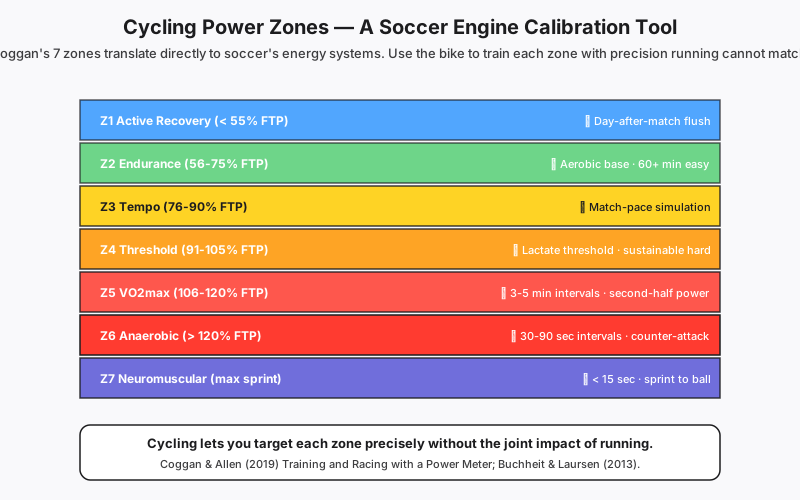
- Session details — “Road bike, 60 min. First 30 min in Zone 2 (HR ~130), then 3 × 3-min tempo intervals. Cadence held at 90 rpm.”
- Verbalizing physical sensations — “My legs felt heavy on the third tempo interval, but I kept the cadence up and pushed through. I’m starting to grasp what it feels like to hold rhythm when fatigued.”
- Transfer point to soccer — “The sensation of maintaining pace with tired legs is the same as forcing out a sprint after the 75th minute.”
- Experiment for the next soccer session — “In the next scrimmage I’ll deliberately increase my sprint count in the final 15 minutes and test the pacing feel I’ve been building on the bike.”
Sample Recovery-Ride Log
For a recovery ride the day after a match, record subjective recovery indicators: “Day after match. Easy 30-min ride, HR kept below 120. Leg tightness at start: 7/10; at finish: 4/10. Mild knee discomfort also eased once I started pedaling and opened up the range of motion.” Accumulating this kind of subjective data helps you discover the recovery methods that work best for you.
Footnote’s periodic AI analysis enables you to compare match performance between weeks that included cycling and weeks that did not. Trends such as “Sprint self-ratings are an average of 0.8 points higher after matches preceded by a recovery ride” become visible, giving you objective evidence of your cross-training’s effectiveness.
Don’t stop at “I rode the bike today.” Write all the way to “I dialed in my pacing feel on the pedals → next match I’ll apply it to second-half energy management.” Only then does a cycling log become an engine for transfer.
Frequently Asked Questions
Can I still get the benefits if I don’t own a bike?▾
Absolutely. A stationary bike (cycle ergometer) at the gym provides the same aerobic benefits. In fact, intensity management is often easier on a stationary bike because you can monitor power output and heart rate on-screen. You do lose the mood-boosting change of scenery that comes with outdoor riding, but the physiological effects on cardiovascular fitness and muscle balance are identical.
How often should I cycle?▾
Once or twice a week for 30–60 minutes is recommended. A good combination is a recovery ride the day after a match (20–40 minutes at low intensity) plus a midweek endurance session (40–60 minutes at moderate intensity). There is no need to significantly cut back on soccer training; the key is integrating cycling as a complement.
Road bike or mountain bike—which is better?▾
For aerobic training purposes, either works equally well. Road bikes are suited to steady-pace long rides, which makes them ideal for developing pacing instincts. Mountain bikes add balance challenges on uneven terrain and more interval-like load variation, bringing a stronger core-training element. The best choice is whichever type you enjoy enough to ride consistently.
Will cycling make my legs too bulky?▾
Moderate-intensity cycling once or twice a week will not cause excessive muscle hypertrophy. The powerful thighs you see on professional cyclists are the result of 20–30+ hours per week of high-intensity training. At cross-training frequency, the primary adaptation is improved muscular endurance. In fact, strengthening the hamstrings through cycling may help prevent injuries.
What is the most effective way to log cycling in Footnote?▾
Record the session details in your practice log and always verbalize at least one “transfer point to soccer.” For example: “Ability to hold pace in the second half of a 60-min ride → can apply the same judgment to conserve sprints late in a match.” Writing this way transforms a cycling entry into a transfer-training record. Once you have five matches’ worth of data, the AI analysis starts detecting trends.
References
- [1] Hagberg, J. M. (1990). “Exercise, fitness, and hypertension” Exercise and Sport Sciences Reviews, 18(1), 391-415.
- [2] Ericson, M. O. & Nisell, R. (1986). “Tibiofemoral joint forces during ergometer cycling” American Journal of Sports Medicine, 14(4), 285-290. Link
- [3] Reilly, T., Bangsbo, J., & Franks, A. (2000). “Anthropometric and physiological predispositions for elite soccer” Journal of Sports Sciences, 18(9), 669-683. Link
- [4] Bangsbo, J., Mohr, M., & Krustrup, P. (2006). “Physical and metabolic demands of training and match-play in the elite football player” Journal of Sports Sciences, 24(7), 665-674. Link
- [5] Abbiss, C. R. & Laursen, P. B. (2008). “Describing and understanding pacing strategies during athletic competition” Sports Medicine, 38(3), 239-252. Link
- [6] Mujika, I. & Padilla, S. (2000). “Detraining: Loss of training-induced physiological and performance adaptations. Part I” Sports Medicine, 30(2), 79-87.
- [7] Ekstrand, J., Hagglund, M., & Walden, M. (2011). “Epidemiology of muscle injuries in professional football (soccer)” American Journal of Sports Medicine, 39(6), 1226-1232. Link
- [8] Monedero, J. & Donne, B. (2000). “Effect of recovery interventions on lactate removal and subsequent performance” International Journal of Sports Medicine, 21(8), 593-597. Link
Related Articles
Verbalization Accelerates Transfer -- Why Writing Makes Skills from Other Sports Carry Over to Soccer
11 min read
How Swimming Transforms Cardiovascular Fitness, Upper-Body Strength, and Recovery for Soccer Players
10 min read
How Track and Field Transfers Sprint Speed, Agility, and Endurance to Soccer
11 min read
The Science Behind Yoga for Soccer: Flexibility, Focus, Breathing, and Injury Prevention
10 min read
The Science Behind How Skateboarding Sharpens Balance, Fearlessness, and Creativity for Soccer
11 min read
Track Your Growth with Footnote
Just record your matches — AI analyzes every 5 games. Visualize growth with PVS Score. All features free during beta.
30-second signup · No credit card required
Last updated: 2026-05-06 ・ Footnote Editorial