The Science Behind How Skateboarding Sharpens Balance, Fearlessness, and Creativity for Soccer
Skateboarding — where you constantly accelerate, turn, and land on an unstable deck — is a rare form of cross-training that simultaneously develops three capabilities essential to soccer: dynamic balance, the psychological skill of confronting fear, and unorthodox creativity. A meta-analysis by Hrysomallis (2011) demonstrated that dynamic balance ability is significantly associated with both injury prevention and performance in soccer. The skateboarding culture of learning through falls on concrete builds resilience to failure and a willingness to take on challenges, giving players the courage to attempt plays on the pitch that nobody else would try.
Training Dynamic Balance on a Moving Platform — How Skateboarding Challenges Your Equilibrium
A skateboard deck is constantly tilting and responding to every bump in the surface beneath it. The postural control required on this 'unstable moving platform' transfers directly to maintaining balance during dribbling, withstanding physical contact, and staying stable through changes of direction in soccer.

Photo by Ilya Yarmosh on Unsplash
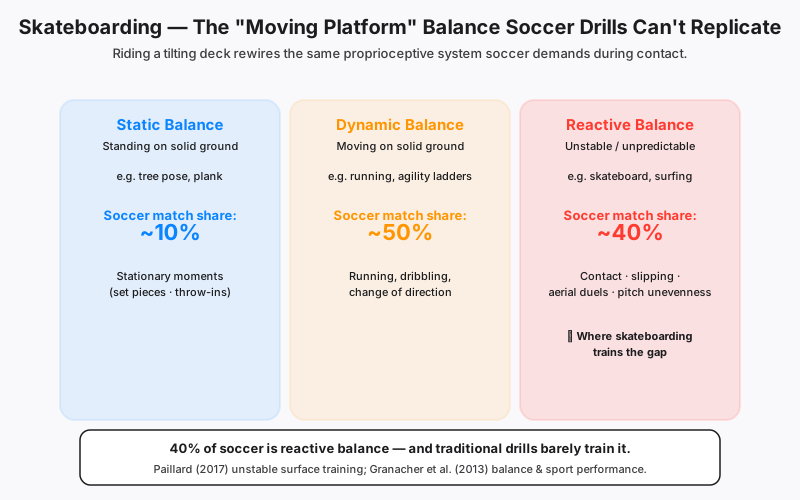
Hrysomallis's (2011) sports science review classified balance ability into static and dynamic categories, showing that dynamic balance in particular is critically important for both athletic performance and injury prevention. During a soccer match, there are virtually no moments when a player is completely still. The ability to maintain posture while constantly moving or absorbing contact — that is dynamic balance.
The 'Continuous Postural Adjustment' Skateboarding Demands
On a skateboard, the deck tilts every time the four wheels hit the slightest bump in the road. The rider unconsciously makes micro-adjustments through the ankles, knees, hips, and core to keep their center of gravity stable. According to Horak's (2006) model of postural control, this kind of continuous sensorimotor feedback loop strengthens the integrated functioning of the vestibular, somatosensory, and visual systems. The postural recovery response needed when an opponent's foot clips you mid-dribble, or when you change direction on a waterlogged pitch, relies on the same neural circuitry that skateboarding trains every second you are on the board.
Foot Pressure Distribution and Center-of-Gravity Shifts
Turns on a skateboard are controlled by shifting weight toward the nose (front) or tail (back) of the deck. Lean onto the toes for a toeside turn; lean onto the heels for a heelside turn. The ability to finely control this pressure distribution across the sole of the foot enhances the precision of feints in soccer — moves that deceive an opponent through weight transfer. The essence of a Matthews feint or a scissors move is 'where to shift your center of gravity, and how quickly.' Skateboarding hones this ability through play.
Skateboarding is a sport of maintaining balance while in motion. Unlike a stationary balance board, it develops dynamic balance involving speed and directional changes — making it exceptionally compatible with soccer.
Fear Management and Progressive Risk-Taking — Building Mental Toughness Through Falls
In skateboarding, falling is part of the learning process. Research by Immonen et al. (2017) on risk-taking showed that progressive challenges and repeated failure build tolerance to fear and strengthen self-efficacy. These psychological skills transfer to committing to 1v1 dribbles, handling penalty-kick pressure, and bouncing back after mistakes in soccer.

Photo by Hans Eiskonen on Unsplash
Every time a skateboarder attempts a new trick, there is a risk of falling. A child trying an ollie (jump) for the first time will fall dozens of times. Yet in skate culture, a fall is not seen as 'failure' but as 'proof of progress.' Immonen et al. (2017) reported that extreme-sports athletes develop the ability to manage fear through graduated exposure to risk.
How Progressive Risk-Taking Works
- Start with small challenges — Balance while stationary, then push slowly, then turn, then try a small ollie, progressively raising the difficulty. This is exactly the accumulation of 'mastery experiences' described by Bandura's (1997) self-efficacy theory.
- Experience falling — Learning how to fall gives you the physical certainty that 'falling is survivable.' The object of fear narrows from 'falling' to 'uncontrolled falling,' enabling rational risk assessment.
- Try again immediately — The culture of getting back up right after a fall and trying again directly builds the psychological resilience to attempt another dribble after losing the ball in soccer.
Psychological Transfer to Soccer
Jordet et al.'s (2007) research on penalty kicks demonstrated that fear of failure significantly degrades performance. The mindset cultivated through skateboarding — that failure is simply part of learning — transforms the quality of risk-taking in soccer. The fear of losing the ball when taking on a defender 1v1, the fear of missing a shot, the fear of trying a new feint and getting it wrong — all of these can be put into perspective through the skateboarding experience of falling and getting back up.
Skateboarding has an 'aesthetics of failure.' Behind every great trick lie hundreds of falls. It is this spirit that nurtures the courage to attempt plays on the pitch that nobody else would try.
— Summarized from research on the psychology of extreme sports
Creativity and Improvisation — The Skateboarding Mindset That Breaks the Mold
Skateboarding has no 'correct form.' Through the ecological approach of Orth et al. (2018), the ability to discover environmental affordances and generate movement solutions on the fly is naturally developed through skateboarding. This creativity produces 'unpredictable play' in soccer.
Skateboarding is a sport without a rulebook. Faced with the same ledge, one person ollies over it, another grinds along it, and yet another manuals across it. There are infinite correct answers, and which route to take is left entirely to the rider's creativity. Orth et al. (2018) argued that, within the ecological approach to motor learning, the key to creative performance is 'how many affordances (action possibilities) in the environment you can perceive.'
'Perceiving Possibilities' and Improvisation in Soccer
During a soccer match, the player on the ball faces a vast array of options — pass, dribble, shoot, turn, feint. Elite players do not merely 'see' their surroundings; they richly perceive the 'affordances (action possibilities) their surroundings offer.' The ability cultivated through skateboarding — instantly assessing 'what can I do with this terrain' — shares an identical cognitive structure with assessing 'what can I do in this game situation' in soccer.
The Freestyle Ethos and Diversity of Play
Santos et al. (2016) reported that soccer players who came from futsal backgrounds (an environment close to street soccer) displayed more creative decision-making than players raised exclusively in structured settings. Skateboarding's culture of 'playing in the streets' has the same effect as this unstructured learning environment. Repeatedly solving 'problems with no rules' through play expands the repertoire of unconventional plays a player can draw on.
What skateboarding cultivates is the ability to find your own answer to a problem that has no single correct solution. The cognitive foundation that produces 'unpredictable dribbles' and 'surprise passes' in soccer is built right here.
Ankle Proprioception — Sprain Prevention and Sharper Changes of Direction
While skateboarding, the muscles and ligaments around the ankle are constantly making micro-adjustments, strengthening proprioception. As McKeon & Hertel (2008) showed, improving ankle proprioceptive ability significantly reduces sprain recurrence rates and sharpens changes of direction in soccer.
Ankle sprains are the most common injury in soccer. Once sprained, an ankle's proprioceptive ability declines, and the recurrence rate reaches 40-70% (Hiller et al., 2011). McKeon & Hertel (2008) demonstrated that ankle training in unstable environments restores and strengthens proprioception, substantially reducing recurrence rates.
The Proprioceptive Training Skateboarding Imposes on the Ankle
While riding a skateboard, the ankle makes micro-adjustments across all three axes: dorsiflexion-plantarflexion (forward-backward tilt), inversion-eversion (side-to-side tilt), and rotation. What balance boards and wobble boards do in a static setting, skateboarding does in a moving environment. Moreover, high-load moments occur frequently — absorbing landing impact after an ollie, resisting centrifugal force through turns — strengthening the muscles surrounding the ankle: the peroneals, posterior tibialis, and anterior tibialis.
The Link to Change-of-Direction Performance in Soccer
Cut-ins, stop-and-gos, and sharp directional changes in soccer depend heavily on ankle joint stability. Sheppard & Young's (2006) agility research identified neuromuscular control at the ankle as one factor contributing to individual differences in change-of-direction speed. The ankle proprioception developed through skateboarding sharpens the 'gripping the ground' sensation during cutting movements in soccer and limits performance drops on slippery or uneven surfaces.
- Pushing — Standing on the deck with one foot while kicking the ground with the other. Repeated single-leg balance strengthens the ankle's stabilizing muscles.
- Ollie landings — Absorbing impact when landing on the deck with both feet increases the reaction speed of the ankle complex.
- Carving turns — A compound control combining dorsiflexion-plantarflexion with inversion-eversion. Closely resembles the cutting motion used in soccer.
A skateboard is a 'balance board in motion.' By training ankle proprioception in a moving environment, it achieves both sprain prevention and agility improvement at the same time.
Street Culture and the Play Mentality — How Fun Accelerates Learning
Skateboarding's culture of 'play' aligns with the concept of Deliberate Play proposed by Erickson (2003). The attitude of enjoying the process rather than fixating on results boosts intrinsic motivation and builds the psychological foundation that supports long-term growth in soccer.
The Developmental Model of Sport Participation by Cote et al. (2007) showed that the majority of elite athletes experienced multiple sports 'for fun' during their junior years. They called this phase the 'sampling years' and reported that it is more beneficial for long-term performance and continued participation than early specialization.
The Intrinsic Motivation Skateboarding Creates
Skateboarding has no coach's instructions and no match-day pressure. What to practice, when to stop — every decision is your own. According to Ryan & Deci's (2000) Self-Determination Theory, intrinsic motivation is highest when three psychological needs are met: autonomy, competence, and relatedness. Skateboarding's structure of 'deciding for yourself, challenging yourself, and sharing with friends' satisfies all three.
How 'Play' Prevents Burnout
Burnout among youth soccer players is a serious problem, with excessive results-orientation and early specialization cited as root causes. Fun-driven cross-training like skateboarding serves as a 'psychological refresh' — players step away from soccer temporarily while maintaining their physical abilities. When the intrinsic drive to improve starts to run dry, the pure enjoyment of skateboarding can reignite the passion for soccer.
The greatest athletes were the children who played the most. A child who broadens their movement intelligence through skateboarding and street play — rather than growing up in a soccer-only world — will compete longer, stronger, and with more joy.
— Summarized from the Developmental Model by Cote et al. (2007)
Tracking Skateboarding-to-Soccer Transfer in Footnote
When recording skateboarding practice in Footnote, articulating your experience across three dimensions — physical sensation, psychological state, and applicable soccer scenarios — maximizes the transfer effect.
Skateboarding transfers both physical and psychological skills to soccer. When recording in Footnote, consciously separating these two aspects allows the AI to detect transfer patterns more accurately.
Examples of What to Record
- Balance transfer — 'I found the feeling of keeping a low center of gravity while carving on my skateboard. In the next soccer session, I'll focus on the same low stance when absorbing contact during dribbles.'
- Fear-management transfer — 'I fell 5 times trying a new trick, but nailed it on the 6th attempt. The feeling of trying again after failure connects directly to the courage to take on defenders 1v1 in soccer.'
- Creativity transfer — 'I tried 3 different approaches to a ledge at the park. In soccer, I want to carry that same mindset of always having multiple dribbling options instead of just one.'
- Ankle-sensation transfer — 'After a long skateboarding session, the sensation in my soles feels sharper. I'll check whether my ball touch precision improves in the next practice.'
Tips for Using Footnote Effectively
By consistently recording both skateboarding and soccer sessions in Footnote, the AI can detect trends such as 'self-rated dribbling success tends to be higher in weeks that include skateboarding' or 'the variety of feints increases after skateboarding sessions.' Creativity and mental shifts — the things hardest to quantify — are precisely the domain where continuous logging combined with AI analysis proves most powerful.
Record skateboarding sessions along two axes: 'physical sensation' and 'psychological state.' Going beyond 'my balance improved' to also note 'my fear of falling decreased' is the key to making mental growth in soccer visible.
Frequently Asked Questions
Could skateboarding injuries interfere with soccer?▾
Risk management is essential. Always wear a helmet, knee pads, and elbow pads, and start on flat ground with pushing and turning. Attempting tricks can wait until you are comfortable with the basics. A progressive approach keeps the risk of serious injury low. Be mindful of your soccer schedule as well — avoid high-difficulty trick practice right before a match.
Can a complete skateboarding beginner still experience transfer benefits for soccer?▾
The beginner stage is actually when the transfer effect is most noticeable. The instability of standing on a deck for the first time immediately stimulates dynamic balance, and the cycle of falling and trying again trains fear-management skills. Regardless of technical level, the simple act of riding and moving on a skateboard is effective cross-training.
How often should I incorporate skateboarding?▾
Aim for 1-2 sessions per week, 30-60 minutes each. The most effective approach is to include it as 'play' on days without soccer training or matches. Research by Cote et al. (2007) showed that incorporating multiple activities into the weekly schedule — a practice they call 'sampling' — benefits long-term development during the junior years. The key is to keep it fun, not turn it into an obligation.
Which soccer positions benefit most from skateboarding?▾
Dribblers and wingers see the greatest transfer. Dynamic balance, ankle proprioception, and the psychological toughness to commit to challenges are most evident in 1v1 situations. That said, balance and creativity are important regardless of position, so every position benefits — goalkeepers included.
What is the most effective way to log skateboarding sessions in Footnote?▾
Always include 'what you experienced on the skateboard and which soccer scenarios it transfers to' in your training notes. The key is to record both the physical dimension (balance feel, ankle sensation) and the psychological dimension (overcoming fear, willingness to challenge). Writing specific transfer hypotheses like 'practiced low center of gravity while carving -> will focus on staying low during dribbles in the next match' improves the accuracy of AI analysis.
References
- [1] Hrysomallis, C. (2011). “Balance ability and athletic performance” Sports Medicine, 41(3), 221-232. Link
- [2] Orth, D., van der Kamp, J., Memmert, D., & Savelsbergh, G. J. P. (2018). “Creative motor actions as emerging from movement variability” Frontiers in Psychology, 8, 1903. Link
- [3] Immonen, T., Brymer, E., Orth, D., Davids, K., Feletti, F., Liukkonen, J., & Jaakkola, T. (2017). “Understanding action and adventure sports participation: An ecological dynamics perspective” Sports Medicine - Open, 3(1), 18. Link
- [4] Horak, F. B. (2006). “Postural orientation and equilibrium: What do we need to know about neural control of balance to prevent falls?” Age and Ageing, 35(suppl_2), ii7-ii11. Link
- [5] McKeon, P. O. & Hertel, J. (2008). “Systematic review of postural control and lateral ankle instability, Part I: Can deficits be detected with instrumented testing?” Journal of Athletic Training, 43(3), 293-304. Link
- [6] Santos, S., Memmert, D., Sampaio, J., & Leite, N. (2016). “The spawns of creative behavior in team sports: A creativity developmental framework” Frontiers in Psychology, 7, 1282. Link
- [7] Cote, J., Baker, J., & Abernethy, B. (2007). “Practice and play in the development of sport expertise” In G. Tenenbaum & R. C. Eklund (Eds.), Handbook of Sport Psychology (3rd ed., pp. 184-202). Wiley.
- [8] Sheppard, J. M. & Young, W. B. (2006). “Agility literature review: Classifications, training and testing” Journal of Sports Sciences, 24(9), 919-932. Link
Related Articles
Verbalization Accelerates Transfer -- Why Writing Makes Skills from Other Sports Carry Over to Soccer
11 min read
Growth Mindset and the Soccer Journal — How to Raise Players Who Believe in Effort Over Talent
9 min read
Mental Training and the Soccer Notebook Habit — The Science of Writing Your Way to a Stronger Mind
9 min read
The Science Behind Yoga for Soccer: Flexibility, Focus, Breathing, and Injury Prevention
10 min read
The Science Behind Cycling for Soccer: Endurance, Pacing, and Knee Protection
10 min read
Track Your Growth with Footnote
Just record your matches — AI analyzes every 5 games. Visualize growth with PVS Score. All features free during beta.
30-second signup · No credit card required
Last updated: 2026-05-06 ・ Footnote Editorial