Baseball Meets Soccer — How Rotational Mechanics and Throwing Biomechanics Transfer to Kicking and Throw-Ins
Baseball and soccer are the two most popular sports in Japan, yet the science of skill transfer between them is rarely discussed. From a biomechanics standpoint, however, throwing and kicking share the same fundamental principle: ground reaction force initiates a rotational energy wave through the trunk that is amplified and delivered to the distal segment via the kinetic chain. As demonstrated by Fleisig et al. (1999) in their pitching biomechanics research and Putnam (1993) in his kicking analysis, this shared rotational mechanism is the scientific basis for turning baseball experience into a soccer advantage. This article covers the transfer pathways from throwing to kicking and throw-ins, from baserunning to sprint acceleration, and the negative transfer risks that players should watch out for.
Rotational Kinetic Chain Transfer — Throwing and Kicking Run on the Same Engine
Fleisig et al. (1999) quantified the pitching motion as a kinetic chain that transmits energy sequentially from the lower body through the trunk, shoulder, elbow, and wrist. Cross-referencing with Putnam's (1993) kicking analysis reveals that the soccer instep kick follows the same proximal-to-distal energy transfer principle.

Photo by Keith Johnston on Unsplash
At first glance, throwing a baseball looks like little more than swinging your arm to release a ball. Yet Fleisig et al. (1999), publishing in the American Journal of Sports Medicine, showed quantitatively that roughly 50% of a professional pitcher's ball velocity is generated by lower-body and trunk rotation. Ground reaction force produced at stride-foot landing triggers a sequential chain: pelvic rotation, trunk rotation, shoulder internal rotation, elbow extension, and wrist snap — each link amplifying and relaying energy toward the fingertips.
Mechanical Equivalence with the Soccer Kick
Putnam (1993), writing in the Journal of Biomechanics, confirmed that the soccer instep kick also follows a proximal-to-distal kinetic chain. Planting the support foot, rotating the pelvis, swinging the thigh forward, extending the knee, and locking the ankle — this energy-transfer sequence is mechanically equivalent to the throwing motion. The only differences are the output limb (hand vs. foot) and the angle of the rotational axis; the core principle of generating rotational energy in the trunk and channeling it to the extremity is identical.
Why Throwing Experience Boosts Kicking Power
Repeated throwing strengthens the trunk rotators (internal obliques, external obliques, multifidus) and the muscles surrounding the pelvis. More importantly, it ingrains the neural firing pattern of initiating movement from the core rather than the limb. Many soccer players who lack power "kick with the leg alone," but athletes with throwing experience unconsciously lead with trunk rotation. When they receive kicking instruction, they grasp the concept of "striking with the whole body" far more quickly.
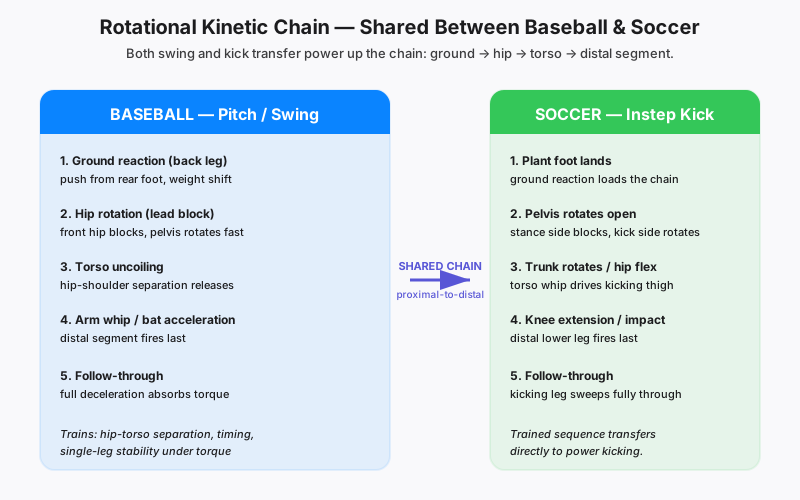
- Pitching wind-up → Kick backswing — Both are preparatory phases that store rotational energy in the trunk
- Pitching stride → Kick plant step — Forward weight transfer generates ground reaction force, triggering the rotational sequence
- Release point → Ball-impact point — The moment energy concentrates at the distal end requires the same fine motor control
- Pitching follow-through → Kick follow-through — Deceleration and load distribution across joints after energy release
A baseball pitching coach says "Don't throw with your arm — throw with your body." A soccer coach says "Don't kick with your leg — kick with your body." These two instructions from different sports are simply different phrasings of the same biomechanical principle.
Visual Tracking Transfer — A Batter's Eyes Sharpen Soccer Ball Tracking
The ball-tracking ability honed in batting — following a high-speed projectile with the eyes and predicting its impact point — transfers directly to processing aerial balls, reacting to crosses, and making save decisions as a goalkeeper in soccer.

Photo by Chris Chow on Unsplash
A professional fastball exceeds 150 km/h (93 mph). The ball reaches home plate roughly 0.4 seconds after leaving the pitcher's hand. Within that window, the batter must identify the ball's trajectory, pitch type, and movement, decide whether to swing, and align the bat with the ball. Bahill & LaRitz (1984), writing in American Scientist, showed that batters can accurately track the ball's trajectory only for the first few hundred milliseconds after release; the rest depends on prediction.
Predictive Visual Tracking and Soccer
This ability to predict a final destination from an initial trajectory is extremely valuable in soccer: anticipating where a long ball or cross will land the instant it is struck, reading the curve on a free kick, or deciding which way to dive as a goalkeeper facing a shot — all rely on the cognitive process of extrapolating trajectory from early visual information.
Land & McLeod (2000), publishing in Nature Neuroscience, confirmed that cricket batsmen (whose visual demands closely parallel those of baseball batters) employ "predictive saccades" — rapid eye movements that jump ahead of the ball — to track high-speed deliveries. This predictive visual tracking pattern is a trainable skill with strong potential for transfer across ball sports.
- Batting trajectory prediction → Heading: predicting the drop point — Reading the ball's final position before it reaches the apex of its arc
- Reading a breaking ball → Reading a curving shot — Predicting spin-induced trajectory changes from the first few frames of flight
- Reacting to a fastball → First-time finishing — Instant responses to a ball arriving at high speed
- Calling balls and strikes → GK shot-stopping reads — Rapid spatial recognition of where the ball will arrive
Elite batters do not "watch the ball all the way in." They predict the arrival point from early trajectory data. This predictive visual tracking is the very skill that translates to handling high balls and making saves in soccer.
— Summary based on findings from Land & McLeod (2000)
Baserunning and Sprint Acceleration — The Shared Explosive "First Three Steps"
The explosive initial acceleration drilled into players through baserunning shares structural similarities with soccer sprinting. The "speed of the first step from a standing start" and "body lean on curved running paths" connect baserunning and soccer agility through a direct transfer pathway.
In soccer, the average distance covered in a full-speed sprint is only 10–20 meters. This means how fast a player accelerates matters far more than top-end speed. And acceleration is precisely the quality that baserunning trains. Stealing a base, taking off on a hit-and-run, sprinting on a batted ball — baseball demands repeated bursts of "zero-to-maximum acceleration" dozens of times per game.
The Stolen-Base Start and Soccer's First-Step Burst
Success in stealing a base comes down not to raw speed but to the quality of the start. Reading the pitcher's motion and generating maximum acceleration at the optimal split-second — this pattern of "cognitive decision plus explosive first step" mirrors several soccer scenarios: breaking behind the defensive line, sprinting during transitions, and making free runs off set pieces.
Baserunning Curves and Agility
Baserunning demands more than straight-line speed; players must navigate the diamond-shaped basepath efficiently. Leaning into the turn while rounding a base and pushing off the bag to redirect momentum are motor patterns shared with soccer's curved runs and sharp changes of direction. As DeWeese et al. (2015) noted in the Strength and Conditioning Journal, generating and controlling ground reaction force during directional changes is a fundamental athletic ability common to many ball sports.
- Stolen-base start → Breaking behind the back line — First-step technique for maximal acceleration from a standing start
- Rounding a base → Curved runs — Controlling body lean and foot-strike angle on a curved path
- Diving back to the bag → Emergency stops and direction changes — A decelerate-then-reaccelerate pattern from full speed to the opposite direction
- Lead-off stance → Transition-ready posture — A low center of gravity poised for instant movement in any direction
What soccer demands is not a fast 100-meter time but explosive speed in the first three steps. Baserunning naturally drills this "zero-to-max acceleration" pattern dozens of times within a single game.
Negative Transfer Risks — The Dangerous Confusion Between Bat Swings and Kicks
Transfer from baseball to soccer is not all positive. The rotational pattern of the batting swing can interfere with the kicking motion — a phenomenon known as negative transfer. Understanding and consciously separating the two movements is essential.
Skill transfer can be positive (enhancing performance) or negative (hindering it). According to Thorndike & Woodworth's (1901) theory of identical elements, negative transfer is most likely when two motor patterns are "similar but subtly different." The baseball batting swing and the soccer kick fall squarely into this category.
Different Planes of Rotation: Swing vs. Kick
The batting swing is dominated by rotation in the transverse (horizontal) plane: the pelvis and trunk rotate horizontally, transmitting that force into the bat. The soccer instep kick, by contrast, is primarily a sagittal-plane (front-to-back) swing, with trunk rotation playing only a supporting role. If a player does not consciously distinguish these planes, excessive horizontal rotation can creep into the kick, causing the ball to veer off target.
Differences in Weight Transfer Patterns
In batting, weight shifts from the back foot to the front foot while the body faces sideways toward the pitcher. In kicking, weight transfers onto the plant foot as the striking leg swings forward. Because the direction of weight shift relative to body orientation differs, importing the batting weight-transfer pattern directly into a kick can destabilize the plant foot and reduce accuracy.
- Excessive horizontal rotation — The batting habit causes the body to open up too much during the kick, imparting unwanted sidespin
- Misplaced plant foot — Using the wide batting stance as a reference leads to incorrect distance from the ball
- Upper-body lunge — The forward weight shift of batting translates into leaning over the ball at impact
- Conflicting arm action — The arm swing pattern from batting can disrupt balance during the kick
The key to preventing negative transfer is conscious separation through verbalization. Articulating differences clearly — "batting = horizontal rotation; kicking = front-to-back swing" or "the bat is swung in front of the body; the leg swings beside the body" — dramatically reduces the brain's tendency to confuse the two motor programs.
Baseball rotation and soccer rotation are "similar but not the same" — and that is exactly what makes them risky. Leverage the commonalities while verbalizing the differences: this deliberate cognitive separation is the technique that blocks negative transfer and isolates only the positive.
Dual-Sport Athletes — Players Who Bridged Baseball and Soccer
Japan offers a uniquely fertile environment for dual-sport development in baseball and soccer. Many athletes played both sports as children before specializing in one, providing real-world case studies in skill transfer.
In Japan's youth sports landscape, it is common for children to play both baseball and soccer. Belonging to a baseball team and a soccer team simultaneously in elementary school, then choosing one upon entering middle school, is a familiar pattern — especially in regional communities.
The Advantages of Dual-Sport Experience
Bridge & Toms (2013), writing in the European Physical Education Review, reported that athletes who experienced multiple sports in childhood outperformed early specializers in both long-term competitive performance and sport-continuation rates. The baseball-soccer combination is one of the ideal pairings, as it promotes balanced whole-body development through a mix of upper-limb-dominant activities (throwing, batting) and lower-limb-dominant activities (kicking, running).
Transfer of Throwing Mechanics to the Throw-In
The soccer throw-in requires the player to deliver the ball with both hands from behind and over the head. This motion is essentially a variation of the overhand throw, where trunk extension-flexion and scapular coordination determine distance. It is no coincidence that players who transition from baseball to soccer often develop the long throw as a weapon: the trunk-to-upper-limb kinetic chain built through years of throwing transfers directly to the throw-in. Linthorne & Everett (2006), in Sports Biomechanics, confirmed that throw-in distance depends most strongly on release velocity, which in turn is proportional to the efficiency of trunk recruitment.
In Japanese soccer coaching, the throw-in has traditionally received little attention. Yet as the long throw has been re-evaluated as a potent set-piece weapon in recent years, the throwing mechanics cultivated through baseball experience represent a clear competitive edge.
Japan is one of the few countries where baseball and soccer coexist as the two dominant sports. Experiencing both as a child is not the disadvantage of "failing to specialize" — it is an advantage that develops whole-body athletic ability.
— Based on findings from multi-sport development research
Recording Baseball-to-Soccer Transfer with Footnote
To effectively transfer physical sensations gained in baseball practice to the soccer pitch, recording not just what you did but which principle carries over to soccer — articulated in words — is the key. Footnote is the tool for that.
To maximize the cross-training benefits of baseball in Footnote, apply the "ALR (Abstract → Language → Re-apply)" framework introduced in the cross-training verbalization article, specialized here for the baseball-soccer combination.
Recording Template
- What you did in baseball — Keep it brief. Example: "30 pitch throws, 20 min batting practice, 5 stolen-base drills"
- Physical sensations noticed — Record at the feeling level. Example: "Focusing on trunk rotation during throwing increased ball speed"
- Transfer hypothesis for soccer — Abstract the insight. Example: "The trunk-leading rotation from throwing should work for kicking too"
- Experiment in the next soccer session — Set an action goal. Example: "Focus on when I initiate trunk rotation during shooting practice"
- Results after applying (add after soccer) — Note the transfer. Example: "Leading with trunk rotation increased shot distance, but accuracy needs work"
Organize Entries into Three Transfer Categories
- Rotational mechanics — Insights from throwing and batting rotation. Transfer targets: kicking power, throw-ins
- Visual tracking — Insights from ball tracking during batting, pitch reading. Transfer targets: aerial ball handling, GK decision-making
- Acceleration & baserunning — Insights from stolen-base starts, baserunning direction changes. Transfer targets: sprinting, agility
Footnote's AI analysis can detect correlations between these categories and match performance. Patterns such as "kicking self-assessments improve in weeks with pitching practice" or "sprint-related reflections increase after baserunning drills" become visible, helping you identify at a personal level which baseball training elements transfer most effectively to soccer.
Recording negative transfer is equally important. Accumulating entries like "kicking felt off after batting — body was opening up too much" provides the data needed to optimize the order and timing of training sessions.
After baseball practice, open Footnote and write one line: "How could the trunk rotation I felt during today's throwing translate to a soccer movement?" That 30-second act of verbalization is the starting point for fusing two sports into a single competitive advantage.
Frequently Asked Questions
Which baseball drills transfer most effectively to soccer?▾
It depends on your goal. To build kicking power, pitching practice is most effective (it strengthens the trunk rotational kinetic chain). To develop a powerful throw-in, long-toss throwing drills transfer best. For sprint acceleration, stolen-base practice offers the highest transfer value. Batting practice sharpens visual tracking, but the horizontal swing pattern can interfere with kicking, so if you do both on the same day, be sure to consciously separate the two motor patterns.
Can the batting swing negatively affect my kicking?▾
Yes, it can. The horizontal rotation pattern of the batting swing may interfere with the front-to-back swing of the kick — a phenomenon called negative transfer. The countermeasure is to verbalize the difference clearly: "batting = horizontal rotation; kicking = front-to-back swing," and consciously separate the two. If you schedule batting and kicking practice on the same day, inserting footwork drills between the two sessions helps the brain switch motor programs more smoothly.
Is it true that baseball players have an advantage in soccer throw-ins?▾
Yes, and there is biomechanical evidence to support it. The trunk-to-upper-limb kinetic chain developed through throwing transfers directly to the throw-in, giving baseball-trained athletes a general advantage in throw-in distance. The long throw, in particular, is mechanically similar to the overhand pitch, and players who can coordinate trunk extension-flexion with scapular movement tend to acquire the long throw more quickly.
Until what age should a child play both sports?▾
Sports science research recommends that children continue to play multiple sports until around age 12–13. Multiple studies have shown that early specialization increases the risks of burnout and overuse injuries, while experiencing both baseball and soccer supports well-rounded athletic development. Even after choosing to specialize, it is important to keep consciously applying the skills acquired in the other sport.
How should I log baseball activities in Footnote?▾
Record baseball content in Footnote's training log and categorize each entry as one of three transfer types: "rotational mechanics," "visual tracking," or "acceleration & baserunning." Adding a brief note on which soccer movement a given baseball drill might transfer to makes it easier for the AI analysis to detect correlation patterns between your cross-training and soccer performance.
References
- [1] Fleisig, G. S., Barrentine, S. W., Zheng, N., Escamilla, R. F., & Andrews, J. R. (1999). “Kinematic and kinetic comparison of baseball pitching among various levels of development” Journal of Biomechanics, 32(12), 1371–1375.
- [2] Putnam, C. A. (1993). “Sequential motions of body segments in striking and throwing skills: Descriptions and explanations” Journal of Biomechanics, 26(Suppl 1), 125–135.
- [3] Lees, A., Asai, T., Andersen, T. B., Nunome, H., & Sterzing, T. (2010). “The biomechanics of kicking in soccer: A review” Journal of Sports Sciences, 28(8), 805–817.
- [4] Bahill, A. T. & LaRitz, T. (1984). “Why can't batters keep their eyes on the ball?” American Scientist, 72(3), 249–253.
- [5] Land, M. F. & McLeod, P. (2000). “From eye movements to actions: How batsmen hit the ball” Nature Neuroscience, 3(12), 1340–1345. Link
- [6] Linthorne, N. P. & Everett, D. J. (2006). “Release angle for attaining maximum distance in the soccer throw-in” Sports Biomechanics, 5(2), 243–260.
- [7] DeWeese, B. H., Hornsby, G., Stone, M., & Stone, M. H. (2015). “The training process: Planning for strength-power training in track and field. Part 2: Practical and applied aspects” Journal of Sport and Health Science, 4(4), 318–324.
- [8] Bridge, M. W. & Toms, M. R. (2013). “The specialising or sampling debate: A retrospective analysis of adolescent sports participation in the UK” Journal of Sports Sciences, 31(1), 87–96.
Related Articles
Verbalization Accelerates Transfer -- Why Writing Makes Skills from Other Sports Carry Over to Soccer
11 min read
Tennis × Soccer — The Science Behind How Anticipation, Footwork, and Rotational Movement Transfer to the Pitch
11 min read
How Track and Field Transfers Sprint Speed, Agility, and Endurance to Soccer
11 min read
How to Review a Match --- What Pro Scouts Look For and Proven Recording Techniques
7 min read
Badminton x Soccer — The Science Behind How Agility, Reaction Speed, and Full-Body Coordination Transfer to the Pitch
10 min read
Track Your Growth with Footnote
Just record your matches — AI analyzes every 5 games. Visualize growth with PVS Score. All features free during beta.
30-second signup · No credit card required
Last updated: 2026-05-06 ・ Footnote Editorial