How Handball Elevates Your Shot Power, Goalkeeping, and Counter-Attack Instincts — Kinetic Chain Transfer and Decision Speed
Handball demands sprinting, throwing, jumping, and physical contact at high intensity — making its transfer potential to soccer exceptionally high. The kinetic chain identified by van den Tillaar & Ettema (2004) in the overarm throw is biomechanically homologous to the soccer instep kick: energy flows sequentially from the trunk through the pelvis, thigh, shank, and foot. Add in goalkeeper positioning, numerical-advantage reads on the fast break, and balance under contact, and you have a sport that builds match-ready soccer skills in every session.
Why Handball Works for Soccer Players
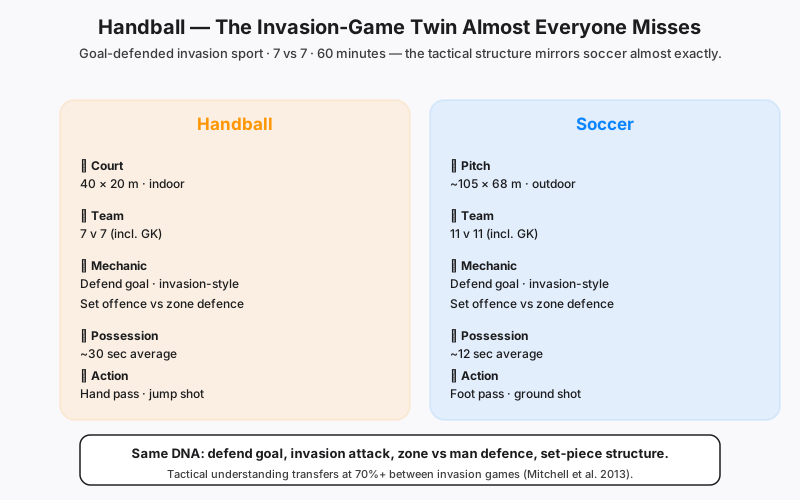
Handball is an invasion game just like soccer, yet it delivers higher-intensity doses of body contact, shooting repetitions, and transition speed. That elevated training load efficiently sharpens three capabilities that directly transfer to the soccer pitch: shot power, GK skills, and fast-break decision-making.

Photo by Kryštof Zajíček on Unsplash
Both handball and soccer are invasion games — sports in which teams defend their own goal while advancing the ball toward the opponent's. Mitchell et al.'s Tactical Games Model identifies them as one of the pairings most likely to produce tactical-understanding transfer, precisely because they share the same underlying game structure.
Three Unique Training Loads Handball Provides
- High-frequency shooting — Each player gets 10–15 shot attempts per game. Compare that to a forward's 2–4 shots in a soccer match, and the sheer volume of throwing/releasing reps becomes clear
- Constant GK 1v1 exposure — From the 6-meter line, goalkeepers face close-range shots and must read angles, react, and predict upward of 50 times per game. That is roughly ten times the number of decisive saves a soccer GK faces (3–6 per match)
- Ultra-fast transitions — The first wave of a fast break can materialize within three seconds of a turnover. Karcher & Buchheit (2014) reported that handball's transition frequency rivals basketball's, placing extreme demands on decision speed
Handball delivers several times more repetitions in shooting, saving, and fast-break execution than soccer alone. Deliberately harnessing that volume-to-quality conversion lets you stockpile experience in the exact moments that decide soccer matches.
In Europe, handball powerhouses like Denmark, Sweden, and Germany also excel at soccer, and multi-sport participation during the developmental years is actively encouraged. The Danish Football Association (DBU) officially recommends that players under 12 take part in at least two sessions of another sport per week — with handball cited as the top candidate.
How the Throwing Kinetic Chain Boosts Kicking Power
The overarm throw in handball and the instep kick in soccer share the same kinetic chain: trunk rotation → pelvic rotation → distal-segment acceleration. Training that chain through the upper limb transfers to the lower limb, improving shot speed on the pitch.
Using high-speed cameras and EMG, van den Tillaar & Ettema (2004) demonstrated that the primary determinant of throwing velocity is the efficiency of proximal-to-distal sequential muscle activation — the kinetic chain. Rotational torque generated by the trunk transfers through the shoulder, elbow, and wrist in sequence, reaching peak velocity at ball release. This mechanism is structurally homologous to the instep kick mechanics described by Lees & Nolan (1998).
Why the Upper-Limb Chain Transfers to the Lower Limb
Motor-learning research refers to the ability to execute the same coordination pattern with different limbs as a Generalized Motor Program (GMP). The temporal pattern of energy transfer originating from trunk rotation is shared across upper and lower extremities. When handball practice optimizes that timing structure in the throw, the optimized pattern carries over to the kick.
Specific Transfer Points
- Trunk pre-stretch — The wind-up in a throw stretches the trunk to store elastic energy, a skill that directly parallels trunk extension during the backswing of a kick
- Pelvic lead rotation — Rotating the hips ahead of the shoulders ('hip lead') is the key to velocity in both throwing and kicking. Handball players drill this pattern hundreds of times per session
- Non-dominant-side stabilization — Using the non-throwing arm for balance mirrors the role of the planted leg and contralateral arm during a kick
- Release-point optimization — The fine-tuned ability to time ball release transfers to impact-moment control when the foot strikes the ball
The proximal-to-distal sequencing of segment rotations is the fundamental mechanism common to all overarm throwing and kicking actions in sport.
— Lees & Nolan, 1998
It is well documented that former handball players who switch to soccer develop impressive shot speed in a short time. This is not a strength advantage — it is the result of an already-optimized kinetic chain, a mastery of 'how to transmit force' rather than how much force to produce.
GK Reflexes, Positioning, and Angle Narrowing
A handball goalkeeper makes over 50 save decisions per game. Reacting to point-blank high-speed shots, narrowing the angle in 1v1 situations, and timing the pre-jump — every one of these skills transfers directly to soccer goalkeeping as a high-density training stimulus.
A 6-meter shot in handball reaches the keeper in roughly 0.3–0.4 seconds. Given that a soccer penalty kick takes about 0.4–0.5 seconds, a handball GK is effectively repeating penalty-level save decisions dozens of times every match. That volume of repetition dramatically accelerates the development of anticipation and reaction speed.
Angle Play Transfer
The single most important skill for a handball GK is positioning to minimize the visible goal area from the shooter's perspective. This is the exact same principle soccer GKs apply in 1v1 situations — step forward to shrink the available target. Because handball features a fixed shooting distance from the 6-meter line, keepers get far more opportunities to internalize optimal positioning.
Anticipation-Based Pre-Jump
Handball GKs routinely read the shooter's arm angle, body orientation, and approach direction to predict the target zone and initiate movement before the ball is released — a technique known as the pre-jump. Sporis et al. (2010) showed that reaction time and prediction accuracy in handball players improve proportionally with training volume, an effect that directly enhances dive timing for soccer goalkeepers.
- Reading the arm swing — Predicting shot direction from the shooter's elbow height and forearm angle shares the same cognitive structure as reading a soccer kicker's ankle and knee orientation
- Lowering the center of gravity — The handball GK's athletic stance (slight knee flexion, weight forward) is identical to the soccer GK's set position
- Rebound reactions — Speed of reaction to deflected balls and quickness in secondary movements transfers to second-save ability in soccer
A soccer GK gets limited save opportunities during a match. Adding handball as cross-training creates an environment where you can repeat penalty-level save decisions 30+ times in a single hour of practice.
How Fast-Break Decisions Transform Counter-Attacks
A handball fast break goes from turnover to shot in under three seconds. Repeatedly recognizing numerical advantages, selecting running lanes, and finishing at speed rewires your counter-attacking instincts for soccer.
According to Karcher & Buchheit's (2014) review, elite handball produces an average of 15–20 fast breaks per game, with roughly 60% resulting in a goal. That high conversion rate reflects the fact that fast-break decisions — 'run or hold,' 'pass or carry,' 'which finishing angle' — have been optimized through sheer repetition.
Speed of Numerical-Advantage Recognition
The most critical fast-break skill in handball is instantly assessing the situation: 'Is it 2v1? 3v2? How many players up are we?' On a smaller court with faster play, a half-second delay collapses the break. This instant recognition of numerical advantage translates directly to soccer counter-attacks — judging whether a free teammate exists on the far side, or whether the defensive line will recover in time.
Concrete Transfer to Soccer
- First-touch direction — The handball habit of accelerating forward the instant you receive the ball transfers to facing forward with your first touch on a soccer counter-attack
- Running angles — Avoiding parallel runs and cutting diagonally to open passing lanes is drilled relentlessly in handball fast breaks
- Composure in front of goal — The sheer volume of finishing at speed against a goalkeeper in 1v1 situations builds the calm required during soccer counter-attacks
- Through-ball instinct — Weighting a pass into the space ahead of a sprinting teammate is the same cognitive skill in both sports
Counter-attacks occur roughly 5–10 times per soccer match. Adding just one handball session per week can triple or quadruple your exposure to these situations. It is a textbook case of volume-driven repetition producing qualitative improvement in decision-making.
Physical Contact and Defensive Body Positioning
Handball permits body contact, and the way defenders use their bodies — staying low, blocking with the shoulder, creating space with the arms — maps directly onto 1v1 defending in soccer.
Soccer allows the shoulder charge as a legal form of contact, yet at youth level many players avoid physical challenges and advance to higher age groups without ever becoming comfortable in contact situations. In handball, contact is constant. Players naturally learn how to hold their ground and use their bodies effectively without conscious drilling.
Defensive Footwork Transfer
Handball defenders near the 6-meter line perform rapid side-steps and crossover steps while physically containing attackers. This lateral footwork is biomechanically identical to 1v1 soccer defending — shuffling backward while reacting to an attacker's changes of direction.
- Maintaining a low center of gravity — Bending the knees and staying low to react instantly to directional changes is the foundational stance for soccer defenders as well
- Distance management — The skill of retreating while maintaining a consistent gap from the attacker is the basis of 'don't dive in' defending in soccer
- Timing of contact — Learning to initiate contact at the exact moment an opponent loses balance transfers to the timing of shoulder charges in soccer
- Arm placement — Using a hand on the attacker's hip to gauge distance translates to legal body-contact technique in soccer — leaning in without committing a foul
Sporis et al. (2010) reported that handball players score equal to or higher than soccer players in agility — specifically reactive agility, the ability to change direction in response to a visual stimulus. This is a direct predictor of 1v1 defensive performance in soccer.
How to Log It in Footnote
When recording handball sessions in Footnote, focus on three elements: the specific situation, what you felt, and which soccer scenario the skill transfers to.
To maximize the benefit of cross-training, you need to put your physical sensations and tactical insights from handball into words and explicitly link them to soccer. Use Footnote's reflection feature to structure your notes as follows.
Sample Log Entries
- "On a 2v1 fast break in handball, I delayed my pass to draw the defender before releasing it. I can do the exact same thing on a soccer counter."
- "Focusing on leading with my hips during the throw visibly increased my ball speed. I'll try the same hip-lead emphasis when shooting in soccer."
- "Stepping out to narrow the angle as GK improved my save rate immediately. I'll apply the same positioning in 1v1 situations in soccer."
- "I got a feel for keeping a hand on the attacker's hip to control distance. I'll use this during shoulder-charge situations in soccer."
Tips for Effective Logging
- Verbalize body sensations — Describe internal feelings like 'my trunk rotated first' or 'I felt my center of gravity drop' in your own words
- Map the handball–soccer connection — Explicitly pair each handball moment with the corresponding soccer scenario
- Declare what you'll try next — Turn every insight into a concrete action item for your next soccer session
- Track numbers over time — Record shot speed, save rate, or fast-break success rate so you can visualize the transfer effect
Use the 'Cross-Training' tag in Footnote to build a running log of handball sessions. Review it after three months and you'll see clearly which soccer skills benefited most from the transfer.
Frequently Asked Questions
I've never played handball. Is it still worth starting, regardless of age?▾
Kinetic-chain learning effects occur at any age. The U-12 to U-15 window offers the highest neuroplasticity, which accelerates new coordination-pattern acquisition. That said, even adults benefit: van den Tillaar & Ettema (2004) showed that kinetic-chain optimization in the overarm throw continues to improve with practice. Three months of once-a-week handball should produce noticeable changes in trunk-rotation efficiency during kicking.
What if there's no handball club or facility nearby?▾
Wall-based overarm throwing drills are effective for optimizing the kinetic chain. Rotational throws with a medicine ball (1–2 kg) offer a similar training stimulus. For GK training, a reaction drill using tennis balls thrown from close range is a solid substitute. However, fast-break decision transfer can only be developed in live game situations, so if at all possible, look into trial sessions at a local handball club.
Isn't there a risk of shoulder injury from overarm throwing?▾
Overarm throwing does place significant load on the shoulder joint. At a cross-training frequency of once or twice a week, however, the risk can be minimized by incorporating shoulder internal-rotation strengthening exercises (rotator-cuff work) in parallel. Keep throw counts manageable — roughly 50 per session as a guideline — and ensure a proper warm-up. Youth players can train safely under these conditions. If any pain occurs, stop immediately and consult a specialist.
Is trying out as a handball GK useful even if I don't play goalkeeper in soccer?▾
Absolutely. The ability to predict where a shot will go by reading the shooter's movements transfers to defensive block decisions and even to choosing finishing angles as a forward. Reading a shooter's eye line and body orientation is a foundation-level 'opponent reading' skill that benefits every position on the soccer field. On top of that, improved spatial awareness around the goal enhances shot-block positioning for defenders.
How should I log handball practice in Footnote?▾
Add a reflection entry under the 'Cross-Training' category and make sure it covers three points: (1) a description of the physical sensation you experienced in handball, (2) a hypothesis about which soccer scenario it could transfer to, and (3) a specific action you'll try in your next soccer session. Logging this three-part set consistently lets you track the transfer effect over time and see your own growth.
References
- [1] van den Tillaar, R. & Ettema, G. (2004). “A force-velocity relationship and coordination patterns in overarm throwing” Journal of Sports Science and Medicine. Link
- [2] Lees, A. & Nolan, L. (1998). “The biomechanics of soccer: A review” Journal of Sports Sciences.
- [3] Karcher, C. & Buchheit, M. (2014). “On-court demands of elite handball, with special reference to playing positions” Sports Medicine.
- [4] Sporis, G., Vuleta, D., Vuleta, D. Jr. & Milanovic, D. (2010). “Fitness profiling in handball: Physical and physiological characteristics of elite players” Collegium Antropologicum.
- [5] Mitchell, S. A., Oslin, J. L. & Griffin, L. L. (2013). “Teaching Sport Concepts and Skills: A Tactical Games Approach for Ages 7 to 18” Human Kinetics.
- [6] Putnam, C. A. (1993). “Sequential motions of body segments in striking and throwing skills: Descriptions and explanations” Journal of Biomechanics.
- [7] Wagner, H., Pfusterschmied, J., von Duvillard, S. P. & Muller, E. (2011). “Performance and kinematics of various throwing techniques in team handball” Journal of Sports Science and Medicine.
Related Articles
Verbalization Accelerates Transfer -- Why Writing Makes Skills from Other Sports Carry Over to Soccer
11 min read
How Basketball Builds Spatial Awareness, Passing Decisions & Transition Speed — The Science of Transfer to Soccer
10 min read
How Martial Arts Build Duel Strength, Body Control, and Mental Toughness for Soccer
10 min read
How to Review a Match --- What Pro Scouts Look For and Proven Recording Techniques
7 min read
The Science Behind How Skateboarding Sharpens Balance, Fearlessness, and Creativity for Soccer
11 min read
Track Your Growth with Footnote
Just record your matches — AI analyzes every 5 games. Visualize growth with PVS Score. All features free during beta.
30-second signup · No credit card required
Last updated: 2026-05-06 ・ Footnote Editorial