Ballet x Soccer -- How Body Awareness, Change of Direction, and Core Control Become Weapons on the Pitch
Ballet and soccer may seem like polar opposites, but viewed through the lens of sports science, they share three decisive skill domains: proprioception (the sense of body position), change-of-direction mechanics, and aerial core control. Ballet dancers excel at knowing exactly where their limbs are in space without relying on vision -- a body awareness that directly translates to soccer agility, aerial duels, and injury prevention. This article draws on research by Koutedakis & Jamurtas, Hewett et al., and Behm et al. to explain, with scientific rigor, how ballet training elevates soccer performance.
Proprioception and Body Awareness -- How Ballet Builds the Ability to Move Without Looking
Ballet dancers possess exceptionally refined proprioception -- the ability to sense limb position without visual feedback. This capacity transfers directly to soccer: precision ball touch, no-look plays, balance under physical contact, and mid-air postural adjustment.

Photo by Kazuo ota on Unsplash
Proprioception is the ability to sense where each part of your body is and how it is moving, via sensory receptors in muscles, tendons, and joints. A review by Lephart et al. (1997) in the Journal of Athletic Training established that proprioception underpins both sports performance and injury prevention.
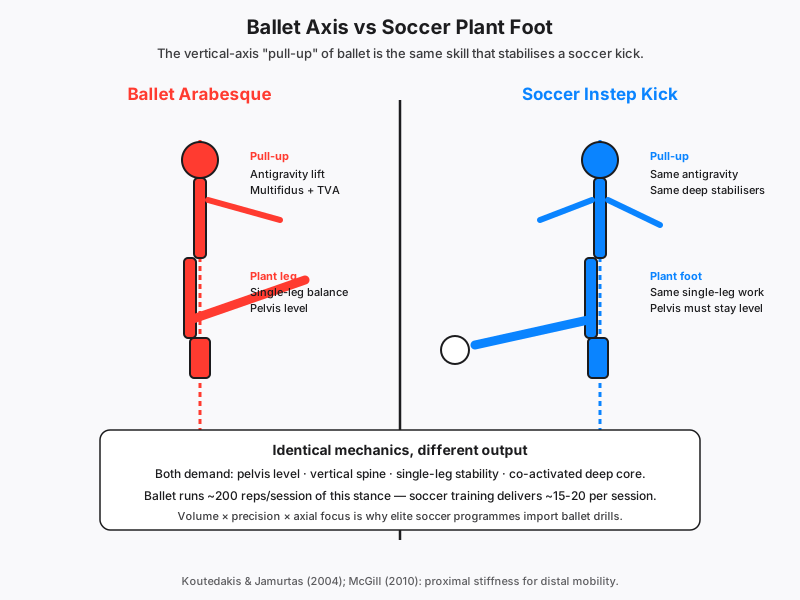
The Quality of Proprioception That Ballet Develops
In ballet training, dancers routinely practice reproducing arabesques (standing on one leg with the other extended behind) and pirouettes (single-leg turns) without a mirror. Research by Koutedakis & Jamurtas (2004) in Sports Medicine found that ballet dancers demonstrate significantly greater stability in single-leg balance tests and smaller errors in joint position sense compared to general athletes. This precise body awareness is the result of neural pathways strengthened through years of deliberate practice.
How It Transfers to Soccer
Soccer demands that players control the ball at their feet while scanning the field, maintain balance through physical contact, and adjust heading posture in mid-air -- all actions powered by proprioception. The ballet-trained ability to "move your body precisely without looking" transfers especially well in these situations:
- First touch -- When trapping while scanning the field instead of watching the ball, proprioception governs the angle and force of the receiving foot
- No-look passing -- When delivering a pass without looking at the target, body sense alone controls the plant foot's stability and the striking foot's angle
- Physical contact -- The reflexive ability to re-center your balance the instant an opponent pushes you, without losing composure
- Aerial duels -- Sensing the position of your torso and limbs mid-jump to adopt the optimal heading posture
Just as a ballet dancer can hold a precise pose with eyes closed, an elite soccer player can manipulate the ball at their feet without looking down. The common source of both skills is proprioception.
Change-of-Direction Mechanics -- How Ballet Turns Transform Agility
The rotational control and center-of-gravity management developed through pirouettes and chaines (continuous turns) in ballet transfer directly to the deceleration-pivot-reacceleration mechanics of soccer's change of direction (COD).

Photo by Kazuo ota on Unsplash
Change of direction in soccer occurs an estimated 1,200 to 1,400 times per match (Bloomfield et al., 2007). The quality of each direction change -- how fast, how precise, and how safely a player can redirect -- has a major impact on performance. Ballet contains training that improves this quality at a fundamental level.
Rotational and Center-of-Gravity Control in Ballet
During a pirouette, a dancer must keep their center of gravity directly above a narrow base of support (the toes of one foot) while using spotting -- a technique of fixing the gaze on a single point and snapping the head around -- to control both the rotation and the moment of exit. This demands ankle stability, rotational core control, and precise integration of the vestibular system (inner-ear balance).
Transfer to Soccer Change of Direction
As Sheppard & Young (2006) showed in their agility research, COD speed is determined by three phases: deceleration, center-of-gravity shift, and reacceleration. The ballet-trained skill of "rotating while precisely controlling your center of gravity" benefits all three phases:
- Deceleration -- The plie (knee bend) in ballet mirrors the knee and hip flexion used in the braking phase before a direction change, improving shock-absorption capacity during hard stops
- Pivot -- The skill of keeping the standing leg stable while rotating in a pirouette transfers directly to plant-foot stability during cut-ins and turns
- Reacceleration -- Ballet's jump-to-landing-to-next-movement sequences (enchainements) train the explosive transition pattern needed after a direction change
This is especially relevant for the "cut" -- the sharp change of direction during a dribble that is central to soccer. The timing of weight transfer and the stability of the plant foot make or break a cut. The ballet-trained experience of "supporting your entire body on one leg while redirecting movement" raises the quality of these maneuvers.
A ballet turn and a soccer cut-in are, from a kinematic standpoint, solving the same problem: support the body on one leg, shift the center of gravity precisely toward the target direction, and transition smoothly into the next action.
— Summarizing insights from change-of-direction biomechanics research
Core Control in Aerial Duels -- How Ballet Jumps Elevate Heading Ability
The in-flight core control developed through grand jete (large leaps) and tour en l'air (aerial turns) in ballet transfers directly to aerial stability in soccer -- heading, contesting, and overhead kicks.
Winning aerial duels in soccer takes more than jump height. The decisive factor is the ability to maintain heading posture while absorbing contact from an opponent in mid-air, then land without losing balance -- in other words, aerial core control. Ballet trains this capacity more systematically than perhaps any other discipline.
The Role of the Core in Ballet Jumps
In a grand jete, a dancer splits the legs nearly 180 degrees in the air while keeping the upper body upright. Achieving this state -- where the lower limbs move dynamically while the trunk remains stable -- requires high-level activation of the deep core muscles (transversus abdominis, multifidus, and pelvic floor). A review by Willson et al. (2005) in the Journal of the American Academy of Orthopaedic Surgeons confirmed that core stability is essential for both athletic performance and injury prevention.
Transfer to Aerial Duels in Soccer
During a heading duel, a player must jump, absorb shoulder-to-shoulder or body contact from an opponent, and still direct the ball accurately with the head. Without sufficient core strength, contact knocks the body off-axis and heading direction and power become uncontrollable. The ballet-trained ability to "lock the core in the air while moving the limbs independently" dramatically improves tolerance for physical contact during aerial play.
- Heading accuracy -- A stable core in the air allows precise control over the angle and force of the neck snap
- Winning contested headers -- The body axis stays true even under contact, maintaining access to the ball
- Safe landings -- A stable aerial posture distributes landing impact appropriately, reducing injury risk to the knees and ankles
- Overhead kicks -- Spatial awareness and core control improve when the body tilts backward to strike the ball
The mechanism by which a ballet dancer controls the body gracefully in the air and the mechanism by which a soccer player holds firm through an aerial duel rest on the same foundation: the deep core musculature.
Flexibility as Armor -- The Injury-Prevention Benefits of Ballet
As Hewett et al. (2005) demonstrated in their ACL injury prevention research, improved neuromuscular control and flexibility significantly reduce injury risk in soccer players. Ballet's systematic stretching and range-of-motion training directly supports this protective effect.
Soccer carries a high risk of lower-extremity injuries. ACL (anterior cruciate ligament) tears, hamstring strains, and ankle sprains can derail a player's career. The flexibility training, balance work, and landing-control drills embedded in ballet contribute to preventing these injuries with solid scientific backing.
ACL Injury Prevention and Neuromuscular Control
A large-scale study by Hewett et al. (2005) in the American Journal of Sports Medicine demonstrated that neuromuscular training programs -- incorporating balance, plyometrics, and landing control -- significantly reduce ACL injury risk. Ballet training includes all of these components, and its emphasis on single-leg landing control and balance is particularly effective at correcting "knee valgus" -- the inward collapse of the knee that is a primary ACL injury mechanism.
Flexibility and Muscle Injury Risk
A review by Behm et al. (2016) in Applied Physiology, Nutrition, and Metabolism showed that appropriate stretching -- dynamic stretching and PNF stretching in particular -- helps reduce muscle injury risk. The ballet barre lesson is a systematic dynamic-stretching protocol that progressively increases the range of motion of the hips, hamstrings, and calves, providing a direct preventive effect against the hamstring strains so common in soccer.
- Greater hip range of motion -- Ballet's turnout increases external rotation of the hip, easing the stress on the joint during sudden direction changes
- Hamstring flexibility -- Grand battement (large leg swings) improves hamstring extensibility, reducing strain risk
- Ankle stability -- Repeated releve (rising onto the toes) and demi-plie strengthens the musculature and ligaments around the ankle, lowering the risk of sprains
- Landing control -- Training to maintain correct knee alignment on jump landings addresses a primary ACL injury mechanism
The body that doesn't get injured is the body that stays on the pitch the longest. Ballet's flexibility and landing-control training may be the best injury-prevention program a soccer player can adopt.
— Summarizing the findings of Hewett et al. (2005)
Adoption in the Pro Game -- Ballet Programs from the NBA to Soccer Academies
Multiple NBA teams have officially incorporated ballet into their training regimens, and European soccer academies are beginning to adopt ballet-derived movement programs for youth development.
The use of ballet to enhance athletic performance has moved well beyond theory -- it is being practiced at the highest levels of professional sport worldwide.
Ballet in the NBA
Several NBA teams have added ballet trainers to their coaching staffs. Programs focused on balance, landing control, and core stability have been credited with improving player agility while reducing injury rates. The biomechanical demands of basketball -- sharp direction changes and jump landings -- closely mirror those of soccer, making the NBA's successful adoption a strong indicator of ballet's applicability to the beautiful game.
Movement Programs in Soccer Academies
Some academies in the Netherlands and Germany have introduced ballet-derived movement education for players under 12. The aim is to develop proprioception and core control early, building the physical "foundation" on which soccer-specific training can be layered later. This approach aligns with the multi-sport development philosophy recommended by the German Football Association (DFB).
The Natural Fit Between Women's Soccer and Ballet
ACL injury rates in women's soccer are reported to be two to eight times higher than in men's soccer (Hewett et al., 2005), making ballet's neuromuscular training especially valuable. Female soccer players with ballet experience tend to exhibit better knee alignment on landing and a lower incidence of dynamic knee valgus -- one of the key risk factors for ACL injury.
The assumption that "ballet has nothing to do with soccer" is itself the biggest barrier to entry. The NBA and European youth academies have already moved past that assumption and are leveraging ballet's value on the basis of science.
Recording Ballet-to-Soccer Transfer in Footnote
When logging ballet practice in Footnote, articulating "which body sensation changed" and "which soccer action it affects" is the key to maximizing transfer effects.
Compared to cross-training from sports like tennis or basketball, ballet-to-soccer transfer is especially rich in the dimension of body sensation. When recording in Footnote, apply the ALR (Abstract-Linguify-Reapply) framework introduced in the cross-training verbalization article, and focus on putting subtle physical sensations into words.
Recording Template
- What you did in ballet -- Note the session content briefly. Example: "30-minute barre lesson, 20-minute center work on pirouettes"
- Where in your body you noticed a new sensation -- Example: "During single-leg balance, my awareness of weight on the ball of my big toe became much sharper"
- Which soccer action it transfers to -- Example: "Plant-foot stability when kicking. I can use the sensation of anchoring through the ball of the foot"
- What to try in next soccer practice -- Example: "Focus on pressing through the ball of the big toe on the plant foot during instep kicks"
- Result after applying (add after soccer practice) -- Example: "Plant foot felt more grounded and kick direction was more consistent. However, overthinking it made my movement stiff"
Organize Insights into Four Transfer Categories
When recording ballet insights, tagging each one with one of the following four categories improves Footnote's analytical precision:
- Body Awareness -- Insights related to proprioception, body awareness, and sensations in the soles, joints, or muscles
- Balance & Direction Change -- Insights related to single-leg stability, turns, center-of-gravity shifts, and cutting
- Core Control -- Insights related to aerial posture, physical-contact resilience, and heading positioning
- Flexibility & Injury Prevention -- Insights related to changes in range of motion, stretching effects, and pain reduction
Footnote's AI analysis, which runs every five matches, can detect correlation patterns between your ballet records and match performance. Trends such as "aerial duel win rate rises in weeks that include ballet" or "dribble success rate improves during periods with more balance-related insights" become visible, helping you identify which elements of ballet training are most effective for you personally.
When you sense that "something inside my body changed" after ballet practice, record it in Footnote immediately. Putting that subtle physical sensation into words is the starting point for lifting your on-pitch performance to the next level.
Frequently Asked Questions
Does ballet training benefit male soccer players too?▾
Absolutely. The benefits are not gender-specific. Multiple NBA teams have male athletes training in ballet, and the improvements in proprioception, core control, and flexibility transfer regardless of sex. The notion that "ballet is only for women" has no scientific basis and has already been dispelled in the world's top sports programs. What matters is not artistic perfection in ballet but its value as a body-control training method.
How often should ballet be incorporated into a weekly schedule?▾
Starting with one session per week, 30 to 45 minutes, is realistic. Even a basic barre lesson focused on fundamentals delivers meaningful improvements in proprioception and balance. There is no need to cut soccer training time -- ballet elements can also be woven into warm-up routines. More intensive blocks during the off-season can be particularly effective.
Can ballet flexibility training cause a loss of strength?▾
Not when done properly. As the review by Behm et al. (2016) shows, dynamic stretching and PNF stretching can improve flexibility without compromising performance. In fact, ballet barre lessons include bodyweight strength exercises such as plies and releves, making them a program that builds flexibility and strength simultaneously.
Where should a complete beginner start with ballet?▾
Taking a beginner class at a ballet studio is ideal, but if that isn't practical, barre lesson videos on YouTube are an effective alternative. Start by learning three foundational movements: plie (knee bend), releve (rise onto toes), and tendu (leg extension). Incorporating these into your pre-practice warm-up alone will improve ankle stability and balance.
How should I log ballet training in Footnote?▾
Record the ballet session content in Footnote's practice log and add a brief note under "transfer point to soccer" describing the body sensation that changed. Tagging the insight as "Body Awareness," "Balance & Direction Change," "Core Control," or "Flexibility & Injury Prevention" makes it easier for the AI analysis to detect patterns.
References
- [1] Koutedakis, Y. & Jamurtas, A. (2004). “The dancer as a performing athlete: Physiological considerations” Sports Medicine, 34(10), 651–661. Link
- [2] Hewett, T. E., Myer, G. D., Ford, K. R., Heidt, R. S., Colosimo, A. J., McLean, S. G., van den Bogert, A. J., Paterno, M. V., & Succop, P. (2005). “Biomechanical measures of neuromuscular control and valgus loading of the knee predict anterior cruciate ligament injury risk in female athletes” American Journal of Sports Medicine, 33(4), 492–501. Link
- [3] Behm, D. G., Blazevich, A. J., Kay, A. D., & McHugh, M. (2016). “Acute effects of muscle stretching on physical performance, range of motion, and injury incidence in healthy active individuals: A systematic review” Applied Physiology, Nutrition, and Metabolism, 41(1), 1–11. Link
- [4] Lephart, S. M., Pincivero, D. M., Giraido, J. L., & Fu, F. H. (1997). “The role of proprioception in the management and rehabilitation of athletic injuries” American Journal of Sports Medicine, 25(1), 130–137.
- [5] Sheppard, J. M. & Young, W. B. (2006). “Agility literature review: Classifications, training and testing” Journal of Sports Sciences, 24(9), 919–932. Link
- [6] Willson, J. D., Dougherty, C. P., Ireland, M. L., & Davis, I. M. (2005). “Core stability and its relationship to lower extremity function and injury” Journal of the American Academy of Orthopaedic Surgeons, 13(5), 316–325.
- [7] Bloomfield, J., Polman, R., & O’Donoghue, P. (2007). “Physical demands of different positions in FA Premier League soccer” Journal of Sports Science and Medicine, 6(1), 63–70.
- [8] Rosalie, S. M. & Müller, S. (2012). “A model for the transfer of perceptual-motor skill learning in human behaviors” Research Quarterly for Exercise and Sport, 83(3), 413–421.
Related Articles
Verbalization Accelerates Transfer -- Why Writing Makes Skills from Other Sports Carry Over to Soccer
11 min read
How Swimming Transforms Cardiovascular Fitness, Upper-Body Strength, and Recovery for Soccer Players
10 min read
How Martial Arts Build Duel Strength, Body Control, and Mental Toughness for Soccer
10 min read
How Basketball Builds Spatial Awareness, Passing Decisions & Transition Speed — The Science of Transfer to Soccer
10 min read
Dance x Soccer -- How Agility, Body Control, and Rhythm Become Weapons on the Pitch
9 min read
Track Your Growth with Footnote
Just record your matches — AI analyzes every 5 games. Visualize growth with PVS Score. All features free during beta.
30-second signup · No credit card required
Last updated: 2026-05-06 ・ Footnote Editorial