How to Review a Match --- What Pro Scouts Look For and Proven Recording Techniques
A post-match review that simply states "good" or "bad" does nothing for your development. Kitsantas & Zimmerman (2002) showed that the biggest difference between experts and novices lies in the degree of structure in their reflection --- what they review, in what order, and at what level of detail. In this article, we explain concrete post-match review techniques, including the four-quadrant analysis method, timestamp logging, and a self-rating system, all informed by what professional scouts actually evaluate.
What Pro Scouts Actually Look for During a Match
Scouts are not searching for "skilled" players --- they are searching for players who can grow. Rather than technique alone, they evaluate the quality of decision-making, the ability to adjust positioning, and the mental switch after a mistake --- plays that reveal thinking.

Photo by B on Unsplash
Understanding the criteria professional scouts use will dramatically improve the quality of your post-match reviews. Many players only record outcomes such as "scored a goal" or "beat a defender with a dribble," but what scouts are watching is the process.
Five Elements Scouts Focus On
- Decision speed and quality --- Whether the player scans the surroundings before receiving the ball and selects the right option
- Positional adjustment --- Whether the player makes micro-adjustments in response to the movement of teammates and opponents
- Recovery after mistakes --- Whether the player instantly switches to defense after a misplaced pass or loss of possession
- Coaching (vocal communication) --- Whether the player directs teammates and makes demands on the pitch
- Sustained intensity --- Whether running volume and playing intensity are maintained throughout the full 90 minutes
What all five elements share is that every one of them is a product of thinking. Physical ability and technique can be assessed from video alone, but cognitive ability is only visible through the accumulation of small decisions made during a match. That is precisely why players who verbalize their decision-making process in a soccer journal stand out to scouts as players with room to grow.
The Four-Quadrant Analysis --- Attack/Defense x On-Ball/Off-Ball
By breaking down a match into four quadrants --- attack/defense crossed with on-ball/off-ball --- you can review your performance holistically without blind spots. Most players only reflect on their on-ball attacking play.
The reflective practice model by Rolfe, Freshwater, & Jasper (2001) argues that a "structured framework" is essential for improving the quality of reflection. One of the most effective frameworks for post-match review in soccer is the four-quadrant analysis.
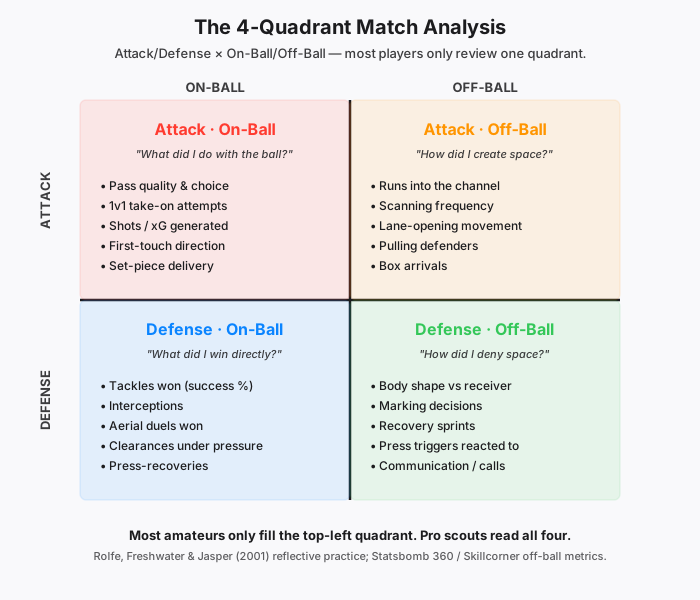
Defining the Four Quadrants
- Quadrant A: Attack x On-Ball --- Dribbling, passing, shooting, first touch, and other plays while in possession during attacks
- Quadrant B: Attack x Off-Ball --- Runs, positioning, creating space, and movement to receive the ball
- Quadrant C: Defense x On-Ball --- Tackling, intercepting, blocking, and 1-on-1 defending
- Quadrant D: Defense x Off-Ball --- Marking, covering, pressing position, and holding the defensive line
Most players only review Quadrant A (Attack x On-Ball). However, the majority of match time is spent off the ball. Players whose reviews of Quadrants B and D are thorough tend to improve their "preparation before the ball arrives" in the next match, which in turn elevates their on-ball performance as well.
How to Write a Four-Quadrant Analysis
For each quadrant, write one positive and one area for improvement --- eight items in total. This alone covers the full picture of your match without bias. For example, under Quadrant D (Defense x Off-Ball), you might write: "I was late covering the far side on crosses. I was ball-watching." This gives you a clear point to focus on in the next match.
Timestamp Logging --- A Chronological Record of Key Moments
Recording important events along a timeline dramatically increases the specificity and reproducibility of your review. A review based on memory is biased toward impressions; timestamps capture facts.
Research by Kitsantas & Zimmerman (2002) showed that experts reflect on their performance in specific episode-level units, whereas novices rely on vague impressions. Timestamp logging is a method that enables anyone to practice this "episode-level reflection."
Recording Format
"12 min, first half: Received the ball on the right side, cut inside and shot --- saved by the keeper. The decision was good but the shot placement was weak. Should have aimed for the far post." Record each entry as a set of time, situation, action, evaluation, and improvement.
How Many Scenes to Record
- Minimum 5, maximum 10 scenes --- Too few and the review becomes shallow; too many and it becomes unsustainable
- Good plays to bad plays at a 3:2 ratio --- Writing only about mistakes lowers motivation. Record successes as well
- Balance across both halves --- If entries are skewed toward the second half, you are only reviewing the period when fatigue set in
If match footage is available, record timestamps while watching the video for accuracy. If no footage exists, take quick notes on your phone immediately after the match while your memory is fresh, then write them up neatly in your journal at home --- a two-step approach that works effectively.
Self-Rating System --- Scoring That Bridges Subjectivity and Objectivity
Accumulating self-ratings after every match makes the fluctuations in your performance visible. As Toering et al. (2009) demonstrated, elite players have highly accurate self-assessments --- and that accuracy is a skill honed through repeated scoring.
Self-rating is far more than a self-indulgent exercise. Toering et al. (2009) found that elite youth soccer players scored significantly higher on self-evaluation compared to non-elite peers. Crucially, the point is not about rating yourself highly, but about being able to evaluate your own performance accurately.
Recommended Self-Rating Format
- Overall rating --- Out of 10. An intuitive holistic score based on your contribution to the team
- Category ratings --- Five categories each scored out of 10: attacking contribution, defensive contribution, physical performance, mental performance, and communication
- Best play index --- Select your single best play of the match and rate its execution out of 100
- Cross-check with coach/teammates --- When possible, compare external assessments against your own to identify gaps in self-evaluation
Once you accumulate self-ratings over 5 or 10 matches, the "waves" in your performance become visible. Patterns such as "my ratings tend to drop on rainy days" or "my physical score declines in the second match of back-to-back games" emerge --- patterns that are only visible through objective data.
The purpose of self-rating is not to assign a number but to train the ability to see yourself objectively. This ability is the very core of what Toering et al. call the self-regulated learning skills that define elite athletes.
From Single-Match Analysis to Multi-Match Analysis --- Finding Patterns
A single-match review cannot distinguish between a one-off incident and a recurring trend. By analyzing data across multiple matches, your true strengths and weaknesses come into focus.
One characteristic of experts identified by Kitsantas & Zimmerman (2002) is that they base their self-evaluation on long-term performance trends rather than a single performance. Even if you fail to score in one match, if your shot conversion rate is on an upward trend over five matches, you can conclude that you are heading in the right direction.
How to Practice Multi-Match Analysis
- Review at five-match intervals --- Look back over five matches of notes and extract recurring keywords and issues
- Graph your score trends --- Plot your self-ratings as a line chart to identify trends at a glance
- Count how often issues recur --- If "ball-watching" appears in 4 out of 5 matches, it is not a coincidence but a structural weakness
- Verify improvement --- Always check whether you improved on the issue you identified in the previous review
Conducting multi-match analysis with a paper notebook is time-consuming, but digital tools can automatically accumulate data and detect trends and patterns. With Footnote, AI automatically generates a trend analysis report every five matches, surfacing patterns you might never have noticed on your own.
A single-match review is about seeing the trees; multi-match analysis is about seeing the forest. Only by doing both can you accurately grasp the full picture of who you are as a player.
Frequently Asked Questions
After a loss, I can only write negative things. Is that okay?▾
Absolutely. However, it is important not to stop at "we lost --- I'm frustrated." Research on expressive writing by Pennebaker (2018) shows that writing about negative emotions itself has a psychological recovery effect. After getting the frustration out, follow up with a fact-based review using the four-quadrant analysis and timestamp logging. This way you can address both emotion and analysis.
What should I write if I didn't get any playing time?▾
The observer's perspective is a valuable asset that players on the pitch do not have. Record five scenes where you note "what decision would I have made in that situation?" In particular, analyzing your teammates through the lens of the five elements scouts value --- decision speed, positional adjustment, post-mistake recovery, coaching, and intensity --- will sharpen your own decision-making for when you do take the field.
How do I use timestamp logging if there is no match footage?▾
Immediately after the match, use a memo app on your phone to jot down rough time periods such as "early first half," "mid first half," or "late second half" along with what happened. Exact minute marks are not necessary. What matters is that the chronological sequence of "when and what happened" is preserved. Flesh out the details later when you write them up in your journal at home.
My self-ratings end up being the same score every time. How can I fix this?▾
Introduce category-level ratings (attack, defense, physical, mental, communication) alongside your overall score. Even if your overall stays at "6," breaking it down may reveal that "defense is an 8 but attack is a 4." Additionally, asking your coach or teammates to evaluate your play and comparing their assessment with your own will improve the accuracy of your self-rating over time.
The four-quadrant analysis feels difficult and I can't fill in every quadrant. Where should I start?▾
Start with the two quadrants most relevant to your position. For forwards, that means Quadrant A (Attack x On-Ball) and Quadrant B (Attack x Off-Ball); for defenders, Quadrant C (Defense x On-Ball) and Quadrant D (Defense x Off-Ball). Once two quadrants become habitual, add the remaining two. It is better to start within a sustainable range than to aim for perfection from the outset.
References
- [1] Toering, T., Elferink-Gemser, M. T., Jordet, G., & Visscher, C. (2009). “Self-regulation and performance level of elite and non-elite youth soccer players” Journal of Sports Sciences, 27(14), 1509-1517.
- [2] Kitsantas, A., & Zimmerman, B. J. (2002). “Comparing Self-Regulatory Processes Among Novice, Non-Expert, and Expert Volleyball Players: A Microanalytic Study” Journal of Applied Sport Psychology, 14(2), 91-105.
- [3] Rolfe, G., Freshwater, D., & Jasper, M. (2001). “Critical Reflection for Nursing and the Helping Professions: A User's Guide” Palgrave Macmillan.
- [4] Pennebaker, J. W. (2018). “Expressive Writing in Psychological Science” Perspectives on Psychological Science, 13(2), 226-229.
Related Articles
The Complete Guide to Soccer Journals — How Pros Build the Habit of Reflection
7 min read
Soccer Journal Templates --- Match, Training, and Monthly Review Formats
5 min read
How Pro Soccer Players Use Journals — Reflection Techniques from World-Class Examples
8 min read
Soccer Journals for U-15 Players --- Recording Techniques That Make the Difference at Tryouts
8 min read
The Complete Tryout Guide — 7 Evaluation Criteria Top Academies Look For and How to Prepare
15 min read
Track Your Growth with Footnote
Just record your matches — AI analyzes every 5 games. Visualize growth with PVS Score. All features free during beta.
30-second signup · No credit card required
Last updated: 2026-05-05 ・ Footnote Editorial