Esports x Soccer — How Gaming Sharpens Tactical Vision, Decision Speed, and Transfers to Real Play
Green & Bavelier (2012) showed that action-video-game players significantly outperform non-gamers in attentional allocation, visual processing speed, and decision-making speed. Soccer titles such as EA FC and eFootball train these cognitive skills while simultaneously building soccer-specific tactical thinking — formation awareness, positional judgment, and more. This article explores the scientific evidence for how esports transfer to real soccer performance, and offers practical advice on managing screen time alongside physical training.
The Surprising Overlap Between Esports and Soccer — Similarities as Cognitive Tasks
Although their physical demands are worlds apart, esports and real soccer impose nearly identical cognitive tasks on the brain: spatial awareness, pattern recognition, decision-making under time pressure, and divided attention. For your brain, a game controller and a soccer ball are simply different tools for solving the same problems.

Photo by Jade Chambers on Unsplash
During a soccer match, players make a decision roughly every six seconds. In competitive esports, professional gamers process multiple actions per second. Both activities are fundamentally the same cognitive task: integrating several streams of information within tight time constraints and selecting the best course of action.
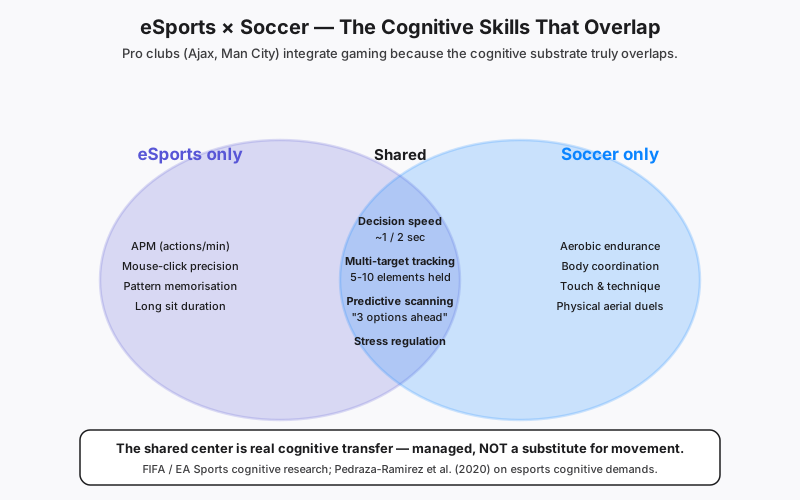
Five Shared Cognitive Structures
- Spatial awareness — Maintaining a bird's-eye view of player positions on the pitch or screen, and recognizing open space
- Pattern recognition — Instantly reading the opponent's formation, attacking patterns, and defensive shape
- Decision-making under time pressure — Choosing in a split second whether to pass, dribble, or shoot
- Divided attention — Focusing on the ball (or controlled player) while simultaneously tracking teammates and opponents
- Anticipation and forward-reading — Predicting the opponent's next move and positioning ahead of it
In a review published in Neuron, Bavelier et al. (2012) systematically demonstrated that action video games promote brain plasticity, enhancing a broad range of cognitive abilities including attention, spatial awareness, and decision-making. Soccer video games deliver these general action-game benefits while also accumulating soccer-specific tactical knowledge — a dual effect.
When you play a soccer video game, your brain is solving the same cognitive challenges it faces on the pitch. The hands on the controller engage the same cognitive circuits as the feet on the field.
How EA FC Builds Tactical Thinking and Decision Speed
In EA FC and eFootball, players must make real-time tactical decisions — switching formations, substituting players, adjusting pressing intensity. These virtual tactical experiences elevate 'soccer IQ' for real-world play.

Photo by Igor Karimov on Unsplash
Top-tier soccer-game players are not simply fast with the controls. They read the flow of a match, switch formations based on the situation, and construct counter-tactics against the opponent on the fly. This is precisely the same process that real-soccer coaches and captains perform during a match.
Tactical Skills Trained Through Gaming
- Formation awareness — Learning the strengths and weaknesses of 4-3-3, 4-2-3-1, 3-5-2, and more through direct experience, and developing the habit of finding the optimal response to the opponent's shape
- Positional sense — The top-down camera angle forces constant awareness of 'where is the space?' — a mindset that transfers to off-the-ball movement on the real pitch
- Build-up construction — Repeatedly designing passing routes from the back to beat the press and progress the ball into the attacking third
- Pressing tactics — Practicing when to use a high press, a mid-block, or a low retreat, and learning how to break each one
Crucially, a single game session involves dozens of tactical decisions, each followed by immediate feedback. Real match opportunities are limited, but gaming lets you accumulate multiple matches' worth of tactical experience in a single day. This high-density tactical repetition enables accelerated growth in soccer IQ.
Top-ranked players can read the opponent's tactical pattern within five minutes of kick-off and switch to the optimal counter-setup. That speed of reading is powered by the same cognitive process as real-world tactical vision.
— Based on esports tactical-analysis research
The Scientific Evidence That Gaming Improves Cognition
Green & Bavelier (2012) demonstrated that action video games improve spatial distribution of attention, visual processing speed, and task-switching speed. Bavelier et al. (2012) concluded that this effect operates at the meta-cognitive level — 'learning to learn.'
Scientific evidence on the cognitive effects of video games has accumulated rapidly over the past two decades. The landmark studies by Green & Bavelier (2003, 2012) proved through rigorous experiments that action video games simultaneously improve multiple cognitive functions, making a major impact in the field of cognitive science.
Scientifically Confirmed Cognitive Benefits
- Wider spatial distribution of attention — Gamers are better at extracting information from the entire visual field. In soccer, this translates directly to using peripheral vision to track teammates and opponents (Green & Bavelier, 2003)
- Faster visual processing — Enhanced ability to track moving objects and process information quickly. This transfers to predicting ball trajectories and detecting an opponent's first movement
- Faster decision-making — Quicker selection of the optimal choice from multiple options — notably, without sacrificing accuracy (Green et al., 2010)
- Faster task-switching — The ability to instantly change mental modes during transitions between attack and defense
- Greater attentional capacity — The number of objects that can be tracked simultaneously increases, corresponding to the ability to monitor multiple players' movements at once
Boot et al. (2008) compared cognitive test results between experienced gamers and non-gamers, confirming gamer advantages in spatial attention, attentional blink, and task-switching — all of which are cognitive functions demanded at high frequency during a soccer match.
Even more significant is the 'accelerated learning transfer' effect noted by Bavelier et al. (2012). Action games strengthen not only specific skills but the ability to learn new tasks rapidly. This directly supports faster mastery of new tactics, adaptation to unfamiliar positions, and response to previously unseen opponent patterns.
What gaming trains is not 'gaming skill.' It upgrades the cognitive operating system — attention, judgment, processing speed. And that OS runs just as well on the soccer pitch.
How Professional Clubs Use Esports
Most top European clubs have established esports divisions, leveraging them for player development and fan engagement. Some academies have officially adopted soccer video games as tools for improving young players' tactical understanding.
The era of 'stop gaming and go train' is over. Since the 2020s, the vast majority of clubs in Europe's top leagues have esports divisions, and their use has expanded beyond marketing into youth development.
Gaming as a Tactical-Education Tool
Some academies use soccer video games to deepen young players' understanding of formations. The experience of controlling all eleven players from a bird's-eye view cultivates a 'tactical overview' — an understanding of the whole team's movement, not just one's own position. This approach is especially valuable during injury rehabilitation or days when bad weather prevents outdoor practice, serving as a supplementary tool to maintain and improve tactical understanding.
Cognitive Profiles: Esports Players vs. Real Players
- Reaction speed — Professional esports players exhibit significantly shorter reaction times to visual stimuli than the general population. This speed directly supports 1v1 defending in soccer
- Pattern-recognition speed — The ability to instantly read formation changes on screen shares the same cognitive foundation as detecting shape shifts on the real pitch
- Multitask processing — Simultaneously monitoring the minimap, player positions, and stamina gauges mirrors the divided-attention demands of a real match
A FIFPro (World Players' Union) survey found that a large proportion of professional soccer players regularly play soccer video games, reporting that they help with opponent analysis and building tactical imagery. Gaming is now part of soccer culture itself, functioning as a shared tactical language.
Top clubs worldwide have esports divisions not just for marketing. Coaching staff are beginning to recognize the value of games as a vehicle for tactical education and cognitive training.
Optimal Play Time and Screen-Time Management
To maximize gaming's cognitive benefits while preventing negative effects on physical health and academics, aim for roughly 5 to 7 hours per week with each session capped at 60 minutes. The difference between 'mindless play' and 'purposeful play' determines how much transfers to the real game.
While plenty of studies document the cognitive benefits of gaming, that does not mean unlimited play is advisable. Excessive screen time can degrade sleep quality, reduce physical-activity time, and cause eye strain — all of which harm soccer performance. What matters is not quantity but quality and self-management.
Recommended Play-Time Guidelines
- Per session — Cap at 60 minutes. Use a timer and build the habit of stopping when it goes off
- Weekly total — Aim for 5 to 7 hours. This range avoids encroaching on physical training and study time
- Set an intention before playing — Instead of playing aimlessly, decide on a focus: 'Today I will practice build-up play' or 'I want to test pressing triggers'
- Avoid the two hours before bed — Blue light and arousal effects can reduce sleep quality. Sleep is the foundation of recovery
Purposeful Play vs. Mindless Play
The cognitive benefits are maximized when gaming is treated as deliberate practice. Concretely, this means setting a goal for each session, reviewing what happened afterward, and jotting down takeaways. This applies the same principles as Anders Ericsson's deliberate-practice theory — not mere repetition, but intentional repetition targeting weaknesses.
- Purposeful play — 'Today I will study how to break a back three' -> play -> 'Attacking the space beside the centre-back worked well' -> log in Footnote
- Mindless play — Queue ranked matches with no goal -> get frustrated after losses -> burn hours -> take away nothing
Thirty minutes of purposeful play outperforms three hours of aimless grinding. Decide what you want to learn before you pick up the controller.
Balancing Physical Training — Gaming Is a Complement, Not a Replacement
The cognitive gains from esports do not replace physical training; they complement it. Designing an integrated plan that combines cognitive training (gaming) with physical training (practice, gym work) maximizes the benefits of both.
After an in-depth look at gaming's cognitive benefits, one critical premise must be made explicit: soccer is a sport played with the body. No amount of tactical brilliance matters if you lack the physical ability to execute on the pitch. Gaming is effective as cognitive training, but it is no substitute for physical work.
Where Gaming Fits in a Weekly Schedule
The ideal approach is to place gaming and physical training in complementary slots. For example, use a recovery day after high-intensity physical practice to sharpen tactical thinking through gaming, or leverage gaming during injury rehabilitation to maintain tactical understanding. This kind of integrated design maximizes overall benefit.
- Training days — Focus on physical practice. Limit gaming to a short warm-up or cool-down session (under 30 minutes)
- Recovery days — Rest the body while using gaming for 45 to 60 minutes of tactical thinking. The brain can train even on a rest day
- Day before a match — Restrict gaming to 15 to 20 minutes. Recreate the opponent's formation in-game and use it as mental imagery rehearsal
- Injury periods — With physical practice off the table, use gaming to maintain tactical awareness and decision speed. This can shorten the readjustment period after returning to play
The key is that time spent gaming must never eat into time for running, practicing, or sleeping. Gaming is a cognitive supplement; physical training always takes priority.
A 100-point tactical brain cannot chase down a ball if your sprint is slow. A 100-point body will run in the wrong direction without tactics. Only by training both can you execute the right decision at full physical capacity on the pitch.
— Based on principles of cognitive-physical integrated training
Gaming is the 'cognitive gym'; the training ground is the 'physical gym.' One without the other is incomplete. Design both in balance and your overall game will level up.
Logging Your Esports x Soccer Growth in Footnote
Writing down tactical insights from gaming in Footnote builds a bridge that transfers virtual experience to real play. The cycle of 'discover in-game -> put it into words -> try it on the pitch -> reflect' accelerates growth.
Even if you gain tactical insights during a game, failing to articulate them leaves them as vague feelings — hard to reproduce on the pitch. By logging your gaming takeaways in Footnote and explicitly noting the connection to real soccer, you can consciously steer the transfer of cognition.
Recording Template
- What you did in-game — e.g., 'Played 3 EA FC online matches in a 4-2-3-1 focusing on build-up play'
- Tactical discovery — e.g., 'Switching from CB to fullback was effective against high press. It lets you progress without going through the middle'
- Transfer point to real soccer — e.g., 'At the next practice, when pressed, I will focus on the escape pass to the fullback'
- Post-practice reflection — e.g., 'Used the fullback switch three times in the real match. It worked just like the image I built in-game'
Three Recording Categories
- Tactical — Formations, build-up routes, press-evasion methods, etc. Transfers to team-level tactical understanding and execution
- Decision-making — Pass/dribble/shoot selection, timing. Transfers to individual decision speed
- Cognitive — Width of vision, pattern recognition, prediction accuracy. Transfers to foundational cognitive improvement
Footnote's AI analysis every five matches can also detect correlations between your gaming-training logs and changes in real soccer performance. Seeing trends such as 'positioning ratings improved in weeks with more tactical gaming notes' helps you find your own optimal balance of game-based training.
After a gaming session, thirty seconds is all it takes. Write down your single biggest takeaway in Footnote. Those thirty seconds are the switch that converts virtual experience into real-world growth.
Frequently Asked Questions
Do soccer video games actually help with real soccer?▾
As shown by Green & Bavelier (2012) and Bavelier et al. (2012), action video games significantly improve attentional allocation, visual processing speed, and decision-making speed. Soccer games add soccer-specific benefits on top of these general cognitive gains — formation awareness, positional judgment, and more. To maximize the effect, play with intention and put your insights into words.
How much time per day should I spend gaming to see benefits?▾
Aim for 30 to 60 minutes per session and roughly 5 to 7 hours per week. Going beyond that risks cutting into physical training and sleep. What matters most is quality, not duration. Set a purpose — such as 'today I will work on build-up play' — and jot down your takeaways afterward. This deliberate-practice approach is the most effective.
I am worried gaming will replace physical activity.▾
That concern is valid. Gaming is a complement, not a replacement, for physical training. Never sacrifice practice time for gaming. The most sensible approach is to use games as cognitive training during recovery days, injury rehabilitation, or days with bad weather — times when physical practice is not possible. Build it into your weekly schedule and keep physical training as the clear top priority.
EA FC or eFootball — which is better for learning soccer?▾
Both are equally effective for deepening tactical understanding. What matters more than the title is how you use it. Online play trains adaptability against diverse tactics, while career or manager mode deepens understanding of team management and player placement. Pick whichever title you enjoy more and commit to purposeful play.
How should I log gaming sessions in Footnote?▾
Enter the session content briefly in your practice log and add a one-liner about the 'transfer point to real soccer.' Tag each entry as Tactical, Decision-making, or Cognitive to help the AI analysis detect patterns. Example: 'EA FC 3 matches. Switching to the fullback was effective for beating the high press -> at next practice, focus on the fullback escape pass under pressure (Tactical).'
References
- [1] Green, C. S. & Bavelier, D. (2012). “Learning, attentional control, and action video games” Current Biology, 22(6), R197–R206. Link
- [2] Bavelier, D., Green, C. S., Pouget, A., & Schrater, P. (2012). “Brain plasticity through the life span: Learning to learn and action video games” Annual Review of Neuroscience, 35, 391–416. Link
- [3] Boot, W. R., Kramer, A. F., Simons, D. J., Fabiani, M., & Gratton, G. (2008). “The effects of video game playing on attention, memory, and executive control” Acta Psychologica, 129(3), 387–398. Link
- [4] Green, C. S. & Bavelier, D. (2003). “Action video game modifies visual selective attention” Nature, 423(6939), 534–537. Link
- [5] Green, C. S., Pouget, A., & Bavelier, D. (2010). “Improved probabilistic inference as a general learning mechanism with action video games” Current Biology, 20(17), 1573–1579. Link
- [6] Vestberg, T., Gustafson, R., Maurex, L., Ingvar, M., & Petrovic, P. (2012). “Executive functions predict the success of top-soccer players” PLoS ONE, 7(4), e34731. Link
- [7] Bediou, B., Adams, D. M., Mayer, R. E., Tipton, E., Green, C. S., & Bavelier, D. (2018). “Meta-analysis of action video game impact on perceptual, attentional, and cognitive skills” Psychological Bulletin, 144(1), 77–110. Link
Related Articles
How Chess Transfers Tactical Thinking, Anticipation, and Pattern Recognition to Soccer
10 min read
Anticipation and Reading the Game — The Science of Prediction That Racket Sports Can Teach You
11 min read
Spatial Cognition — The Science of Reading Space, Trained Through Team Sports
10 min read
Metacognition Training — The Science Behind 'Thinking Soccer' and How to Develop It Through Journaling
12 min read
How to Review a Match --- What Pro Scouts Look For and Proven Recording Techniques
7 min read
Track Your Growth with Footnote
Just record your matches — AI analyzes every 5 games. Visualize growth with PVS Score. All features free during beta.
30-second signup · No credit card required
Last updated: 2026-05-06 ・ Footnote Editorial