Music and Soccer -- How Rhythm, Focus, and Mental Control Are Built Through an Unlikely Combination
Zatorre et al. (2007) demonstrated that musical training strengthens the coupling between the auditory cortex and motor cortex, dramatically improving rhythm perception, timing control, and sensorimotor integration. In soccer, the timing of a pass, the rhythm change in a dribble, and coordinated team movement are all forms of 'the art of timing.' This article breaks down the neuroscience behind how music and instrument playing transfer to soccer performance, and offers concrete strategies -- from pre-match playlists to drum practice -- that you can put into action today.
The Neuroscience Linking Music and Sport
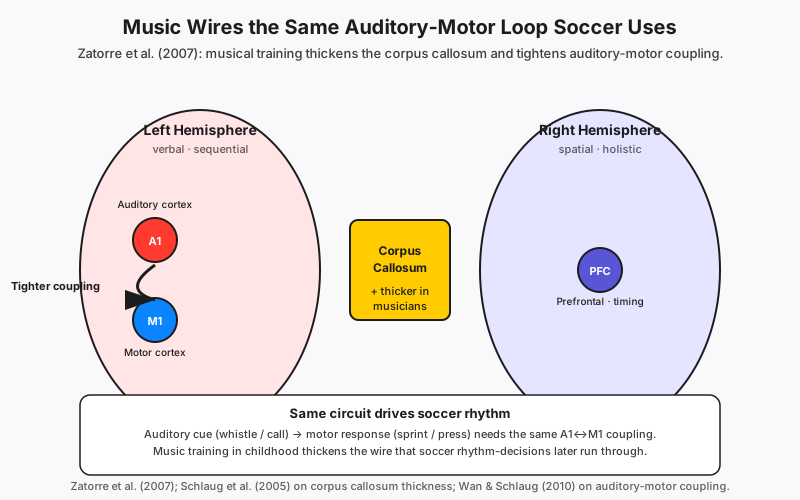
Music and movement are tightly coupled inside the brain. Zatorre et al. (2007) showed that musical training reinforces auditory-motor circuits, while Schlaug et al. (2005) found that the corpus callosum is thicker in instrumentalists than in non-players. This neural foundation is what makes transfer from music to sport possible.

Photo by Hao Zhang on Unsplash
Music and sport seem to belong to entirely different worlds, yet from a neuroscience perspective they share a remarkably deep connection. In a review published in Nature Reviews Neuroscience, Zatorre et al. (2007) comprehensively demonstrated that perceiving and performing music activates a wide network spanning the auditory cortex, motor cortex, prefrontal cortex, and cerebellum, and strengthens the connections among these regions.
Brain Regions Activated by Music -- And Their Soccer Counterparts
- Motor cortex -- Instrument playing hones fine motor control. In soccer, this corresponds to precise ball touches and subtle adjustments to kicks
- Cerebellum -- The hub of rhythmic timing control. In soccer, it governs the timing of passes, the tempo of dribbles, and the peak height of a jump
- Prefrontal cortex -- Responsible for sustaining and switching attention. In soccer, it underpins concentration across a full 90 minutes and rapid decision-making during transitions
- Corpus callosum -- The bridge between the left and right hemispheres. Schlaug et al. (2005) found it is thicker in musicians. More efficient inter-hemispheric communication transfers to using both feet and performing coordinated movements in sport
Especially important is a mechanism known as 'auditory-motor coupling.' Simply listening to music activates the motor cortex, priming the body to move in time with the rhythm. Chen et al. (2008) confirmed via fMRI that listening to a rhythmic beat alone is enough to engage motor regions. This means that listening to music before a match is not mere relaxation -- it has a solid neurological basis as preparation for physical activity.
The urge to move when you hear music is no accident. The auditory cortex and motor cortex are hardwired together, so the moment you hear a rhythm your brain is already preparing to move.
Why Rhythm Perception Elevates Soccer Performance
Grahn & Brett (2007) showed that rhythm perception depends on the basal ganglia and the supplementary motor area. The tempo shifts in a dribble, the timing of give-and-go passes, and the attacking rhythm of a team are all expressions of 'rhythm perception' transferring into movement.

Photo by Clark Young on Unsplash
Soccer is a sport of rhythm. Dribbling has a tempo, passing sequences have a rhythm, and the team's overall attack-defense cycle ebbs and flows like a wave. When a gifted dribbler beats a defender, there is always a 'rhythm disruption' at work -- a change in tempo, a momentary freeze, a sudden burst of acceleration.
Three Pathways Through Which Rhythm Transfers to Soccer
- Tempo control -- By internalizing BPM (tempo) through music, you develop the ability to consciously manipulate the pace of your own movement. This directly feeds into varying the speed of a dribble or the intensity of pressing
- Timing precision -- Practicing movement in exact sync with a beat improves the synchronization between passer and receiver. The accuracy of 'when to release the ball' goes up
- Rhythm prediction and disruption -- Understanding syncopation (off-beat accents) in your body translates into the ability to deliberately break an opponent's expected rhythm. This is the essence of the feint
The research by Grahn & Brett (2007) revealed that perceiving and reproducing rhythm depends on the basal ganglia and the supplementary motor area. Intriguingly, these same brain regions are also deeply involved in motor timing control during sport. In other words, training your sense of rhythm through music directly strengthens the neural circuitry that controls the timing of your movements on the pitch.
A person who can tap out a beat precisely to a metronome can deliver a pass precisely to a teammate's run. Musical timing accuracy and passing timing accuracy rely on the same neural circuitry.
— Based on neuroscience research into rhythm perception and motor timing
When we describe a player as having 'good timing' or 'great rhythm,' it is not a metaphor -- those abilities literally share the same neural substrate as musical rhythm perception.
How Instrument Playing Builds Focus and Teamwork
Playing an instrument is a high-level cognitive activity that simultaneously demands sustained concentration, attention to detail, and synchronization with others. These three elements map precisely onto the 90-minute focus required in soccer, tactical awareness, and coordinated team play.
Playing a musical instrument places an extraordinarily high cognitive load on the brain. Reading a score while moving your fingers, listening to the sound and making corrections, maintaining tempo, and synchronizing with other parts in an ensemble -- this multi-tasking trains executive function comprehensively.
Cognitive Abilities Trained by Instrument Playing -- And Their Soccer Transfer
- Sustained attention -- A single piece lasts 5 to 10 minutes during which you cannot lose focus for an instant. This transfers to maintaining attention throughout a 90-minute soccer match
- Working memory -- Reading ahead on the score while playing the current note. In soccer, this corresponds to processing 'the play happening now' and 'the next move' simultaneously
- Attention to detail -- Perceiving and correcting subtle deviations in pitch and timing. This transfers to the precision of ball touches and fine-tuning the weight of passes
- Social synchronization -- The experience of breathing in unison with others in a band or orchestra elevates the quality of coordinated play with teammates
Moreno et al. (2011) found that children who received music training scored significantly higher on executive function tests -- inhibitory control, working memory, and cognitive flexibility. These executive functions align with the cognitive skills that Vestberg et al. (2012) identified as predictive of soccer performance. In other words, instrument playing trains the very cognitive foundation that drives soccer success.
Ensemble Experience and Team Play
Playing in a band or ensemble specifically trains the ability to synchronize with others -- an essential skill in team sport. Performing your own part while listening to the other parts, sensing the overall balance, and adjusting your volume and timing accordingly: this maps directly onto the sensation of holding your position in soccer while moving in coordination with the rest of the team.
The experience of 'listening and adjusting' in a band uses the same cognitive process as 'watching teammates and coordinating' on the pitch. Playing in an ensemble is, in effect, a rehearsal for team sport.
Pre-Match Music -- A Science-Backed Performance Routine
A meta-analysis by Terry et al. (2012) confirmed that music has a positive effect on sports performance. Choosing music before a match serves three evidence-based purposes: regulating arousal level, optimizing mental state, and triggering focus.
The sight of professional soccer players wearing earphones before a match is familiar to every fan. This is not casual relaxation -- it is a performance routine grounded in science. In a review published in the Journal of Sport and Exercise Psychology, Terry et al. (2012) systematically confirmed that music exerts a positive effect on exercise performance.
Three Performance Effects of Music
- Arousal regulation -- Up-tempo music activates the sympathetic nervous system, raising heart rate and alertness. Conversely, slow-tempo music tips the balance toward the parasympathetic system and promotes relaxation. You can select tracks to match your optimal pre-match arousal state
- Mood regulation -- Music stimulates dopamine release, generating a positive mood. It modulates anxiety and tension to an appropriate level, creating the 'just-right edge' for competition
- Focus trigger -- Using the same song repeatedly as a pre-match routine conditions it to act as a 'switch into focus mode.' This is the same classical-conditioning principle behind Pavlov's dog
Pre-Match Track Selection Guidelines
- To raise intensity -- Up-tempo tracks at 120-140 BPM. Listen during the 30 minutes before kickoff through warm-up
- To sharpen focus -- Instrumental tracks with no lyrics. Without words competing for cognitive processing, it is easier to maintain internal concentration
- To ease nerves -- Slow-tempo tracks at 60-80 BPM. Before a high-stakes match, these shift the nervous system toward parasympathetic dominance to dial back excessive tension
- To build a routine -- Listen to the same 3-5 tracks in the same order before every match. The repetition strengthens the conditioned association between the music and a focused state
The key is to experiment and find the tracks that work best for you. Log the songs you listened to before each match alongside your performance in Footnote, and discover your optimal playlist pattern through data. This is performance optimization driven by evidence, not guesswork.
Pre-match music is more than 'listening to songs you like.' It can be used as a scientific tool to deliberately control your arousal level and focus state.
Drums and Soccer -- Concrete Training Methods
Drumming is 'rhythmic multi-tasking' -- it requires each of the four limbs to move independently in different rhythmic patterns. This four-limb independence and precise timing output offer high transfer potential to using both feet in soccer, executing complex body movements, and refining timing accuracy.
Among all instruments, drums are considered to have the highest transfer potential to soccer. The reason is straightforward: drums are the only instrument that requires each of the four limbs to move independently in different rhythmic patterns. The right hand plays the hi-hat, the left hand the snare, the right foot the bass drum, and the left foot the hi-hat pedal -- each limb executing a different pattern simultaneously.
Soccer Skills That Drumming Builds
- Four-limb independence -- The ability to drum different rhythms with hands and feet transfers to body feints (deceiving with the upper body while carrying the ball with the feet)
- Tempo-control precision -- Training to keep an exact beat with a metronome improves the timing accuracy of passes
- Rhythm switching -- Smoothly inserting fills (rhythm-pattern changes) transfers to fluid rhythm changes during dribbling
- Sustained concentration -- Maintaining tempo without faltering for an entire 4-5 minute track builds the kind of enduring attention that soccer demands
Drum Exercises Designed for Soccer Players
- Steady basic beat -- Start a 4/4 basic beat at 80 BPM on a metronome and maintain it without drift for 3 minutes. This builds the foundation of tempo control
- Tempo-change drills -- Shift intentionally from 80 BPM to 120 BPM and back to 80 BPM. This develops the rhythm-manipulation ability that directly feeds into dribble pace changes
- Four-limb independence exercise -- Right hand on eighth notes, left hand on quarter notes, right foot on beats 2 and 4. Each limb executes a different pattern simultaneously
- Fill-and-recover -- Go from a basic beat into a fill and smoothly return to the original beat. This mirrors the transition from a normal run into a feint and back to full stride
With an electronic drum pad or a drumming app you can practice at home without worrying about noise. Two to three sessions per week at 15-20 minutes each is enough to see results. The goal is to ingrain precise rhythm into your body -- advanced technique is not required.
The sensation of your right hand and left foot moving independently on a drum kit engages the same neural circuitry as a soccer feint, where your upper body deceives the defender while your feet carry the ball.
How Professional Players Use Music
Many of the world's top soccer players incorporate music into their daily routines. Beyond pre-match focus, a growing number also use instrument playing for recovery and mental care.
The relationship between soccer players and music goes well beyond the realm of hobby. Numerous professionals have spoken in interviews about the importance of music, deliberately using it for pre-match routines, mental care, and recovery.
Three Patterns of Music Use
- Pre-match routine -- Listening to a specific playlist before every match to recreate the optimal arousal state and focus. This is why so many pros wear earphones on the team bus and in the locker room
- Instrument playing -- Players who play guitar or piano use their practice sessions as both concentration training and mental refreshment. The fine motor control of the fingertips uses the same motor-control circuits as delicate ball touches with the feet
- Mental care -- Listening to music to recover from match-day stress and maintain psychological stability. This is especially valuable for managing mental load during fixture congestion and away trips
Many players on the Brazil national team listen and dance to samba and funk on a daily basis. This constant immersion in musical culture is thought to naturally cultivate the distinctive rhythm sense of Brazilian players -- known as ginga. It is a cultural example of how music can shape a soccer playing style.
At European clubs, it is not uncommon for teams to play background music during training sessions. This is not just about atmosphere: rhythmic background music has been reported to naturally regulate the tempo of drills and subconsciously reinforce the players' sense of rhythm in their movements.
Music flips a switch inside me. When I hear my usual tracks before a match, I naturally shift into focus mode. It feels as though my body is already preparing to compete.
— Based on interview insights from professional soccer players on their use of music
Logging in Footnote -- Connecting Musical Experiences to Soccer Growth
By putting into words the rhythm perception and focus shifts gained through music -- 'Which rhythm pattern changed?' 'Which pre-match track was most effective?' -- you turn a fleeting sensation into a repeatable weapon.
To maximize the effect music has on your soccer, it is essential to put your experiences into words and log them in Footnote. Rather than 'I think my sense of rhythm got a bit better,' write specifically about which musical experience influenced which soccer skill and how. Doing so consciously builds the bridge of transfer.
Logging Template
- What you did with music -- e.g., 'Drum practice, 20 min. Tempo-change drill (80 BPM → 120 BPM → 80 BPM)'
- Rhythm / focus insight -- e.g., 'The rhythm broke down the moment I sped up. Keeping it steady was harder than expected'
- Transfer point to soccer -- e.g., 'Same structure as when my dribble rhythm falls apart when I accelerate. Focus on stabilizing at a slow tempo first, then speed up'
- Pre-match music effect -- e.g., 'Three tracks at 130 BPM → warm-up. Was able to press hard from the opening whistle'
- Next action -- e.g., 'Try the same playlist before next week's match to test reproducibility'
Three Logging Categories
- Rhythm -- Insights on tempo control gained from instrument playing or rhythm training. Transfers to dribble pace variation and pass timing
- Focus -- Sustained attention during instrument practice or the focus-triggering effect of pre-match music. Transfers to maintaining concentration over 90 minutes
- Mental -- Tension relief, motivation boost, or recovery effect from music. Transfers to mental conditioning
Footnote's AI analysis can also detect correlations between your music-related entries and performance changes. Patterns such as 'matches where I listened to a specific playlist beforehand had higher first-half aggression scores' or 'during weeks with drum practice, my pass-timing ratings improved' will emerge, helping you discover the music strategy that works best for you.
After a drum session, after listening to your pre-match tracks, take 30 seconds to jot it down in Footnote. 'This rhythm sensation can help my dribbling.' 'That track helped me lock in.' -- That single line is the key that converts a musical experience into soccer growth.
Frequently Asked Questions
Can music improve my soccer performance even if I have never played an instrument?▾
Yes. Even without instrument experience, there are ways to use music intentionally. Choosing tracks that match your arousal level as a pre-match routine, or clapping and moving your body in time with a metronome as rhythm training -- these alone deliver the performance benefits shown by Terry et al. (2012). If you want to take it further, starting with an electronic drum pad or a rhythm app is the easiest entry point.
Which instrument is most effective for soccer?▾
Drums stand out for their transfer potential because they train four-limb independence. That said, piano develops independent hand control and the ability to read ahead on a score, guitar sharpens fine finger control and rhythmic sense, and wind instruments build breath control and sustained focus -- each instrument trains a different cognitive ability. The key to sticking with it is choosing an instrument you enjoy; regardless of which you pick, rhythm perception, focus, and attention to detail are trained across the board.
What kind of music should I listen to before a match?▾
Choose tracks based on your goal. To raise intensity, go with up-tempo songs at 120-140 BPM. To sharpen focus, pick instrumental tracks without lyrics. To ease nerves, select slow-tempo tracks at 60-80 BPM. The crucial step is to listen to the same 3-5 tracks in the same order before every match, turning it into a routine. That repetition strengthens the conditioned response. Log the tracks you listened to and your performance in Footnote to find your optimal selection over time.
Is rhythm perception something you are born with, or can it be trained?▾
Rhythm perception absolutely improves with training. As the research by Grahn & Brett (2007) shows, rhythm perception depends on the activity of the basal ganglia and the supplementary motor area, and these regions change plastically through music training. With clapping to a metronome, rhythm games, or drum practice two to three times a week, rhythmic accuracy improves significantly within three to six months. It can be developed at any age, though the effects are especially pronounced when started during childhood, when neural plasticity is at its peak.
How should I log music-related entries in Footnote?▾
Add a brief music-experience note to your practice log, along with a one-line 'transfer point to soccer.' Being conscious of whether it falls under the Rhythm, Focus, or Mental category makes it easier for the AI analysis to detect patterns. Examples: 'Drum practice 15 min. Tempo-change drill -- transition from 80 to 120 BPM got smoother → focus on acceleration timing in dribbles (Rhythm).' 'Listened to usual 5-track playlist before match → pressed aggressively from the first half (Focus).'
References
- [1] Zatorre, R. J., Chen, J. L., & Penhune, V. B. (2007). “When the brain plays music: Auditory–motor interactions in music perception and production” Nature Reviews Neuroscience, 8(7), 547–558. Link
- [2] Terry, P. C., Karageorghis, C. I., Saha, A. M., & D’Auria, S. (2012). “Effects of synchronous music on treadmill running among elite triathletes” Journal of Science and Medicine in Sport, 15(1), 52–57. Link
- [3] Grahn, J. A. & Brett, M. (2007). “Rhythm and beat perception in motor areas of the brain” Journal of Cognitive Neuroscience, 19(5), 893–906. Link
- [4] Schlaug, G., Forgeard, M., Zhu, L., Norton, A., Norton, A., & Winner, E. (2005). “Effects of music training on the child’s brain and cognitive development” Annals of the New York Academy of Sciences, 1060(1), 219–230. Link
- [5] Chen, J. L., Penhune, V. B., & Zatorre, R. J. (2008). “Listening to musical rhythms recruits motor regions of the brain” Cerebral Cortex, 18(12), 2844–2854. Link
- [6] Moreno, S., Bialystok, E., Barac, R., Schellenberg, E. G., Cepeda, N. J., & Chau, T. (2011). “Short-term music training enhances verbal intelligence and executive function” Psychological Science, 22(11), 1425–1433. Link
- [7] Vestberg, T., Gustafson, R., Maurex, L., Ingvar, M., & Petrovic, P. (2012). “Executive functions predict the success of top-soccer players” PLoS ONE, 7(4), e34731. Link
Related Articles
Rhythm and Timing -- How Music and Dance Sharpen Soccer Performance Through the Science of Rhythm
10 min read
Dance x Soccer -- How Agility, Body Control, and Rhythm Become Weapons on the Pitch
9 min read
Mental Training and the Soccer Notebook Habit — The Science of Writing Your Way to a Stronger Mind
9 min read
Metacognition Training — The Science Behind 'Thinking Soccer' and How to Develop It Through Journaling
12 min read
Conquering Fear — The Science of Mental Toughness Built Through Extreme Sports
12 min read
Track Your Growth with Footnote
Just record your matches — AI analyzes every 5 games. Visualize growth with PVS Score. All features free during beta.
30-second signup · No credit card required
Last updated: 2026-05-06 ・ Footnote Editorial