The Kinetic Chain -- The Science of Cross-Sport Body Mechanics and Its Application to Soccer
A pitcher's blazing fastball, a tennis player's 230 km/h serve, a soccer player's knuckleball shot -- these movements look completely different on the surface, yet they are all governed by a single mechanical principle: the kinetic chain. This mechanism, in which energy generated by the trunk is transmitted sequentially from proximal to distal segments to produce maximum velocity at the extremity, underlies every power-based athletic action. In this article, we explore the science of the kinetic chain and explain how cross-sport training can improve both the power and accuracy of your soccer kicks.
What Is the Kinetic Chain -- And Why Does It Matter Across Sports?
The kinetic chain refers to the mechanism by which multiple body segments coordinate in sequence, transferring energy from proximal (trunk-side) to distal (extremity-side) segments. Since Putnam's (1993) research, this principle has been established as the foundation of all power-based actions, including throwing, kicking, and serving.

Photo by Jakub Klucký on Unsplash
The kinetic chain is the mechanism by which multiple body segments -- trunk, shoulder, upper arm, forearm, and hand (or trunk, pelvis, thigh, shank, and foot) -- accelerate sequentially with precise timing, channeling energy toward the extremity. It works on the same principle as cracking a whip: a wave travels from the handle to the tip, where it ultimately breaks the sound barrier. The same physics operates in human movement.
Why the Kinetic Chain Matters
- Energy amplification effect -- As each segment accelerates in sequence, the velocity at the extremity can reach several times the rotational speed of the trunk alone. Putnam (1993) formalized this effect as 'proximal-to-distal sequencing'
- Injury prevention -- When the chain breaks down, specific joints become overloaded. Kibler et al. (2006) demonstrated that kinetic chain disruption significantly increases the risk of shoulder and elbow injuries
- Cross-sport transferability -- All actions that channel power to an extremity -- throwing, kicking, serving, spiking -- follow this principle. Chain coordination mastered in one sport can transfer to another
The critical insight is that the kinetic chain is not a matter of 'strength' but of 'timing.' No matter how strong your muscles are, if the acceleration timing of each segment is off, extremity velocity will not increase. Conversely, if you master the correct timing, even athletes with less raw strength can produce surprisingly powerful kicks and throws.
The essence of the kinetic chain is not 'force magnitude' but 'timing precision.' Optimizing the acceleration sequence from trunk to pelvis to thigh to shank to foot at the 0.01-second level is what determines kick speed.
The Proximal-to-Distal Sequence in Kicking
High-speed camera analysis by Nunome et al. (2006) confirmed a clear proximal-to-distal sequence in the soccer instep kick: forward pelvic rotation, forward thigh swing, knee extension, and ankle fixation. The precision of this sequence is the primary factor behind individual differences in kick speed.
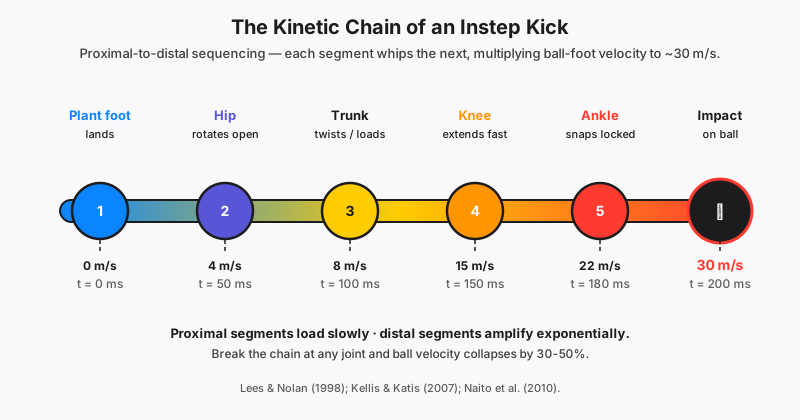

Photo by Uriel Soberanes on Unsplash
In the Journal of Sports Sciences, Nunome et al. (2006) captured professional soccer players' instep kicks with high-speed cameras at 1000 fps and precisely analyzed the angular velocity changes of each segment. The following sequence was clearly confirmed:
- Forward pelvic rotation -- The starting point of the kick. As the support foot lands, the pelvis begins rotating toward the kicking-foot side
- Forward thigh swing -- Receiving rotational energy from the pelvis, the hip flexes. At this moment, the knee is at maximum flexion, creating a 'whip-loading' effect
- Explosive knee extension -- Immediately after the thigh reaches peak velocity, the knee extends rapidly. The angular velocity of the shank reaches its maximum at this instant
- Ankle fixation -- At impact, the ankle is plantarflexed and locked, transmitting the shank's energy into the ball
A review by Kellis & Katis (2007) showed that approximately 60% of the kick-speed gap between elite and non-elite players can be explained by the 'timing precision' of this proximal-to-distal sequence. The decisive factor is not a difference in muscle strength, but the precision of the 'order' and 'time intervals' at which each segment reaches its peak angular velocity.
Common Chain Breakdown Patterns
- Knee-first pattern -- Knee extension begins before the thigh swing is complete. Results in insufficient power and a tendency for the ball to float
- Trunk-locked pattern -- Pelvic rotation is not utilized, leading to a 'kicking with the leg only' state. Kick speed drops dramatically
- Ankle instability pattern -- The ankle cannot be locked at impact, causing energy to dissipate. Ball control also suffers
'Lacking kick power' is usually not a muscle strength issue but a chain breakdown. It is not uncommon for kick speed to improve by 10-20% simply by correcting the timing.
Transfer from Throwing to Kicking -- The Upper and Lower Limbs Share the Same Principle
Hirashima et al. (2007) analyzed the kinetic chain of throwing in detail and demonstrated that the proximal-to-distal sequence of shoulder internal rotation, elbow extension, and wrist snap is structurally identical to pelvic rotation, knee extension, and foot snap in kicking. Chain coordination acquired in the upper limbs transfers to the lower limbs.
Baseball pitching, handball throwing, javelin throwing -- upper-limb throwing actions are a 'textbook' of the kinetic chain. In a study published in the Journal of Neurophysiology, Hirashima et al. (2007) confirmed an extremely precise proximal-to-distal sequence in skilled pitchers' throwing motions: trunk rotation, shoulder abduction, shoulder internal rotation, elbow extension, and wrist flexion.
Structural Correspondence
When you align the kinetic chains of throwing and kicking, the correspondence becomes clear. The trunk rotation as the energy origin, the intermediate segment (upper arm / thigh) creating a 'loading' phase, and the distal segment (forearm-hand / shank-foot) accelerating explosively -- every element matches like a mirror image.
- Trunk rotation -> Trunk rotation (shared origin)
- Shoulder abduction & external rotation -> Hip extension & external rotation (loading phase)
- Shoulder internal rotation & elbow extension -> Hip flexion & knee extension (explosive acceleration)
- Wrist snap -> Ankle fixation (energy transfer at the extremity)
A study by Anderson & Sidaway (1994) in Research Quarterly for Exercise and Sport experimentally demonstrated that throwing practice produces a positive transfer effect on kicking movement patterns. In particular, improvements were observed in trunk rotation timing and the distal acceleration sequence.
Although throwing and kicking appear to be different movements on the surface, they likely share the same motor program in terms of neural control hierarchy.
— Hirashima et al., 2007
In other words, athletes who have mastered the kinetic chain of throwing through baseball or handball already possess the groundwork to apply that 'timing sense' to kicking. Indeed, Ford et al.'s (2009) multi-sport experience study suggests that athletes with experience in multiple sports tend to exhibit higher kick speeds.
Tennis Serve to Bicycle Kick -- The Pinnacle of Full-Body Rotation
The kinetic chain of the tennis serve (knee extension, trunk rotation, shoulder internal rotation, pronation) and the kinetic chain of the bicycle kick (jump, backward trunk rotation, hip flexion, knee extension) share the most advanced chain pattern in terms of full-body energy transfer in three-dimensional space.
In the Journal of Sports Sciences, Elliott et al. (2003) described in detail the kinetic chain of the elite tennis serve using 3D motion analysis. The serve consists of a seven-stage proximal-to-distal sequence starting from ground reaction force: knee extension, pelvic rotation, trunk rotation, shoulder abduction, shoulder internal rotation, forearm pronation, and wrist flexion.
Commonality with the Bicycle Kick
The bicycle kick (overhead kick) is the soccer technique demanding the most complex kinetic chain. Transforming the upward momentum of the entire body from the jump, through backward trunk rotation, into a forward swing of the kicking leg -- this 'three-dimensional energy conversion in midair' is mechanically analogous to the airborne phase of the tennis serve.
- Spatial degrees of freedom -- In both actions, the chain must be executed without ground contact (the jump phase of the serve; the airborne phase of the bicycle kick)
- Redirecting trunk rotation -- In the serve, lateral trunk rotation is redirected upward; in the bicycle kick, backward trunk rotation is converted into a forward kicking motion
- Critical timing window -- Time in the air is limited, so chain timing precision is even more demanding than in ground-based actions
Athletes who have internalized the sensation of 'channeling the entire body's energy into a single point' through the tennis serve tend to pick up the bicycle kick more quickly. This is no coincidence -- it results from the transfer of a shared motor program for kinetic chain control in three-dimensional space.
Both the tennis serve and the bicycle kick involve 'concentrating full-body energy into the extremity while airborne.' The 3D chain coordination honed through serving translates directly to the most spectacular technique on the pitch.
Training the Kinetic Chain -- Cross-Sport Training Methods
Improving the kinetic chain is more effective through experiencing 'timing' across multiple movement patterns than through repetitive single-sport practice. Fleisig et al. (2011) showed that diverse throwing and striking patterns promote generalization of the chain.
To train the kinetic chain, it is essential to experience the sensation of 'transferring force with the right timing' through a variety of movements. The following cross-training exercises have evidence directly supporting improvement in the soccer kicking chain.
Recommended Cross-Training Exercises
- Rotational medicine ball throw -- Allows you to consciously feel the chain from trunk rotation through ball release. Szymanski et al. (2007) confirmed that this training significantly improves rotational power
- Handball throwing -- The ball simply will not travel unless you fully engage the proximal-to-distal sequence. The sensation of 'throwing from the legs' transfers to trunk-initiated kicking
- Tennis/badminton smash practice -- Experience full-body chain coordination overhead. The sensation of energy transfer at a high spatial position contributes to heading and bicycle kicks
- Towel snap drill -- Producing a clean 'snap' at the tip of the towel requires a perfect proximal-to-distal sequence. A safe, beginner-friendly drill for learning chain timing
- Kick imitation from single-leg stance -- Practice executing the chain while maintaining support-leg stability. Promotes integration of balance and chain coordination
Internal Cues for 'Feeling' the Chain
- 'Send a wave from the hips to the toes' -- A cue for awareness of the pelvis leading the rotation
- 'Keep the knee bent until the very last moment, then release all at once' -- A cue for the loading and explosive extension phases
- 'Imagine the tip of a whip cracking' -- A cue for maximizing extremity velocity
- 'Lock the ankle' -- A cue for energy transfer at impact
By verbalizing these cues and recording them in your notes, you bring to awareness the commonalities of chain patterns across different sports, accelerating transfer. As research by Kawasaki et al. (2019) demonstrates, verbalizing movements activates motor imagery brain activity and contributes to actual movement improvement.
Recording the Kinetic Chain with Footnote
Kinetic chain improvement does not happen overnight. By using Footnote's growth tracking features to regularly verbalize changes in your chain coordination, you can visualize long-term technical development.
When recording kinetic chain improvements, reflecting along the following three axes is most effective.
- Chain origin -- 'Did I initiate today's kick from the hips?' 'Was I using trunk rotation?' Evaluate the quality of the origin
- Loading and release -- 'Was I bending the knee enough during the thigh swing?' 'Did I feel the sensation of loading up and then releasing all at once?'
- Sensation at the extremity -- 'Was my ankle firmly locked at impact?' 'Did I feel the force transferring into the ball?'
Example Recording Templates
- 'In today's shooting practice, focusing on leading pelvic rotation increased my distance'
- 'After applying the handball throwing sensation to my kick, it felt like I was kicking from the core'
- 'After tennis serve practice, my kick felt like a full-body movement'
- 'I still have a habit of extending the knee too early. Need to focus on the loading phase'
On days when you do cross-sport training, always record 'how it connects to your soccer kick' and 'the chain sensation you felt.' This cumulative verbalization drives the integration of body knowledge across sports.
Recording tip: Don't just write 'what you did' -- put into words 'where the energy started and where it traveled.' Verbalizing this internal sensation is the key to chain improvement.
Frequently Asked Questions
Won't focusing on the kinetic chain make my kick feel unnatural?▾
In the initial stage, movements may temporarily feel awkward. This is a normal phenomenon during the 'conscious competence' stage. According to the Fitts & Posner (1967) three-stage model of motor learning, as you progress from the cognitive stage to the associative stage and then to the autonomous stage, conscious attention is no longer required. With continued practice, the chain becomes automatic, and you will not need to think about it during matches.
Is kinetic chain training effective for elementary school-age children?▾
Yes, it is effective. However, an approach that lets children experience diverse movement patterns through 'play' is more effective than verbal explanation. By engaging in various actions -- throwing, kicking, hitting, and swinging -- during play, children naturally develop a feel for the proximal-to-distal sequence. Ford et al.'s (2009) research also shows that multi-sport experience in early childhood has a positive impact on subsequent motor skill development.
Can weight training improve the kinetic chain?▾
Single-joint exercises (leg curls, leg extensions, etc.) do not improve the kinetic chain. Chain improvement requires multi-joint, coordinated movements. Exercises that demand full-body coordination, such as medicine ball throws and kettlebell swings, are effective for chain improvement. However, if individual muscle strength is extremely weak, baseline strength must be built up first.
Is the kinetic chain really behind most kick speed issues?▾
According to Kellis & Katis's (2007) review, approximately 60% of individual differences in kick speed can be explained by chain timing precision. The remaining factors include muscle strength, flexibility, and ball contact accuracy (where the foot strikes the ball). However, in amateur and junior players, chain issues tend to be the dominant factor, and timing correction alone can yield a 10-20% speed improvement.
How long does it take to improve the kinetic chain?▾
It varies by individual, but with deliberate chain practice, changes in movement patterns typically begin to appear within 4-6 weeks. Full automatization generally takes 3-6 months. Combining cross-training (throwing practice, medicine ball work) 2-3 times per week with kicking practice 3-4 times per week enables efficient re-learning of the chain.
References
- [1] Putnam, C. A. (1993). “Sequential motions of body segments in striking and throwing skills: descriptions and explanations” Journal of Biomechanics.
- [2] Nunome, H., Ikegami, Y., Kozakai, R., Apriantono, T., & Sano, S. (2006). “Segmental dynamics of soccer instep kicking with the preferred and non-preferred leg” Journal of Sports Sciences.
- [3] Elliott, B., Fleisig, G., Nicholls, R., & Escamilla, R. (2003). “Technique effects on upper limb loading in the tennis serve” Journal of Sports Sciences.
- [4] Hirashima, M., Kudo, K., Watarai, K., & Ohtsuki, T. (2007). “Control of 3D limb dynamics in unconstrained overarm throws of different speeds performed by skilled baseball players” Journal of Neurophysiology.
- [5] Kellis, E., & Katis, A. (2007). “Biomechanical characteristics and determinants of instep soccer kick” Journal of Sports Science & Medicine.
- [6] Kibler, W. B., Press, J., & Sciascia, A. (2006). “The role of core stability in athletic function” Sports Medicine.
- [7] Anderson, D. I., & Sidaway, B. (1994). “Coordination changes associated with practice of a soccer kick” Research Quarterly for Exercise and Sport.
- [8] Ford, P., De Ste Croix, M., Lloyd, R., Meyers, R., Moosavi, M., Oliver, J., Till, K., & Williams, C. (2009). “The long-term athlete development model: physiological evidence and application” Journal of Sports Sciences.
Related Articles
Verbalization Accelerates Transfer -- Why Writing Makes Skills from Other Sports Carry Over to Soccer
11 min read
Tennis × Soccer — The Science Behind How Anticipation, Footwork, and Rotational Movement Transfer to the Pitch
11 min read
Baseball Meets Soccer — How Rotational Mechanics and Throwing Biomechanics Transfer to Kicking and Throw-Ins
12 min read
How Track and Field Transfers Sprint Speed, Agility, and Endurance to Soccer
11 min read
How Volleyball Builds Jump Power, Aerial Body Control, and Team Communication — The Science of Cross-Training Transfer to Soccer
10 min read
Track Your Growth with Footnote
Just record your matches — AI analyzes every 5 games. Visualize growth with PVS Score. All features free during beta.
30-second signup · No credit card required
Last updated: 2026-05-06 ・ Footnote Editorial