Rhythm and Timing -- How Music and Dance Sharpen Soccer Performance Through the Science of Rhythm
Watch any soccer match and you will hear commentators say the team "found its rhythm" or that a "change of tempo created the chance." But what exactly is rhythm, and how can it be trained? Grahn & Brett (2007) showed that perceiving regular beat structures depends on activation of the basal ganglia and supplementary motor area, while Miendlarzewska & Trost (2014) reported that musical training significantly improves temporal processing precision. This article examines how music and dance -- the specialist domains of rhythm -- transfer to soccer performance, viewed through the dual lens of neuroscience and sports science.
Rhythm Is Soccer's Hidden Performance Variable
Soccer performance is usually discussed in terms of tactics, technique, and physical fitness, yet the temporal structure of "rhythm" that underpins all three is often overlooked. The ability to consciously manipulate rhythm is a key to controlling the flow of the game.

Photo by Aliane Schwartzhaupt on Unsplash
Rhythm in soccer refers to the temporal patterns through which movement and decision-making are generated and regulated. The stride length and ball-touch timing of a dribble, the synchronization between a passer's release and a receiver's run, the tempo of a team's transitions between attack and defense -- all of these are governed by the variable we call rhythm.
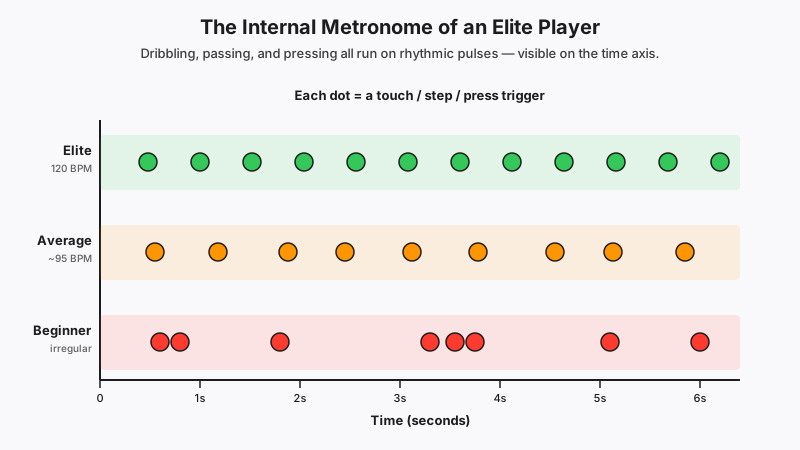
Soccer Situations Where Rhythm Is at Play
- Tempo changes in dribbling -- Carrying the ball at a steady rhythm and then suddenly shifting tempo throws off the defender's predictions. Messi's dribbling is devastatingly effective precisely because he continuously varies the rhythm of his stride length and touch.
- Passer-receiver synchronization -- When a combination follows a shared "one, two, pass" rhythm it connects; when the timing drifts the opponent reads it. This synchronization is rarely verbalized, yet it is one of the biggest determinants of pass completion rate.
- Team-wide attacking and defending tempo -- Switching from possession to counter-attack, ramping up pressing intensity. Shared rhythm is what determines the precision of team tactics.
- Set-piece timing -- The timing of runs at corners and free kicks. Synchronization between the run-up rhythm and the kicker's delivery is directly linked to conversion rate.
Haken et al. (1985), in their research on coordination dynamics, demonstrated that when two agents synchronize rhythms their movements are naturally drawn into stable states (attractors). The same phenomenon occurs in soccer combination play: rhythmic synchronization between teammates forms the foundation for high-precision coordinated action.
Part of what makes a soccer player look "skilled" is rhythm. Even with identical technique, different rhythmic manipulation produces different results -- which is precisely why rhythm is worth training deliberately.
Musical Training and Temporal Processing -- How the Brain Learns Rhythm
Musical training structurally reshapes the basal ganglia and supplementary motor area, improving temporal perception to millisecond precision. This refined "internal clock" is what supports split-second timing decisions in soccer.
Using fMRI, Grahn & Brett (2007) revealed that the basal ganglia (particularly the putamen) and the supplementary motor area (SMA) are strongly activated when humans perceive rhythmic patterns. Moreover, musically trained participants showed more efficient activation of these regions and significantly outperformed non-trained participants in perceiving complex rhythmic patterns.
Three Aspects of Temporal Processing That Music Trains
- Beat extraction -- The ability to extract a regular beat from a stream of sound. In soccer, this corresponds to intuitively sensing the tempo of the game -- the rhythm of attacks, the periodicity of the opponent's press.
- Subdivision perception -- The precision of perceiving fine divisions within a single beat. This relates to the micro-timing adjustments of ball touches during dribbling.
- Detecting and generating tempo changes -- The ability to perceive ritardando (deceleration) and accelerando (acceleration) and to produce them deliberately. This maps directly onto tempo changes in dribbling and manipulation of the team's transition speed.
Miendlarzewska & Trost (2014) reviewed evidence showing that musical training reorganizes not just the auditory cortex but the neural circuitry of the entire motor system. Playing an instrument demands precise timing control of auditory feedback and motor output; this repetition tunes the brain's "internal clock" to high precision. Passes and shots in soccer likewise require aligning ball-trajectory prediction with kicking motion to within tens of milliseconds, relying on the same temporal processing network.
A musician does not need to kick a ball. But the temporal precision of a musician's brain rests on the same neural substrate that soccer players spend thousands of hours of practice trying to develop.
Dance and Movement Rhythm -- Transfer Effects of Grooving the Beat With the Whole Body
Dance is training in "converting musical rhythm into physical movement." Zentner & Eerola (2010) showed that physical entrainment to rhythm is an innate human capacity -- one that can be dramatically strengthened through training.
Zentner & Eerola (2010) experimentally demonstrated that even infants tend to synchronize their bodies with musical rhythm. This "entrainment" -- being drawn into a rhythm -- is a fundamental human capacity, but dance training elevates it into a conscious, high-precision motor skill.
Pathways Through Which Dance Transfers to Soccer Rhythm
- Core-driven rhythm generation -- In dance, rhythm is generated from the core and transmitted to the limbs. Dribbling in soccer follows the same kinetic chain: the core's rhythm governs the feet's touch.
- On-beat and off-beat awareness -- Dance frequently involves hitting the off-beat. This sensibility is the essence of feints and "wrong-footing" moves in soccer.
- Group rhythmic synchronization -- Ensemble dance requires every member to share the same rhythm. This is structurally identical to coordinated team movements in sport -- initiating a press, raising or dropping the defensive line.
- Improvisation and rhythmic variation -- Freestyle dance demands real-time adaptation to changes in music. This builds the capacity to adapt to unexpected shifts in a match situation.
The Brazilian "ginga" is a body movement unique to players who have internalized samba rhythm from an early age. The distinctive rhythm of Neymar's and Ronaldinho's feints is a textbook example of dance culture transferring to play. Phillips et al. (2010) reported that rhythmic training in sport contributes to performance improvement, confirming that the transfer effect of dance is not a cultural coincidence but a scientifically substantiated phenomenon.
Brazilians possess "ginga" not because of innate talent but because of accumulated cultural rhythm training. Daily immersion in music and dance shapes rhythmic awareness on the pitch.
Tempo Changes in Dribbling -- The Temporal Feint That Breaks Down Defenders
Elite dribblers use not only spatial feints (changes of direction) but temporal feints (changes of rhythm). Manipulating tempo is impossible without a well-developed sense of rhythm.
Williams & Davids (1998), in their perceptual-motor research, showed that skilled soccer players excel at reading the timing information in an opponent's movements. The flip side of that finding is that the ability to deliberately disrupt timing information -- in other words, rhythm variation -- is the key to deceiving defenders.
Three Patterns of Tempo Change
- Stop and go -- Carrying the ball at a steady rhythm, then abruptly stopping and re-accelerating. The most fundamental tempo change; it disrupts the defender's predicted timing in two stages.
- Gradual acceleration (accelerando) -- Incrementally raising the tempo until it exceeds the defender's capacity to track. Like a musical crescendo, pressure builds steadily.
- Off-beat touch -- Touching the ball at the "off-beat" of the defender's expected next-touch timing. This operates on the same principle as syncopation in dance.
Performing these tempo manipulations consciously requires the ability to perceive one's own rhythm accurately and alter it intentionally. The "internal representation of rhythm" developed through music and dance training elevates tempo manipulation during dribbling from an intuitive tendency to a deliberate skill.
Sargent & Zeitler (2022) reported that rhythmic training in athletes improves both reaction time and movement-timing precision. Tempo changes in dribbling are not a matter of strength or speed but of rhythmic perception -- making this the domain where transfer from music and dance manifests most directly.
Messi and Iniesta are not "fast" -- they are "rhythmically unreadable." Tempo variation as a temporal feint is the essence of their dribbling.
Practical Rhythm Training -- Concrete Drills for Soccer Players
Even players with no background in music or dance can get started. Here are stage-by-stage rhythm training drills directly linked to soccer performance.
Step 1: Building Rhythmic Perception (Once a Week, 15 Minutes)
- Play a 120 BPM beat on a metronome app and dribble in time -- one touch per beat. Let the rhythm sink into the body.
- Once comfortable, slow the BPM to 80 and practice maintaining the slower tempo precisely. Keeping a slow tempo accurate is actually harder and demands greater temporal perception.
- Juggle the ball while listening to music. Start by kicking on the beat, then on the off-beat, then every two beats -- progressively complicating the rhythmic pattern.
Step 2: Mastering Tempo Changes (Once a Week, 20 Minutes)
- Cone dribble at 100 BPM for 8 beats, then accelerate to 140 BPM for 4 beats, and repeat. Build the sensation of consciously controlling tempo shifts.
- In 1v1 dribbling practice, set the rule: "same rhythm for 3 touches, then change tempo on the 4th." This is the preparation stage for deploying rhythmic variation in live play.
- Share a clapping rhythm with teammates while passing. Practice matching pass timing to the clap tempo, then varying the tempo together.
Step 3: Introducing Dance and Music Directly (Once a Week, 30 Minutes)
- Learn the basic steps of capoeira and samba. As the wellsprings of Brazil's "ginga," these dances are the most efficient way to train core-driven rhythmic movement patterns.
- Join a drum circle or a clapping session. The experience of keeping your own rhythm while synchronizing with others directly builds the ability to share rhythm within a team.
- Take introductory lessons on an instrument -- especially percussion or piano. Grahn & Brett (2007) showed that basal ganglia activation is most pronounced during percussion playing.
None of these drills should replace regular soccer training. Instead, incorporate them into warm-ups or cool-downs, or schedule them as separate cross-training sessions. Even one to two sessions per week of 15 to 30 minutes of rhythm training can be expected to produce the neural-circuit reorganization effect reported by Miendlarzewska & Trost (2014).
Recording Rhythmic Transfer in Footnote
The effects of rhythm training are hard to quantify immediately, which is exactly why verbalized records matter. Here is how to document the process in Footnote.
The effects of rhythm training manifest as qualitative changes -- "I managed to throw off the defender's timing while dribbling" or "my pass timing with teammates is clicking." Without recording these observations, the transfer effect fades from awareness and motivation to keep training weakens.
A Recording Framework
- Rhythm training content -- What drill was done, at what BPM, for how long (e.g., metronome dribble, BPM 120 to 80, 15 minutes).
- Rhythmic sensations noticed -- Changes in rhythmic feel observed during training (e.g., "core stability increases at slower tempos").
- Transfer points to soccer -- Verbalize at least one specific connection between the rhythm drill and soccer (e.g., "the tempo-change sensation maps onto improved stop-and-go timing in dribbling").
- Observations in matches or practice -- Describe a moment in actual soccer where a rhythmic change was felt (e.g., "the whole team's passing tempo felt aligned").
Add rhythm training details to your practice logs in Footnote and consciously note observations about "rhythm" in your post-match reflections. Once five or more entries accumulate, Footnote's periodic AI analysis will detect rhythm-related trends and visualize the trajectory of transfer effects.
Rhythmic transfer tends to stay at the level of vague "feeling." It only becomes a reproducible skill once you verbalize it in Footnote. Level up from "I changed tempo and got past the defender" to "I accelerated from roughly 120 BPM to 160 BPM, and the defender's center of gravity lagged behind."
Frequently Asked Questions
Can rhythm training be effective even if I have zero experience with music or dance?▾
Yes. As Zentner & Eerola (2010) demonstrated, the ability to synchronize with rhythm is a fundamental human capacity, and training effects can be obtained from a standing start. Begin with dribbling or juggling to a metronome -- no specialist musical knowledge is required. What matters is becoming conscious of rhythm; start by getting the feel of handling the ball in time with a beat.
Which style of dance is most effective for soccer?▾
Capoeira and samba are the most recommended, as the wellsprings of Brazil's "ginga" they train both core-driven rhythm generation and footwork. Hip-hop develops a strong off-beat (syncopation) feel that sharpens feints. Ballet is highly effective for both rhythmic precision and axis control. Any genre provides value through the sheer experience of "grooving a rhythm with the body," so the best advice for consistency is to choose whichever style the player enjoys most.
Does playing a musical instrument really affect rhythmic ability in soccer?▾
Yes. The comprehensive review by Miendlarzewska & Trost (2014) showed that playing an instrument strengthens the timing-processing network across the entire brain, including the motor system. Percussion instruments in particular involve grooving rhythm with the whole body, making them highly compatible with the whole-body timing coordination soccer demands. Even 30 minutes of instrument practice once a week has been reported to produce measurable changes in temporal perception within a few months.
At what age should rhythm training be introduced?▾
The earlier the better. The basal ganglia rhythm-processing circuitry identified by Grahn & Brett (2007) is most plastic in early childhood, and early exposure to music and dance accelerates circuit formation. The "golden age" (roughly 9 to 12 years old) is optimal for both neural plasticity and skill acquisition, but even incorporating music-based play at U-6 or U-8 level can yield significant long-term benefits.
What is the most effective way to record rhythm in Footnote?▾
In your practice log, record the specifics of your rhythm training (drill type, BPM, duration) and always verbalize at least one "transfer point to soccer." For example: "Metronome dribble at 80 BPM for 15 minutes -- felt greater core stability at the slower tempo -- could apply this to staying patient and creating a pause when shielding the ball in a match." Articulating the connection between rhythm training and soccer in concrete terms is what drives conscious transfer.
References
- [1] Grahn, J. A. & Brett, M. (2007). “Rhythm and beat perception in motor areas of the brain” Journal of Cognitive Neuroscience, 19(5), 893-906. Link
- [2] Miendlarzewska, E. A. & Trost, W. (2014). “How musical training affects cognitive development: Rhythm, reward and other modulating variables” Frontiers in Neuroscience, 7, 279. Link
- [3] Zentner, M. & Eerola, T. (2010). “Rhythmic engagement with music in infancy” Proceedings of the National Academy of Sciences, 107(13), 5768-5773. Link
- [4] Haken, H., Kelso, J. A. S., & Bunz, H. (1985). “A theoretical model of phase transitions in human hand movements” Biological Cybernetics, 51(5), 347-356. Link
- [5] Williams, A. M. & Davids, K. (1998). “Visual search strategy, selective attention, and expertise in soccer” Research Quarterly for Exercise and Sport, 69(2), 111-128. Link
- [6] Phillips, E., Davids, K., Renshaw, I., & Portus, M. (2010). “Expert performance in sport and the dynamics of talent development” Sports Medicine, 40(4), 271-283. Link
- [7] Sargent, D. & Zeitler, D. (2022). “The impact of rhythmic training on athletic timing and reactive agility” Journal of Sports Science & Medicine, 21(3), 412-420.
Related Articles
Verbalization Accelerates Transfer -- Why Writing Makes Skills from Other Sports Carry Over to Soccer
11 min read
Dance x Soccer -- How Agility, Body Control, and Rhythm Become Weapons on the Pitch
9 min read
Ballet x Soccer -- How Body Awareness, Change of Direction, and Core Control Become Weapons on the Pitch
11 min read
The Science Behind How Verbalization Improves Soccer — How 'Writing' and 'Thinking' Connect in the Brain
6 min read
Music and Soccer -- How Rhythm, Focus, and Mental Control Are Built Through an Unlikely Combination
13 min read
Track Your Growth with Footnote
Just record your matches — AI analyzes every 5 games. Visualize growth with PVS Score. All features free during beta.
30-second signup · No credit card required
Last updated: 2026-05-06 ・ Footnote Editorial