A Parent's Guide to Cross-Training — How to Support Your Child's Multi-Sport Development
A large-scale longitudinal study by Fredricks & Eccles (2004) demonstrated that parents' beliefs and behaviors toward sport exert the strongest influence on children's motivation to participate and their long-term retention rates. No matter how robust the scientific case for cross-training becomes, its benefits cannot be realized without the understanding and active involvement of the parents who support their children day to day. This article explains how parents can concretely introduce multi-sport experiences to soccer-playing children and foster their long-term athletic development.
Why Parental Understanding Matters — Early Specialization Pressure vs. Scientific Evidence
The worry that 'we should just focus on soccer' is entirely natural, yet the scientific data runs counter to that instinct. Recognizing that parental beliefs are the single biggest determinant of a child's sport participation patterns is the essential first step.

Photo by Olek Buzunov on Unsplash
Fredricks & Eccles (2004) showed that three parental factors — beliefs about the child's competence, the value placed on the activity, and emotional reactions — are the strongest predictors of a child's motivation and sport participation behavior. In other words, parents' attitudes shape a child's relationship with sport more powerfully than coaches or peers.
Where Does the Pressure to Specialize Early Come From?
When teammates train year-round in soccer alone, it is easy for parents to worry: 'Will my child fall behind by doing other sports?' DiFiori et al. (2014) termed this phenomenon 'the social pressure of early specialization,' noting that competitive anxiety among parents accelerates single-sport concentration in children.
What the Science Actually Shows
- Elite attainment rate: Moesch et al. (2011) found that the majority of international-level elite athletes had participated in multiple sports before age 12
- Injury risk: Young athletes who specialize in a single sport face up to 70% higher risk of overuse injuries compared to multi-sport peers (Jayanthi et al., 2015)
- Dropout rate: Approximately 70% of early-specializing athletes quit sport entirely by age 17 (Brenner, 2007)
The key point: when parents understand the scientific evidence rather than yielding to the pressure of early specialization, they can safeguard the environment their child needs for long-term growth.
How to Talk to Your Child When Introducing Cross-Training
According to Ryan & Deci's (2000) Self-Determination Theory (SDT), sustained engagement in a new sport requires that three basic psychological needs be met: autonomy, competence, and relatedness. The way a parent communicates is the single most powerful lever acting on all three.
The most common mistake when introducing cross-training is for a parent to pitch it purely on functional merits: 'It will make you better at soccer.' For children, the real motivators are almost always intrinsic — 'It looks fun,' 'My friend does it,' 'I chose it myself.' Ryan & Deci's (2000) SDT research has repeatedly demonstrated that intrinsic motivation (self-driven) leads to deeper engagement and far greater long-term persistence than extrinsic motivation (parent-directed).
Effective Communication — Concrete Examples
- Offer choices (supporting autonomy) — 'Swimming or basketball — which one sounds more fun to you?' Let the child decide. 'You're doing swimming' is counterproductive
- Acknowledge the process (supporting competence) — 'It was your first time and you stuck with it all the way through.' Praise the effort and the challenge itself, not the result or skill level
- Show that you enjoy it too (supporting relatedness) — 'I used to play basketball when I was your age.' Relate as a fellow enthusiast, not a supervisor
What NOT to Say
- 'You're doing swimming so you get better at soccer' — Framing it as a means to an end kills the enjoyment
- 'Your teammate does swimming too — you'll fall behind' — Social comparison breeds anxiety and extrinsic motivation only
- 'You started it, so you have to keep going' — Forcing a child to persist in an ill-fitting sport is counterproductive. Trying something and stepping away is also a valid form of learning
The strongest motivation arises when a child feels they chose the activity themselves, started it on their own terms, and are genuinely enjoying it.
— Ryan & Deci, 2000 (Self-Determination Theory)
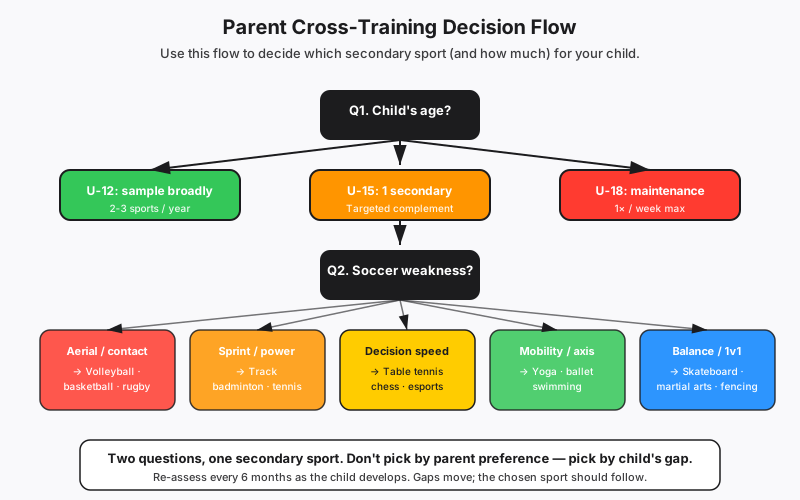
Choosing the Right Sport by Age Group (Early Elementary, Upper Elementary, Middle School)
Based on Cote et al.'s (2007) Developmental Model of Sport Participation (DMSP), the appropriate cross-training activities and their objectives differ significantly across developmental stages. Selecting age-appropriate sports maximizes the synergy with soccer.
Early Elementary (Ages 6 – 8): Early Sampling Years — Diverse Movement Through Play
At this stage, children are in the process of acquiring Fundamental Movement Skills (FMS). The top priority is exposing them to a wide range of basic motor patterns — running, jumping, throwing, swimming, rolling — across diverse environments. Rather than being formally 'coached' in a specific sport, children benefit most from expanding their movement vocabulary through play.
- Swimming — Develops whole-body coordination and aquatic body awareness. Engages upper-body muscle groups rarely used in soccer
- Gymnastics — Builds spatial awareness, rotational sense, and core control. Provides the foundation for aerial play and balance in soccer
- Tag games and outdoor play — Develops change of direction, acceleration and deceleration, and decision-making. The most natural form of motor development
Upper Elementary (Ages 9 – 12): Late Sampling Years — Broadening Athletic Capacity
Often called the 'golden age' of motor learning, this period represents the highest skill-acquisition window in the entire lifespan. Adding one or two sessions per week in a sport with movement patterns different from soccer dramatically expands the child's overall athletic toolkit.
- Basketball — Develops hand-eye coordination, spatial awareness, and an alternative perspective on team tactics
- Track and field — Teaches sprint mechanics and proper running form. Directly improves linear speed in soccer
- Martial arts (judo, karate) — Strengthens core stability, builds comfort with physical contact, and develops mental discipline
Middle School (Ages 13 – 15): Specializing Years — Strategic Supplementary Training
As players enter the PHV (Peak Height Velocity) phase, the purpose of cross-training shifts from 'multi-sport fun' to 'strategic supplementary training that complements soccer performance.' According to Lloyd & Oliver's (2012) Youth Physical Development (YPD) model, training responsiveness for strength, power, and endurance increases rapidly at this stage.
- Swimming — Builds aerobic base and serves as active recovery. Minimal joint impact during a period of rapid growth
- Yoga / Pilates — Prevents flexibility loss caused by growth spurts, strengthens deep core muscles, and supports mental stability
- Track / sprints — Refines sprint mechanics. Improves acceleration and top-end speed
As children get older, 'why you choose' matters more than 'what you choose.' For middle schoolers, prioritize a process where the young athlete understands the purpose and makes the selection themselves.
Schedule Management and Finding the Right Balance
The biggest practical barrier to cross-training is time. Fitting another sport alongside soccer training, schoolwork, and family time demands realistic scheduling ability from parents.
Brenner (2007) proposed a widely referenced guideline for young athletes: weekly training hours should not exceed the child's age (e.g., no more than 10 hours per week for a 10-year-old). How to split that allowance between soccer and cross-training is the judgment call parents must make.
Time Allocation Models by Age Group
- Early elementary (ages 6 – 8) — Soccer 2 – 3 sessions/week + another sport 1 – 2 sessions/week. Total no more than 6 – 8 hours/week. Unstructured play counts as physical activity
- Upper elementary (ages 9 – 12) — Soccer 3 – 4 sessions/week + another sport 1 – 2 sessions/week. Total no more than 10 – 12 hours/week. In the off-season, it is fine to flip the ratio
- Middle school (ages 13 – 15) — Soccer 4 – 5 sessions/week + supplementary training 1 – 2 sessions/week. Total no more than 13 – 15 hours/week. Balancing academics is the top priority
Scheduling Pitfalls to Avoid
- Zero rest days are non-negotiable — Ensure at least one full rest day per week. A growing body needs adequate recovery time
- Don't underestimate travel time — Juggling multiple sports doubles the transportation burden. Choose programs and clubs within a manageable distance
- Watch for fatigue signals — 'I don't want to go' or 'My body hurts' are important messages. Do not force attendance
Before building the schedule, ask your child: 'How much do you want to do?' Even the most well-designed plan will not last without the child's buy-in.
Working With Your Child's Coach and Team
The most delicate aspect of introducing cross-training is managing the relationship with the soccer team's coach. Even when a coach favors single-sport focus, there are constructive ways to have the conversation.
In youth soccer environments, it is not uncommon for club coaches to feel that 'any time spent on another sport would be better spent on extra soccer practice.' In such cases, open conflict with the coach backfires. The key is to share a common goal and frame the discussion around the child's soccer development.
Steps for a Productive Dialogue With the Coach
- Listen first — Find out what the coach values most (technique, fitness, team discipline). Understand their perspective before making your case
- Share scientific evidence — Reference objective data: 'The AOSSM position statement by LaPrade et al. recommends this approach.' An appeal to evidence is stronger than 'I think this is better'
- Show the soccer payoff explicitly — 'Building an aerobic base through swimming should help maintain work rate in the final minutes of matches.' Be concrete about anticipated benefits
- Propose a trial period — 'Could we try it for three months and track any changes together?' A defined time frame makes the idea easier for a coach to accept
When the Coach Remains Unconvinced
Some teams have a firm policy against multi-sport participation. There is no need to force a confrontation. Practical alternatives include using the off-season or school breaks for intensive cross-training blocks, or choosing activities that can be done independently at home, such as yoga, stretching, or bodyweight exercises.
The relationship with a coach is a long game. You do not need to settle it in a single conversation. Building trust on the shared foundation of the child's development — and gradually broadening understanding from there — is the best approach.
Why 'Fun' Must Come First
In a large-scale survey, Visek et al. (2015) found that 'fun' is the number-one reason children continue playing sports — ranking above winning and skill development. When parents judge cross-training solely by whether it 'helps soccer,' they risk undermining the child's overall appetite for sport.
Visek et al.'s (2015) Fun Integration Theory (FIT) study, conducted with approximately 150 young athletes aged 9 – 19, identified 81 discrete elements of 'fun.' The top-ranked factors were team camaraderie, the feeling of personal improvement, and the sheer pleasure of giving full effort. 'Winning games' ranked near the bottom.
Fun Is What Drives Persistence
Crane & Temple's (2015) dropout research confirmed that the leading reason young athletes quit sport is that 'it stopped being fun.' The three biggest fun-killers are monotony from early specialization, excessive competitive pressure, and unrealistic expectations from parents and coaches. If cross-training becomes 'just another obligation,' it will add burden rather than provide a refreshing counterpoint to soccer.
Signs of Fun That Parents Should Look For
- The child wants to go on their own — 'It's swimming day!' signals genuine excitement. Reluctant attendance is a red flag
- They talk about it afterward — Wanting to share the experience verbally is strong evidence of intrinsic enjoyment
- They're making friends — New relationships in the second sport satisfy the relatedness need and reinforce motivation
- They want to continue even when they're not good at it — Enjoying the process rather than the outcome is the healthiest motivational state
The greatest benefit of cross-training is not the physical gains — it is the accumulation of 'I love playing sport' experiences across multiple settings. A child who has lost the joy of sport will not grow, regardless of how well-designed the program may be.
Sharing Records Between Parent and Child With Footnote
To connect the lessons learned through cross-training with soccer development, an effective approach is for parent and child to share the process of recording and reflecting together. Footnote is designed to facilitate this parent-child dialogue naturally.
By logging cross-training observations alongside the soccer practice diary in a single place, children begin to notice transfer between activities on their own — 'That swimming drill actually helped me in this soccer situation.' The metacognitive benefits shown in Toering et al.'s (2009) research are amplified when reflections from multiple sports are combined.
Three Ways to Use Footnote as a Family
- Five-minute post-session chat — Ask, 'What was the most interesting part of swimming today?' and encourage the child to record the answer in Footnote. The child should always be the one writing
- Weekend review time — Look back over the week's soccer and cross-training entries together and ask, 'Can you see anything these two have in common?' The parent acts as facilitator, not director
- Monthly growth check — Review the growth records in Footnote as a family and discuss, 'How have things changed compared to last month?' Look not only at numbers but at changes in the quality of the child's observations
For parents, Footnote also serves as a window into the child's inner world. It is not unusual for children who clam up when asked directly to reveal their honest thoughts in their written entries. That said, reading those entries and responding with 'You need to write more carefully' is counterproductive. Accept the child's words as they are and use them as a springboard for dialogue.
Footnote is not a 'parental management tool' — it is a tool for children to record their own growth in their own words. The parent's role is to enjoy those records alongside the child and turn them into conversation starters.
References
- [1] Fredricks, J.A. & Eccles, J.S. (2004). “Parental influences on youth involvement in sports” Developmental Sport and Exercise Psychology: A Lifespan Perspective, Fitness Information Technology.
- [2] Ryan, R.M. & Deci, E.L. (2000). “Self-determination theory and the facilitation of intrinsic motivation, social development, and well-being” American Psychologist, 55(1), 68-78. Link
- [3] DiFiori, J.P., Benjamin, H.J., Brenner, J.S., Gregory, A., Jayanthi, N., Landry, G.L., & Luke, A. (2014). “Overuse injuries and burnout in youth sports: a position statement from the American Medical Society for Sports Medicine” British Journal of Sports Medicine, 48(4), 287-288. Link
- [4] Brenner, J.S. (2007). “Overuse injuries, overtraining, and burnout in child and adolescent athletes” Pediatrics, 119(6), 1242-1245. Link
- [5] Visek, A.J., Achrati, S.M., Mannix, H., McDonnell, K., Harris, B.S., & DiPietro, L. (2015). “The fun integration theory: toward sustaining children and adolescents sport participation” Journal of Physical Activity and Health, 12(3), 424-433. Link
- [6] Crane, J. & Temple, V. (2015). “A systematic review of dropout from organized sport among children and youth” European Physical Education Review, 21(1), 114-131. Link
- [7] Moesch, K., Elbe, A.M., Hauge, M.L.T., & Wikman, J.M. (2011). “Late specialization: the key to success in centimeters, grams, or seconds (cgs) sports” Scandinavian Journal of Medicine & Science in Sports. Link
- [8] Jayanthi, N., Pinkham, C., Dugas, L., Patrick, B., & LaBella, C. (2015). “Sports specialization in young athletes: evidence-based recommendations” Sports Health, 5(3), 251-257. Link
Related Articles
Multi-Sport Participation for Elementary-Age Athletes — The Scientific Case Against Early Specialization and a Practical Guide to Cross-Training
8 min read
A Parent's Guide to the Soccer Journal — How to Support Your Child's Growth the Right Way
7 min read
Cross-Training for Junior-High Soccer Players — A Strategic Approach to Standing Out at Tryouts
9 min read
Growth Mindset and the Soccer Journal — How to Raise Players Who Believe in Effort Over Talent
9 min read
Conquering Fear — The Science of Mental Toughness Built Through Extreme Sports
12 min read
Track Your Growth with Footnote
Just record your matches — AI analyzes every 5 games. Visualize growth with PVS Score. All features free during beta.
30-second signup · No credit card required
Last updated: 2026-05-06 ・ Footnote Editorial