The Science of Multi-Sport Training — How Playing Multiple Sports Rewires the Brain and Body
Playing multiple sports is not a sign of indecisiveness — it is a scientifically validated growth strategy that benefits both the brain and the body. Schmidt's (1975) Schema Theory showed that diverse movement experiences build generalized motor programs, and Moesch et al. (2011) found that the majority of elite athletes participated in multiple sports during childhood. This article examines the latest evidence on how multi-sport training shapes neural circuitry, motor learning, cognitive ability, and injury prevention.
The Neuroscience of Multi-Sport Experience
Participating in multiple sports stimulates neuroplasticity across many dimensions. Research in neuroscience shows that different movement tasks activate distinct neural circuits, increasing both the diversity and density of synaptic connections.

Photo by Neuro Equilibrium on Unsplash
The brain possesses neuroplasticity — the ability to change its structure and function in response to experience. Repetitive practice of a single sport strengthens specific neural circuits, but multi-sport experience develops different circuits in parallel, increasing overall network density throughout the brain.
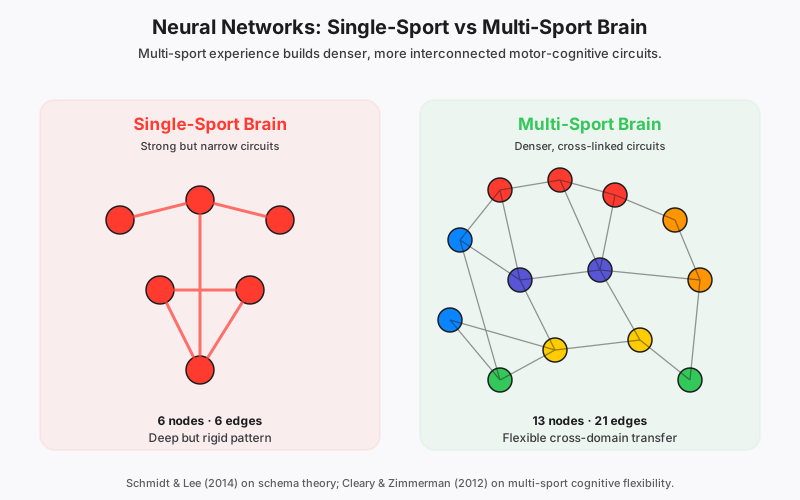
Multiple Motor Maps in the Motor Cortex
Because different sports demand different movement patterns, diverse 'motor maps' form in the motor cortex. A soccer kick, a basketball shot, and a swimming stroke each engrave a distinct coordination pattern among muscle groups in the brain. This multiple mapping accelerates the ability to adapt to entirely unfamiliar movements.
Expanded Adaptive Capacity of the Cerebellum
The cerebellum governs fine-tuning and timing control of movement. Repeated adaptation to varied movement tasks develops the cerebellum's predictive models (internal models) in multiple dimensions. The result is an improvement in the ability to learn new movements quickly — motor learning ability itself.
- Prefrontal cortex — Adapting to different rule systems trains executive functions (task switching, inhibition, planning)
- Parietal lobe — Activity in diverse spatial environments enhances spatial awareness and body-schema precision
- Basal ganglia — Adapting to different reward structures makes the motivational system more flexible
Key insight: Multi-sport training is not about learning multiple techniques. It is about upgrading the brain's capacity to learn.
Schema Theory and Motor Learning — Schmidt's (1975) Breakthrough
Schmidt's (1975) Schema Theory fundamentally changed our understanding of motor learning. It demonstrated that varied practice conditions strengthen a 'generalized motor program' (GMP), producing adaptable movement ability that transfers to novel situations.
Richard Schmidt's Schema Theory of Motor Learning, published in 1975, reframed motor learning not as the memorization of specific movements but as the construction of a rule system (schema) for movement. This theory remains one of the scientific pillars supporting multi-sport training.
What Is a Schema?
A schema is a set of movement rules extracted from past motor experiences. When you throw a ball, for example, your brain has already built rules from previous throws — the relationship between force and distance, the relationship between release angle and trajectory. Because these rules exist, you can adaptively execute a throw to a distance you have never attempted before.
The Variability of Practice Effect
The central prediction of Schema Theory is the variability of practice effect: practicing under varied conditions strengthens the schema more than repeating the same movement under identical conditions, and results in superior transfer to new situations. A child who experiences throwing, kicking, and rotating across basketball, tennis, and gymnastics will adapt to unfamiliar motor tasks better than one who only practices soccer.
In motor learning, the most important factor is not precise repetition but the quality of the abstract rules (schemas) extracted from experience under diverse conditions.
— Schmidt, R. A. (1975) A Schema Theory of Discrete Motor Skill Learning
Baker et al. (2003) tested this theory in a sporting context and found that athletes who experienced a wider variety of sports activities in childhood reached higher performance levels after specializing. Consistent with Schema Theory's predictions, diverse motor experience promotes 'learning to learn.'
The variability of practice effect in a nutshell: 300 kicks + 300 throws + 300 jumps build more adaptive kicking ability than 1,000 identical kicks.
Early Specialization vs. Multi-Sport: What the Meta-Analyses Show
Large-scale studies by Moesch et al. (2011), Bridge & Toms (2013), and Gullich (2017) consistently demonstrate that multi-sport experience is more conducive to reaching elite levels than early specialization.
Contrary to the intuition that 'starting earlier is better,' multiple large-scale studies of elite athletes have repeatedly confirmed the advantages of childhood multi-sport experience.
Moesch et al. (2011) — Elite vs. Near-Elite Comparison
This study compared Danish Olympic athletes with near-elite athletes and found that those who reached the international level had participated in more sports during childhood and specialized later. Elite athletes began specializing an average of two to three years later than near-elites, with a broad movement foundation supporting their long-term development.
Gullich (2017) — Career Pathway Analysis of German Olympians
Gullich analyzed the career pathways of German Olympic athletes and found that medalists participated in more sports during childhood and began concentrating on their primary sport later than non-medalists. A particularly important finding was that early specializers held a temporary advantage between ages 15 and 18, but were clearly overtaken by multi-sport athletes after age 20.
Bridge & Toms (2013) — A Premier League Academy Longitudinal Study
This study tracked players in English Premier League academies and found that those who earned professional contracts had played an average of 3.4 sports before age 12, compared to 2.1 for those who were released. The gap in multi-sport experience manifested not as a difference in technical skill but as a difference in adaptability and learning speed.
The conclusion shared by all three studies: early specialization produces short-term advantages, but multi-sport experience is more conducive to reaching elite levels in the long run. This trend holds consistently across sports.
Effects on Cognitive Flexibility and Creativity
Multi-sport experience trains executive functions in the brain — particularly cognitive flexibility (task-switching ability). Cote et al. (2009) showed that diverse sport experience is associated with the development of creative play and superior decision-making.
Cognitive flexibility is the ability to rapidly shift thinking and behavior in response to changing circumstances. In a soccer match, players must constantly switch between attack and defense, adjust tactics, and respond to unexpected situations. This ability develops most efficiently through experience in varied environments.
The Training Effect of Task Switching
Different sports involve different rules, constraints, and decision criteria. In basketball you handle the ball with your hands, in soccer with your feet, and in volleyball you rally the ball over a net — entirely different constraints to play within. Routinely switching between these contexts strengthens the brain's task-switching ability, an executive function of the prefrontal cortex.
Creativity and Sport Diversity
Cote et al. (2009) reported that athletes who experienced multiple sports through deliberate play tended to demonstrate more creative play. The larger the repertoire of movement patterns drawn from different sports, the higher the probability of finding unconventional solutions during a match.
- Futsal background — Quick decision-making and creative passing in tight spaces transfer to the 11-a-side game
- Basketball experience — The concept of screening transfers to off-the-ball movement
- Martial arts experience — The ability to read an opponent's center of gravity in 1v1 situations enhances dribbling
- Chess experience — Thinking several moves ahead transfers to game reading
Creativity does not emerge from nothing. It is born from novel combinations of diverse experiences. The more movement patterns a player carries from different sports, the more unpredictable they become on the pitch.
— Cote, Baker, & Abernethy (2009)
Injury Prevention and Long-Term Career Sustainability
The consensus statement by DiFiori et al. (2014) in the American Journal of Sports Medicine warns that early specialization significantly increases overuse injury risk in young athletes, and recommends multi-sport participation to distribute physical load.
Injury risk is one of the most practical reasons to advocate for multi-sport participation. Excessive repetition of the same movement patterns poses the greatest threat to developing tissues.
The Mechanism Behind Overuse Injuries
DiFiori et al. (2014) identified single-sport specialization as an independent risk factor for overuse injuries. In soccer, patellar tendinitis, shin splints, and hip impingement are typical overuse conditions. These injuries result from the cumulative effect of repetitive loading patterns.
The Science of Load Distribution
Participating in multiple sports distributes load across different tissues. Swimming loads the upper body and core, while soccer concentrates load on the lower body. This alternating loading pattern prevents overload on any single area while promoting balanced whole-body development.
- Musculoskeletal balance — Multi-directional loading prevents imbalances in strength and flexibility
- Psychological recovery — Switching to a different sport reduces mental fatigue and the risk of burnout
- Diverse proprioception — Varied movement patterns develop proprioceptive awareness, improving the ability to instinctively avoid injury
- Growth-plate protection — Repetitive identical movements during growth can place excessive stress on growth plates. Multi-sport participation distributes this stress
The IOC's (2015) consensus on youth athlete development states clearly: weekly training hours should not exceed the athlete's age, and multi-sport participation is endorsed for distributing physical and psychological load.
Global Trends in Multi-Sport Advocacy — IOC & FIFA Statements
The IOC's (2015) consensus on youth athlete development and FIFA's youth development guidelines both advise against early specialization and recommend diverse sport experiences. The world's major sporting bodies now stand united behind multi-sport participation.
The recommendation for multi-sport training is not the opinion of a handful of researchers; it is a consensus officially communicated by the world's governing bodies in sport. Behind it lies a remarkably consistent body of evidence.
The IOC Consensus Statement (2015)
The International Olympic Committee's 2015 consensus on youth athlete development explicitly flagged the risks of early specialization. It warned in particular against single-sport concentration before the age of 12 and officially endorsed multi-sport participation as beneficial to long-term athlete development.
FIFA's Youth Development Policy
FIFA's youth development program designates the period before age 12 as the 'foundation phase' and recommends well-rounded motor development through sports and play beyond soccer. Futsal, in particular, is officially positioned as a cross-training tool for developing technique and decision-making in small spaces.
Initiatives by National Football Associations
- German Football Association (DFB) — Recommends multi-sport experience before the 'golden age' of development. Talent identification programs include motor-ability tests that cover non-soccer movements
- Royal Dutch Football Association (KNVB) — Ajax and other academies incorporate gymnastics, swimming, and tennis as supplementary training
- Japan Football Association (JFA) — Explicitly states in its youth coaching guidelines that players in developmental stages should experience sports beyond soccer
- Brazil — Street football culture (including futsal and beach soccer) effectively provides a built-in multi-sport environment
What the world's strongest footballing nations share is a development environment that extends beyond soccer alone. Whether through street football culture or structured multi-sport academy programs, diverse movement experience forms the bedrock of elite player development.
Recording Multi-Sport Experience with Footnote
To maximize the benefits of multi-sport training, it is vital to go beyond just doing it — articulate what you gained and record it. Footnote lets you structurally document cross-sport experiences within the context of your soccer development.
As the science shows, the benefits of multi-sport experience do not transfer automatically. When you put the experience into words and consciously identify its connections to soccer, the rate of transfer improves dramatically. Footnote is designed to make this process a natural habit.
Three Points Worth Recording
- What you did — Record the specific activity from the other sport (e.g., basketball dribbling drills, tennis rallies)
- What you felt — Put the physical sensations and insights into words (e.g., 'core engagement felt different from soccer dribbling')
- What could transfer to soccer — Identify the transfer point explicitly (e.g., 'the wide field of vision in basketball could improve my passing decisions')
Recording Depth by Age Group
- Elementary school — Two lines are enough: 'what I did today' and 'what was fun.' A parent can transcribe for the child
- Middle school — Add one line about 'similarities with soccer.' Encourage analogical thinking
- High school and above — Record at the level of movement principles and include an intentional plan for application
Footnote's five-match analysis AI processes cross-sport experience logs as well. It can surface patterns such as 'sprint endurance tends to improve in matches during weeks that include swimming' or 'first-touch ratings rise during periods that include tennis.' Visualizing these cross-training effects helps you discover the optimal combination of supplementary sports for your own game.
The scientific benefits of multi-sport training are maximized through recording and articulation. The act of writing it down in Footnote itself accelerates the transfer process in the brain.
Frequently Asked Questions
What is the most reliable study demonstrating the benefits of multi-sport participation?▾
Moesch et al. (2011) is a widely cited Scandinavian study. It compared international-level elite athletes with near-elites and found that the elite group had participated in more sports during childhood and specialized later. Gullich (2017), studying German Olympic athletes, reached the same conclusion.
Schmidt's (1975) Schema Theory is 50 years old. Is it still valid?▾
Yes. The theory's central prediction — the variability of practice effect — has been repeatedly tested and supported in hundreds of experiments over the past 50 years. While modern motor-learning research has refined the theory, the core principle that varied practice builds generalizable motor ability remains robust.
Are there professional athletes who succeeded despite early specialization?▾
Yes, some athletes have reached the professional level through early specialization. However, the data describe average trends, and multiple studies confirm that the success rate of early specialization is statistically lower than that of multi-sport backgrounds. Early specializers also tend to face higher risks of injury and burnout later in their careers.
Do the IOC and FIFA set specific age thresholds in their recommendations?▾
The IOC's (2015) consensus statement explicitly warns against single-sport specialization before age 12. FIFA's youth development guidelines likewise designate the period before age 12 as the 'foundation phase' and recommend diversified motor development. A gradual deepening of specialization from around age 13 onward is the international consensus.
How does Footnote use multi-sport records?▾
Footnote lets you log cross-sport practice and experiences and articulate the transfer points to soccer. The accumulated records are fed into the AI analysis engine, which detects correlations between cross-training and soccer performance. It visualizes which sport contributes to which ability, helping you design an optimal training strategy.
References
- [1] Schmidt, R. A. (1975). “A schema theory of discrete motor skill learning” Psychological Review, 82(4), 225-260.
- [2] Moesch, K., Elbe, A. M., Hauge, M. L. T., & Wikman, J. M. (2011). “Late specialization: the key to success in centimeters, grams, or seconds (cgs) sports” Scandinavian Journal of Medicine & Science in Sports, 21(6), e282-e290. Link
- [3] Bridge, M. W. & Toms, M. R. (2013). “The specialising or sampling debate: a retrospective analysis of adolescent sports participation in the UK” Journal of Sports Sciences, 31(1), 87-96. Link
- [4] Gullich, A. (2017). “International medallists and non-medallists developmental sport activities - a matched-pairs analysis” Journal of Sports Sciences, 35(23), 2281-2288. Link
- [5] Bergeron, M. F., Mountjoy, M., Armstrong, N., Chia, M., Cote, J., Emery, C. A., et al. (2015). “International Olympic Committee consensus statement on youth athletic development” British Journal of Sports Medicine, 49(13), 843-851. Link
- [6] DiFiori, J. P., Benjamin, H. J., Brenner, J. S., Gregory, A., Jayanthi, N., Landry, G. L., & Luke, A. (2014). “Overuse injuries and burnout in youth sports: a position statement from the American Medical Society for Sports Medicine” British Journal of Sports Medicine, 48(4), 287-288. Link
- [7] Cote, J., Horton, S., MacDonald, D., & Wilkes, S. (2009). “The benefits of sampling sports during childhood” Physical & Health Education Journal, 74(4), 6-11.
- [8] Baker, J., Cote, J., & Abernethy, B. (2003). “Sport-specific practice and the development of expert decision-making in team ball sports” Journal of Applied Sport Psychology, 15(1), 12-25. Link
Related Articles
Verbalization Accelerates Transfer -- Why Writing Makes Skills from Other Sports Carry Over to Soccer
11 min read
Multi-Sport Participation for Elementary-Age Athletes — The Scientific Case Against Early Specialization and a Practical Guide to Cross-Training
8 min read
Metacognition Training — The Science Behind 'Thinking Soccer' and How to Develop It Through Journaling
12 min read
The Kinetic Chain -- The Science of Cross-Sport Body Mechanics and Its Application to Soccer
10 min read
Anticipation and Reading the Game — The Science of Prediction That Racket Sports Can Teach You
11 min read
Track Your Growth with Footnote
Just record your matches — AI analyzes every 5 games. Visualize growth with PVS Score. All features free during beta.
30-second signup · No credit card required
Last updated: 2026-05-06 ・ Footnote Editorial