How Pro Soccer Players Use Cross-Training — Multi-Sport Backgrounds and Methods from the World's Best
The world's greatest soccer players did not reach the top through soccer alone. Messi built his technical foundation in futsal. Ibrahimovic developed his flexibility and acrobatic body control through taekwondo. Ryan Giggs forged the physical toughness that sustained his career in rugby. This article examines the multi-sport backgrounds of top players, the cross-training programs modern clubs have adopted, and how youth athletes can apply the same principles to accelerate their own development.
Pro Players with Multi-Sport Backgrounds
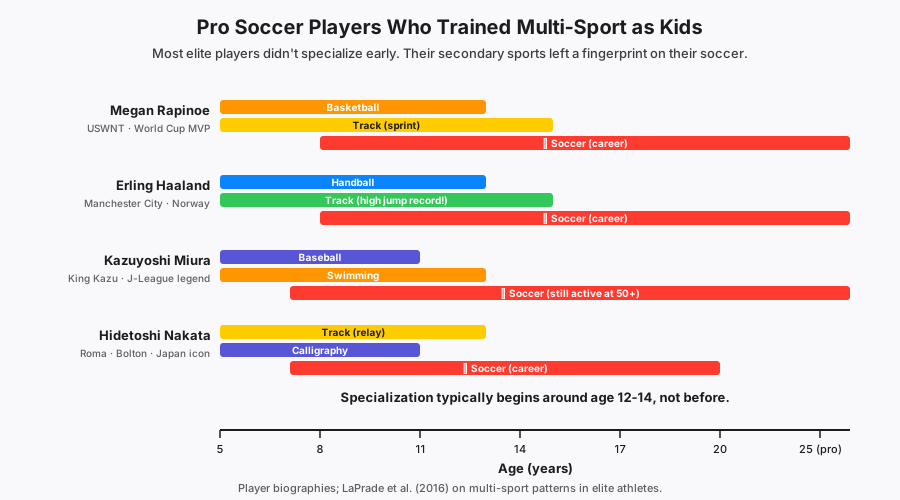
Many legends in soccer history played multiple sports during childhood. Here we look at how each player's experience in another discipline shaped their style on the pitch.

Photo by Frederik Rosar on Unsplash
The assumption that young players should focus exclusively on soccer is contradicted by the careers of the world's best. Many of them credit the diverse sporting experiences of their childhood with forging the very qualities that set them apart.
Lionel Messi — Futsal-Forged Genius
Messi played in Argentine futsal leagues as a child. The small pitch and rapid tempo of futsal honed his ability to make split-second decisions and execute precise ball control in tight spaces. Because futsal imposes unique constraints — cramped areas, instant pressure, fewer passing options — it creates a cognitive training environment of exceptionally high load compared to the 11-a-side game.
Zlatan Ibrahimovic — Taekwondo-Powered Acrobatics
Ibrahimovic earned a taekwondo black belt as a teenager. His trademark scorpion kicks and acrobatic overhead strikes are built on the flexibility, rotational awareness, and aerial body control he developed in taekwondo. The kinetic chain involved in taekwondo's kicking techniques shares deep structural similarities with the soccer kicking motion.
Ryan Giggs — Rugby-Built Resilience
Giggs, born in Wales, played rugby as a boy. The physical toughness and tolerance for contact he developed in rugby laid the foundation for a career that lasted 24 seasons in the Premier League's bruising physical environment.
Pavel Nedved — Ice Hockey Roots
Czech-born Nedved was passionate about ice hockey as a child. The balance required for skating, the ability to change direction at high speed, and the multi-sport culture of Czech athletics all contributed to the explosive agility and seemingly inexhaustible stamina he displayed on the soccer pitch.
The common thread: in every case, the abilities these players developed in other sports became central to what made them unique as soccer players. Messi's close control, Ibrahimovic's acrobatics, Giggs's durability — the weapons that differentiated them from their peers were forged outside of soccer.
Cross-Training Methods Used by Active Professionals
Multi-sport experience in childhood is only part of the story. Active professional players also incorporate strategic cross-training — yoga, Pilates, swimming, boxing, and more — to sharpen specific aspects of performance.
In modern professional soccer, what happens outside the main training session is increasingly recognized as a decisive performance factor. Here are the cross-training methods elite players are using today.
Yoga & Pilates — Flexibility and Core Stability
Ryan Giggs famously adopted yoga later in his career and continued playing at the top level into his late thirties. Today, many elite players include yoga or Pilates in their daily routine. Breath control, deep core activation, and joint mobility maintenance benefit both injury prevention and sustained performance.
Swimming — Low-Impact Recovery and Cardiovascular Fitness
Many clubs now use pool-based training for post-match recovery. Buoyancy reduces joint stress while full-body movement promotes circulation and accelerates the recovery process. Additionally, the unique breathing patterns required in swimming strengthen the respiratory muscles, contributing to sustained sprint ability in the final minutes of matches.
Boxing — Footwork and Reaction Speed
A growing number of soccer players are incorporating boxing training. Boxing footwork — split steps, lateral shuffles, forward-backward transitions — closely mirrors the movement patterns required in defensive one-on-one situations in soccer. Punch-reaction drills also transfer to goalkeeper shot-stopping and outfield players' reaction speed in 1v1 duels.
Cycling — Maintaining the Aerobic Base
Many clubs use cycling during injury rehabilitation and as active recovery between matches. It provides a low-impact aerobic workout that maintains conditioning while developing lower-body muscular endurance without stressing the joints.
In the professional game, the era of training only with a ball at your feet is over. Cross-training is not a supplement — it is a core component of the performance equation.
Pioneering Club-Level Programs
World-class clubs such as Bayern Munich, Ajax, and Barcelona have systematized cross-training from the academy level upward. Here are concrete examples of how these organizations structure multi-sport development.
Beyond individual player initiatives, a growing number of clubs are embedding cross-training into their organizational methodology. Examining the programs at top academies reveals where the cutting edge of player development is heading.
Bayern Munich — Holistic Athletic Development
Bayern's academy schedules at least one cross-training session per week for players under U-12. The program includes gymnastics fundamentals (forward rolls, cartwheels, handstands), track-and-field sprint drills, and basketball ball-handling exercises — a multi-faceted motor development curriculum aligned with the German Football Association (DFB) development guidelines.
Ajax — The Dutch Model of Multi-Sport Sampling
Ajax's youth academy is known for regularly incorporating swimming, tennis, and gymnastics sessions for its youngest players. The Dutch development philosophy rests on the belief that "breadth of skill equals breadth of movement experience" — that mastering a wide variety of movement patterns forms the foundation for soccer-specific technique.
FC Barcelona (La Masia) — The Futsal Integration
At La Masia, Barcelona's renowned academy, futsal is a formal part of the curriculum. The exceptional close-quarters technique shared by La Masia graduates — Xavi, Iniesta, Messi — owes much to their futsal training. In the 5-a-side format, every player is forced into constant ball involvement, and studies report that technical repetition rates are roughly six times higher than in the 11-a-side game.
- FC Porto (Portugal) — Integrates martial arts elements into physical training to develop duel ability
- RB Leipzig (Germany) — A coach with a handball background applies throwing-motion training to throw-in tactics
- Benfica (Portugal) — Built a swimming pool within the academy facility, unifying recovery and cardiovascular training
What the world's top academies share is a mindset that positions cross-training not as "something extra outside soccer" but as a core method within soccer development itself. Systematic organizational structures deliver benefits that go beyond individual initiative.
Cross-Training Examples from Japanese Players
Multi-sport backgrounds and cross-training practices are not limited to European and South American players. A number of Japanese professionals who compete in the J-League and abroad bring diverse sporting experiences to the pitch.
Japan's youth soccer culture has traditionally emphasized single-sport dedication through the school club system, yet many Japanese players who have succeeded at the highest levels possess multi-sport backgrounds.
Shunsuke Nakamura — Baseball Roots and Kicking Precision
Renowned as one of the world's finest free-kick specialists, Shunsuke Nakamura played baseball as a child. The kinetic chain cultivated in the throwing motion — transferring energy from the lower body through the core to the extremities — shares a common biomechanical structure with the precision kicking technique.
Yuto Nagatomo — A Diversified Physical Training Approach
Yuto Nagatomo, who spent years at top European clubs including Inter Milan, Galatasaray, and Marseille, is widely recognized as a pioneer of core training in Japanese soccer. He incorporated yoga, Pilates, and even surfing into his regimen, building a body capable of winning physical battles despite his smaller stature.
The Evolving Landscape of Japanese Youth Development
In recent years, the Japan Football Association (JFA) has shifted toward recommending multi-sport participation at the youth level. Some J-League club academies have begun introducing futsal, gymnastics, and track-and-field cross-training sessions. A transition is under way — from the traditional "soccer only" culture toward an evidence-based development model that recognizes diverse movement experience as an accelerator of soccer growth.
The next stage for Japanese soccer lies in shifting from "developing players through soccer alone" to "developing players by integrating diverse sporting experiences." Success stories from abroad and the weight of scientific evidence both point in this direction.
From the Pros to the Pitch — Applying These Principles at Youth Level
Pro player stories are inspiring, but copying them directly only goes so far. The key is to extract the underlying principles — why a particular sport helped a particular player — and adapt those principles to your own situation.
Rather than stopping at "that's cool," here is a framework for translating top-level examples into actionable cross-training for youth players.
Three Questions to Extract the Principle
- What did the player gain from the other sport? — Identify whether the transfer was technical, physical, or cognitive.
- Why was that sport effective? — Analyze the shared structures between it and soccer: movement patterns, cognitive processes, and constraint conditions.
- What does your own game need most? — Choose the alternative sport that best addresses your current development gap.
Recommended Cross-Training by Position
- GK — Volleyball (diving, reaction), handball (distribution, shot-selection decisions), tennis (lateral split step)
- DF — Judo/wrestling (physical contact, center-of-gravity control), chess (anticipation, positioning)
- MF — Basketball (spatial awareness, passing sense), tennis (rhythm, court management), futsal (decision-making in tight spaces)
- FW — Boxing (reaction speed, feints), taekwondo (flexibility, kicking accuracy), track sprints (explosive acceleration)
Stages of Implementation
- Pick one sport that interests you — Use pro examples as inspiration, but choose something you genuinely want to try. Enjoyment is the key to consistency.
- Start with once a week — Maintain your regular soccer training volume and add one cross-training session per week.
- Identify the transfer points — After each session, note down observations like "Today's ○○ felt similar to △△ in soccer."
- Test it on the pitch — In your next soccer practice, deliberately apply the sensations and skills from your cross-training session.
Don't copy the pros — apply their principles. You don't need to take up taekwondo just because Ibrahimovic did. The principle is "improve flexibility and rotational awareness" — find the sport that achieves that for you.
Track Your Multi-Sport Journey with Footnote
To build on cross-training benefits the way the pros have, youth players need one critical habit: recording. Use Footnote to document your multi-sport experience systematically and write your own growth story.
What Messi gained from futsal is told through hindsight — his own reflections and the observations of those around him. Imagine how much more deliberately those transfer effects could have been leveraged if they had been recorded in real time. Footnote is the tool for capturing the impact of cross-training as it happens.
Three Steps to Recording
- Log the cross-training session — Record what you did and for how long in concrete terms (e.g., 30 minutes of tennis rallies, 20 minutes of boxing footwork drills).
- Note the transfer points to soccer — Put the connection into words: "The split step in tennis could help my defensive 1v1 positioning."
- Add follow-up notes after soccer practice — Record how it felt when you actually tried applying the skill on the pitch, and whether it made a difference.
Building a Long-Term Multi-Sport Profile
The cross-training records you accumulate in Footnote become a tangible asset during trials and scouting evaluations, making your multi-sport background visible to coaches and recruiters. Being able to demonstrate that "this player has experience in ○○, which has contributed to their ability in △△" is especially valuable when targeting overseas academies.
Footnote's AI analysis detects performance correlations even from records of other sports. Patterns such as "injuries decreased in months when yoga was practiced" or "dribble success rate improved in weeks that included futsal" help you discover the cross-training combinations that work best for you.
Pro players' success stories are told with the benefit of hindsight. But by recording in real time, you can grow while scientifically understanding why each experience matters for your soccer. That is the value Footnote provides.
Frequently Asked Questions
Which cross-training method used by pro players has the strongest evidence behind it?▾
The link between futsal and soccer is the most extensively researched. Multiple studies confirm that futsal experience improves technical precision and decision-making speed in soccer. The sheer number of top players with futsal backgrounds — Messi, Xavi, Iniesta, Neymar — reinforces this finding. The injury-prevention benefits of yoga and Pilates have also been validated across several clubs.
Is it safe for elementary-age children to do the same cross-training as professional players?▾
There is no need to replicate professional training intensity. What matters is adopting the underlying principle. If Ibrahimovic's taekwondo inspires you, a light martial arts session focused on flexibility and kicking accuracy is more than enough. For younger children, enjoyment should always come first; sport-specific intensity can be increased gradually from middle school onward.
My club schedule is already packed. How can I fit in cross-training?▾
Even 30 minutes once a week can make a difference. You can also concentrate sessions during the off-season or on weekends without matches. Beyond that, simply being intentional about family recreation — badminton, catch, swimming — as cross-training adds diverse movement patterns to your experience base without requiring extra time.
Are there any Japanese clubs that have adopted cross-training programs?▾
The JFA now officially recommends multi-sport participation at the youth level, and some J-League academy programs have introduced futsal, gymnastics, and swimming as supplementary training. An increasing number of grassroots clubs are also designating cross-training days. Sharing the scientific evidence for multi-sport benefits with coaches can be the catalyst for a team-wide initiative.
How should I log pro-inspired cross-training in Footnote?▾
Write entries that connect the pro example to your own experience — for instance, "In today's tennis practice I focused on the kind of tight-space decision-making Messi developed in futsal." The important thing is to put into words what felt similar and what might transfer to soccer. As your Footnote records grow, the AI analysis will identify correlation patterns between your cross-training activities and on-pitch performance.
References
- [1] Moesch, K., Elbe, A. M., Hauge, M. L. T., & Wikman, J. M. (2011). “Late specialization: the key to success in centimeters, grams, or seconds (cgs) sports” Scandinavian Journal of Medicine & Science in Sports, 21(6), e282-e290. Link
- [2] Gullich, A. (2017). “International medallists and non-medallists developmental sport activities - a matched-pairs analysis” Journal of Sports Sciences, 35(23), 2281-2288. Link
- [3] Bridge, M. W. & Toms, M. R. (2013). “The specialising or sampling debate: a retrospective analysis of adolescent sports participation in the UK” Journal of Sports Sciences, 31(1), 87-96. Link
- [4] Travassos, B., Araujo, D., & Davids, K. (2018). “Is futsal a donor sport for association football? Exploiting complementarity for early diversification in talent development” Science and Medicine in Football, 2(1), 66-70. Link
- [5] Bergeron, M. F., Mountjoy, M., Armstrong, N., Chia, M., Cote, J., Emery, C. A., et al. (2015). “International Olympic Committee consensus statement on youth athletic development” British Journal of Sports Medicine, 49(13), 843-851. Link
- [6] Cote, J., Horton, S., MacDonald, D., & Wilkes, S. (2009). “The benefits of sampling sports during childhood” Physical & Health Education Journal, 74(4), 6-11.
- [7] Baker, J., Cote, J., & Abernethy, B. (2003). “Sport-specific practice and the development of expert decision-making in team ball sports” Journal of Applied Sport Psychology, 15(1), 12-25. Link
Related Articles
Shunsuke Nakamura's Soccer Journal — Dissecting the Methodology of an 18-Year Writing Habit Through Science
7 min read
Verbalization Accelerates Transfer -- Why Writing Makes Skills from Other Sports Carry Over to Soccer
11 min read
The Complete Cross-Training Guide for Soccer — 20 Science-Backed Sports That Transfer to the Pitch
15 min read
The Kinetic Chain -- The Science of Cross-Sport Body Mechanics and Its Application to Soccer
10 min read
The Art of 1v1 Duels — What Martial Arts, Fencing & Basketball Teach Us About Winning Individual Battles
10 min read
Track Your Growth with Footnote
Just record your matches — AI analyzes every 5 games. Visualize growth with PVS Score. All features free during beta.
30-second signup · No credit card required
Last updated: 2026-05-06 ・ Footnote Editorial