The Complete Cross-Training Guide for Soccer — 20 Science-Backed Sports That Transfer to the Pitch
Soccer alone is not enough to maximize soccer development — over 120 years of scientific research support this claim. Since Thorndike & Woodworth (1901) introduced the 'identical-elements theory' of skill transfer, evidence has continued to accumulate: Rosalie & Müller's (2012) systematic review of perceptual-motor skill transfer, Moesch et al.'s (2011) survey of multi-sport backgrounds among elite athletes, and Lloyd & Oliver's (2012) Youth Physical Development model all confirm that varied sporting experiences accelerate long-term growth in soccer players. This guide covers 20 cross-training sports with proven transfer mechanisms, along with age-specific, position-specific, and season-specific recommendations for choosing the right ones.
What Is Cross-Training? — Definition and Scientific Foundations
Cross-training is the strategic incorporation of non-primary sports and exercises to improve performance in a primary sport. Its benefits are not anecdotal — they are supported by more than 120 years of transfer research.

Photo by zero take on Unsplash
Cross-training is a training strategy that deliberately introduces exercises and sports outside an athlete's primary discipline to enhance performance, prevent injury, and promote psychological freshness. In the context of soccer, it means developing abilities that transfer to the pitch through non-soccer movement experiences.
Three Pillars of Scientific Evidence
- Skill Transfer Theory — Since Thorndike & Woodworth's (1901) 'identical-elements theory,' research has repeatedly shown that the more elements two tasks share, the more readily skills transfer between them
- Multi-Sport Experience and Elite Achievement — Moesch et al. (2011) reported that the majority of athletes who reached the international level had participated in multiple sports before age 12, outperforming early-specializers in long-term performance
- Developmental Windows for Physical Abilities — Lloyd & Oliver's (2012) YPD model demonstrates that trainable 'windows' for different physical qualities exist at each growth stage — soccer alone cannot exploit all of them
Hammami et al.'s (2018) systematic review found that cross-training programs for youth soccer players produced significantly greater improvements in sprint speed, agility, and aerobic capacity compared to soccer-only training groups. Cross-training is validated not just in theory but through controlled intervention studies.
The essence of cross-training is not simply 'playing other sports.' It is the intentional development of abilities that soccer training alone cannot build, using the unique demands of other disciplines as the vehicle.
Three Types of Skill Transfer — Near, Far, and Non-Specific
Skills do not transfer from one sport to another in a single, uniform way. Using Rosalie & Müller's (2012) framework, understanding the three types of transfer enables purposeful sport selection.
Skill transfer is classified into three types based on the degree of similarity between the source task and the target task. The following framework draws on Rosalie & Müller's (2012) systematic review, applied to the soccer context.
Near Transfer — Movement Patterns That Closely Overlap
Near transfer occurs between sports that share highly similar movement structures. Futsal's quick-passing sequences and soccer's short-pass game, or handball's spatial exploitation and soccer's positional play, are prime examples. Because the motor structures are fundamentally the same, near transfer has the highest transfer rate and the most immediate impact.
Far Transfer — Cognitive Transfer Across Different Movement Patterns
Far transfer occurs when the movement patterns differ substantially but the underlying cognitive processes — decision-making, anticipation, spatial awareness — are shared. Chess's multi-step planning transferring to tactical vision on the pitch, or a martial artist's ability to read an opponent's center of gravity transferring to dribbling duels, are classic cases. The movements look nothing alike, yet the brain's information-processing pathways overlap.
Non-Specific Transfer — Building a Broader Athletic Foundation
Non-specific transfer is the indirect improvement in performance that comes from developing foundational physical capacities or psychological qualities rather than specific skills. Swimming for cardiovascular fitness, yoga for flexibility and focus, or climbing for core strength all fall into this category. The effects take longer to appear, but they build the platform on which long-term growth depends.
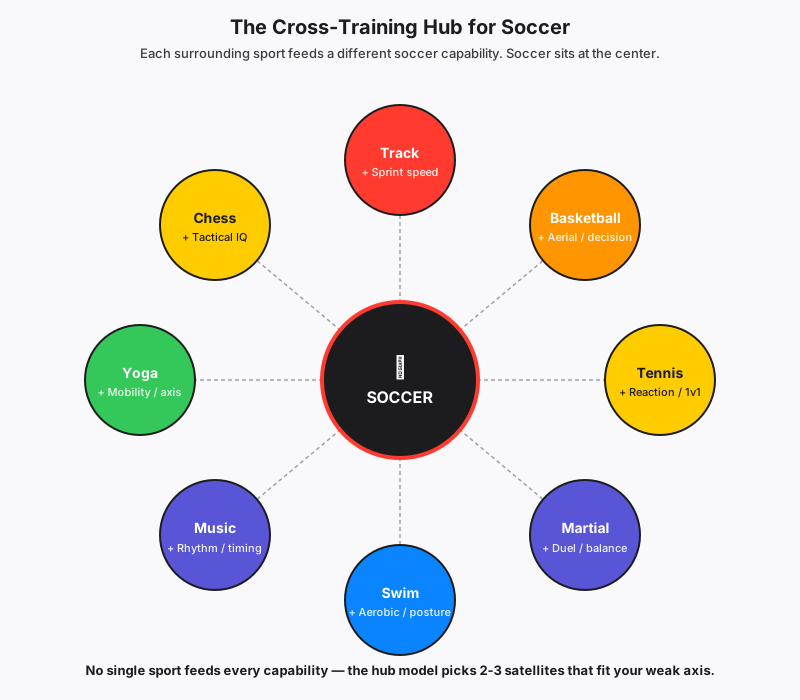
Choose sports by transfer type: for immediate impact, pick 'near transfer' options (futsal, handball); for cognitive gains, go with 'far transfer' options (chess, martial arts); for building a broader base, use 'non-specific transfer' options (swimming, yoga). Choosing without a clear purpose cuts the benefit in half.
The 20 Recommended Sports — Transfer Effects at a Glance
Here are 20 sports with scientifically supported transfer potential to soccer, listed with their primary transfer type, the abilities they develop, and recommended age ranges. Use this as an index to match sports to your team's or individual's specific needs.
The following 20 sports were selected by cross-referencing sports science research with the specific demands of soccer. Detailed breakdowns of each sport are available in their individual articles.
Near Transfer — High Structural Similarity to Soccer
- Basketball — Spatial awareness, transition play, team coordination. Court positioning and passing decisions overlap extensively with soccer
- Handball — Space exploitation, attack-to-defense transitions, physical contact. Goal-area confrontations closely mirror soccer finishing situations
- Volleyball — Jumping power, spatial awareness, vocal team communication. Aerial body control transfers directly to heading ability
- Rugby — Contact tolerance, 1v1 evasion, body leverage. Overcoming the fear of physical collisions in a structured environment
Far Transfer — High Cognitive Overlap
- Tennis — Rapid anticipation-reaction cycles, footwork. The reading and reacting within rallies is cognitively equivalent to 1v1 soccer duels
- Table Tennis — Reaction speed, anticipation, fine wrist adjustments. The world's fastest racquet sport pushes neural reaction times to their limit
- Badminton — Multi-directional movement, shuttle trajectory prediction, stamina. Full-court coverage footwork transfers directly to agility
- Fencing — Predicting opponent movement, feints, distance management. The reading of spacing in 1v1 bouts maps directly onto dribbling breakthroughs
- Chess — Strategic foresight, pattern recognition, decision-making. The ultimate cognitive training for developing the ability to think two moves ahead during a match
- Martial Arts — Reading an opponent's center of gravity, timing, fear management. Builds contact tolerance and 1v1 duel intelligence
Non-Specific Transfer — Foundational Ability Development
- Swimming — Cardiovascular fitness, zero-impact aerobic conditioning, breath control. Ideal for active recovery during the competitive season
- Track and Field — Sprint mechanics, proper running form, explosive power. Improving running efficiency directly raises the quality of soccer sprints
- Cycling — Low-impact aerobic conditioning, leg muscular endurance, cardiovascular fitness. Builds an aerobic base without stressing the knees or ankles
- Yoga — Flexibility, core stability, focus, mental regulation. Benefits both injury prevention and psychological conditioning
- Ballet / Dance — Balance, axial alignment, proprioception, rhythm. The ability to change direction while maintaining a stable axis transfers to 1v1 situations
- Climbing — Core strength, grip strength, problem-solving, fear management. Develops the ability to control one's own bodyweight and solve spatial problems
- Skateboarding — Balance, core engagement, plantar sensitivity, overcoming fear. Maintaining balance on an unstable surface strengthens ankle stability
- Surfing — Core strength, balance, wave-reading anticipation, decision-making in natural environments. Adapting to an unstable surface develops proprioception
- Baseball — Reaction to ball speed, spatial awareness, kinetic chain in throwing. The throwing motion's kinetic chain transfers to throw-ins and kicking power
- Dance (general) — Rhythm, physical expression, coordination, creativity. Moving to music develops the sense of rhythm that underpins fluid play
Choosing by Age and Level
The optimal sports and volume for cross-training differ significantly depending on a player's age and developmental stage. By integrating Cote et al.'s (2007) DMSP model with Lloyd & Oliver's (2012) YPD model, we can outline clear guidelines for each age group.
Cote et al.'s (2007) Developmental Model of Sport Participation (DMSP) divides sport involvement into three stages: the Sampling Years (ages 6–12), the Specializing Years (ages 13–15), and the Investment Years (age 16+). Cross-training goals and volume should shift at each stage.
Ages 6–12: Sampling Years — "Experience as Many Sports as Possible"
- Recommended volume: 2–3 sessions per week, at least 30 minutes each — At this stage, diverse movement experiences contribute more to long-term development than specialized soccer training
- Recommended sports: Swimming, gymnastics, basketball, tag games, dance — Prioritize activities that develop fundamental movement skills — running, jumping, throwing, swimming, and balancing — across a wide spectrum
- Key principle: Fun comes first — As Brenner (2007) warns, early specialization raises burnout risk. At this age, cross-training should be about broadening the joy of movement, not about making a child 'better at soccer'
Ages 13–15: Specializing Years — "Soccer as the Core, 2–3 Purposeful Supplements"
- Recommended volume: 1–2 sessions per week, 20–30 minutes each — Soccer training volume increases at this stage; cross-training takes a complementary role
- Recommended sports: Table tennis, tennis, yoga, martial arts — Shift to deliberate sport selection with a clear objective: 'I want to develop this specific ability'
- Key principle: Make the transfer target explicit — Aim for the level where the player can articulate: 'The X from tennis helps my Y in soccer'
Ages 16+: Investment Years — "Targeted Weakness Correction and Recovery"
- Recommended volume: Once per week, 15–20 minutes (within warm-up) + concentrated blocks in the off-season — Keep it minimal during the season and ramp up during off-season windows
- Recommended sports: Swimming (recovery), yoga (flexibility), chess (cognition), plus position-specific choices — Prescriptive cross-training targeted at individual weaknesses
- Key principle: Data-driven sport selection — Choose only those sports that address specific weaknesses identified through match analysis, and measure the results
As players grow older, cross-training shifts from quantity to quality. Elementary-age players should go broad and wide; middle-school players should narrow with purpose; high-school players should prescribe based on data. A coach's ability to design this progression is a defining measure of their expertise.
Recommended Combinations by Position
Each soccer position demands a distinct set of abilities. Here are the optimal cross-training combinations for goalkeepers, defenders, midfielders, and forwards, matched to the specific demands of each role.
To fine-tune cross-training sport selection, we analyze the demands unique to each position. The combinations below address abilities that are 'required in matches but difficult to develop through soccer training alone.'
Goalkeeper (GK)
- Volleyball — Aerial body control, hand coordination while jumping, reaction speed. The most direct training for the 'mid-air body management' goalkeepers need
- Martial Arts — Split-second decisions, reading distance in 1v1 situations, overcoming fear of contact. Sharpens rushing-out decisions and shot-stopping in 1v1 scenarios
- Tennis — Lateral reactions, anticipation during service returns, footwork. Improves the dive-reaction speed used in shot-stopping
Defender (DF)
- Rugby — Contact tolerance, 1v1 tackling technique, body positioning. Fundamentally strengthens the intensity of individual defending
- Chess — Foresight, reading opponent intent, positional judgment. Sharpens the tactical eye for defensive line control and cover positioning
- Basketball — Spatial awareness, aerial positioning, coordinated team defense. Set-piece marking and zone-defense instincts transfer directly
Midfielder (MF)
- Table Tennis — The world's fastest decision cycle, anticipation, multi-directional footwork. Improves press evasion and first-touch quality in the midfield
- Badminton — Endurance for full-court coverage, rapid multi-directional movement, shuttle trajectory prediction. Directly extends midfield covering range
- Swimming — Multi-dimensional cardiovascular development, breath control. Strengthens the aerobic base required of midfielders who cover 90 minutes of high-intensity running
Forward (FW)
- Fencing — Feint techniques, unbalancing an opponent's center of gravity, explosive acceleration. Transfers to making runs behind the defensive line and finishing duels
- Martial Arts — Predicting opponent movement, body balance, physical gamesmanship. Directly improves hold-up play and ability to retain possession under pressure
- Track Sprints — Sprint mechanics, acceleration technique, explosive starts. Fundamentally upgrades the speed of runs in behind
Position-specific prescriptions should follow a 'complementary' philosophy. Rather than further strengthening what a player already does well, use other sports to address the abilities their position demands but they personally lack — that is the most efficient approach.
Sample Weekly Schedules — In-Season and Off-Season
For coaches and players who want to introduce cross-training but are unsure where it fits into the week, here are model schedules for both in-season and off-season periods.
The schedules below are templates. Adapt them to your team's training calendar, match frequency, and players' school commitments. The key mindset is not 'cut soccer sessions to make room for cross-training' but rather 'embed cross-training into existing time slots and training structures.'
In-Season Model (4 Soccer Sessions per Week)
- Monday: Off (full rest)
- Tuesday: Soccer training — Replace the 15-minute warm-up with basketball-based elements
- Wednesday: Soccer training — Standard warm-up
- Thursday: Soccer training — Replace the 15-minute warm-up with table-tennis footwork elements
- Friday: Soccer training — Standard warm-up; low intensity as a pre-match day
- Saturday: Match day
- Sunday: Active recovery — 30 minutes of swimming or 20 minutes of yoga (optional attendance)
Off-Season Model
- Monday: Swimming 40 min + Yoga 20 min — Active recovery and flexibility
- Tuesday: Individual soccer practice 60 min — Technical work with a conscious focus on applying cross-training transfer
- Wednesday: Martial arts session 60 min — 1v1 dueling, body contact, balance
- Thursday: Individual soccer practice 60 min + Table tennis 30 min — Technical work followed by reaction-speed training
- Friday: Off (full rest)
- Saturday: Climbing 60 min or Basketball 60 min — Concentrated core and spatial-awareness development
- Sunday: Pickup soccer game or Futsal — Maintaining soccer feel while having fun
The golden rule of scheduling: during the season, use 'warm-up swaps' for minimal-cost integration. In the off-season, build concentrated blocks at a soccer-to-cross-training ratio of roughly 6:4.
Common Pitfalls and How to Avoid Them
Most cases where cross-training fails to deliver results trace back to design errors at the outset. Here are seven typical failure patterns — grounded in research and practitioner experience — along with strategies to avoid each one.
Cross-training is not a cure-all. Implemented incorrectly, it can waste time, trigger negative transfer, or even increase injury risk. Understand the following failure patterns before you begin.
Seven Typical Pitfalls
- No clear purpose — Starting 'because it seems helpful' makes it impossible to identify what is working, and motivation fades. → Fix: Set one explicit transfer goal per sport
- Drastically cutting soccer training time — Becoming so engrossed in cross-training that the primary sport suffers. → Fix: Maintain at least 70% of total soccer training volume
- Ignoring negative transfer — A baseball swing, for example, can interfere with a kicking motion because the patterns are similar yet subtly different. → Fix: Build the habit of articulating 'what is similar and what is different'
- Overload injuries from unfamiliar movements — Jumping into unfamiliar movement patterns at high intensity strains muscles and joints. → Fix: Always start a new sport at low intensity and increase gradually over 2–3 weeks
- Age-inappropriate sport selection — Forcing chess on elementary-age children who lack the abstract-reasoning maturity, or applying loads unsuited to a developmental stage. → Fix: Follow the age-group guidelines and match activities to the player's developmental phase
- No performance tracking — Being satisfied with 'doing it' without verifying whether the training actually transfers to soccer performance. → Fix: Run a performance test once a month for objective measurement
- Mandating participation and killing enjoyment — Especially for U-12 players, a 'forced' feeling saps motivation for both cross-training and soccer. → Fix: Offer options and let players choose
The single most important safeguard is articulation. Cross-training that cannot be expressed in words — why you are doing it, what you are developing, and how it transfers — is indistinguishable from unstructured play. Conversely, the moment you can articulate the purpose, transfer accelerates regardless of the sport.
Recording and Analyzing Cross-Training with Footnote
To maximize the value of cross-training, you need to move beyond 'I did it' to 'what transferred?' — and that requires systematic recording and data accumulation. Footnote streamlines this entire process.
As Kawasaki et al. (2019) demonstrated in Brain Sciences, verbalizing movement experiences reactivates motor programs in the brain. When you not only experience cross-training but also write about it, the probability of transfer rises dramatically.
How to Log Cross-Training in Footnote
- Add cross-training details to your practice log — Record the sport and duration: 'Tennis wall-rally 30 min,' 'Basketball mini-game 20 min,' etc.
- Write one transfer point — Capture a specific insight, e.g., 'The quick approach to the contact point in tennis uses the same principle as preparing my first touch in soccer'
- Set an application goal for the next soccer session — For example, 'Tomorrow I will focus on orienting my body before the ball arrives'
- Follow up with the result — Reflect on whether the application worked. This feedback loop progressively refines the quality of transfer
Patterns Revealed by AI Analysis
Footnote's AI analysis, triggered every five matches, also detects patterns in cross-training data. Correlations such as 'self-rated anticipatory actions rise in weeks that include table tennis' or 'injury entries decrease during sustained yoga periods' become visible over time, enabling you to objectively identify which cross-training sports work best for you.
Finding the ideal cross-training sport from a list of 20 through trial-and-error alone is inefficient. Record, analyze, and discover patterns — Footnote brings scientific rigor to this process.
Frequently Asked Questions
Do I need to try all 20 sports?▾
No. You will get better results by choosing 2–3 sports that match your position, age, and specific areas for improvement and focusing on those. Use the 'By Age' and 'By Position' sections in this guide to narrow down your priorities. That said, the off-season is a great time to explore a sport you have never tried before.
Can cross-training actually make my soccer worse?▾
The risk of 'negative transfer' does exist — for example, a baseball swing can interfere with kicking mechanics. However, this risk drops significantly when you build the habit of articulating what is similar and what is different between the two movements. Additionally, keeping soccer training at 70% or more of your total volume protects your primary skills while still capturing the benefits of cross-training.
Do better soccer players benefit more from cross-training?▾
Cross-training is effective at every level, but the type of benefit changes. Beginners gain the most from non-specific transfer — broad improvements in fundamental athleticism. Advanced players benefit more from specific transfer — faster cognitive decisions or targeted correction of individual weaknesses. The key is matching the sport and its purpose to your current level.
How long does cross-training take to show results?▾
Physical effects (agility, flexibility) typically become measurable after 4–8 weeks of consistent practice. Cognitive effects (decision speed, spatial awareness) generally require 3–6 months. Hammami et al. (2018) documented significant improvements in sprint speed and agility after a 12-week cross-training program. Above all, consistency matters: one session per week sustained over six months beats daily sessions abandoned after one month.
How can I track cross-training in Footnote?▾
Add the cross-training sport, duration, and a specific transfer point to your Footnote practice log. Once five matches of data accumulate, the AI automatically detects correlation patterns between your cross-training habits and match performance. This allows you to objectively identify which sports produce the biggest positive effect for you.
References
- [1] Thorndike, E. L. & Woodworth, R. S. (1901). “The influence of improvement in one mental function upon the efficiency of other functions” Psychological Review, 8(3), 247-261.
- [2] Rosalie, S. M. & Müller, S. (2012). “A model for the transfer of perceptual-motor skill learning in human behaviors” Research Quarterly for Exercise and Sport, 83(3), 413-421.
- [3] Moesch, K., Elbe, A. M., Hauge, M. L., & Wikman, J. M. (2011). “Late specialization: The key to success in centimeters, grams, or seconds (cgs) sports” Scandinavian Journal of Medicine & Science in Sports, 21(6), e282-e290.
- [4] Lloyd, R. S. & Oliver, J. L. (2012). “The Youth Physical Development Model: A new approach to long-term athletic development” Strength and Conditioning Journal, 34(3), 61-72.
- [5] Hammami, A., Gabbett, T. J., Slimani, M., & Bouhlel, E. (2018). “Does cross-training improve physical fitness in youth soccer players? A systematic review” Biology of Sport, 35(4), 361-369.
- [6] Cote, J., Baker, J., & Abernethy, B. (2007). “Practice and play in the development of sport expertise” Handbook of Sport Psychology (3rd ed.), Wiley, 184-202.
- [7] Kawasaki, T., Kono, S., & Tozawa, R. (2019). “Verbal description of motor imagery enhances motor learning: Implications for mental practice” Brain Sciences, 9(8), 187. Link
- [8] Brenner, J. S. (2007). “Overuse injuries, overtraining, and burnout in child and adolescent athletes” Pediatrics, 119(6), 1242-1245.
- [9] LaPrade, R. F., Agel, J., Baker, J., et al. (2016). “AOSSM Early Sport Specialization Consensus Statement” Orthopaedic Journal of Sports Medicine, 4(4). Link
- [10] Issurin, V. B. (2010). “New horizons for the methodology and physiology of training periodization” Sports Medicine, 40(3), 189-206.
Related Articles
Verbalization Accelerates Transfer -- Why Writing Makes Skills from Other Sports Carry Over to Soccer
11 min read
The Kinetic Chain -- The Science of Cross-Sport Body Mechanics and Its Application to Soccer
10 min read
Multidimensional Cardiovascular Development — The Science of Synergy from Multi-Sport Training
10 min read
Spatial Cognition — The Science of Reading Space, Trained Through Team Sports
10 min read
Flexibility and Mobility — The Science Behind How Yoga, Ballet, and Gymnastics Prevent Soccer Injuries
10 min read
Track Your Growth with Footnote
Just record your matches — AI analyzes every 5 games. Visualize growth with PVS Score. All features free during beta.
30-second signup · No credit card required
Last updated: 2026-05-06 ・ Footnote Editorial