A Coach's Guide to Implementing Cross-Training — How to Elevate Your Entire Team's Performance
For coaches looking to take their team's performance to the next level, cross-training is one of the most cost-effective tools available. Cote & Gilbert's (2009) coaching effectiveness model showed that coaches who drive long-term player development deliberately provide a variety of movement experiences. Lloyd & Oliver's (2012) Youth Physical Development (YPD) model further demonstrated that multi-faceted training matched to developmental stage determines the performance ceiling an athlete can reach after maturation. This article explains how coaches can design cross-training programs for their teams, plan around the competitive season, build consensus with parents, and measure results.
Why Coaches Should Adopt Cross-Training
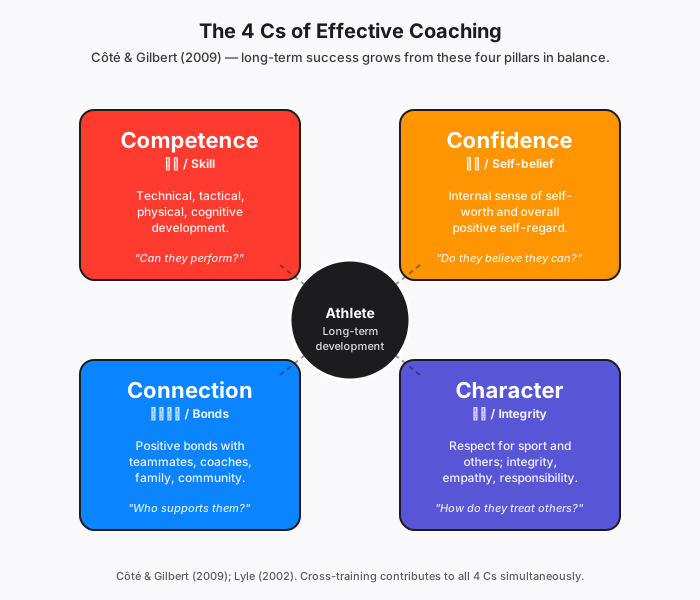
Cote & Gilbert's (2009) effective coaching model identifies four Cs — competence, confidence, connection, and character — that coaches must cultivate for long-term success. Cross-training contributes to every one of them.

Photo by Salah Regouane on Unsplash
Many soccer coaches feel that every minute of practice should be devoted to soccer-specific skills. Yet when measured against Cote & Gilbert's (2009) definition of effective coaching — developing competence, confidence, connection, and character in an integrated way — soccer-only sessions leave certain growth areas unreachable.
Four Areas Soccer-Only Training Cannot Reach
- Multi-directional physical development — Soccer is dominated by forward movement patterns. Swimming introduces rotation, basketball adds vertical movement, and martial arts develop lateral weight transfer — movement patterns that soccer alone under-trains.
- Cognitive flexibility — Adapting to different rules and decision contexts in other sports sharpens the ability to handle unexpected situations during a soccer match (Vestberg et al., 2012).
- Burnout prevention — Brenner (2007) found significantly higher burnout rates among young athletes who specialize in a single sport. Cross-training directly sustains enjoyment.
- Injury-risk distribution — Overuse injuries caused by repetitive movement patterns can be mitigated by distributing load across different movement types.
Lloyd & Oliver's (2012) YPD model identifies 'sensitivity windows' — developmental periods during which specific physical capacities are most trainable. Once a window closes, the capacity becomes much harder to acquire. Soccer practice alone cannot exploit every window. Cross-training is the vehicle that makes full use of them.
Key mindset shift: Cross-training is not 'time spent away from soccer.' It is 'time invested in abilities that soccer alone cannot develop.' Reframing it this way is the first step toward successful implementation.
Designing a Team-Wide Program
The difference between an effective program and wasted practice time is intentional design. Rather than ad-hoc multi-sport sessions, build a structured program that targets your team's specific needs.
An effective cross-training program starts with team analysis. Martindale, Collins, & Daubney (2005) reported that goal-driven, systematic approaches to long-term player development produce significantly better outcomes than ad-hoc coaching.
Five Steps to Program Design
- Identify team weaknesses — Analyze recent matches to pinpoint up to three team-wide issues, such as poor aerial duels, lack of agility, or slow decision-making.
- Map weaknesses to sports — Example: aerial weakness → basketball (jumping and spatial awareness), agility deficit → table tennis (reaction speed), slow decisions → futsal (decision-making in tight spaces).
- Integrate into the weekly schedule — Avoid cutting core soccer time. Instead, replace 15–20 minutes of warm-up or 10 minutes of cool-down with cross-training elements.
- Explain the purpose to players — Tell them why they are doing each activity. Practice performed with a clear understanding of its purpose produces roughly 1.4 times the learning effect of practice without that understanding (Wulf & Lewthwaite, 2016).
- Evaluate and adjust every four weeks — Measure results and swap out activities that are not working. Maintain the flexibility to iterate.
Iron Rules of Program Design
- One transfer goal per activity — Assign exactly one intended transfer outcome to each cross-training activity. Trying to achieve multiple goals blurs the focus.
- Keep soccer at 70 % or more of total training time — Cross-training supplements; it does not replace. Never drastically cut core soccer practice.
- Fun comes first — Especially for U-12 and younger, the moment cross-training feels like a chore, its effectiveness drops to zero.
The most effective programs are designed to address specific team weaknesses through other sports. By contrast, 'playing another sport for no particular reason' carries a high risk of simply wasting practice time.
Incorporating Other Sports into Your Warm-Up
You do not need to carve out a separate session for cross-training. Replacing just 15 minutes of warm-up with elements from other sports lets you embed cross-training benefits into every single practice.
The most realistic way to introduce cross-training within limited practice time is to redesign the warm-up. Replace the conventional jog → stretch → Brazilian exercise routine with a dynamic warm-up that borrows elements from other sports.
Sample Cross-Training Warm-Up Menu
- Basketball elements (5 min) — Pairs perform chest passes → bounce passes → running passes. This stimulates spatial awareness and hand-eye coordination while activating the upper body.
- Tag rugby (5 min) — Players try to pull tags attached at the waist. Trains change of direction, acceleration and deceleration, and peripheral awareness — all in a game format.
- Table-tennis-style reactions (5 min) — Two players face each other and shuffle laterally on the coach's command, mimicking table tennis footwork. Builds reaction speed and agility.
Tips for Integration
- Maintain a progressive heart-rate build-up — Even with cross-training elements, the warm-up must still fulfill its physiological purpose: raising body temperature and improving muscle elasticity.
- Verbalize the soccer connection — Before each drill, say one sentence like 'This will help your [specific soccer skill].' That simple cue can double the transfer effect by directing the player's attention.
- Rotate activities weekly — Using the same warm-up every session kills novelty. Keep a rotation of three to four activities.
The warm-up is not preparation for practice — it is part of practice. By dedicating these 15 minutes to cross-training, you can provide over 50 multi-sport experiences per year to every player on your team.
— Adapted from Long-Term Athlete Development (LTAD) coaching principles
Season-Phase Planning — Pre-Season, In-Season, and Off-Season
The volume and type of cross-training should vary significantly by season phase. Drawing on Bompa & Buzzichelli's (2019) periodization principles, here is an optimal implementation strategy for each phase.
Applying cross-training uniformly throughout the year is inefficient. Bompa & Buzzichelli's (2019) periodization framework shows that systematically varying training volume, intensity, and type across phases maximizes adaptation.
Pre-Season (2–3 Months Before the Season)
- Volume: 2–3 sessions per week, 20–30 minutes each — This is the time to actively incorporate other sports alongside soccer-specific fitness building.
- Recommended activities: swimming, track and field, gymnastics — Build a broad base of cardiovascular fitness, strength, flexibility, and coordination.
- Goal: multi-directional physical development — Focus on strengthening foundational capacities that cannot be addressed during the competitive season.
In-Season (League and Tournament Period)
- Volume: once per week, 15 minutes within the warm-up — Match performance and recovery take priority; keep cross-training at a maintenance level.
- Recommended activities: table tennis, yoga, light basketball — Low-load activities that stimulate the nervous system without accumulating fatigue, maintaining cognitive freshness.
- Goal: cognitive freshness and recovery — Inject novel stimuli into a soccer-heavy schedule to prevent psychological burnout.
Off-Season (2–3 Months After the Season)
- Volume: 3–4 sessions per week, 30–45 minutes each — This is the concentrated cross-training block where you can go all in.
- Recommended activities: martial arts, climbing, dance, new team sports — Introduce movement patterns and cognitive challenges that normal soccer environments never provide.
- Goal: raising the performance ceiling — Following Issurin's (2010) block periodization theory, intensively develop capacities that are difficult to build through soccer alone.
The key to annual planning: pre-season is for 'building the foundation,' in-season is for 'maintenance and freshness,' off-season is for 'raising the ceiling.' This three-phase rhythm maximizes the return on cross-training.
Communicating with Players and Parents
The biggest barrier to cross-training adoption is the fear that 'soccer practice time will shrink.' Pairing scientific evidence with concrete success stories and walking stakeholders through the rationale is the key to gaining buy-in.
Even the best-designed program will fail without player and parent understanding. Keegan et al. (2010) showed that parental influence on young athletes' motivation is at least equal to that of the coach. Getting parents on board is not optional — it is a prerequisite for success.
Talking to Players
- Cite professional role models — 'Messi played basketball and handball as a child,' 'Shohei Ohtani swam and played badminton growing up.' Concrete examples of admired athletes resonate most powerfully with young players.
- Let them experience it before you explain — Rather than leading with theory, run a 15-minute basketball warm-up first, then ask: 'What part of that basketball drill do you think helps your soccer?' This discovery approach sticks better.
- Make it clear that soccer time is not being cut — Emphasize that cross-training replaces the warm-up, not the main session. Core soccer practice time remains intact.
Talking to Parents
- Share the science at a parent meeting — Present Moesch et al.'s (2011) data showing that the majority of elite athletes played multiple sports as children, alongside LaPrade et al.'s (2016) early-specialization risk research, in one or two clear slides.
- Address the 'falling behind' fear directly — 'In the short term, a child who only plays soccer may outperform, but the research consistently shows that multi-sport athletes surpass them over the long run.' Say it plainly.
- Report measurable outcomes regularly — Visualize the team's performance changes after implementation and share them with parents. Data is the most persuasive argument of all.
The instinct that 'they should just focus on soccer' is a perfectly natural parental concern. But the data consistently shows that diverse movement experiences support long-term growth. A coach's job is to translate that data into a parent's language.
— Informed by LaPrade et al. (2016) consensus statement
Measuring Effectiveness and Giving Feedback
Without measuring whether cross-training is actually working, you cannot sustain or improve the program. Use both quantitative and qualitative metrics to create a continuous improvement cycle.
Martindale, Collins, & Daubney (2005) identified systematic monitoring and feedback as essential conditions for effective long-term development programs. Cross-training is no exception. 'It seems to be working, so let's keep going' is not enough — a professional approach demands data-driven decisions.
Quantitative Metrics
- Agility tests (monthly) — Use standardized tests such as the T-test or Illinois Agility Test and record times.
- Sprint times (monthly) — Measure 10 m and 30 m sprints regularly to track changes in acceleration and top speed.
- Flexibility tests (monthly) — Assess sit-and-reach scores and hip range of motion to confirm mobility improvements from cross-training.
- In-match performance indicators — Track metrics aligned with your transfer goals — aerial-duel win rate, 1-v-1 success rate, pass completion — on a per-match basis.
Qualitative Feedback
- Player self-assessment survey (monthly) — Ask players to rate on a five-point scale whether they feel cross-training is benefiting their soccer.
- Free-form reflections — Have players record in their own words what they learned from other sports that they can apply to soccer.
- Parent feedback — Periodically ask parents whether they have noticed changes in their child's attitude toward practice or motivation for soccer.
The heart of measurement: don't settle for 'we are doing cross-training.' Verify that cross-training is actually transferring to soccer performance. If you cannot confirm transfer, have the courage to revise the activities or the approach.
Managing Team-Wide Cross-Training with Footnote
Footnote is not just an individual player's journal — it is a platform that lets coaches see the effects of cross-training across the entire team at a glance.
The most time-consuming part of running a cross-training program is tracking who did what and what effect it had. Paper notebooks make it virtually impossible to analyze records across 20 players side by side.
What Footnote Offers Coaches
- Centralized player records — See at a glance what cross-training each player has experienced and what they felt transferred to soccer.
- AI-powered pattern detection — Once five matches' worth of data has been collected, Footnote automatically analyzes correlations between cross-training and performance. Insights like 'aerial-duel win rate tends to rise in weeks that include basketball' surface on their own.
- Team-wide trend analysis — Move beyond individual players to see which cross-training activities are most effective for the team as a whole.
- Parent sharing — Within the permissions each player sets, cross-training content and its effects can be shared transparently with parents.
Recording Tips for Coaches
- Include the cross-training activity and its transfer goal in the session plan — Write something like 'Today's warm-up: basketball elements. Transfer goal: spatial awareness.'
- Ask each player to log just one 'transfer point' — Rather than demanding detailed written analysis, focus on a single prompt: 'Name one thing from today's activity you can use in soccer.'
- Run an effectiveness review at the end of each month — Use Footnote's accumulated data to identify the highest-impact cross-training activities and feed the results into the next month's program.
A coach's intuition is valuable, but intuition backed by data is far more powerful. Footnote prevents cross-training from becoming a 'set it and forget it' exercise and serves as a coach's partner in making results visible.
Frequently Asked Questions
We barely have any spare practice time. Can just 30 minutes once a week make a difference?▾
Yes — that is enough to see real benefits. Simply replacing 15 minutes of warm-up with multi-sport elements creates over 50 cross-training opportunities per year. What matters is not volume but intentionality. When you are clear about why you are using a particular activity, transfer effects emerge even from short sessions.
Some players resist cross-training. Should I make it mandatory for everyone?▾
Forcing participation is counterproductive. Start by understanding why a player objects. If the answer is 'I want to practice soccer,' show them with concrete examples how the activity is soccer training. If resistance persists, offer that player a soccer-specific warm-up alternative and let them see teammates' progress. In most cases, they will eventually ask to join on their own.
Can a soccer coach run cross-training without specialists in other sports?▾
Absolutely. What is needed is not expert-level instruction in another sport but the ability to weave elements of other sports into a soccer-context warm-up. Basketball passing, tag-rugby chase games, and table-tennis-style footwork drills are all straightforward to run. For activities that do require specialist guidance — martial arts, ballet, etc. — consider organizing off-season taster sessions at external facilities.
How should I respond if parents complain that they want the team to focus on soccer?▾
Parental concern is a natural reaction. First, show them a concrete timetable demonstrating that core soccer practice time has not been reduced. Then share research data from Moesch et al. (2011) and LaPrade et al. (2016) in plain terms: 'The vast majority of elite athletes played multiple sports as children.' The most effective approach is to present measurable changes in team performance at a parent meeting after the program has been running for a few months.
How long does it take before cross-training shows results?▾
Physical improvements — agility, flexibility — typically become measurable within four to eight weeks. Cognitive improvements — decision speed, spatial awareness — take longer, generally three to six months before they reliably show up in match performance. Crucially, do not evaluate success on short-term numbers alone. Sustained enjoyment and maintained motivation for soccer are equally important long-term outcomes to track.
References
- [1] Cote, J. & Gilbert, W. (2009). “An integrative definition of coaching effectiveness and expertise” International Journal of Sports Science & Coaching, 4(3), 307-323.
- [2] Lloyd, R. S. & Oliver, J. L. (2012). “The Youth Physical Development Model: A new approach to long-term athletic development” Strength and Conditioning Journal, 34(3), 61-72.
- [3] Bompa, T. O. & Buzzichelli, C. (2019). “Periodization: Theory and Methodology of Training (6th ed.)” Human Kinetics.
- [4] Martindale, R. J. J., Collins, D., & Daubney, J. (2005). “Talent development: A guide for practice and research within sport” Quest, 57(4), 353-375.
- [5] Moesch, K., Elbe, A. M., Hauge, M. L., & Wikman, J. M. (2011). “Late specialization: The key to success in centimeters, grams, or seconds (cgs) sports” Scandinavian Journal of Medicine & Science in Sports, 21(6), e282-e290.
- [6] Issurin, V. B. (2010). “New horizons for the methodology and physiology of training periodization” Sports Medicine, 40(3), 189-206.
- [7] Keegan, R. J., Harwood, C. G., Spray, C. M., & Lavallee, D. E. (2010). “A qualitative investigation exploring the motivational climate in early career sports participants: Coach, parent and peer influences on sport motivation” Psychology of Sport and Exercise, 10(3), 361-372.
- [8] Wulf, G. & Lewthwaite, R. (2016). “Optimizing performance through intrinsic motivation and attention for learning: The OPTIMAL theory of motor learning” Psychonomic Bulletin & Review, 23(5), 1382-1414.
Related Articles
Why Coaches Should Have Players Keep Soccer Journals — and How to Implement Them
8 min read
Verbalization Accelerates Transfer -- Why Writing Makes Skills from Other Sports Carry Over to Soccer
11 min read
Multi-Sport Participation for Elementary-Age Athletes — The Scientific Case Against Early Specialization and a Practical Guide to Cross-Training
8 min read
Off-Season Cross-Training Plan — Month-by-Month Programming and the Science Behind It
9 min read
Pacing Strategy — The Science of Surviving 90 Minutes, Borrowed from Endurance Sports
10 min read
Track Your Growth with Footnote
Just record your matches — AI analyzes every 5 games. Visualize growth with PVS Score. All features free during beta.
30-second signup · No credit card required
Last updated: 2026-05-06 ・ Footnote Editorial