Off-Season Cross-Training Plan — Month-by-Month Programming and the Science Behind It
The moment the season ends, players split into two groups: those who rest and lose fitness, and those who use stimuli outside of soccer to raise the ceiling of their abilities. Mujika & Padilla (2000) showed that four weeks of complete rest can reduce VO2max by 6–20% and muscle strength by up to 16%. At the same time, the off-season is the one and only window in which players can introduce novel movement stimuli that time constraints and physical demands make impossible during the competitive season. This article presents a science-backed, three-month cross-training plan organized by month, providing a roadmap to return in peak condition on day one of preseason.
Why the Off-Season Is the Optimal Window for Cross-Training
During the season, the match-and-recovery cycle leaves no room for introducing new movement stimuli. The three months of the off-season represent the only period in which players can devote concentrated effort to developing abilities that soccer alone cannot build.

Photo by Thompson Le on Unsplash
During the competitive season, fitting meaningful cross-training around weekend matches and weekday practice sessions is simply unrealistic. Factor in fatigue management, injury risk, and the need to stay focused on team training, and the most a player can add is one or two light supplementary sessions per week at best.
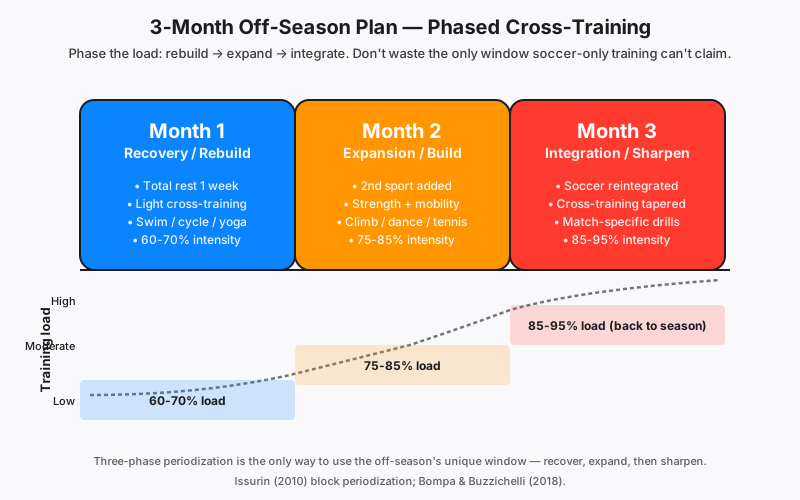
Three Advantages of the Off-Season
- Freedom of schedule — Without match-day commitments, it becomes possible to fit two different training stimuli into a single day. Weekly scheduling becomes highly flexible
- Physical headroom — Cumulative match fatigue resets, freeing up the neural capacity required to learn new movement patterns
- Psychological refresh — Stepping away from a soccer-only environment prevents mental burnout and boosts motivation upon return (Gustafsson et al., 2011)
Issurin's (2010) block periodization theory demonstrates that concentrating on distinct training objectives in dedicated time blocks yields greater adaptation than trying to develop many abilities simultaneously. The three off-season months are the perfect opportunity to design exactly this kind of concentrated block.
The off-season is not a "rest period" — it is a period of concentrated development for abilities that soccer cannot build. Recognizing this distinction is what creates a visible performance gap on the first day of preseason.
Month 1: Active Recovery and Exploring New Sports
The first month immediately after the season prioritizes recovery from cumulative fatigue while gradually introducing the body to movement stimuli that differ from soccer.
Immediately after the season, the body carries an accumulation of micro-level fatigue from months of match loading. Kellmann's (2010) recovery research emphasizes the importance of dedicating the first two to three weeks post-season to psychological and physical restoration. That said, complete rest is the worst possible choice. As Mujika & Padilla (2000) showed, total inactivity degrades aerobic capacity significantly in as little as two weeks.
Weeks 1–2: Active Recovery Phase
- Swimming (2–3 sessions per week, 30–40 min) — Zero joint impact while promoting whole-body circulation and accelerating resolution of lingering inflammation
- Light cycling (twice per week, 40–60 min) — Low-intensity Zone 1–2 effort maintains leg blood flow while providing a psychological change of scenery
- Yoga (3–4 sessions per week, 20–30 min) — Restores range of motion in the hips, thoracic spine, and ankles — areas that tighten during the season
Weeks 3–4: Sport Exploration Phase
- Climbing — Delivers novel stimuli for upper-body strength and core stability, while also training fear management and problem-solving
- Badminton / Tennis — Demands anticipation, reaction, and lateral movement, imposing cognitive loads that differ from those in soccer
- Martial arts fundamentals — Basic judo or wrestling drills develop center-of-gravity control and resilience in physical contact situations
- Dance — Stimulates rhythm, spatial awareness, and coordination in a context entirely different from soccer
Elite athletes are never the product of a single sport. Diverse movement experiences ultimately form the foundation of creativity and adaptability in the primary sport.
— Istvan Balyi (creator of the Long-Term Athlete Development model)
Month 2: Concentrated Development of Soccer-Complementary Abilities
With the exploration phase complete, Month 2 shifts to the concentrated, purposeful development of abilities that directly enhance soccer performance — delivered through cross-training modalities.
Once the body has begun adapting to new movement stimuli in Month 1, Month 2 transitions to targeted "complementary ability building." The key at this stage is to identify weaknesses or underdeveloped areas in your soccer game and select the cross-training activities that address them most efficiently.
Cross-Training Map by Target Ability
- Raising the aerobic ceiling — Swimming intervals (8 x 200 m, 30-second rest) plus cycling hill climbs (2 x 20 min), 3–4 times per week
- Upper-body and core strength — Climbing twice per week plus bodyweight training. Strengthens the pulling and pushing patterns that soccer leaves underdeveloped
- Flexibility and range of motion — Yoga 2–3 times per week, focusing on thoracic rotation and hip external rotation
- Tolerance for cognitive load — Racket sports or basketball expose players to decision-making speeds that differ from those in soccer
- Contact resilience — Basic judo or wrestling drills improve the ability to maintain balance under physical contact
Sample Weekly Schedule
- Mon & Sat — Swimming (50-min intervals / 40-min continuous) to raise the aerobic ceiling
- Tue — Climbing 60 min + core work 20 min to build upper-body and core strength
- Wed — Long bike ride 70 min (Zone 2–3) to expand the aerobic base
- Thu — Yoga 60 min + light jog 20 min to combine flexibility and recovery
- Fri — Racket sport or basketball 60 min for cognitive-load training
- Sun — Full rest day or 30-min walk
Bompa & Buzzichelli (2019) recommend that during the General Preparation Phase, non-sport-specific training should account for 60–70% of overall volume. Month 2 corresponds precisely to this phase: soccer ball work is limited to one or two small-sided games per week, with cross-training forming the backbone of the program.
The key to Month 2 is not volume — it is focused attention on weaknesses. Identify what limits you on the soccer field, then choose the cross-training activity that addresses it most efficiently.
Month 3: Integration and Transition to Preseason
The final month is about integrating the abilities gained through cross-training back into the soccer context, so the player arrives at day one of preseason in peak condition.
Month 3 follows the Principle of Specificity: the ratio of cross-training is gradually reduced while soccer-specific movement is progressively increased. An abrupt switch would compromise adaptation, so a phased transition is essential.
Week-by-Week Transition Schedule
- Weeks 9–10 — 60% cross-training / 40% soccer. Resume soccer with a focus on technical work
- Week 11 — 40% cross-training / 60% soccer. Add small-sided games and possession drills
- Week 12 — 20% cross-training / 80% soccer. Retain only swimming and yoga while shifting to match-format sessions
How to Integrate Cross-Training Gains
As Rosalie & Müller (2012) demonstrated, skill transfer depends on a conscious extraction process. Deliberately connecting the abilities you have gained to soccer-specific movements is essential.
- Breathing control from swimming → Apply controlled breathing patterns during high-intensity runs
- Core stability from climbing → Consciously engage core stability during aerial duels and physical contact
- Range of motion from yoga → Use full-range movement in kicking and turning actions
- Reaction speed from racket sports → Notice the improvement in your response to opponents' movements in 1v1 situations
Month 3 is about translating your gains into the soccer context. Put into words what each cross-training activity gave you and identify the specific match situations where you can apply it — that is the key to transfer.
Periodization Principles — Designing Three Months on Scientific Foundations
By managing progressive load increases and recovery cycles scientifically, it is possible to maximize adaptation while avoiding overload.
Bompa & Buzzichelli's (2019) periodization theory structures training across three layers: the macrocycle (months), the mesocycle (weeks), and the microcycle (one week). The three off-season months constitute the macrocycle's "preparatory phase," with each month forming a mesocycle.
Four Principles of Load Management
- Progressive overload — Increase weekly training load (duration x intensity) by 5–10% per week. Sudden spikes raise injury risk
- Scheduled recovery weeks — After every three weeks of load progression, insert one recovery week at 40–50% of peak load. This is the key to keeping Gabbett's (2016) acute:chronic workload ratio within the safe zone
- Variation — Avoid repeating the same activity at the same intensity on autopilot. Alternate between intervals and steady-state swimming, for example, to prevent adaptation plateaus
- Convergence toward specificity — Gradually reduce the cross-training ratio as Month 3 approaches, increasing the proportion of soccer-specific training
Monitoring Indicators to Prevent Overload
- Resting heart rate on waking — If it stays more than 5 bpm above normal for three consecutive days, reduce the load
- Session RPE — Calculate RPE x duration (minutes) using the method of Foster et al. (2001), and ensure the week-over-week total does not exceed a 1.2x increase
- Sleep quality and motivation — Difficulty falling asleep or three consecutive days of low training motivation are signs of overload
Tracking Off-Season Growth with Footnote
Use Footnote to record training content, subjective feelings, and performance changes — building a data set that clearly tells your preseason self "what worked."
The most common pitfall in off-season cross-training is ending up in a state of "I did stuff, but I have no idea what actually helped." By leveraging Footnote's logging features, you can objectively review the entire three-month block and design next year's off-season plan with even greater precision.
What Every Session Log Should Include
- Activity, duration, and intensity — e.g., "Swimming 50 min, intervals 8 x 200 m, RPE 7." Specifying the activity improves AI analysis accuracy
- Soccer-connection note — e.g., "Felt strong core engagement during climbing. Should translate well to aerial stability during headers"
- Physical status — Location and severity of muscle soreness, any joint discomfort, overall fatigue level
- Observations and insights — New perspectives gained from other sports. e.g., "Tracking the shuttlecock in badminton seems to sharpen my ball-watching quality"
Weekly and Monthly Reviews
Use Footnote's review feature to write a short reflection once a week on how cross-training changed something that week. At the end of each month, assess progress against your goals and note any adjustments for the following month. Repeating this cycle for three months means that when preseason arrives, you will be a player who can clearly articulate "what I did, how much I did, and what changed as a result."
Logging is a gift to your future self. On the first day of preseason, the player who can look back and say exactly what they did during the off-season and the player who "just sort of hung out" are on fundamentally different growth trajectories.
Frequently Asked Questions
Is it okay to not touch a soccer ball at all during the off-season?▾
Going completely without the ball is not recommended. While technical memory is retained relatively well, ball feel begins to dull after two to three weeks. Even in Month 1, including 15–20 minutes of ball-touch work once or twice a week will maintain the feel while letting you focus on cross-training.
How should I compress the plan if my off-season is shorter than three months?▾
For a six-week off-season, condense Month 1 into two weeks, Month 2 into three weeks, and Month 3 into one week. In the shortened version, it is more efficient to focus on reinforcing soccer weaknesses with activities you already know rather than exploring new sports. Do not skip the recovery week — schedule it in Week 3.
Should the entire team adopt an off-season cross-training program together?▾
Training as a team offers the benefits of sustained motivation and team building. However, because each player has different weaknesses, prescribing an identical program for everyone is inefficient. The ideal approach combines a shared foundation (e.g., swimming + yoga) with individually tailored supplementary activities.
How should I choose which cross-training activities to do?▾
Use three criteria. First, does it address a soccer weakness? (If your cardio is lacking, choose swimming or cycling; if your core is weak, try climbing or yoga.) Second, is it accessible? (Is there a pool or gym nearby?) Third, do you enjoy it? As Gustafsson et al. (2011) demonstrated, psychological refreshment during the off-season is essential for long-term performance — and training that feels like a chore increases the risk of burnout.
How can I manage my off-season plan in Footnote?▾
Log the activity, duration, intensity, and subjective feel of each cross-training session in Footnote's practice log, and write a weekly review. The AI analysis feature will detect correlations between cross-training frequency and changes in physical condition, so after three months you can verify with data which activities were most effective. Reviewing these logs on the first day of preseason lets you design next year's off-season plan with even greater precision.
References
- [1] Mujika, I. & Padilla, S. (2000). “Detraining: Loss of training-induced physiological and performance adaptations. Part I” Sports Medicine, 30(2), 79–87. Link
- [2] Issurin, V. B. (2010). “New horizons for the methodology and physiology of training periodization” Sports Medicine, 40(3), 189–206. Link
- [3] Bompa, T. O. & Buzzichelli, C. (2019). “Periodization: Theory and Methodology of Training (6th ed.)” Human Kinetics.
- [4] Gustafsson, H., Kentta, G., Hassmen, P., & Lundqvist, C. (2007). “Prevalence of burnout in competitive adolescent athletes” The Sport Psychologist, 21(1), 21–37. Link
- [5] Kellmann, M. (2010). “Preventing overtraining in athletes in high-intensity sports and stress/recovery monitoring” Scandinavian Journal of Medicine & Science in Sports, 20(s2), 95–102. Link
- [6] Gabbett, T. J. (2016). “The training-injury prevention paradox: Should athletes be training smarter and harder?” British Journal of Sports Medicine, 50(5), 273–280. Link
- [7] Rosalie, S. M. & Müller, S. (2012). “A model for the transfer of perceptual-motor skill learning in human behaviors” Research Quarterly for Exercise and Sport, 83(3), 413–421. Link
- [8] Foster, C., Florhaug, J. A., Franklin, J., Gottschall, L., Hrovatin, L. A., Parker, S., Doleshal, P., & Dodge, C. (2001). “A new approach to monitoring exercise training” Journal of Strength and Conditioning Research, 15(1), 109–115.
Related Articles
Verbalization Accelerates Transfer -- Why Writing Makes Skills from Other Sports Carry Over to Soccer
11 min read
How Swimming Transforms Cardiovascular Fitness, Upper-Body Strength, and Recovery for Soccer Players
10 min read
The Science Behind Yoga for Soccer: Flexibility, Focus, Breathing, and Injury Prevention
10 min read
Multidimensional Cardiovascular Development — The Science of Synergy from Multi-Sport Training
10 min read
The Science Behind Cycling for Soccer: Endurance, Pacing, and Knee Protection
10 min read
Track Your Growth with Footnote
Just record your matches — AI analyzes every 5 games. Visualize growth with PVS Score. All features free during beta.
30-second signup · No credit card required
Last updated: 2026-05-06 ・ Footnote Editorial