Cross-Training for Goalkeepers — How Handball, Volleyball, and Gymnastics Build Elite Shot-Stoppers
The goalkeeper is the most specialized position in soccer. The skill set required is fundamentally different from that of outfield players: saving with the hands, catching the ball in mid-air, reacting to close-range shots in a split second, and adjusting angles in one-on-one situations. Research by Ziv & Lidor (2011) on goalkeeper performance identified three decisive factors: reaction time, anticipation, and physical coordination. Developing all of these at high intensity through soccer training alone is difficult. Handball, volleyball, and gymnastics, however, each strengthen goalkeeper-specific abilities from a distinct angle, making them ideal cross-training disciplines.
Why Goalkeepers Benefit Most from Cross-Training
Of all soccer positions, goalkeepers perform the widest variety of movement patterns yet get the fewest in-game repetitions. This paradox of high diversity and low frequency is the core challenge that cross-training is uniquely positioned to solve.

Photo by Alfonso Scarpa on Unsplash
Outfield players cover 10-12 km per match, repeating sprints, changes of direction, and kicks hundreds of times. Goalkeepers, by contrast, cover only 5-6 km, and goalkeeper-specific actions such as saves, punches, and high-ball claims occur just a handful of times per game. A Premier League analysis by Di Salvo et al. (2008) found that goalkeepers average only 3-5 saves per match. Sharpening skills on such limited in-game repetitions alone is structurally impossible.
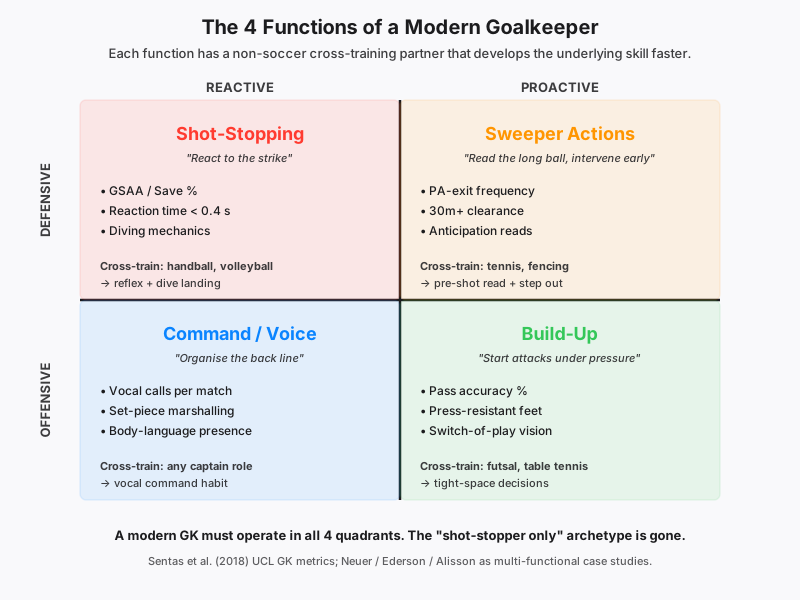
Five Core Ability Categories for Goalkeepers
- Reaction speed and anticipation -- Reflexive responses to close-range shots and reading the shooter's body to predict shot direction
- Aerial ability -- Jump reach during high-ball claims, body control in the air, and cross handling
- Diving technique -- Lateral reach, ground-contact management, and rapid recovery after a dive
- One-on-one positioning -- Closing down angles, blocking posture, and spread-save decisions
- Footwork and distribution -- Participating in build-up play, accurate feeds, and press evasion
Sheppard & Young (2006) demonstrated in their reactive-agility research that the quality of responses to stimuli depends on the diversity of stimuli encountered in the training environment. Soccer goalkeeper sessions alone offer limited variation in shot angles, speeds, and distances. Different sporting contexts -- close-range handball shots, volleyball spikes, mid-air posture control in gymnastics -- expose the goalkeeper's nervous system to unfamiliar stimuli and expand the response repertoire.
Goalkeepers are the multi-athletes within soccer: they use their hands, dive, roll, and kick. It is precisely this versatility that makes them the position most primed to benefit from cross-training.
Handball -- A Training Ground for Reflexes and Angle Play
A handball goalkeeper faces 30-50 shots per game. Close-range shots from the 6-meter line leave the goal at over 100 km/h, giving a reaction window of just 0.3-0.4 seconds. This high-frequency, high-speed environment is an unmatched accelerator for a soccer goalkeeper's reaction speed and anticipation.
The handball goalkeeping environment is an ideal overload stimulus for soccer goalkeepers. According to Karcher & Buchheit (2014), elite handball goalkeepers face 30-50 shots per match, roughly 60% of which come from near the 6-meter line. Compared with the 3-6 decisive save opportunities a soccer goalkeeper experiences per match, the gap in repetition volume is stark.
Transfer Mechanism for Reaction Speed
At close range in handball, there is physically not enough time for the goalkeeper to see the ball's trajectory and then react. This forces the development of anticipation through advance cues: the shooter's trunk rotation, arm-swing angle, and gaze direction. Williams & Burwitz (1993) showed that the ability to read these advance cues is the single biggest factor separating elite from non-elite goalkeepers. The high-frequency prediction-reaction cycles in handball transfer directly to penalty-kick and free-kick situations in soccer.
Shared Principles of Angle Play
Positioning for a handball goalkeeper follows the same geometric principle as angle play in soccer: stand on the line connecting the shooter and the center of the goal, then step forward to narrow the effective shooting angle. In handball this is practiced dozens of times per match. Although goal dimensions differ (handball: 3 m x 2 m; soccer: 7.32 m x 2.44 m), the underlying geometry is identical, and the high-frequency reps in handball's compact space sharpen a soccer goalkeeper's positional accuracy.
A handball goalkeeper faces roughly ten times as many save opportunities per match as a soccer goalkeeper. This overwhelming volume of repetitions rapidly optimizes the neural pathway of predict-react-reposition.
Volleyball -- Expanding Diving Technique and Aerial Reach
The dig (receive) and block in volleyball share remarkably similar movement patterns with a soccer goalkeeper's diving save and high-ball handling. The superior vertical-jump ability of volleyball players reported by McNeal et al. (2007) translates directly to improved high-ball claims for goalkeepers.
Volleyball's fundamental task is to play the ball before it hits the ground -- a challenge that is structurally identical to goalkeeping. The flying dig (pancake, diving dig) performed by liberos in particular shares strong biomechanical similarities with a soccer goalkeeper's lateral dive.
Transfer of Diving Mechanics
In a volleyball dig, the player launches laterally from a low stance, controls contact with the floor, and reaches the ball. This cycle of dive-land-recover mirrors the soccer goalkeeper's sequence of diving save followed by reaction to the second ball. A single set offers 10-20 dig opportunities, meaning 30-60 repetitions across a three-set match. Overcoming the fear of ground contact, refining impact-absorption technique, and extending lateral reach -- all of these transfer directly to goalkeeping saves.
Blocking and High-Ball Handling
A volleyball block requires contacting the ball at peak reach above the net. McNeal et al. (2007) reported that volleyball players demonstrate superior vertical-jump performance compared to athletes in other sports, attributing this to the optimization of the stretch-shortening cycle (SSC) through repetitive jump training. For goalkeepers, an increase in peak reach height directly strengthens aerial dominance when punching or catching crosses. Volleyball blocking practice simultaneously trains timing, takeoff, and hand manipulation in the air, making it a highly efficient drill.
Developing Reads and Anticipation
A volleyball receiver reads the spiker's approach angle, shoulder rotation, and arm-swing direction to predict where the ball will land. This anticipatory process shares the same cognitive architecture as shot-stopping for a soccer goalkeeper. Abernethy et al. (2001) demonstrated that anticipation skills can transfer between sports, meaning that the high volume of read-react cycles in volleyball enhances a goalkeeper's prediction accuracy.
Volleyball trains the three core goalkeeper skills -- diving laterally, jumping vertically, and reading where the ball will go -- all within a single sport. That makes it a uniquely well-rounded cross-training tool.
Gymnastics -- Building Acrobatic Body Control
Gymnastics develops spatial awareness and mid-air postural control -- foundational abilities for diving and collapsing saves. Jemni et al. (2006) found that gymnasts' proprioceptive processing speed significantly exceeds that of other athletes.
Gymnastics and goalkeeping share a central challenge: controlling the body while airborne. During a diving save, a goalkeeper must adjust hand position mid-flight and manage the impact of landing. This entire sequence of aerial actions can be systematically trained through floor work and trampoline exercises from gymnastics.
Forward Rolls, Backward Rolls, and Cartwheels -- Building a Foundation for Falls and Landings
What young goalkeepers fear most during a match is the impact of diving. Particularly at the youth level, goalkeepers tend to subconsciously avoid ground contact, which shrinks their effective saving range. Forward rolls, backward rolls, and cartwheels teach the body that the ground is not the enemy. Learning how to distribute impact, absorb energy through rotation, and recover posture after landing -- much like breakfall techniques in judo -- lays the groundwork for safe diving technique.
Trampoline -- Developing Air Sense and Core Stability
Trampoline training develops the ability to control mid-air posture in a temporarily weightless environment. When claiming a high ball, a goalkeeper must stabilize the core and position the hands optimally during the airborne phase between takeoff and ball contact. Building on Komi & Bosco's (1978) SSC research, subsequent findings have shown that repetitive trampoline jumping significantly improves core stability in the air. Even two 15-minute trampoline sessions per week can produce measurable benefits.
Handstands and Balance Skills
Handstands train the ability to maintain posture in an inverted position, heightening vestibular-system (inner-ear balance organ) sensitivity. Because goalkeepers frequently perform movements that momentarily disrupt balance -- diving, collapsing, spreading -- a highly responsive vestibular system is a prerequisite for safe and effective saves. Moreover, the capacity to maintain core tension while inverted translates directly into axial stability across every goalkeeping action.
The ability gymnastics cultivates -- knowing exactly where your body is in space at every moment -- lies at the heart of goalkeeping technique. A goalkeeper who does not fear the ground and can manipulate the body freely in the air extends the effective saving range itself.
Integrating Cross-Training into the Weekly GK Schedule -- Practical Program Design
Rather than cramming handball, volleyball, and gymnastics in haphazardly, placing the right sport at the right point in the weekly cycle avoids overload and maximizes transfer.
The guiding principle when embedding cross-training in a goalkeeper's weekly routine is: never compromise the quality of dedicated GK sessions. Cross-training is a supplement, not a substitute for specialized goalkeeper practice. The framework below assumes a high-school goalkeeper training six days a week.
Sample Weekly Schedule (In-Season)
- Monday (Recovery day): 15 min of gymnastics floor work (forward rolls, backward rolls, cartwheels) -- doubles as flexibility training and active recovery
- Tuesday (GK-specific day): Standard 90-min GK session. Incorporate a 10-min volleyball-style dig drill into the warm-up
- Wednesday (Team-tactics day): Full team training. No additional cross-training needed
- Thursday (GK-specific day): 30-min handball GK session (close-range shot-stopping) + 60-min soccer GK session
- Friday (Match-eve): Light 10-min trampoline work + set-piece review. No high-intensity cross-training
- Saturday: Match day
- Sunday: Full rest
Priority Cross-Training by Phase
- Reaction-speed phase -- Handball GK sessions twice a week. Close-range shot-stopping raises the reaction threshold. An application of the overload principle from Sheppard & Young's (2006) reactive-agility theory
- Aerial-ability phase -- Volleyball blocking and trampoline twice a week. The goals are to raise peak reach height and optimize the stretch-shortening cycle (SSC)
- Body-control phase -- Gymnastics floor work and balance exercises three times a week. Best placed during the early-season foundation-building period
The key is not to pursue all three sports at full intensity simultaneously but to rotate the emphasis in 4-6-week blocks. For example, a six-week preseason might progress through gymnastics (weeks 1-2), volleyball (weeks 3-4), and handball (weeks 5-6).
Cross-training for goalkeepers works by substitution, not addition. Replace part of the warm-up or cool-down with movements from another sport, and you gain stimulus diversity without increasing total training load.
Recording Progress in Footnote -- Making Goalkeeper Growth Visible
Goalkeeper development cannot be captured by match statistics alone -- save counts and goals conceded tell only part of the story. Documenting how abilities gained through cross-training change the quality of your saves is what deepens self-understanding as a goalkeeper.
Evaluating goalkeeper performance is more complex than for any other position. A clean sheet does not necessarily equal a strong performance, and conceding three goals while stopping seven clear chances may demonstrate far greater ability. When recording the effects of cross-training in Footnote, keep the following perspectives in mind.
Recording Framework for Goalkeepers
- Changes in save quality -- Concrete qualitative changes such as diving reach, reaction timing, and recovery speed after landing. Example: "After handball sessions, I feel faster reacting to close-range shots. I'm starting to move on anticipation rather than reaction."
- Changes in aerial duels -- Cross handling, punching height, and confidence in the air. Example: "Volleyball blocking improved my jump timing. In Sunday's match I punched a cross I never would have reached before."
- Changes in body control -- Reduced fear of diving, improved collapsing technique. Example: "Thanks to gymnastics breakfall drills, I'm less afraid of going to ground. My saving range feels noticeably wider."
- Changes in mentality -- Confidence, sustained concentration, composure under pressure. Example: "Facing 30 consecutive shots in handball gave me a calm in one-on-one situations I didn't have before."
The most important habit is a weekly reflection: "Which moment in this week's match benefited from my cross-training?" This hypothesis-and-verification cycle sharpens self-analysis and enables productive conversations with coaches. When it comes to trials or pathway decisions, being able to logically explain how your goalkeeping strengths were built is a clear differentiator from other candidates.
Goalkeeper growth is hard to see -- and that is exactly why it is worth recording. The cross-training journey documented in Footnote builds both the goalkeeper's own conviction and the trust of those who coach them.
Frequently Asked Questions
I have zero experience in handball or volleyball. Will cross-training still help if I start from scratch?▾
Yes. The goal of cross-training is not to become proficient in another sport but to repeat movement patterns that goalkeepers need in a different environment. Even casual shooting practice with a friend in handball serves as close-range reaction training, and recreational volleyball provides ample dig repetitions. It is the volume of movement repetitions, not the level of competitive experience, that drives transfer.
Won't adding cross-training on top of team GK sessions lead to overtraining?▾
The principle is to substitute, not to add. Replace 15 minutes of the warm-up with volleyball-style dig drills and the cool-down with gymnastics floor work, and you increase stimulus diversity without raising total load. If you do add volume, follow DiFiori's guideline of keeping weekly training hours at or below the athlete's age.
How does goalkeeper cross-training differ from outfield-player cross-training?▾
Cross-training for outfield players centers on running capacity, agility, and tactical decision-making. Goalkeeper cross-training should focus on aerial ball handling with the hands, ground-contact technique, and close-range reaction speed. Handball, volleyball, and gymnastics address these goalkeeper-specific needs precisely, so it is logical to design a separate cross-training menu from that of outfield players.
I can't do breakfalls or rotational skills from gymnastics. What level should I start at?▾
Begin with three basics: the forward roll, the lateral roll, and getting up from a back-down position. The first priority is simply accumulating the experience that rolling on a mat does not hurt. That alone will reduce the fear of diving. Advanced skills like handstands or back flips are unnecessary. The purpose is not acrobatic mastery but physical preparation for ground contact and improved spatial awareness.
How should I explain cross-training to my GK coach?▾
Three talking points work well. First, in-game repetitions for goalkeeper-specific actions are structurally scarce -- goalkeepers average only 3-5 saves per match. Second, a handball goalkeeper faces roughly ten times that volume, offering a far more efficient pathway to improving reaction speed. Third, volleyball and gymnastics have scientific backing for overcoming the fear of diving and developing aerial ability. Presenting effect data recorded in Footnote strengthens the case further.
References
- [1] Ziv G, Lidor R (2011). “Physical characteristics, physiological attributes, and on-field performances of soccer goalkeepers” International Journal of Sports Physiology and Performance. Link
- [2] Sheppard JM, Young WB (2006). “Agility literature review: classifications, training and testing” Journal of Sports Sciences. Link
- [3] Karcher C, Buchheit M (2014). “On-court demands of elite handball, with special reference to playing positions” Sports Medicine. Link
- [4] Williams AM, Burwitz L (1993). “Advance cue utilization in soccer goalkeeping” Journal of Sports Sciences.
- [5] McNeal JR, Sands WA, Shultz BB (2007). “Muscle activation characteristics of tumbling take-offs” Sports Biomechanics. Link
- [6] Abernethy B, Gill DP, Parks SL, Packer ST (2001). “Expertise and the perception of kinematic and situational probability information” Perception. Link
- [7] Di Salvo V, Benito PJ, Calderon FJ, et al. (2008). “Activity profile of elite goalkeepers during football match-play” Journal of Sports Medicine and Physical Fitness.
- [8] Jemni M, Sands WA, Friemel F, Stone MH, Cooke CB (2006). “Any effect of gymnastics training on upper-body and lower-body aerobic and power components in national and international male gymnasts?” Journal of Strength and Conditioning Research. Link
Related Articles
Verbalization Accelerates Transfer -- Why Writing Makes Skills from Other Sports Carry Over to Soccer
11 min read
How Handball Elevates Your Shot Power, Goalkeeping, and Counter-Attack Instincts — Kinetic Chain Transfer and Decision Speed
10 min read
How Volleyball Builds Jump Power, Aerial Body Control, and Team Communication — The Science of Cross-Training Transfer to Soccer
10 min read
Ballet x Soccer -- How Body Awareness, Change of Direction, and Core Control Become Weapons on the Pitch
11 min read
Cross-Training for Defenders -- How Martial Arts, Basketball & Gymnastics Build a Stronger Defensive Foundation
10 min read
Track Your Growth with Footnote
Just record your matches — AI analyzes every 5 games. Visualize growth with PVS Score. All features free during beta.
30-second signup · No credit card required
Last updated: 2026-05-06 ・ Footnote Editorial