Parkour for Soccer — Urban Training That Builds Spatial Awareness, Landing Skills, and Mental Toughness
Parkour is a movement discipline centered on traversing obstacles efficiently, turning urban environments into training grounds. Grosprêtre & Lepers (2016) reported that parkour practitioners utilize elastic energy in their muscle-tendon units more efficiently than gymnasts, while Puddle & Maulder (2013) demonstrated that parkour landing techniques reduce joint impact forces by up to 18% compared to untrained individuals. The spatial cognition, landing mechanics, environmental adaptability, and fear management cultivated through scaling walls, dropping from heights, and landing with precision are forms of embodied knowledge that transfer directly to soccer agility, injury prevention, and decision-making under pressure.
Where Parkour and Soccer Overlap Physically — Body Control in Unpredictable Environments
Both parkour and soccer share a common cognitive-motor challenge: selecting and executing the optimal physical action in an unpredictable environment, in a split second. This structural similarity is what produces parkour's high transfer effect to soccer.

Photo by Creative Christians on Unsplash
Parkour founder David Belle defined parkour as "the art of movement." Spotting an obstacle, instantly evaluating its shape relative to your own physical capabilities, and choosing the most efficient way to clear it — this process is structurally identical to the cognitive sequence a soccer player follows when registering a defender's position, assessing the available space, and choosing the best dribbling line or passing lane.
Overlapping Physical Capacities
- Agility (change of direction) — In parkour, you change direction instantly based on how obstacles are arranged. In soccer, you change direction repeatedly in response to opponents' movements. Both demand reactive agility that cannot be pre-planned.
- Plyometric ability — Jumps, vaults (clearing obstacles with your hands), and precision jumps (leaping to an exact landing spot) all harness the SSC (stretch-shortening cycle) for explosive movement. They share the same force-production mechanism as soccer sprints and headed clearances.
- Dynamic core stability — Controlling rotation in midair, absorbing impact on landing, and maintaining posture during wall runs all depend on dynamic core stability. These engage the same neuromuscular control patterns used to maintain balance during contact play in soccer.
- Upper-lower body coordination — Vaults require full-body coordination: supporting your weight with your hands while swinging your legs through. In soccer, throw-ins and shielding demand simultaneous control of the upper and lower body in the same way.
A study by Leite et al. (2011) published in the Journal of Sports Science & Medicine reported that parkour practitioners outperformed athletes from other sports on agility tests (the T-test and the Illinois Agility Test). This provides evidence that parkour's emphasis on "adapting movement to the environment" develops a generalized agility that transfers even to standardized testing conditions.
Parkour and soccer are both sports where you "solve problems with your body in an uncertain environment." Replace obstacles with defenders and landings with ball control, and the overlap in the abilities they develop becomes unmistakable.
Spatial Cognition and Environmental Adaptability — Reading the City Trains You to Read the Pitch
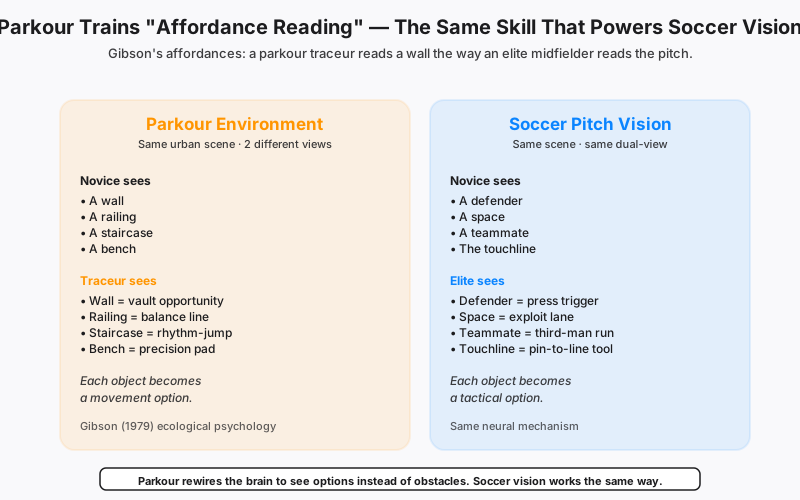
Parkour practitioners develop a specialized spatial cognition in which urban structures are perceived as "movement affordances" — possibilities for action. This ability to read the environment in terms of what actions it allows is structurally identical to the field vision that soccer players use to identify space and construct plays on the pitch.

Photo by Liam Shaw on Unsplash
According to affordance theory, proposed by ecological psychologist J.J. Gibson, the environment offers an observer "possibilities for action." For a parkour practitioner, a wall is "something to climb," a railing is "something to vault over," and a ledge is "a precision-jump landing point." Pepping & Li (2000) showed that skilled movers perceive environmental affordances more richly than novices.
Affordance Perception on the Soccer Pitch
Elite soccer players perceive the arrangement of players on the pitch instantly as "passing possibilities," "gaps to dribble through," and "space to run in behind." This shares the same cognitive structure as a parkour practitioner reading the urban environment as "movement possibilities." Training affordance perception in urban spaces through parkour has the potential to indirectly strengthen spatial cognition on the soccer pitch.
- Environmental scanning — In parkour, you continuously scan the layout, height, surface texture, and distance of obstacles ahead while running. In soccer, this transfers to the habit of checking over your shoulder to register teammates, opponents, and open space.
- Dynamic distance judgment — The ability to judge takeoff points accurately while in motion. In soccer, this applies to gauging pass distance, shooting range, and the timing of forward runs.
- Simultaneous evaluation of multiple routes — Envisioning several ways to clear an obstacle at once and instantly choosing the most efficient path. In soccer, this maps to evaluating multiple passing lanes or dribbling routes simultaneously.
Parkour is training for "the eye that reads the environment." The sharper your ability to read wall-and-railing layouts becomes, the sharper your ability to read defender-and-space configurations becomes — transfer occurs precisely because the underlying cognitive structure is the same.
Landing Technique, Breakfalls, and Soccer Injury Prevention — The Science of Impact Absorption
Puddle & Maulder (2013) demonstrated that parkour practitioners' landing techniques reduce joint impact forces by up to 18% compared to untrained individuals. The majority of ACL tears and ankle sprains in soccer occur during landing, deceleration, and changes of direction, making parkour's landing mechanics directly relevant to injury prevention.
In a study published in the Journal of Sports Science & Medicine, Puddle & Maulder (2013) had parkour practitioners and untrained individuals perform drop landings from a height of 75 cm. Parkour practitioners exhibited significantly lower peak impact forces at the knee joint and naturally performed "soft landing" techniques that used greater joint range of motion. Parkour's landing system includes a breakfall technique called the roulé (roll), which distributes the impact of a high drop across the entire body in a codified sequence of movements.
When Landing Technique Makes the Difference in Soccer
- Landing after aerial duels — The moment a player lands in an unstable posture after jumping for a header is when ACL injury risk peaks. Parkour's soft-landing technique reduces excessive load on the knee joint.
- Deceleration during direction changes — Sudden direction changes place enormous force on the braking leg. The landing control developed through parkour precision jumps enhances joint stability during deceleration.
- Falling after tackles — When a player goes down after a challenge, parkour's roulé (forward-roll breakfall) reduces the risk of injury. Unlike judo breakfalls practiced on soft mats, parkour breakfalls are designed for hard surfaces, making them directly transferable to a soccer pitch.
- Goalkeeper diving — Absorbing the impact of landing after a lateral diving save. Parkour's side-roll technique improves the precision and safety of goalkeepers' breakfall movements.
Krosshaug et al. (2007), writing in the British Journal of Sports Medicine, reported that over 70% of ACL injuries are non-contact — occurring without collision with another player — and that most happen during landing, deceleration, or changes of direction. Because parkour landing training systematically builds joint control during these high-risk movements, it holds significant value as a complement to soccer injury-prevention programs.
The best athletes are separated not by how they jump but by how they land. The landing mechanics systematized through parkour are among the most practical injury-prevention skills for protecting a soccer player's career.
— Principles of Landing Biomechanics
Agility, Direction Changes, and Explosiveness — Harnessing Elastic Energy in Muscle-Tendon Units
Grosprêtre & Lepers (2016) reported that the SSC (stretch-shortening cycle) efficiency of parkour practitioners' muscle-tendon units surpasses that of gymnasts. This superior elastic-energy utilization transfers directly to soccer sprint acceleration, sudden stops, and changes of direction.
A study by Grosprêtre & Lepers (2016) in the Journal of Electromyography and Kinesiology compared the muscle-tendon properties of parkour practitioners, gymnasts, and untrained individuals, finding that parkour practitioners exceeded gymnasts in SSC efficiency. The SSC is the mechanism by which a muscle that has first been stretched contracts rapidly, using spring-like elastic energy — a foundational motor capacity involved in every jump, sprint, and change of direction.
How Parkour SSC Training Transfers to Soccer
- Repetitive jump-and-land cycles — Parkour involves continuous sequences of jumping and landing. Precision jumps, vaults, and wall runs all exploit the SSC, progressively improving tendon elasticity. Soccer sprint acceleration depends heavily on this SSC efficiency.
- Non-standard ground contact — Producing force not just on flat ground but on wall surfaces, railings, and ledge edges trains adaptability that transfers to soccer's variable surfaces — muddy pitches, long or short grass, and artificial turf.
- Repeated sudden stops and explosive restarts — The parkour pattern of braking hard before an obstacle and accelerating hard after clearing it is mechanically identical to soccer's stop-and-go movements and acceleration out of feints. It trains both deceleration strength (eccentric) and acceleration strength (concentric).
In a review published in the Journal of Sports Sciences, Sheppard & Young (2006) classified agility into "planned change-of-direction ability" and "reactive change-of-direction ability," arguing that the latter is what drives sport performance. Because parkour involves moving through environments where obstacle layouts differ every time, it naturally trains "changes of direction in situations that cannot be pre-planned" — a perfect match for the reactive agility required when changing direction in response to an opponent during a soccer match.
A parkour practitioner's muscle-tendon units evolve into "the ultimate springs." This elastic-energy utilization underpins the core elements of soccer's physical performance — initial sprint speed, sharpness of direction changes, and jump height. The SSC efficiency that surpasses even gymnasts is an adaptation unique to parkour, born from repeatedly performing diverse movements on hard surfaces.
Overcoming Fear and Developing Risk-Assessment Skills — Engaging with Height, Speed, and Impact
Cazenave et al. (2012) reported that parkour practitioners stand out among extreme-sport athletes for their notably rational approach to risk assessment. The psychological skill of "using fear as information" rather than "ignoring fear" transfers to soccer duels, one-on-one attacks, and decisive moments under pressure.
Parkour routinely involves movements that trigger instinctive fear — jumping from heights, scaling walls, and landing at speed. Yet parkour culture does not emphasize "conquering fear" but rather "dialoguing with fear." Cazenave et al. (2012) found that parkour practitioners are not reckless risk-takers; instead, they act only after accurately evaluating their own abilities against the difficulty of the environment.
How Fear Management Transfers to Soccer
- One-on-one attacking — The moment you commit to a dribble, you feel the fear: "If I fail, we'll get countered." A player trained through parkour to "assess risk and then execute" develops the capacity for calculated challenges — neither reckless nor timid.
- Penalties and free kicks under pressure — These are moments where the outcome can decide the match. The parkour experience of repeatedly moving your body while acknowledging fear transfers to maintaining physical control under extreme pressure.
- Intense physical contact — The fear of colliding with a bigger opponent. A player who has routinely experienced impacts against walls and hard ground in parkour, and who has internalized breakfall techniques, stops avoiding body contact.
- Instant recovery after mistakes — In parkour, failure — missed landings, loss of balance — is everyday. The habit of instantly regaining composure and transitioning to the next move transfers to faster mental recovery after a misplaced pass or a failed dribble in soccer.
As Bandura's (1997) self-efficacy theory demonstrates, the most effective way to build self-efficacy is through "mastery experiences of progressively difficult tasks." Parkour systematically builds a player's self-efficacy through graduated progression — small obstacles, then larger obstacles, then complex routes. This deep-seated conviction of "I can do this" is what supports bold decision-making in soccer's biggest moments.
What parkour teaches is not fearlessness but "using fear as information." The feeling of your legs freezing when you look up at a wall is a signal telling you the limits of your current ability. A player who can engage in that dialogue with fear becomes neither reckless nor timid on the soccer pitch — they become the player who makes the strongest decisions.
Safe Introduction — The Principles of Graduated Progression
Graduated progression is a non-negotiable requirement when introducing parkour. Start with basic movements on flat ground, advance to low obstacles, then to medium obstacles, confirming solid technical mastery at each stage before moving to the next — this is how safety and effectiveness are achieved simultaneously.
To introduce parkour safely as a cross-training tool for soccer, graduated progression that always prioritizes "quality of movement" over "difficulty of movement" is essential. Standing & Maulder (2015) discussed the effectiveness of a step-by-step approach in parkour instruction, demonstrating that mastery of fundamental movements is a prerequisite for the safe execution of advanced techniques.
The Four Stages of Progression
- Stage 1: Ground-level fundamentals (Weeks 1–2) — Practice precision squats (landing squats at exact positions), QM (Quadrupedal Movement), and forward/side-roll breakfalls on flat ground. These also work well as a dynamic warm-up for soccer sessions.
- Stage 2: Low obstacles (Weeks 3–4) — Using benches and ledges at knee to hip height, practice step vaults (placing one hand and swinging the legs over), lazy vaults (clearing sideways), and precision jumps (landing on a target spot). Always prioritize soft landings.
- Stage 3: Medium obstacles and sequential movement (Weeks 5–8) — Using obstacles at hip to chest height, practice speed vaults, kong vaults (pushing off with both hands and driving the body through), and basic wall climbs. Begin attempting flows — linking multiple obstacles in sequence.
- Stage 4: Advanced movements and free flow — Attempt taller obstacles, wall runs, and jumps between precision points. Reaching this stage requires at least two to three months of graduated practice. Always train under the supervision of an experienced practitioner or coach.
For soccer players, the movements in Stages 1 and 2 alone provide ample cross-training benefits. QM in particular is extremely effective for simultaneous upper-body and core strengthening and can be incorporated into the opening minutes of soccer practice as a parkour-infused dynamic warm-up. Progressing to advanced techniques is optional; repeating the fundamentals is enough to improve spatial cognition, landing skill, and dynamic balance.
- Environmental safety checks — Before every session, inspect the ground surface (wet, gravel, cracks), the stability of obstacles, and the presence of pedestrians or vehicles nearby.
- Protective equipment — Knee pads and gloves are recommended during the initial stages. Gloves are especially useful for preventing friction injuries to the palms during vault practice.
- In-season risk management — Within three days of a match, avoid attempting any new movements. Perform only well-mastered movements at low intensity.
The most important principle in parkour instruction is "honestly evaluating your own ability." Rather than forcing movements you cannot do, raise the quality of the movements you can do to the highest possible level. This philosophy is a universal training principle that applies to soccer growth as well.
Using Footnote to Get the Most out of Parkour Training
To maximize the impact of parkour on soccer development, it is important to articulate not just "what you can now do" but "which soccer situations this movement transfers to" and record that in Footnote.
When recording parkour as soccer cross-training, always include a "transfer hypothesis" alongside the parkour movements in your Footnote practice log. Do not stop at "what I did today" — extend it to "what I will try in the next soccer session or match." This is the key to accelerating the transfer effect.
Sample Parkour Session Log Entries
- Movement content and achievement level — "Repeated step vaults on a hip-height bench 20 times. Performed on both sides. Noticed my core wobbles when planting with my left hand."
- Spatial-cognition insights — "Practiced a flow across three consecutive obstacles. Realized that if I don't register the distance and height of the third obstacle while clearing the second, my landing falls apart. Same principle as looking two moves ahead in soccer."
- Landing technique self-assessment — "Correcting a tendency for my knees to collapse inward on precision-jump landings. Consciously aligning my knees over my toes improved stability. Will apply the same knee control during direction changes in soccer."
- Fear-management reflection — "First attempt at a vault at a new height. Hesitated on the first two tries and my movement was stiff, but by the third attempt the fear had eased and my movement smoothed out. Realized the same hesitation structure applies when trying a new play in a match for the first time."
Confirming Transfer in Soccer Practice and Matches
Take the insights gained from parkour, consciously apply them in soccer contexts, and log the results back in Footnote. Entries like "Applied the knee-alignment awareness from parkour landings to my direction changes — noticeably more stable after cutting" create a concrete experiment-and-result cycle that accelerates the transfer of cross-training benefits.
Using Footnote's review features, you can track changes in your agility self-assessment, landing stability, and willingness to engage in one-on-ones over time. After three to four weeks of entries, patterns emerge showing which parkour movements are most effective for your soccer game.
Don't stop at "I got better at vaults." Write it all the way to "left-hand plant core stability leads to better accuracy on left-foot kicks." Only when you articulate the transfer point in Footnote does parkour truly function as soccer cross-training. The habit of verbalizing transfer points is the bridge between these two worlds.
Frequently Asked Questions
Isn't parkour too risky for soccer players in terms of injury?▾
When graduated progression is followed, parkour's injury risk is equal to or lower than that of general sports activities. As Puddle & Maulder's (2013) research shows, parkour practitioners' landing techniques actually reduce joint impact forces, meaning you gain injury-prevention skills in the process. The key is to never attempt movements beyond your current level of mastery and to always progress in a safe environment. During the competition season, perform only well-mastered movements at low intensity.
What age can you start parkour? Is it safe for elementary-school children?▾
Basic movement patterns — quadrupedal movement, jumping off low ledges, forward rolls — can be started safely from the early elementary years. Children naturally perform parkour-like movements through play: climbing walls, jumping, walking on balance beams. Under the supervision of a qualified instructor with graduated progression, this is actually an ideal age for developing spatial cognition and landing skills. Movements involving taller obstacles or high speed should be introduced from middle school onward, only after a solid foundation has been established.
Where can you practice parkour? Do you need a dedicated facility?▾
No dedicated facility is required. One of parkour's great advantages is that you can practice on everyday structures — park benches, low walls, steps, and railings. Gymnasium equipment such as vaulting boxes and balance beams can also be repurposed for parkour movement practice. However, always check the ground for hazards (wet surfaces, gravel, broken glass) and confirm the stability of obstacles before training. Dedicated parkour gyms are also growing in number and are worth considering if you want to progress indoors in a controlled environment.
Is there a way to incorporate parkour movements into soccer practice?▾
Integrating parkour fundamentals into the warm-up is the most practical approach. Just five minutes of QM (quadrupedal movement) — forward, backward, and lateral — effectively activates the core and upper body. Vault drills using cones or mini-hurdles as obstacles, and precision jumps targeting markers, can all be done on a regular training pitch. Adding parkour elements for 15 to 20 minutes once or twice a week is enough to see improvements in agility and landing technique.
What is the most effective way to log parkour training in Footnote?▾
Record your parkour movements alongside a "transfer hypothesis to soccer" in your practice log. For example: "Focused on knee alignment during precision-jump landings → will apply to knee control during direction changes." Then try the transfer hypothesis in your next soccer session and add the results. This feedback loop clarifies which parkour movements are most effective for which soccer abilities. Use Footnote's review features to track changes over three to four weeks.
References
- [1] Grosprêtre, S. & Lepers, R. (2016). “Performance characteristics of Parkour practitioners: Who are the traceurs?” European Journal of Sport Science, 16(5), 526-535. Link
- [2] Puddle, D. L. & Maulder, P. S. (2013). “Ground reaction forces and loading rates associated with parkour and traditional drop landing techniques” Journal of Sports Science & Medicine, 12(1), 122-129.
- [3] Krosshaug, T., Nakamae, A., Boden, B. P., Engebretsen, L., Smith, G., Slauterbeck, J. R., ... & Bahr, R. (2007). “Mechanisms of anterior cruciate ligament injury in basketball: Video analysis of 39 cases” American Journal of Sports Medicine, 35(3), 359-367. Link
- [4] Sheppard, J. M. & Young, W. B. (2006). “Agility literature review: Classifications, training and testing” Journal of Sports Sciences, 24(9), 919-932. Link
- [5] Pepping, G. J. & Li, F. X. (2000). “Changing action capabilities and the perception of affordances” Journal of Human Movement Studies, 39(2), 115-140.
- [6] Cazenave, N., Michel, G., & Le Scanff, C. (2012). “Self-determination in Parkour: A psychological study” Ricyde: Revista Internacional de Ciencias del Deporte, 8(29), 313-327. Link
- [7] Bandura, A. (1997). “Self-efficacy: The exercise of control” W.H. Freeman and Company.
- [8] Leite, N., Aguiar, M., Abade, E., & Sampaio, J. (2011). “Effect of fatigue on agility and change of direction in different sports” Journal of Sports Science & Medicine, 10(4), 680-686.
Related Articles
The Science Behind How Climbing Transfers Problem-Solving, Core Stability, and Fear Management to Soccer
11 min read
Conquering Fear — The Science of Mental Toughness Built Through Extreme Sports
12 min read
Spatial Cognition — The Science of Reading Space, Trained Through Team Sports
10 min read
Core and Axis -- How Ballet, Gymnastics, and Yoga Build Soccer's Unshakable Foundation
11 min read
Flexibility and Mobility — The Science Behind How Yoga, Ballet, and Gymnastics Prevent Soccer Injuries
10 min read
Track Your Growth with Footnote
Just record your matches — AI analyzes every 5 games. Visualize growth with PVS Score. All features free during beta.
30-second signup · No credit card required
Last updated: 2026-05-06 ・ Footnote Editorial