Nutrition Strategies for Cross-Training: A Meal & Fueling Guide for Multi-Sport Soccer Players
Soccer players who combine multiple sports through cross-training see total energy expenditure rise by 20 to 40 percent compared with single-sport athletes. The joint position statement by the ACSM, AND, and DC (Thomas et al., 2016) established that carbohydrate and protein intake timing relative to training volume has a decisive effect on performance and recovery. Desbrow et al. (2014) further emphasize that nutrition strategies for junior athletes must simultaneously meet the demands of growth and competitive performance. This article provides a comprehensive, evidence-based nutrition strategy for soccer players who cross-train.
Rising Energy Demands During Cross-Training and How to Meet Them
Players who add swimming, running, or other activities on top of soccer practice expend significantly more total energy than single-sport athletes. Thomas et al. (2016) showed that adjusting energy intake to match training volume is the key to sustaining performance and recovery.

Photo by Mike Von on Unsplash
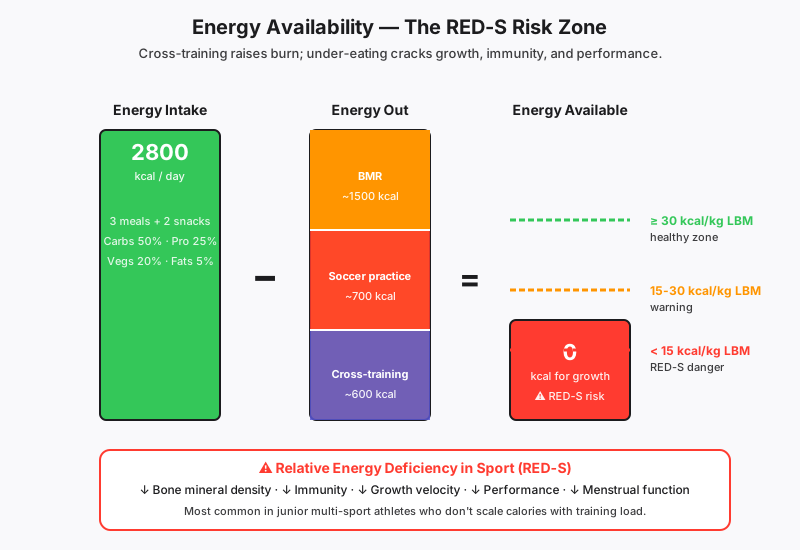
A 90-minute soccer session burns roughly 600 to 900 kcal. Add 60 minutes of swimming (about 500 to 700 kcal) or 30 minutes of running (about 300 to 400 kcal), and total daily expenditure can reach 1.5 to 2 times normal levels. Failing to compensate for this increase risks Relative Energy Deficiency in Sport (RED-S), which can impair performance, suppress immune function, and interfere with growth.
Fundamentals of Energy Intake Design
- Basal metabolism + activity energy — Growing junior athletes need 1,400 to 1,800 kcal per day for basal metabolism alone. On cross-training days, total expenditure can reach 2,500 to 3,500 kcal, so three main meals plus two to three snacks are necessary to cover the demand
- Increase carbohydrate intake — Thomas et al. (2016) recommend 5 to 7 g of carbohydrate per kilogram of body weight for athletes engaged in moderate-to-high-intensity endurance training. On heavy cross-training days, this may need to rise to 7 to 10 g/kg
- Distribute protein throughout the day — Spreading total daily protein (1.2 to 1.6 g/kg) into 20 to 30 g doses every three to four hours maximizes muscle protein synthesis (Morton et al., 2018)
A critical point is that although "eat more on heavier training days" seems obvious, many athletes fail to do it. Burke et al. (2011) reported that athletes commonly underestimate energy intake on high-intensity training days without realizing it. When introducing cross-training, both the quantity and quality of meals must be consciously adjusted.
Cross-training means adding more practice volume. Without a matching increase in fueling, the result is chronic fatigue, not performance gains.
Sport-Specific Nutrition: Endurance, Power, and Intermittent Activities
Different cross-training activities consume different ratios of energy substrates (carbohydrate vs. fat) and inflict different levels of muscle damage. Tailoring nutrition to each activity type maximizes both recovery speed and training effectiveness.
Fueling every cross-training session with the same meal plan is inefficient. Swimming and sprint drills place very different nutritional demands on the body. In a comprehensive review in the Journal of Sports Sciences, Burke et al. (2011) stressed that periodized nutrition—adjusting dietary strategy to match training type—is a cornerstone of athletic development.
Endurance Training (Swimming, Distance Running, Cycling)
- Primary energy substrates — At moderate intensity (60 to 75% HRmax), fat and carbohydrate are used roughly equally. As intensity rises, carbohydrate dependence increases
- Pre-session — Eat a carbohydrate-centered meal two to three hours beforehand (e.g., a bagel with jam, a banana, and a light soup). Choose easily digestible foods that will not sit heavy in the stomach
- During the session — For endurance work lasting more than 60 minutes, 30 to 60 g of carbohydrate per hour is recommended. Sports drinks or energy gels are the most practical options
- Post-session — Within 30 minutes, consume 20 g of protein plus 1 g/kg of carbohydrate. This golden window accelerates muscle glycogen replenishment
Power Training (Sprints, Jumps, Martial Arts)
- Primary energy substrates — The ATP-CP and glycolytic systems dominate. Large amounts of energy are burned in a short time, but total calorie expenditure is lower than in endurance work
- Pre-session — Eat a light carbohydrate snack one to two hours before (e.g., a banana with yogurt). Stomach heaviness directly affects explosive performance, so avoid overeating
- Post-session — Protein intake is especially important. Supply 20 to 25 g of protein within 30 minutes to repair micro-damage to muscle fibers
Intermittent-Activity Training (Basketball, Handball, Tennis)
- Energy demands — Both endurance and power systems are taxed. Because the stop-and-go pattern resembles soccer, carbohydrate consumption is high
- Pre-session — Two hours before, eat a balanced meal of carbohydrate and protein (e.g., pasta with chicken, or a rice bowl with salad)
- During the session — Prioritize fluids and electrolytes. If the session exceeds 60 minutes, add carbohydrate supplementation
- Post-session — Replenish both carbohydrate and protein. A rice ball with a protein shake, or a meat- or fish-based meal, is ideal
Simply asking "Is today's cross-training endurance, power, or intermittent?" clarifies dietary priorities. Load up on carbohydrate for endurance days, emphasize protein for power days—this distinction is what separates fast recovery from slow.
Nutrient Timing: Fueling Before, During, and After Training
The ISSN position stand by Kerksick et al. (2017) demonstrated that the timing of nutrient intake significantly affects muscle glycogen recovery rate and muscle protein synthesis. Nutrient timing is essential knowledge for any athlete who trains more than once per day through cross-training.
The biggest nutritional challenge facing cross-training athletes is managing recovery across multiple sessions in a single day. When the schedule calls for soccer in the morning and swimming in the afternoon, the few hours between sessions must be used to recover as fully as possible. What you eat, when you eat it, and how much you eat makes all the difference.
Pre-Session (2 to 3 Hours Before)
The goal of a pre-session meal is to top off muscle glycogen and stabilize blood sugar. Focus on high-GI foods (white rice, bread, noodles) that are easy on the digestive system. Fat and fiber slow digestion, so keep them low close to training. Begin hydrating two hours beforehand, sipping 250 to 500 ml of water in small amounts.
During the Session
- Sessions under 60 minutes — Water or a sports drink for hydration is sufficient. No additional energy intake is needed
- Sessions of 60 to 90 minutes — 30 to 60 g of carbohydrate per hour is recommended. A standard sports drink (roughly 30 g of sugar per 500 ml) is the most practical option
- Sessions over 90 minutes — 60 to 90 g of carbohydrate per hour is needed. Supplement drinks with energy gels or bananas
Post-Session (Ideally Within 30 Minutes)
The 30 minutes following exercise are known as the recovery window, when muscle glycogen synthesis rate is at its highest. During this period, aim for 1 to 1.2 g/kg of carbohydrate and 0.3 g/kg of protein (Kerksick et al., 2017). On two-a-day training days, this post-session snack directly determines performance in the later session.
- Grab-and-go snack example — One to two rice balls plus 200 ml of milk (roughly 50 g carbohydrate + 15 g protein)
- Convenience-store combination — Grilled chicken breast + a rice ball + 100% orange juice
- Home-prepared ideal snack — Banana + protein shake + honey toast
On two-a-day training days, the post-session snack doubles as the pre-session meal for the next practice. Skip it, and concentration drops in the afternoon session—raising the risk of injury.
Essential Nutrients for Growing Junior Athletes
Desbrow et al. (2014) stressed that nutritional strategies for junior athletes must satisfy both "nutrition for growth" and "nutrition for competition" at the same time. Growing athletes have different nutritional needs from adult athletes, and understanding those differences is key to getting the most out of cross-training.
The central challenge for growing athletes is that they must build bigger, stronger bodies while simultaneously fueling intense training. Bone growth, muscle development, and hormonal balance all require ample nutrients, and when cross-training pushes energy expenditure higher, intake can easily fall behind.
Nutrients of Special Importance During Growth
- Calcium (1,000 to 1,300 mg/day) — Bone density formation peaks between ages 10 and 18, making calcium intake during this period a lifelong investment. A 200 ml glass of milk provides about 220 mg; 100 g of kale provides about 170 mg. Pay extra attention on cross-training days that include high-impact activities such as running or basketball
- Iron (8 to 15 mg/day) — Iron is the raw material for hemoglobin, which carries oxygen. During puberty, expanding blood volume drives a surge in iron demand. Lean red meat, liver, spinach, and legumes are excellent sources. Consuming iron with vitamin C boosts absorption
- Vitamin D (600 to 800 IU/day) — Vitamin D promotes calcium absorption and is involved in both immune function and muscle function. Sunlight exposure (15 to 20 minutes per day) is the most efficient source, but athletes who train mostly indoors should consciously increase intake from food (salmon, mushrooms, egg yolks)
- Zinc (8 to 11 mg/day) — Essential for growth hormone secretion and muscle protein synthesis. Found in high concentrations in oysters, beef, cheese, and soy products. Deficiency is particularly likely on heavy-sweat cross-training days
Warning Signs of RED-S (Relative Energy Deficiency in Sport)
The IOC consensus statement by Mountjoy et al. (2018) highlighted the risk of RED-S in junior athletes and the importance of early detection. If any of the following signs appear after increasing training volume through cross-training, dietary intake should be reviewed immediately and a specialist should be consulted.
- Persistent fatigue — Tiredness that does not resolve with adequate sleep. A drop in motivation to train
- Frequent illness — Reduced immune function lowers resistance to viruses, leading to repeated colds or infections
- Performance plateau or decline — Records stagnate or worsen despite an increase in training volume
- Slowed growth — Height gain is noticeably slower than peers. Body weight fails to increase or begins to drop
- Reduced concentration — A marked decline in focus during schoolwork or decision-making during practice
Energy deficiency during the growth years carries long-term risks including reduced bone density and hormonal disruption. When increasing training volume through cross-training, food intake must increase in parallel. Restricting food to "stay lean" or "cut weight" is extremely dangerous for a growing athlete.
The Science of Hydration: How Dehydration Impairs Performance
The ACSM position stand by Sawka et al. (2007) demonstrated that dehydration of 2 percent or more of body weight significantly reduces endurance performance. For athletes whose total daily sweat loss increases through cross-training, a planned hydration and electrolyte strategy is essential.
When multiple sports are played in a single day, total sweat loss can reach 1.5 to 2 times that of a single-sport day. Swimming after soccer is a particular concern: sweating is hard to notice in the water, so dehydration can progress without awareness. Sawka et al. (2007) reported that a mere 2 percent drop in body weight from dehydration (1.2 kg for a 60 kg athlete) can reduce VO2max by up to 10 percent.
Dehydration Levels and Their Impact on Performance
- 1% body-weight loss — Thermoregulation begins to decline. The effect on performance is minor, but thirst starts to appear
- 2% body-weight loss — Endurance performance drops by 5 to 10 percent. Cognitive function (focus and reaction time) also begins to deteriorate
- 3% or more body-weight loss — Core body temperature rises significantly. The risk of heat illness spikes sharply. Continuing exercise becomes dangerous
A Practical Hydration Protocol
- Before training — Drink 400 to 600 ml of water two hours before the session. If urine is a pale yellow, hydration is adequate
- During training — Sip 150 to 250 ml every 15 to 20 minutes. Small, frequent drinks are easier on the stomach than large gulps
- After training — Consume 1.5 times the weight lost through sweat over the following two to four hours (e.g., 1.5 L for every 1 kg lost)
- Electrolyte replacement — For sessions longer than 60 minutes, a sports drink containing sodium is recommended. Rehydrating with water alone carries a risk of exercise-associated hyponatremia
By the time you feel thirsty, you have already lost 1 to 2 percent of your body weight in fluid. Thirst is not a warning of dehydration—it is a report that dehydration has already begun.
— Sawka et al., 2007 — ACSM Position Stand
On cross-training days, make it a habit to weigh yourself before and after each session. The difference is your sweat loss—a direct indicator of how much fluid you need to replace.
Supplements: Necessity and Cautions for Junior Athletes
The IOC consensus statement (2018) clearly states that junior athletes should prioritize nutrition from food and consider supplements only when a specific deficiency has been confirmed.
When cross-training increases practice volume, it is tempting to think "I need supplements to keep up." In reality, the situations where supplements are genuinely necessary for junior athletes are limited. The IOC consensus statement by Maughan et al. (2018), published in the British Journal of Sports Medicine, noted that even among adult athletes, only a handful of supplements are supported by strong evidence—and for juniors, an even more cautious approach is warranted.
Food First: What Matters More Than Supplements
In their review in the International Journal of Sport Nutrition and Exercise Metabolism, Desbrow et al. (2014) stated plainly that the foundation of junior athlete nutrition is securing adequate quality, quantity, and timing of whole-food meals—supplements cannot substitute for real food. Nutrients from food are absorbed more efficiently and benefit from synergistic interactions between nutrients, making whole food physiologically superior.
When Supplements May Be Warranted
- Diagnosed iron-deficiency anemia — When blood tests confirm low ferritin levels and dietary changes alone cannot restore them quickly enough. Iron supplementation must always be supervised by a physician
- Confirmed vitamin D insufficiency — Athletes who live in low-sunlight regions or train predominantly indoors and whose serum 25(OH)D levels are below the recommended range. Again, physician guidance is required
- Dietary restrictions due to food allergies — For example, a calcium supplement for athletes with a dairy allergy who cannot meet calcium requirements through food alone
Important Precautions for Junior Athletes and Supplements
- Anti-doping considerations — Commercial supplements may contain prohibited substances not listed on the label. Choose products certified by a recognized anti-doping agency (e.g., Informed Sport, NSF Certified for Sport)
- Risk of overconsumption — Fat-soluble vitamins (A, D, E, K) accumulate in the body, and excessive intake can cause toxicity
- Over-reliance on protein powder — Protein powder is a supplement, not a staple. In most cases, sufficient protein can be obtained from regular meals (chicken, fish, eggs, legumes, dairy products)
- Parental and professional involvement — Any supplement use by a junior athlete should have parental consent and guidance from a physician or registered dietitian
In summary, the single most important nutrition strategy for a junior soccer player who cross-trains is optimizing the quality, quantity, and timing of whole-food meals. Supplements are an ancillary tool that sits on top of a solid dietary foundation. Get the food right first.
Using Footnote to Track Your Meals
Maximizing the benefits of cross-training means linking your training log to your meal records and analyzing them together. Use Footnote’s tracking features to objectively evaluate how well your nutrition strategy is working.
No matter how much sports-nutrition science you absorb, it is meaningless unless you put it into practice. And the most effective way to sustain execution is to track it. By recording both training and meals in Footnote and looking for connections to performance, you will uncover the nutrition strategy that works best for you.
What to Record
- Pre-session meals — What you ate, when, and how much. This lets you analyze the link between nutrition and how you felt during training
- Post-session snacks — What you consumed within the 30-minute recovery window. Compare this with how fatigued you feel the next day
- Fluid intake — Record body-weight difference before and after training along with how much you drank. This reveals your personal dehydration patterns
- In-session condition — Subjective notes like "faded in the second half," "lost focus," or "felt strong throughout." These can later be cross-referenced with meal data
By adding meal data to Footnote’s reflection notes, the AI can detect patterns such as "this player’s self-rated performance is higher on days with adequate pre-soccer carbohydrate intake" or "fatigue is consistently reported the day after a post-swim snack is skipped." This kind of objective feedback supports continuous, data-driven improvement of your nutrition strategy.
Anyone can learn the science of nutrition. What separates athletes is the discipline to execute and record consistently. Footnote acts as a lens that connects meals to training—helping you find your own optimal formula.
Frequently Asked Questions
How many extra calories should I eat on a cross-training day?▾
Although individual needs vary, a useful estimate is 300 to 600 kcal of additional energy expenditure for each extra hour of cross-training activity. For example, on a day that includes soccer practice (90 min) plus swimming (60 min), you would aim to eat roughly 400 to 600 kcal more than on a soccer-only day. Monitor your weight weekly: if it is trending downward, that signals an energy deficit and you should increase food intake. For growing athletes, erring on the side of eating a little more is the right approach.
What should I eat if I only have two hours between sessions?▾
When the gap is only two hours, there is no time for a full meal. Instead, eat a high-carbohydrate, low-fat snack with moderate protein within 30 minutes of the first session. Practical options include two rice balls plus a banana and 200 ml of milk, or a slice of sponge cake with a protein shake. Avoid high-fat foods (fried items, pastries) because they digest slowly and can cause stomach discomfort during the next session.
Is it safe for middle-school-age athletes to use protein powder?▾
Protein powder is a safe food product in itself, but it is unnecessary if daily protein needs are already being met through regular meals. A middle-school athlete (ages 12 to 15) typically needs about 1.2 to 1.6 g of protein per kilogram of body weight—an amount easily covered by roughly 150 g of chicken, two eggs, 400 ml of milk, and three bowls of rice per day. Protein powder can be a helpful backup when whole food is not available immediately after training, but improving the quality and quantity of regular meals should always come first.
Are there specific nutrition concerns for cross-training in the summer heat?▾
In hot weather, sweat volume can increase by 1.5 to 2 times, making hydration and electrolyte replacement—especially sodium—the top priority. Drinking large amounts of plain water without electrolytes raises the risk of exercise-associated hyponatremia, so pair water with a sports drink or salt tablets. Appetite also tends to drop in the heat, so choose easy-to-eat options such as cold noodles, fruit, yogurt, or smoothies to keep energy and nutrient intake on track. Weigh yourself before and after each session to gauge your personal sweat rate and calibrate fluid replacement accordingly.
What is the benefit of logging meals in Footnote?▾
By linking meal records to training logs in Footnote, the AI can detect patterns between your nutrition and performance. For example, it might surface insights like "performance self-ratings are higher on days with sufficient pre-training carbohydrate" or "fatigue is more likely the day after a post-session snack is skipped." This replaces guesswork with data-driven feedback, enabling ongoing optimization of your nutrition strategy.
References
- [1] Thomas, D. T., Erdman, K. A., & Burke, L. M. (2016). “Position of the Academy of Nutrition and Dietetics, Dietitians of Canada, and the American College of Sports Medicine: Nutrition and Athletic Performance” Journal of the Academy of Nutrition and Dietetics, 116(3), 501–528. Link
- [2] Burke, L. M., Hawley, J. A., Wong, S. H., & Jeukendrup, A. E. (2011). “Carbohydrates for training and competition” Journal of Sports Sciences, 29(sup1), S17–S27. Link
- [3] Desbrow, B., McCormack, J., Burke, L. M., Cox, G. R., Fallon, K., Hislop, M., Logan, R., Marino, N., Sawyer, S. M., Shaw, G., Star, A., Vidgen, H., & Leveritt, M. (2014). “Sports Dietitians Australia position statement: Sports nutrition for the adolescent athlete” International Journal of Sport Nutrition and Exercise Metabolism, 24(5), 570–584. Link
- [4] Kerksick, C. M., Arent, S., Schoenfeld, B. J., Stout, J. R., Campbell, B., Wilborn, C. D., Taylor, L., Kalman, D., Smith-Ryan, A. E., Kreider, R. B., Willoughby, D., Arciero, P. J., VanDusseldorp, T. A., Ormsbee, M. J., Wildman, R., Greenwood, M., Ziegenfuss, T. N., Aragon, A. A., & Antonio, J. (2017). “International Society of Sports Nutrition position stand: Nutrient timing” Journal of the International Society of Sports Nutrition, 14, 33. Link
- [5] Sawka, M. N., Burke, L. M., Eichner, E. R., Maughan, R. J., Montain, S. J., & Stachenfeld, N. S. (2007). “American College of Sports Medicine position stand: Exercise and fluid replacement” Medicine & Science in Sports & Exercise, 39(2), 377–390. Link
- [6] Mountjoy, M., Sundgot-Borgen, J. K., Burke, L. M., Ackerman, K. E., Blauwet, C., Constantini, N., Lebrun, C., Lundy, B., Melin, A. K., Meyer, N. L., Sherman, R. T., Tenforde, A. S., Torstveit, M. K., & Budgett, R. (2018). “IOC consensus statement on relative energy deficiency in sport (RED-S): 2018 update” British Journal of Sports Medicine, 52(11), 687–697. Link
- [7] Maughan, R. J., Burke, L. M., Dvorak, J., Larson-Meyer, D. E., Peeling, P., Phillips, S. M., Rawson, E. S., Walsh, N. P., Garthe, I., Geyer, H., Meeusen, R., van Loon, L. J. C., Shirreffs, S. M., Spriet, L. L., Stuart, M., Vernec, A., Currell, K., Ali, V. M., Budgett, R. G., ... Engebretsen, L. (2018). “IOC Consensus Statement: Dietary Supplements and the High-Performance Athlete” British Journal of Sports Medicine, 52(7), 439–455. Link
- [8] Morton, R. W., Murphy, K. T., McKellar, S. R., Schoenfeld, B. J., Henselmans, M., Helms, E., Aragon, A. A., Devries, M. C., Banfield, L., Krieger, J. W., & Phillips, S. M. (2018). “A systematic review, meta-analysis and meta-regression of the effect of protein supplementation on resistance training-induced gains in muscle mass and strength in healthy adults” British Journal of Sports Medicine, 52(6), 376–384. Link
Related Articles
Multidimensional Cardiovascular Development — The Science of Synergy from Multi-Sport Training
10 min read
Pacing Strategy — The Science of Surviving 90 Minutes, Borrowed from Endurance Sports
10 min read
Off-Season Cross-Training Plan — Month-by-Month Programming and the Science Behind It
9 min read
Cross-Training During Injury — Evidence-Based Strategies to Turn Rehab into a Growth Period
12 min read
A Parent's Guide to Cross-Training — How to Support Your Child's Multi-Sport Development
12 min read
Track Your Growth with Footnote
Just record your matches — AI analyzes every 5 games. Visualize growth with PVS Score. All features free during beta.
30-second signup · No credit card required
Last updated: 2026-05-06 ・ Footnote Editorial