The Science of Core Training for Kids — Age-Specific Programs and Their Impact on Soccer
Core stability is the foundation of every movement in soccer — kicking, sprinting, changing direction, and aerial duels. Kibler et al. (2006) defined the core as "a stable fulcrum from which the limbs generate force," demonstrating that core dysfunction directly leads to both diminished performance and increased injury risk. However, core training for children requires a fundamentally different approach than it does for adults. This article begins with the anatomical definition of the core, then presents evidence-based, age-appropriate training programs for U-8, U-10, and U-12 players.
What Is the Core? — Anatomical Definition and Its Role in Soccer
The core does not simply mean the abs. The true essence of the core lies in the "inner unit" — four deep muscles consisting of the transversus abdominis, multifidus, pelvic floor muscles, and diaphragm. This inner unit provides the stable base from which the limbs generate force in every soccer movement.

Photo by Opus Form on Unsplash
When told to "train your core," most people picture ab exercises — sit-ups and crunches. But the definition of the core in sports medicine is far broader and deeper. Kibler et al. (2006) defined the core as "the stability generated by the coordinated function of the muscles surrounding the thorax, spine, pelvis, and hips." The visible rectus abdominis (the so-called six-pack) is only one part of the core.
The Inner Unit — Four Deep Muscles at the Heart of the Core
- Transversus Abdominis — The deepest abdominal muscle that wraps around the torso like a corset. It automatically contracts 0.03 seconds before any limb movement, securing spinal stability. By activating unconsciously just before a kick, it creates a stable fulcrum for the swinging leg
- Multifidus — A group of small muscles that individually stabilize each vertebra of the spine. Rather than the spine moving as a single unit, each segment is independently fine-tuned, enabling precise postural control
- Pelvic Floor Muscles — The muscle group forming the base of the pelvis. They support intra-abdominal pressure from below, maintaining overall core pressure. These muscles provide stability against gravity during jump landings and contact play
- Diaphragm — The primary muscle of respiration, but also a key component of core stabilization that regulates intra-abdominal pressure from above. Proper breathing patterns and core stability are inseparable
When these four deep muscles contract in coordination, intra-abdominal pressure increases, stabilizing the spine from the inside — this mechanism is the "inner unit." Research by Richardson et al. (1999) discovered that in patients with lower back pain, the activation timing of the inner unit was delayed, revealing that core stability is not just a matter of strength but a neuromuscular control issue.
Three Roles of the Core in Soccer
- Force Transmission Hub — The force transmitted from the ground through the hips to the leg during a kick passes through the core. When the core is unstable, energy dissipates, and kicking power can decrease by up to 30% (Kibler et al., 2006)
- Postural Control Center — Upper body sway during sprinting, balance during direction changes, heading posture in the air — all are governed by core stability. Granacher et al. (2013) demonstrated that core muscle strength is significantly correlated with balance ability
- Injury Prevention Shield — Players with poor core stability have been reported to face a higher risk of ACL (anterior cruciate ligament) injuries. Landing and changing direction with an unstable core place excessive stress on the knee joint
Core does not equal abs. The "inner unit" — transversus abdominis, multifidus, pelvic floor muscles, and diaphragm — is the true essence of the core, and sit-ups alone cannot train it. Core training for children begins with the natural activation of these deep muscles.
Scientific Benefits of Core Training — Balance, Kicking Power, Sprint Stability, and Injury Prevention
The benefits of core training for junior soccer players go far beyond the subjective feeling that "the body feels more solid." Scientific evidence has accumulated across four key areas: balance, kicking power, sprint stability, and injury prevention.
The claim that "core training improves soccer performance" is widely believed, but how exactly does it affect specific abilities, and to what extent? The review by Granacher et al. (2013) systematically organized the effects of core training and confirmed positive impacts particularly on balance and functional performance.
Improved Balance — Stability in Single-Leg Play
Soccer is a "single-leg sport." Kicking, passing, shooting, changing direction — all are performed while supporting the body on one leg. Granacher et al. (2013) reported that an 8-week core training program significantly improved static and dynamic balance in youth athletes. In particular, sway during single-leg stance was reduced — a change directly linked to improved kicking accuracy.
Kicking Power and Accuracy — The Force a Stable Base Creates
Kicking power is not determined by leg strength alone. As Kibler et al. (2006) explained through the concept of the "kinetic chain," force is transmitted from the ground through the foot, knee, hip, core, and upper body in sequence. If the core does not function as a stable fulcrum along this chain, force dissipates along the way. A player with a stable core can deliver a stronger and more accurate kick with the same amount of leg strength.
Sprint Stability — How Upper Body Sway Robs You of Speed
You have likely seen players whose upper body sways side to side during a sprint. This sway is pure energy loss. Energy that should be used for forward propulsion is instead consumed to control body sway. Players with a stable core convert energy into forward propulsion more efficiently, allowing them to run faster and longer with the same fitness level.
Injury Prevention — Reducing ACL Injury Risk
The position paper by Behm et al. (2010) from the Canadian Society for Exercise Physiology clearly stated that appropriate resistance training (including core training) is effective for injury prevention in youth athletes. Core stability during direction changes and landings in particular reduces the valgus stress on the knee joint, lowering the risk of ACL (anterior cruciate ligament) injuries.
The benefits of core training come not only from improved "strength" but from enhanced "neuromuscular control." Faigenbaum et al. (2009) emphasized that the majority of the training effect in children comes from neural adaptations — that is, learning to use muscles more efficiently — rather than muscle hypertrophy.
The effects of core training in children manifest not through "bigger muscles" but through "a smarter nervous system." That is precisely why repeating correct movement patterns is far more important than the amount of load.
U-8 Core Training Program — Awakening the Core Naturally Through Play
For U-8 (ages 8 and under), the word "training" should not even be used. Animal walks, balance games, modified tag games — designing an environment where the core is naturally activated through play is the optimal approach for this age group.

Photo by Brett Wharton on Unsplash
The Youth Physical Development Model (YPDM) by Lloyd & Oliver (2012) designates the stage below age 7 as "FUNdamentals," recommending the development of fundamental movement skills through diverse play-based activities rather than structured training. The same applies to the core. Having children hold a plank for 30 seconds is less appropriate and less effective at this age than incorporating activities that naturally activate the core as a byproduct.
Animal Walks — Full-Body Core Activation
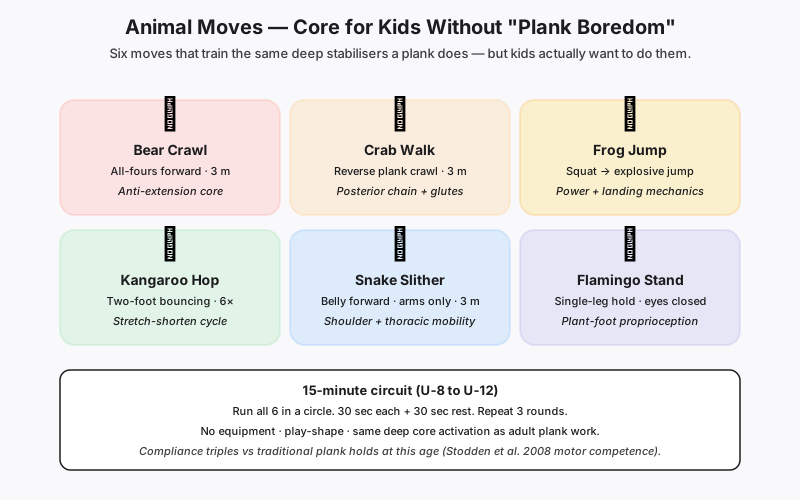
- Bear Crawl — Moving forward on all fours, alternating hands and feet. The core is constantly engaged to support the body in an unstable position, automatically activating the transversus abdominis and multifidus. Aim for 10m x 3 sets, and children will get excited if you turn it into a race
- Frog Jump — Jumping forward from a deep squat using both arms. At the moment of landing, the entire core absorbs the impact, activating the inner unit including the pelvic floor muscles
- Crocodile Walk — Crawling forward in a push-up position while keeping the body low. Since the core must remain level throughout, the core load is equal to or greater than a plank
- Crab Walk — Facing upward with hands and feet on the floor, lifting the hips and moving sideways. This simultaneously activates the posterior core muscles (multifidus, erector spinae) and the glutes
Balance Games — Unstable Environments That Build the Core
- Single-Leg Rock-Paper-Scissors — Playing rock-paper-scissors while standing on one leg. With attention directed toward the cognitive task (deciding rock, paper, or scissors), the core activates unconsciously. This is the most natural way to train the core's "automatic stabilization"
- Ball Carry Relay — A relay race with a ball balanced on the head. Controlling posture to keep the ball from falling demands core engagement and whole-body coordination
- Tightrope Walk — Walking along a line drawn on the ground, placing one foot in front of the other. This incorporates balance beam elements and develops lateral core stability
Play Activities Combined with Soccer Movements
Core play does not need to be completely separate from soccer. For example, "playing catch while standing on one leg," "backward-walking tag while holding a ball," or "returning a ball with a header from an all-fours position" are all activities that incorporate soccer elements while naturally activating the core.
The golden rule of U-8 core training: the child should not realize they are training their core. If they are having fun and fully engaged, and the core is naturally activating in the process — that is the best program design.
Common Mistakes and Practical Tips — Five Principles for Maximizing Results
The most common mistake in children's core training is "copying adult programs as-is." High-load training that ignores developmental stages is not only ineffective but increases injury risk. Proper form, appropriate frequency, and gradual progression are the keys to maximizing results.
Social media and video platforms are flooded with "ultimate core workouts," but the vast majority are designed for adult athletes. The musculoskeletal system of a growing child is fundamentally different from that of an adult — growth plates (epiphyseal plates) are still present at the ends of the bones. Faigenbaum et al. (2009) concluded that properly designed resistance training does not adversely affect growth plates, but the key phrase is "properly designed."
Mistake 1: Using Adult Programs Without Modification
It is not uncommon to see "core workouts used by professional players" being applied to elementary school children. However, as Lloyd & Oliver's (2012) YPDM clearly shows, the content and load of training must be progressively matched to the developmental stage. Assigning a 2-minute plank to a U-8 player is a textbook example of an inappropriate program that ignores development.
Mistake 2: Prioritizing Duration and Reps Over Form
Before celebrating "I held a plank for 2 minutes!" check whether the lower back was sagging. Holding an incorrect form for a long duration reinforces compensatory patterns in the surface muscles rather than training the deep muscles that actually need strengthening. McGill (2010) stated that "10 seconds of a perfect plank beats 60 seconds of a broken one," emphasizing that quality takes precedence over quantity.
Mistake 3: Repeating the Same Routine Every Day
The benefits of core training emerge not during the workout but during the recovery period. Especially for children, Behm et al. (2010) recommended resistance training 2-3 times per week. A scientifically supported target is 3-4 sessions per week at 10-15 minutes each. Daily sessions can lead to accumulated neural fatigue and a vicious cycle of declining form quality.
Five Principles for Maximizing Results
- Quality over Quantity — Always prioritize form accuracy over duration or rep count. If form breaks down, stop the set even if time remains
- Gradual Progression — U-8 starts with play, U-10 moves to foundational exercises, U-12 advances to applied exercises. Progress step by step according to age and proficiency. Do not skip stages
- Balance Frequency and Rest — Aim for 3-4 sessions per week at 10-15 minutes each. Daily sessions are unnecessary. Understand that neural adaptation occurs during rest days
- Connect It to Soccer — Explain concrete benefits to the child, such as "this exercise makes your kicks more stable" or "you will be harder to push off the ball in 1v1s." Give the training meaning
- Keep It Fun — Especially for U-10 and younger, the moment training feels boring, its effectiveness plummets. Incorporate games, challenges, and variety to maintain engagement
Children are not miniature adults. Training programs for children must be designed based on the child's developmental stage.
— Faigenbaum et al., 2009 — NSCA Youth Resistance Training Position Statement
Core training is not a "magic pill." It takes 6-8 weeks of consistency to see results. Stick with 3 sessions per week at 10 minutes each for 2 months, and you will see noticeable improvements in single-leg stability, kicking balance, and resilience during contact play.
References
- [1] Behm, D. G., Faigenbaum, A. D., Falk, B. & Klentrou, P. (2010). “Canadian Society for Exercise Physiology position paper: Resistance training in children and adolescents” Applied Physiology, Nutrition, and Metabolism.
- [2] Granacher, U., Gollhofer, A., Hortobagyi, T., Kressig, R. W. & Muehlbauer, T. (2013). “The importance of trunk muscle strength for balance, functional performance, and fall prevention in seniors: a systematic review” Sports Medicine.
- [3] Lloyd, R. S. & Oliver, J. L. (2012). “The Youth Physical Development Model: a new approach to long-term athletic development” Strength and Conditioning Journal.
- [4] Faigenbaum, A. D., Kraemer, W. J., Blimkie, C. J., Jeffreys, I., Micheli, L. J., Nitka, M. & Rowland, T. W. (2009). “Youth resistance training: Updated position statement paper from the National Strength and Conditioning Association” Journal of Strength and Conditioning Research.
- [5] Kibler, W. B., Press, J. & Sciascia, A. (2006). “The role of core stability in athletic function” Sports Medicine.
Related Articles
Soccer Training to Get Faster — 5 Methods Proven by Sprint Science
14 min read
The Truth About the Golden Age — Neuroscience Reveals Optimal Training by Age Group
11 min read
Flexibility and Mobility — The Science Behind How Yoga, Ballet, and Gymnastics Prevent Soccer Injuries
10 min read
Cross-Training During Injury — Evidence-Based Strategies to Turn Rehab into a Growth Period
12 min read
Multi-Sport Participation for Elementary-Age Athletes — The Scientific Case Against Early Specialization and a Practical Guide to Cross-Training
8 min read
Track Your Growth with Footnote
Just record your matches — AI analyzes every 5 games. Visualize growth with PVS Score. All features free during beta.
30-second signup · No credit card required
Last updated: 2026-05-06 ・ Footnote Editorial