Soccer Position Aptitude Guide — Find Your Best Position Through Physique, Personality & Playing Style
Picking a soccer position is never as simple as 'fast players play forward' or 'tall players play goalkeeper.' Di Salvo et al. (2007) showed that the locomotive demands differ markedly from position to position, and Bush et al. (2015) revealed through Premier League analysis that those demands continue to evolve year after year. This guide systematically examines positional aptitude in modern soccer across three dimensions — physique, personality, and playing style — and provides a five-axis self-assessment framework. A position is not something assigned to you; it is something you discover for yourself.
The Modern Positional System — How 4-3-3 and 4-2-3-1 Reshape Every Role
Formations dramatically alter what each position demands. In today's game, roles are increasingly defined by tasks rather than position names.

Photo by Yuan Yang Goh on Unsplash
In the two dominant modern formations — 4-3-3 and 4-2-3-1 — a 'fullback' in one system can have an entirely different job description than in the other. In a 4-3-3, fullbacks are expected to overlap with wingers and provide attacking width, whereas in a 4-2-3-1 the wide midfielders take on that responsibility, making defensive solidity the fullback's primary concern.
Core Tasks by Position in a 4-3-3
- GK — The first link in build-up play. Footwork and distribution accuracy are now non-negotiable for modern goalkeepers
- CB (2) — Anchor the centre of the back line. A high defensive line also demands the pace to recover and cover space in behind
- FB (2) — Push forward inside or outside the winger during attacks. Inverted fullbacks who tuck into midfield are increasingly common
- Anchor (1) — The defensive filter. Drops between the centre-backs during build-up to receive possession
- Interior midfielders (2) — The connectors between attack and defence. Must combine box-to-box stamina with technical quality
- Wingers (2) — Take on defenders in 1v1 situations, cut inside to shoot, and press back defensively when possession is lost
- CF (1) — Finishing and hold-up play. Depending on the system, may drop deep as a false nine to link play in midfield areas
How Roles Shift in a 4-2-3-1
A 4-2-3-1 employs a double pivot that forms the midfield's defensive foundation, lightening the fullback's attacking burden compared with a 4-3-3. In exchange, the number-10 (AMF) becomes the creative hub, while the wide midfielders must balance winger-like attacking duties with disciplined defensive pressing. When the formation changes, so do the abilities required for the same position name — this is the single most important premise when thinking about positional aptitude.
Bush et al. (2015) found in their Premier League analysis that, between 2006 and 2013, CB pass counts rose by 23% and FW sprint counts climbed by 17%. Positional demands shift every year — basing position decisions on outdated stereotypes is a mistake.
What coaches and parents need to understand is that position selection should account for both current aptitude and long-term development. The position where a player performs best right now is not necessarily the one that will maximise their future growth. Resist the pull of short-term match results and think about positional choices through a long-term developmental lens.
GK (Goalkeeper) Aptitude — Why Reflexes Alone No Longer Cut It
The modern goalkeeper is expected to do far more than stop shots. Build-up participation, coaching, and 1v1 decision-making mean this is a position that demands complete all-round ability — including outfield skills.

Photo by Omar Ramadan on Unsplash
The goalkeeper is the most specialised position in soccer. The training required is fundamentally different from any outfield role, and Di Salvo et al. (2007) confirmed that GK locomotive profiles are clearly distinct from field players. At the same time, modern soccer increasingly relies on the goalkeeper's outfield qualities — technical ability on the ball, passing precision, and positional judgement — to shape the team's entire tactical approach.
Physical Profile for Goalkeepers
- Height — Taller is an advantage, but it is not a prerequisite. Unnithan et al. (2012) demonstrated that youth height is a poor predictor of adult stature. That said, 180 cm and above is the norm at professional level
- Reflexes and explosiveness — Reaction speed to close-range shots. Diving reach is determined more by explosive leap ability than by height alone
- Flexibility — Range of motion during saves. Greater hip and shoulder mobility directly expands the keeper's coverage area
- Kicking power — Distance on goal kicks and distribution. Modern goalkeepers must be able to launch counter-attacks with a single long pass
Personality and Mental Traits for Goalkeepers
- Courage and decisiveness — Judging when to come off the line and committing fearlessly to 1v1 challenges. The ability to act despite feeling fear
- Composure — Mental resilience to stay steady immediately after conceding. The capacity to reset and focus on the next play
- Communication — Organising the defensive line through vocal instruction (coaching). Acting as the 'commander from the rear' who marshals the team during the match
- Tolerance for isolation — Goalkeeper mistakes lead directly to goals. An ability to move past errors without dwelling on them is essential
Build-Up Participation in the Modern Game
Since Neuer at Bayern Munich, goalkeeper involvement in build-up play has become the global standard. Under a high press, the GK is now expected not only to pass to centre-backs but, when necessary, to dribble past pressure themselves. Even at youth level, developing technical ability on the ball from an early age widens a goalkeeper's future possibilities.
The modern goalkeeper must be the team's eleventh outfield player.
— Pep Guardiola
In summary, the characteristics of a player well-suited to goalkeeping include sharp reflexes, the confidence to organise teammates vocally, mental strength that does not buckle after mistakes, and the focus to stay engaged in a solitary position. At youth level, height should not be over-emphasised.
DF (Defender) Aptitude — How CB and FB Demand Different Qualities
Defence is no longer a 'just defend' role. Centre-backs need aerial dominance and anticipation; fullbacks need sprint capacity and crossing accuracy. In today's game, a fullback can be the key to unlocking an attack.
CB (Centre-Back) Aptitude
The centre-back is the last line of protection and the defensive heartbeat of the team. Data from Di Salvo et al. (2007) show that CBs cover the shortest total distance of any outfield position, yet record the highest number of aerial duels and the highest tackle success rate. A centre-back's job is not to run everywhere, but to be in the right place at the right time and win the key moment.
- Aerial strength — Directly affects set-piece goals scored and conceded. Success depends on heading technique, jump timing, and positioning — not just height
- Reading the game and anticipation — Predicting the opponent's attacking patterns and cutting off passing lanes. The battle is often won before the ball arrives
- 1v1 defending — Physical strength to hold off forwards and the technique to legally obstruct body movement
- Build-up ability — Accurate distribution from the back line. Modern CBs are expected to pass with midfielder-level precision
- Leadership — Commanding the defensive line and organising the team's entire defensive structure
Cannavaro (176 cm / 5' 9") won the Ballon d'Or as a centre-back. With sharp anticipation, perfectly timed jumps, and exceptional positioning, even shorter players can dominate in the air. Never judge CB aptitude on body size alone.
FB (Fullback) Aptitude
No position in modern soccer has undergone a greater transformation than the fullback. Bush et al. (2015) reported a year-on-year increase in high-intensity sprints by Premier League fullbacks, alongside a significant rise in attacking involvement. Defensive reliability and the ability to serve as an attacking launchpad are both mandatory in today's game.
- Sprint capacity — The endurance and explosive pace to shuttle up and down the flank. Fullbacks frequently log the highest total distance in a match
- Crossing accuracy — The primary weapon when joining attacks. The ability to deliver precise balls into dangerous areas
- Defensive stability — Recovery speed when beaten and the balance between engaging in 1v1 duels and providing cover
- Decision-making — Knowing when to push forward and when to hold position. Speed of thought in attacking-to-defending transitions
The Inverted Fullback — A New Role in Modern Soccer
Guardiola's inverted fullback concept at Manchester City redefined the position: instead of hugging the touchline, the fullback tucks into central midfield during build-up. Cancelo and Walker have both filled this role, sitting alongside the anchor to create a numerical advantage in possession. This variant demands not only the traditional sprint ability but also the passing technique and positional intelligence to operate as a central midfielder.
Personality traits that align with defensive roles include patience, a strong sense of responsibility, the ability to analyse situations calmly, and a willingness to sacrifice personal glory for the team. Players who find satisfaction in disciplined, understated play rather than flashy moments tend to have high aptitude as defenders.
MF (Midfielder) Aptitude — Understanding the Three-Layer Structure of DMF, CMF & AMF
Midfielders control the game from the centre of the pitch. Defensive midfielders (DMF), central midfielders (CMF), and attacking midfielders (AMF) each carry distinct demands and call for very different aptitudes.
Midfield is the most varied positional group in soccer. Di Salvo et al. (2007) found that central midfielders cover the greatest total distance and rank among the highest for high-intensity runs. Both the physical and technical demands peak in midfield, which is precisely why aptitude here is the hardest to assess.
DMF (Defensive Midfielder / Anchor / Holding Midfielder) Aptitude
The DMF is the team's heartbeat and the junction between attack and defence. Players like Busquets (Barcelona) and Rodri (Manchester City) embody this role — rarely the headline act, yet the player whose absence causes the entire system to collapse.
- Defensive coverage — The positional awareness to patrol midfield space and snuff out attacks before they develop
- Distribution (passing accuracy and decision-making) — Receiving from the back line and redirecting play forward. The relay station between defence and attack
- Danger recognition — Spotting and eliminating counter-attack threats early. Anticipating risk and pre-positioning accordingly
- Composure — The mental strength to stay calm under pressure. In a position where a turnover can lead directly to a goal, misjudgement is unforgivable
- Physical strength — Winning duels when contesting for the ball. The power to dispossess opponents in tight spaces
CMF (Central Midfielder / Box-to-Box) Aptitude
The CMF covers every blade of grass in both attack and defence, making it the most physically demanding position on the pitch. Bush et al. (2015) data show that CMFs frequently top the team's per-match distance chart — without a robust endurance base, this role is simply unsustainable.
- Box-to-box engine — The stamina to shuttle between both penalty areas throughout the match
- Transition speed — The ability to switch instantly from attack to defence after losing the ball, and from defence to attack after winning it
- Goal threat — Long-range shooting and late runs into the box. A CMF who can score is a potent weapon for any team
- Duelling ability — Winning individual battles in the middle of the park. The capacity to win the ball and protect it under pressure
AMF (Attacking Midfielder / Playmaker / Number 10) Aptitude
The AMF is the wellspring of a team's creativity. Key passes, through balls, and decisive dribbles that unlock goal-scoring chances are the playmaker's stock in trade. The classic 4-2-3-1 number 10 has become rarer in recent years, yet players like Messi and De Bruyne — those who can receive between the lines — remain among the most highly valued in the sport.
- Creativity and vision — Seeing passing lanes that others miss. The spatial awareness to thread the ball behind a defensive line
- Final-ball precision — Delivering the killer pass that creates a goal-scoring opportunity. Combining timing with pinpoint accuracy
- Between-the-lines positioning — The movement to find pockets of space between the opponent's defensive and midfield lines
- Shooting ability — The goal-scoring instinct to finish as well as create
- Technical skill — Ball control in congested areas. The individual quality to beat multiple defenders in tight spaces
The personality profile for midfielders varies sharply by sub-position. DMFs tend to be cool-headed and analytical; CMFs are energetic and fiercely competitive; AMFs possess rich instinct and the ability to improvise in the moment. The common thread is a love of being involved with the ball and an interest in understanding the game as a whole.
FW (Forward) Aptitude — CF, Winger & False Nine: The Diversifying Front Line
A forward's job extends well beyond scoring goals. Centre-forward, winger, false nine — the roles available at the top of the pitch have multiplied, each carrying its own aptitude requirements.
Forwards occupy the position closest to goal and serve as the team's ultimate attacking weapon. Di Salvo et al. (2007) found that forwards produce a high proportion of sprints, making short-distance explosive acceleration critical. Yet the modern forward role has diversified enormously, and not every forward needs the same set of attributes.
CF (Centre-Forward / Striker) Aptitude
The CF is the team's spearhead — the position expected to deliver the most goals. Clinical finishing is a given, but the ability to hold up the ball under pressure and bring teammates into play is equally important. Lewandowski and Haaland, who combine prolific scoring with formidable physicality, embody the modern CF ideal.
- Finishing accuracy — The composure to convert limited chances. Technical proficiency with both feet and in the air
- Hold-up play — Receiving with a defender on your back, shielding, and laying the ball off. Body positioning and first-touch quality are decisive
- Timing of runs — Breaking behind the defensive line. Gambling on the offside line requires experience and a sixth sense
- Goal-scoring instinct — Positioning inside the box, reacting to rebounds. The ability to 'smell where the goal is'
- Leading the press — The modern CF is also the first line of defence. Pressing opposition centre-backs to disrupt build-up play
WG (Winger) Aptitude
Wingers are the speed merchants who attack from wide areas. Bush et al. (2015) found that winger sprint counts have risen steadily, confirming that pace and 1v1 dribbling ability are the lifeblood of this position. Players like Mbappe and Salah, who leave defenders trailing with devastating acceleration, illustrate the winger's ultimate weapon.
- Speed (top speed and acceleration) — Raw pace to beat defenders down the line. Being faster than the opposing fullback is the baseline requirement
- 1v1 dribbling ability — Feints, cut-ins, and driving runs — a diverse toolkit for getting past defenders
- Crossing accuracy — Delivering precise balls into the box from wide areas. Maintaining quality even at full pace
- Cutting inside to shoot — An 'inverted winger' (e.g. a right-footed player on the left) makes the cut-inside shot a lethal weapon
- Defensive press-back — Tracking the opposing fullback's overlapping runs. Tactical discipline off the ball
The Rise of the False Nine
The false nine, pioneered by Guardiola with Messi at Barcelona, is a revolutionary concept in which the centre-forward drops into midfield to participate in build-up play. By dragging opposition centre-backs forward, the false nine opens space behind the defensive line for wingers and interior midfielders to exploit — a tactic that has profoundly influenced modern soccer.
- Decision-making over pace — The false nine's currency is situational awareness and positional intelligence, not explosive speed
- Passing ability — Delivering final balls with the vision of a midfielder despite nominally being a forward
- Finishing precision — Even while dropping deep, clinical composure in front of goal remains indispensable
Personality traits commonly seen in forwards include being assertive (in the best sense), fiercely competitive, unafraid of failure, and confident in expressing themselves. Centre-forwards in particular need the unwavering conviction that 'I will be the one to score.' The false-nine type, by contrast, suits a more cerebral player who blends team-first awareness with creative flair.
Polyvalence — Why Youth Players Should Not Be Locked into One Position
Fixing a young player in a single position can hinder long-term development. Multi-position experience — polyvalent development — has become the global standard in modern youth soccer.
Vaeyens et al. (2008) highlighted that early positional specialisation may negatively affect talent development. Players who experienced only one position before U-12 showed lower tactical understanding and weaker situational adaptability compared with peers who had played multiple roles.
Risks of Early Position Specialisation
- Narrow tactical understanding — A forward who has never played in defence struggles to recognise and exploit defensive weaknesses
- Lopsided technical development — A player who only plays CB may never develop dribbling skills; one who only plays winger may never learn to defend
- Physical-development mismatch — A child who is tall at age 10 may end up average height after their growth spurt. If CB is the only skill set they possess, their options shrink dramatically
- Motivation loss — Being permanently assigned to an unwanted position can erode a player's love for the game entirely
Benefits of Polyvalent Development
- Higher soccer IQ — Understanding every position's perspective cultivates the ability to read the entire game
- Well-rounded technical base — Experiencing GK reflexes, CB defending, MF passing, and FW finishing elevates overall foundational ability
- Discovering hidden aptitude — Unexpected positional fits emerge when players are given the chance. A fullback may flourish as a number 10
- Wider future options — When a position conversion is required at professional level, a broad experiential base makes adaptation far smoother
Fixing a player in one position before the age of twelve carries the risk of limiting future performance. Diverse positional experience represents the most effective approach to long-term player development.
— Vaeyens et al., 2008
Successful Position Conversions in Professional Soccer
The professional game is rich with examples of successful position changes. Lahm (FB to DMF) — enjoyed a second peak as an anchor at Bayern. Mascherano (MF to CB) — converted at Barcelona and became a world-class defender. Bale (FB to WG) — started as a fullback at Southampton, moved to winger at Tottenham and won the Golden Boot. These cases prove that a position is not something fixed but something that evolves.
A note for youth coaches: implement a rotation system at U-12 level so that every player experiences every position. Begin identifying individual aptitudes from U-14 onward, and narrow down a primary position by U-16. This is the ideal developmental timeline.
Self-Assessment Framework — Five Axes to Find Your Best Position
Rate yourself across speed, power, technique, decision-making, and personality. This five-axis framework offers an objective starting point for identifying which position suits you best.
Drawing on the talent-identification research of Williams & Reilly (2000), we have built a five-axis framework that allows youth players to evaluate their own positional aptitude objectively. Score each axis from 1 to 5, then use the combination to identify the positions where your profile fits most naturally.
Axis 1: Speed
Evaluate your top-end pace, acceleration, and agility combined. Players who rate high on speed (4–5) show strong aptitude for winger and fullback roles. Average speed (2–3) is not a major handicap for hold-up-style CFs or DMFs.
Axis 2: Power
Evaluate body strength, ability in physical contests, and jump height. High-power players suit CB and CF roles, where aerial duels, hold-up play, and 1v1 defending all depend on winning physical contact. Players lower on power can compensate with technique and decision-making in positions like AMF and winger.
Axis 3: Technique
Evaluate ball control, passing precision, dribbling skill, and shooting accuracy. High-technique players tend to excel as AMFs, wingers, and false nines. Modern soccer demands a baseline of technical quality across all positions, but for midfielders and forwards, limited technique seriously restricts the range of actions available.
Axis 4: Decision-Making
Evaluate speed of situational judgement, quality of positioning, and depth of tactical understanding. High decision-making scores correlate with aptitude for DMF, CB, and GK. In these positions, excellent judgement and timing can deliver elite performance even without a physical edge. Unnithan et al. (2012) suggest that cognitive ability contributes to talent identification more than physical ability.
Axis 5: Personality
Personality is not about 'good' or 'bad' — it is about compatibility with a position. Assertive, extroverted players align with FW and AMF. Calm, patient players align with GK, CB, and DMF. Strong natural leaders thrive at CB or DMF, where they can marshal the team.
How to Use the Five-Axis Map
- Rate each axis from 1 to 5 — Be honest and objective. Asking a parent or teammate for a second opinion can help
- Identify your two highest axes — For example, Speed 4 and Technique 5 gives you a 'Speed x Technique' profile
- Match the combination to a position — Speed x Technique = Winger. Power x Decision-Making = CB. Technique x Decision-Making = AMF/DMF
- Try the position on the pitch — Any framework is only a guide. Play the suggested position and evaluate how it feels in practice
- Re-assess periodically — As your body grows and your skills develop, your aptitude will change. Revisit the assessment every six months to a year
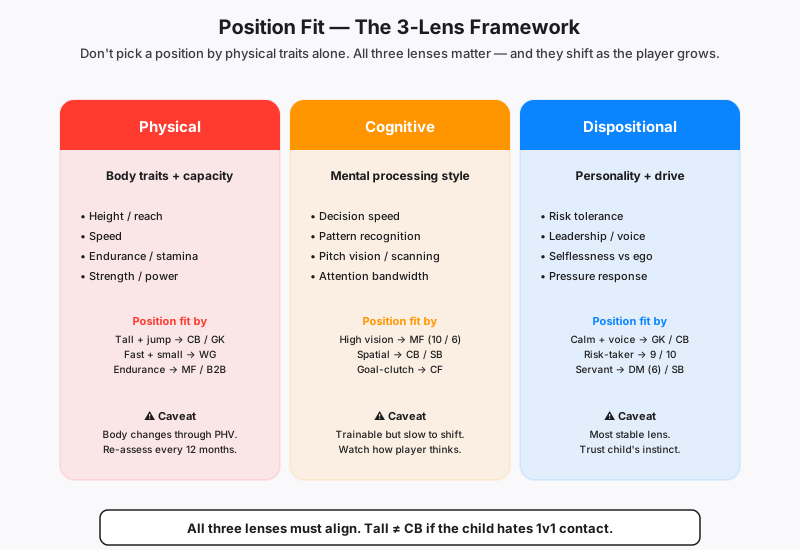
Representative five-axis combinations: Speed x Power = FB/CF. Speed x Technique = Winger. Power x Decision-Making = CB/GK. Technique x Decision-Making = AMF/DMF. Technique x Personality (leadership) = CMF. These are guidelines — ultimately, experience and feel on the pitch are the most reliable basis for any decision.
This five-axis framework is a thinking tool, not a verdict. A low score on any axis is not a reason to rule out a specific position. Especially at youth level, growth potential matters far more than current ratings.
Finally, the single most important piece of advice on choosing a position: playing in the role you enjoy most is what accelerates your growth the fastest. Regardless of what any assessment says, pouring your passion into a position you love will, over the long run, produce the greatest results. Soccer is meant to be enjoyed — let choosing your position be part of that enjoyment.
Frequently Asked Questions
Should I lock my child into one position at primary-school age?▾
We recommend against it. As Vaeyens et al. (2008) showed, experiencing every position before U-12 is more beneficial for long-term development. Early specialisation risks narrow tactical understanding, lopsided technical growth, and a mismatch with eventual adult physique. A rotation system that exposes every player to every role, with gradual narrowing from U-14 onward, is the ideal approach. Some coaches fix positions early to win matches, but doing so may come at the cost of the player's long-term growth.
Can a shorter player succeed as a centre-back?▾
Absolutely. Cannavaro (176 cm / 5' 9") won the Ballon d'Or as a centre-back, excelling in aerial duels through razor-sharp anticipation, perfectly timed jumps, and impeccable positioning. At youth level especially, Unnithan et al. (2012) demonstrated that current height is a poor predictor of adult stature. By honing reading of the game, 1v1 defending, and build-up passing, a shorter player can develop into a highly capable centre-back.
I'm not fast — can I still play forward?▾
Not every forward role demands blistering pace. A false nine or a hold-up-style CF values decision-making and finishing precision above raw speed. Inzaghi was far from the fastest player on the pitch, yet his positioning and finishing instinct made him the all-time top scorer in Serie A. Rather than lamenting a lack of pace, learn the type of forward play that rewards other strengths. Sharpen your movement timing, hold-up play, and finishing accuracy relentlessly.
Which positions suit a quieter, more introverted personality?▾
A quiet temperament is not a disadvantage — it can be a significant asset. GK, CB, and DMF all demand the kind of cool-headed, analytical thinking that quieter players often excel at. In these positions, staying composed and reading the game objectively matters more than outward intensity. That said, vocal communication is necessary in every position. There is no need to change your personality, but developing the habit of giving clear, play-related instructions through practice is important.
Is there an age limit for changing positions?▾
There is no age limit. Professional soccer is full of successful mid-career conversions: Lahm switched from fullback to defensive midfield at 28, Mascherano from midfield to centre-back at 26, and Bale from fullback to winger at 21 — each went on to reach new heights. If professionals can adapt, youth players can do so even more readily. Never assume 'this is the only position I can play.' Staying open to new possibilities is one of the keys to continued growth.
References
- [1] Williams, A. M., & Reilly, T. (2000). “Talent identification and development in soccer” Journal of Sports Sciences, 18(9), 657-667.
- [2] Unnithan, V., White, J., Georgiou, A., Iga, J., & Drust, B. (2012). “Talent identification in youth soccer” Journal of Sports Sciences, 30(15), 1719-1726.
- [3] Vaeyens, R., Lenoir, M., Williams, A. M., & Philippaerts, R. M. (2008). “Talent Identification and Development Programmes in Sport: Current Models and Future Directions” Sports Medicine, 38(9), 703-714.
- [4] Di Salvo, V., et al. (2007). “Performance characteristics according to playing position in elite soccer” International Journal of Sports Medicine, 28(3), 222-227.
- [5] Bush, M., et al. (2015). “Evolution of match performance parameters for various playing positions in the English Premier League” Human Movement Science, 39, 1-11.
Related Articles
The Complete Tryout Guide — 7 Evaluation Criteria Top Academies Look For and How to Prepare
15 min read
Why Coaches Should Have Players Keep Soccer Journals — and How to Implement Them
8 min read
The Truth About the Golden Age — Neuroscience Reveals Optimal Training by Age Group
11 min read
Traits of Kids Who Excel in Soccer — 5 Growth Factors Backed by Sports Science
16 min read
20 Tactical Revolutions That Changed Soccer — From Catenaccio to the Inverted Full-Back, Traced Through the Great Managers and Players
11 min read
Track Your Growth with Footnote
Just record your matches — AI analyzes every 5 games. Visualize growth with PVS Score. All features free during beta.
30-second signup · No credit card required
Last updated: 2026-05-06 ・ Footnote Editorial