Decision Speed in Soccer — How Pros Decide in 0.5 Seconds, and How to Train It
A pro player's decision is not faster — it is already finished. Roca et al. (2011)'s eye-tracking experiment showed that elite players scan the field 2–3× more often than amateurs in the seconds before receiving the ball. "Decision Speed" decomposes into four cognitive processes — Perception, Anticipation, Selection, Execution — each independently trainable. This article walks through the research evidence for each and the practical training methods that work from the youth level.
What Decision Speed Really Is — Pre-Decision, Not "Faster Decision"
The real mechanism is not faster decision-making after receiving the ball, but pre-decision: by the time the ball arrives, the next action is already chosen. Pros make 90% of the decision during the seconds before reception, using peripheral information.

Photo by Nigel Msipa on Unsplash
"That player decides so fast" — cognitive science decomposes this. The pro is not deciding after receiving; the pro has been gathering information and narrowing options for the 1–3 seconds before the ball arrives. By the time the ball reaches them, the candidate action and the criteria are already loaded.
Roca et al. (2011) put 24 male professional and 24 amateur players through an eye-tracking experiment, asking them to predict the next action while watching match footage. Pros scanned the field 2–3× more often during off-ball moments and rapidly cycled through 5–7 different points on the pitch. Amateurs concentrated their gaze on the ball.
Not "decide faster" but "decide earlier." The mechanism that enables this is the combination of scanning, pattern recognition, and predictive modeling.
The Four Processes — Perception, Anticipation, Selection, Execution
Decision Speed is not one ability but four sequential processes: Perception (information gathering), Anticipation (pattern matching), Selection (choosing the best response), Execution (motor control). Each has its own training pathway.
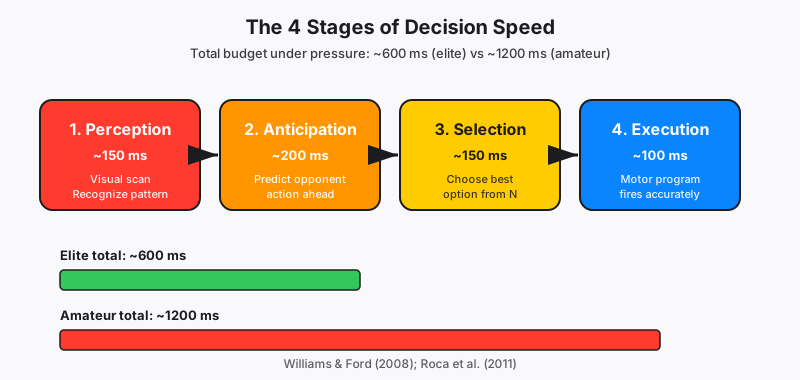
1. Perception — Visual Scanning and Information Gathering
Perception is gathering the field information (teammates, opponents, space, ball) visually. The key driver is scanning frequency. Jordet (2005) analyzed Premier League match footage and found that the number of scans in the 10 seconds before receiving the ball correlated with subsequent pass success rate (r = 0.41, p < 0.05).
2. Anticipation — Pattern Matching and Prediction
Anticipation is using the perceived information to simulate "what happens next" before it happens. Williams & Ward (2003) demonstrated that experts can anticipate opponent actions 100–200 milliseconds earlier than novices, reading body posture and weight transfer. The same mechanism that lets a chess master read the board.
3. Selection — Choosing the Best Response
Selection is the executive-function process of choosing the optimal response from multiple candidates (pass to A, B, C; dribble; shoot). High Design Fluency Test scores in Vestberg et al. (2012)'s pro players reflect strong selection capacity.
4. Execution — Motor Control of the Chosen Action
Execution is converting the selected action into accurate motor output. Technical drills sharpen this, but Perception → Anticipation → Selection together take ~0.4 seconds while Execution takes ~0.1 seconds — meaning a fast executor still looks slow if any earlier stage lags.
A "skilled but slow-decision" player has fast execution but a bottleneck in perception, anticipation, or selection. Technical drills alone cannot fix that.
Training Perception — Increase Scanning Frequency
Scanning frequency responds to deliberate training. Jordet et al. (2009) showed that 6 weeks of perceptual training increased scanning frequency by 30–45% in match settings.
1. Shoulder-Check Scanning Before Receiving
While the ball is traveling toward you, perform at least two shoulder-checks behind. This was Pep Guardiola's signature instruction to Xavi and Iniesta and remains foundational at La Masia (Barcelona's academy).
2. Numbering Drills
The coach holds up a flag with a number or color behind the player; the player must turn to identify it before receiving the ball. This forces information gathering before reception.
3. Constraint-Based Possession
"Maximum two touches," "first-touch must face forward," "weak-foot only" — constraints force the player to gather information before the ball arrives.
Training Anticipation — Build the Pattern Library
Anticipation rests on a stored library of game patterns. Volume of game experience plus deliberate verbalization of each pattern is the foundation.
1. Video Analysis with Prediction
Watch pro footage with a "predict what happens next" intent. Pause, verbalize the prediction, then play to verify. Footnote's tactical understanding quiz implements exactly this loop.
2. Positional Games
4v4+2, rondos, and other repeating-pattern drills build the library of candidate actions tied to recognizable shapes.
3. Cross-Training (Chess, Tennis)
Other sports build the same pattern-recognition machinery. Chess for tactical evaluation, tennis for reading body weight transfer — both transfer to soccer (see chess-soccer article).
Training Selection — Strengthen Executive Function
Selection is supported by prefrontal executive function. Small-sided games and the constraints-led approach are the most effective tools.

Photo by Sven Kucinic on Unsplash
1. 4v4 / 5v5 Small-Sided Games
Garcia-Calvo et al. (2014) reported that 8 weeks of three-times-per-week SSG training significantly increased youth players' spatial-cognition test scores. SSG raises decision frequency by 3–5× compared to 11v11.
2. Constraints-Led Approach
Adding artificial constraints — "weak foot only," "maximum three touches," "knocking over a cone costs a goal" — forces exploration of options usually skipped, building cognitive flexibility (Davids et al., 2008).
3. Tactical Quizzes
Show a frozen game state; require both an action choice AND a verbalization of the reasoning. By making the selection criteria conscious, the player refines the underlying decision logic.
Conclusion — Decision Speed Means "Decide Earlier," Not "Decide Faster"
Speeding up Decision Speed is not about shortening decision time but about advancing the timing. Train Perception, Anticipation, Selection, and Execution as separate components, and the player arrives at every reception with the decision already made.
The gap between pros and amateurs is not execution speed but the presence or absence of pre-decision. Whether a youth player learns this "thinking sequence" largely determines what kind of player they become long-term.
Footnote's tactical understanding quiz combines the selection process with verbalization, supporting the accumulation of cognitive patterns. Players doing 1–2 scenarios per week for 3 months reliably show measurable improvement in their tactical-level score (which correlates with PVS).
References
- [1] Roca, A., Ford, P. R., McRobert, A. P., & Williams, A. M. (2011). “Identifying the processes underpinning anticipation and decision-making in a dynamic time-constrained task” Cognitive Processing.
- [2] Jordet, G. (2005). “Perceptual training in soccer: An imagery intervention study with elite players” Journal of Applied Sport Psychology.
- [3] Jordet, G., Bloomfield, J., & Heijmerikx, J. (2013). “The hidden foundation of field vision in English Premier League (EPL) soccer players” Proceedings of the MIT Sloan Sports Analytics Conference.
- [4] Williams, A. M., & Ward, P. (2003). “Anticipation and decision making: Exploring new horizons” Handbook of Sport Psychology (3rd ed.).
- [5] Vestberg, T., Gustafson, R., Maurex, L., Ingvar, M., & Petrovic, P. (2012). “Executive Functions Predict the Success of Top-Soccer Players” PLoS ONE. Link
- [6] Garcia-Calvo, T., Sanchez-Oliva, D., Sanchez-Miguel, P. A., Leo, F. M., & Amado, D. (2014). “Effects of small-sided games on the perceptual and cognitive demands in young soccer players” International Journal of Sports Science & Coaching.
- [7] Davids, K., Button, C., & Bennett, S. (2008). “Dynamics of Skill Acquisition: A Constraints-Led Approach” Human Kinetics.
Related Articles
What Is Soccer IQ? The 3 Cognitive Components Identified by Vestberg's Research
6 min read
Anticipation and Reading the Game — The Science of Prediction That Racket Sports Can Teach You
11 min read
Science-Based Training to Expand Your Field Vision — Scanning Technique and Peripheral Vision Development
13 min read
How to Develop Decision-Making in Soccer — What Cognitive Science Reveals About 'Smart Players'
14 min read
How Chess Transfers Tactical Thinking, Anticipation, and Pattern Recognition to Soccer
10 min read
Track Your Growth with Footnote
Just record your matches — AI analyzes every 5 games. Visualize growth with PVS Score. All features free during beta.
30-second signup · No credit card required
Last updated: 2026-05-08 ・ Footnote Editorial