Is Early Soccer Specialization Harmful? Evidence-Based Conclusions from AAP & AOSSM
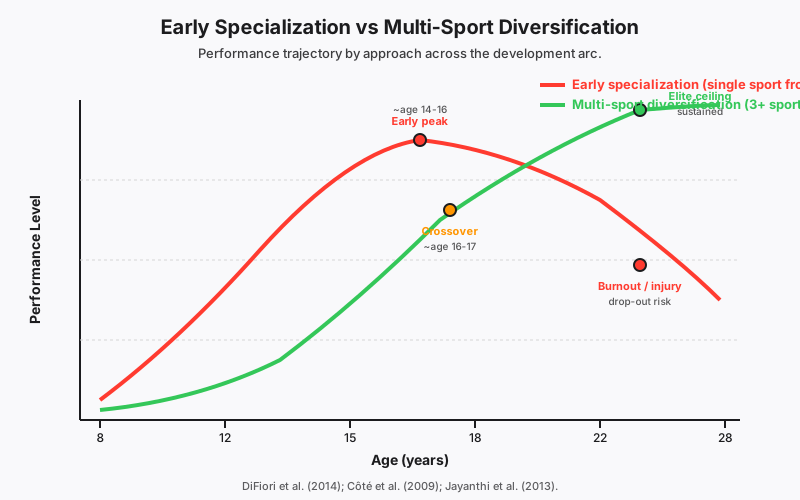
Early specialization in soccer — concentrating on one sport under age 12, training more than 8 months per year on that single sport — raises overuse-injury risk by 1.5–3× (DiFiori et al., 2014). Consensus statements from the American Academy of Pediatrics (AAP), the American Orthopaedic Society for Sports Medicine (AOSSM), and the NSCA all recommend multi-sport participation under age 12 with at least 3 months off per year. Côté et al. (2009) showed that players who experienced sampling (multiple sports) in youth reach the same elite level as early specializers — and often stay in the sport longer. This article walks through the definition, the four documented risks, and the recommended alternative.
What Counts as Early Specialization
Early Specialization, per Jayanthi et al. (2013), is defined by three conditions co-occurring: under age 12, more than 8 months/year of training in a single sport, and not participating in any other organized sport.

Photo by Daniel Norin on Unsplash
The research definition of "is your child early-specialized?" requires all three of the following (Jayanthi et al., 2013):
- Under age 12, AND
- More than 8 months/year of dedicated training (team practice, lessons, individual training combined)
- Not participating in any other organized sport
An elementary-school child attending soccer training five times a week with no other sport activity year-round is the textbook case. A child training 3–4 times a week in soccer plus playing basketball or swimming at school is in the multi-sport sampling category, not early-specialized.
The boundary is set by hours and number of sports. "5+ sessions a week + 8+ months a year + single sport" is when risk rises sharply.
Four Documented Risks of Early Specialization
Early specialization carries four research-backed risks: overuse injury, burnout, movement-pattern imbalance, and reduced long-term participation. All have been demonstrated across multiple prospective studies.
1. Overuse Injury Risk Up 1.5–3×
DiFiori et al. (2014)'s AOSSM position statement showed that early single-sport specialization significantly raises overuse-injury risk in youth athletes. Knee (Osgood-Schlatter), lower back (spondylolysis), and elbow (Little League elbow analogs) injuries from repetitive motion patterns increase markedly.
2. Burnout and Drop-Out
Wall & Côté (2007) found that 35% of early-specializing ice hockey players dropped out of the sport completely by age 13, while sampling-pathway players had less than half that drop-out rate. Multiple studies confirm the same pattern in soccer.
3. Movement-Pattern Imbalance and "Movement Poverty"
Repeating the same patterns of sprinting, low-stance posture, and ankle-dominant motion creates muscular imbalance and underdeveloped upper body and core. Bergeron et al. (2015) — the IOC's youth athletic development consensus statement — emphasizes movement variability as critical at younger ages.
4. Reduced Long-Term Participation
Côté et al. (2009)'s elite-career retrospective found that players who experienced sampling in youth had higher rates of continuing to compete past age 30 than those who specialized early. Long careers correlate with the sampling pathway, not the early-specialization pathway.
Consensus Recommendations from AAP / AOSSM / NSCA
The major U.S. sports medicine organizations consistently recommend multi-sport participation through age 12, at least 3 months of off-season annually, and a weekly training-hours cap (hours per week ≤ age in years).
AAP (American Academy of Pediatrics) 2016
- Multi-sport participation through age 12 is recommended
- At least 3 months off-season per year (full break from the sport)
- Training hours per week ≤ age in years
- At least 1 full rest day per week
AOSSM 2014
- Early specialization is not necessary for performance gains
- Prioritize overuse-injury prevention
- Strengthen coach and parent education
NSCA 2019
- Under age 12: at least 2 sports throughout the year
- Ages 13–15: pick the main sport, keep 1 secondary sport
- Age 16+: full specialization is appropriate
These three organizations are aligned: "early specialization is unnecessary for performance and carries significant risk" is the modern sports-medicine consensus.
Elite Players Are Mostly "Samplers"
Career retrospective studies of professional players show that the majority of elites experienced multiple sports in youth. Early specialization is not a prerequisite for elite achievement.

Photo by Robert Collins on Unsplash
Bridge & Toms (2013) analyzed 1,006 UK elite athletes and found that the majority experienced multiple sports in youth. In soccer specifically, Messi, Ronaldo, Beckham, and Zidane all played other sports (tennis, basketball, karate, judo) as children.
Cross-Training Transfer Effects
Many of Footnote's 86 articles document specific transfer effects from other sports to soccer:
- Chess — tactical decision making, pattern recognition (chess-soccer)
- Swimming — cardiovascular, rhythm, core (swimming-soccer)
- Basketball — vision, 3D spatial cognition (basketball-soccer)
- Tennis — anticipation, stop-and-go (tennis-soccer)
- Martial arts — center of mass control, opponent reading (martial-arts-soccer)
The Modern Youth Soccer Environment Lean Toward Specialization
Modern youth soccer environments — especially elite club academies — often default to 5–6 sessions per week with summer and winter camps, structurally pushing children toward early specialization. Parents must consciously create space for sampling.
The "club-centric, 5–6 sessions per week, no school sports" model is increasingly the standard at elite clubs worldwide. Few clubs honor the AAP recommendation of "at least 3 months off."
Parent checklist
- Weekly soccer hours ≤ child's age: a 9-year-old caps at 9 hours per week
- At least 3 months off the sport per year: even during important seasons or breaks
- Other sports experience: school PE, after-school activities, family sports — anything counts
- At least 1 full rest day per week
"More is better because she wants to be good" can backfire. The data shows children who rest appropriately and play multiple sports actually develop further long-term.
Conclusion — "Soccer Plus One or Two" Is the Scientifically Correct Path Under 12
Early specialization raises injury, burnout, and imbalance risk without performance benefit. Under age 12, "soccer + 1–2 other sports" is the AAP / AOSSM / NSCA consensus recommendation.
Early specialization is not "the right path to becoming a better player." The data points the opposite direction. Across performance, health, and long-term retention, sampling beats specialization.
Most of Footnote's cross-training articles exist because of this scientific basis. The child who loves soccer most should also be playing other sports — that is what keeps them in soccer the longest.
"If she loves soccer, just soccer" reflects a parent's natural concern, but the data says "if she loves soccer, also play other things."
References
- [1] DiFiori, J. P., Benjamin, H. J., Brenner, J. S., Gregory, A., Jayanthi, N., Landry, G. L., & Luke, A. (2014). “Overuse injuries and burnout in youth sports: a position statement from the American Medical Society for Sports Medicine” British Journal of Sports Medicine.
- [2] Jayanthi, N., Pinkham, C., Dugas, L., Patrick, B., & LaBella, C. (2013). “Sports specialization in young athletes: evidence-based recommendations” Sports Health.
- [3] Côté, J., Lidor, R., & Hackfort, D. (2009). “ISSP position stand: To sample or to specialize? Seven postulates about youth sport activities that lead to continued participation and elite performance” International Journal of Sport and Exercise Psychology.
- [4] Wall, M., & Côté, J. (2007). “Developmental activities that lead to dropout and investment in sport” Physical Education and Sport Pedagogy.
- [5] Bergeron, M. F., Mountjoy, M., Armstrong, N., et al. (2015). “International Olympic Committee consensus statement on youth athletic development” British Journal of Sports Medicine.
- [6] Brenner, J. S., & American Academy of Pediatrics Council on Sports Medicine and Fitness (2016). “Sports specialization and intensive training in young athletes” Pediatrics.
- [7] Bridge, M. W., & Toms, M. R. (2013). “The specialising or sampling debate: a retrospective analysis of adolescent sports participation in the UK” Journal of Sports Sciences.
Related Articles
Multi-Sport Participation for Elementary-Age Athletes — The Scientific Case Against Early Specialization and a Practical Guide to Cross-Training
8 min read
The Science of Multi-Sport Training — How Playing Multiple Sports Rewires the Brain and Body
11 min read
The Complete Cross-Training Guide for Soccer — 20 Science-Backed Sports That Transfer to the Pitch
15 min read
Injury Prevention Guide for Junior Soccer Players — FIFA 11+ Kids and Evidence-Based Prevention Programs
16 min read
U-12 / U-15 / U-18 — Age-Specific Development Roadmap for Soccer Players
7 min read
Track Your Growth with Footnote
Just record your matches — AI analyzes every 5 games. Visualize growth with PVS Score. All features free during beta.
30-second signup · No credit card required
Last updated: 2026-05-09 ・ Footnote Editorial