The First 5 Seconds After Losing the Ball — Soccer Transition Theory and Youth Implementation
Transition is the central tactic of modern soccer. Klopp's gegenpressing and Guardiola's juego de posición both rest on the same principle: win the ball back within 5 seconds of losing it. Bradley et al. (2009)'s analysis of Premier League data shows that approximately 45% of goals come from transitions within 15 seconds of a turnover — roughly 2× the goal expectancy of established possession sequences. This article splits transition into negative (attack → defense) and positive (defense → attack), explains what happens in the first 5 seconds and what should happen, and shows how to implement it for youth players.
What Transition Is — The Game Has Four Phases
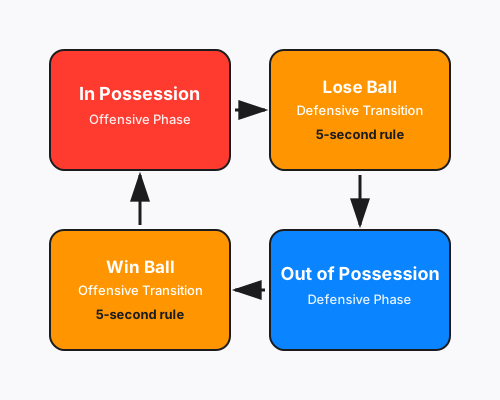
Modern soccer is best understood as a cycle of four phases: possession, negative transition (attack → defense), defense, and positive transition (defense → attack). Transition is shorter than possession but generates the highest goal expectancy of any phase.

Photo by Salah Regouane on Unsplash
The four-phase model — formalized in Hewitt et al. (2016) and now standard in UEFA and FIFA coaching curricula — splits the match by what each team is doing relative to the ball:
- Possession — 30–35% of match time
- Defense — 30–35%
- Negative transition (attack → defense) — 15–20%
- Positive transition (defense → attack) — 15–20%
In time terms, transitions only account for 30–40% combined, but Bradley et al. (2009) showed that approximately 45% of Premier League goals come from these phases. "Brief but decisive" describes transition in the modern game.
You can touch the ball 100 times during possession and score a few goals; transitions occur "every 30 seconds," and each one creates a goal opportunity. Probabilistically, the team that wins the transition battle wins the match.
Why "5 Seconds" — The Scientific Basis
In the 5 seconds immediately after losing the ball, the opponent is technically attacking but their organization is broken. Recovering the ball in this window means catching them before their defensive shape is set. Beyond 5 seconds, organization recovers and recovery becomes far harder.
Klopp's gegenpressing philosophy starts from the recognition that the moment you lose the ball is the best attacking opportunity — because the players who were just attacking are committed forward and the opponent's back line has lost their marking reference. Tenga et al. (2010) used Norwegian first-division data to show that attacks completed within 5 seconds of a turnover have a goal expectancy roughly 2.4× higher than possession-style attacks.
What Happens in the First 5 Seconds of Negative Transition
- 0–2 sec: ball-loss recognition + first reaction (forward-committed players reposition)
- 2–4 sec: immediate counter-press OR retreat to protective shape
- 4–5 sec: organized defensive shape OR concede the counter
What If You Take Longer Than 5 Seconds?
The opponent's build-up shape is set, and recovery probability drops below ~15% (Hughes & Franks, 2005). By contrast, counter-press within 5 seconds yields recovery probability of 30–40%. The first 5 seconds decide the outcome — and the research backs that up.
Negative Transition (Attack → Defense) — Klopp's Gegenpress
The moment you lose the ball, what should you do? An immediate counter-press is the highest goal-expectancy choice. The principle is "the 3–4 closest players collapse within 5m of the ball."
Klopp's three principles of gegenpressing
- Counter-press immediately — within 0–3 seconds of loss, the closest player pressures the ball-carrier
- Cut passing lanes — the surrounding 3–4 players stand on passing lanes to remove options
- Compactness — the team's vertical length stays at or below 25m to make immediate recovery possible
How to coach this at the youth level
For youth players, "win it back the moment you lose it" is counterintuitive. Many players default to "give up" or "walk back." Three interventions help:
- 5-Second Rule scrimmage: if you don't recover the ball within 5 seconds, the opponent's goal counts as 2
- Clear roles for the closest 3 players to the ball-loss — explain who presses, who covers behind, and who blocks the passing lane before each match
- Video + verbalization: pick 10 ball-loss moments from the match video and analyze each player's first 3 seconds
Positive Transition (Defense → Attack) — Maximizing the Counter
The moment you win the ball, what should you do? Speed and direction. Tenga et al. (2010) showed that recoveries followed by a vertical pass within 5 seconds had ~3× the goal expectancy of horizontal or back passes.
Three principles of positive transition
- Verticality — the first pass after recovery should be vertical or diagonal-forward whenever possible
- Speed of execution — finish in 1 or 2 touches; do not give the opponent time to reorganize
- Layered runs — first runner goes vertical, second runner follows, third runner provides balance
"Before the CBs Get Set"
At the moment of recovery, the opposing center-backs are typically facing forward (toward the goal you defend). Reorienting to defensive position takes 2–3 seconds. A vertical pass within that window forces the CBs to backpedal, and goal-scoring chances multiply.
Track "first pass after recovery is vertical or diagonal-forward" as the team's key transition KPI. It quantifies the team's positive-transition capacity.
How to coach this at the youth level
- 4v4 + 2 free players: the two free players are designated vertical-pass receivers — recovery must immediately go vertical to them
- Rondo + target goal: during a regular rondo, when the coach signals, the team must immediately push to a target goal
- 3v3 transition game: long-narrow pitch, evaluate only the first vertical push after each recovery
Transition Metrics — Quantifying It in Footnote
Transition ability can be quantified with metrics like "shots within 5s of recovery / total shots" and "ball-recovery rate within 5s of loss." With Footnote's match-record feature, you can also visualize transition contribution at the individual player level.

Photo by Maxim Hopman on Unsplash
Example transition KPIs
- Counter-Press Recovery % — recoveries within 5s / total ball losses
- Transition Goal % — goals from sequences within 15s of recovery / total goals
- Counter-Attack Speed — average seconds from recovery to shot
- Vertical First Pass % — % of first passes after recovery that were vertical or diagonal-forward
Recording in Footnote
Set "transition" as a monthly focus topic in Footnote for 1–3 months and rate "transition contribution" after every match using the topic-rating system. With coach verification, this feeds into the PVS Match Evaluation Score and shows up as growth acceleration over the 3-month window.
Conclusion — The Match Is Won and Lost in Transition
Possession % and total distance covered matter less than what you can do in the first 5 seconds of transition. It is no accident that Klopp and Guardiola — opposite philosophies on the surface — converged on the same principles (immediate recovery + vertical penetration).
Whether a youth player learns this concept dramatically shapes who they become long-term. The cognitive flip from "if I lose the ball, I retreat" to "the moment I lose the ball is the best attacking moment" is the single largest separator between top-level players and the rest.
Footnote's tactical understanding quiz includes multiple transition scenarios (negative and positive). Repeating the choose-and-verbalize cycle internalizes "what to think and what to choose in 5 seconds" until the response becomes automatic.
References
- [1] Bradley, P. S., Sheldon, W., Wooster, B., Olsen, P., Boanas, P., & Krustrup, P. (2009). “High-intensity running in English FA Premier League soccer matches” Journal of Sports Sciences.
- [2] Tenga, A., Holme, I., Ronglan, L. T., & Bahr, R. (2010). “Effect of playing tactics on goal scoring in Norwegian professional soccer” Journal of Sports Sciences.
- [3] Hughes, M., & Franks, I. (2005). “Analysis of passing sequences, shots and goals in soccer” Journal of Sports Sciences.
- [4] Hewitt, A., Greenham, G., & Norton, K. (2016). “Game style in soccer: what is it and can we quantify it?” International Journal of Performance Analysis in Sport.
- [5] Lijnders, P., & Klopp, J. (2022). “Intensity: Inside Liverpool FC (paraphrased coaching content)” Reach Sport.
- [6] Memmert, D., & Roca, A. (2019). “Tactical creativity and decision making in sport” Anticipation and Decision Making in Sport (Routledge).
- [7] Vogelbein, M., Nopp, S., & Hökelmann, A. (2014). “Defensive transition in soccer — are prompt possession regains a measure of success?” Journal of Sports Sciences.
Related Articles
Decision Speed in Soccer — How Pros Decide in 0.5 Seconds, and How to Train It
5 min read
What Is Soccer IQ? The 3 Cognitive Components Identified by Vestberg's Research
6 min read
20 Tactical Revolutions That Changed Soccer — From Catenaccio to the Inverted Full-Back, Traced Through the Great Managers and Players
11 min read
How to Review a Match --- What Pro Scouts Look For and Proven Recording Techniques
7 min read
Anticipation and Reading the Game — The Science of Prediction That Racket Sports Can Teach You
11 min read
Track Your Growth with Footnote
Just record your matches — AI analyzes every 5 games. Visualize growth with PVS Score. All features free during beta.
30-second signup · No credit card required
Last updated: 2026-05-09 ・ Footnote Editorial