Youth Soccer Contracts and Transfers — What High-School Players Need to Know
The choice at high-school graduation — pro contract, university, abroad, or retire — shapes a player's career trajectory more than any other single decision. Civil law in most jurisdictions sets adulthood at 18, while FIFA's Regulations on the Status and Transfer of Players (RSTP) allow international transfers from 16 with strict exceptions, and parental consent is required under 18 across the board. This article walks through the legal framework, how to read performance/release/transfer clauses, how Individual Development Plans (IDPs) tie into contract structure, and how Footnote's continuous recording becomes a quantitative argument the player owns at the negotiating table.
Legal Foundations — Civil Law + FIFA RSTP
Youth contracts sit at the intersection of two layers: domestic civil law (governing the contract itself and minor-protection rules) and FIFA RSTP (governing eligibility for international transfers and registration). Two age boundaries matter: 18 (adulthood and full international mobility) and 20 (some jurisdictions extend protections).

Photo on Unsplash
Civil Law (typical Western framework)
- Adulthood at 18 in most jurisdictions (Japan moved to 18 in April 2022)
- Minors' contracts: void or voidable without parental consent (most Western legal systems converge here)
- Authorization for business: legal guardian's permission can authorize specific business acts by a minor
In practical terms: any contract signed by a player under 18 requires parental consent to be enforceable. Without it, the contract can be voided after the fact. This applies to professional contracts, sponsorship deals, image-rights deals, and agent contracts.
FIFA RSTP key provisions
- Article 5 (Registration) — players can be registered from age 12, but international transfers require age 16+
- Article 18bis (Third-Party Ownership) — agents/investors cannot hold contractual rights over players
- Article 19 (Protection of Minors) — international transfers under 18 are prohibited except for three narrow exceptions (parents' employment-driven move, intra-EU/EEA 16–18, etc.)
- Article 20 (Solidarity Contribution) — when a player transfers before age 23, prior clubs receive a share of the fee as compensation for development
Article 19 prioritizes child protection above all. If your situation does not fit the three exceptions, an under-18 international move is impossible. This is why Japanese players' overseas moves reliably begin at 18.
Reading a Pro Contract — The Major Clauses
A pro contract layers base salary, performance bonuses, release/buyout clauses, transfer fees, and option clauses. Signing without understanding each clause meaningfully narrows future options for the player.
1. Base Salary
Fixed monthly or annual compensation. J1 rookies typically earn ¥2-4M annually, J3 ¥1-2.5M. European lower-tier deals tend to keep base salary lower and weight bonuses heavier.
2. Performance Bonus
Variable compensation tied to appearances, goals, team standings, and call-ups. Bonuses often account for 30-70% of total compensation. Common structures:
- Appearance bonus — ¥50K-300K per match depending on league and position
- Goal bonus — ¥100K-500K per goal (predominantly for forwards)
- Team bonus — based on standings, promotion, championships, AFC qualification
- International call-up bonus — for U-23 and senior national team selection
- Loyalty bonus — milestone bonus after N years of continuous service
Footnote's match records — appearances, goals, assists, team results — are precisely the data your performance bonuses are calculated against. Continuous recording creates objective leverage when negotiating clause weights.
3. Release / Buyout Clause
The minimum transfer fee that obligates the current club to accept a transfer (release), or the price at which the player can unilaterally exit the contract (buyout). European contracts routinely include €100M+ buyouts for top players.
4. Transfer Fee
The fee paid by the buying club to the selling club during the contract period. Shorter remaining contract length means lower transfer fee. Players can transfer freely in the final 6 months (Bosman ruling, 1995).
5. Priority Negotiation / Option Clauses
Right of first refusal at renewal time, contract extension options (held by either club or player). Heavy club-side options restrict the player's negotiation freedom with other clubs.
Reading Performance Bonuses — Why Footnote Data Is Leverage
Performance bonuses tie directly to match data — appearances, goals, assists, team results. The continuously logged record from Footnote is exactly the input to bonus calculation, so it becomes leverage both in pre-signing negotiations and post-signing income.
A typical performance bonus formula:
Bonus = Base Salary × N% × (Appearance Coefficient × 0.4 + Goal Coefficient × 0.4 + Team Result Coefficient × 0.2)
The weighting of each coefficient varies by position and by negotiation. Forwards push for heavier goal weighting; defenders for clean-sheet and appearance weighting. The negotiation is largely about getting the formula to favor your strengths.
Putting Footnote data on the table
To argue "I will produce these numbers" in a negotiation, you need objective evidence. Two to three years of Footnote's continuous record + coach verification + monthly reviews lets you instantly produce:
- Past appearances, goals, and assists (as numbers, not adjectives)
- PVS by position and Soccer Deviation Score (relative to peers)
- Coach-verified match evaluation history
An agent or representative can be useful, but the player who can articulate their own market value with their own data holds the leverage. The biggest factor in a fair contract is who controls the conversation about your numbers.
Players with data and players without data live in different negotiation worlds. The latter must trust whatever number the club proposes; the former pushes back with their own data.
Signing as a Minor — Parent's Role and Voidability Risk
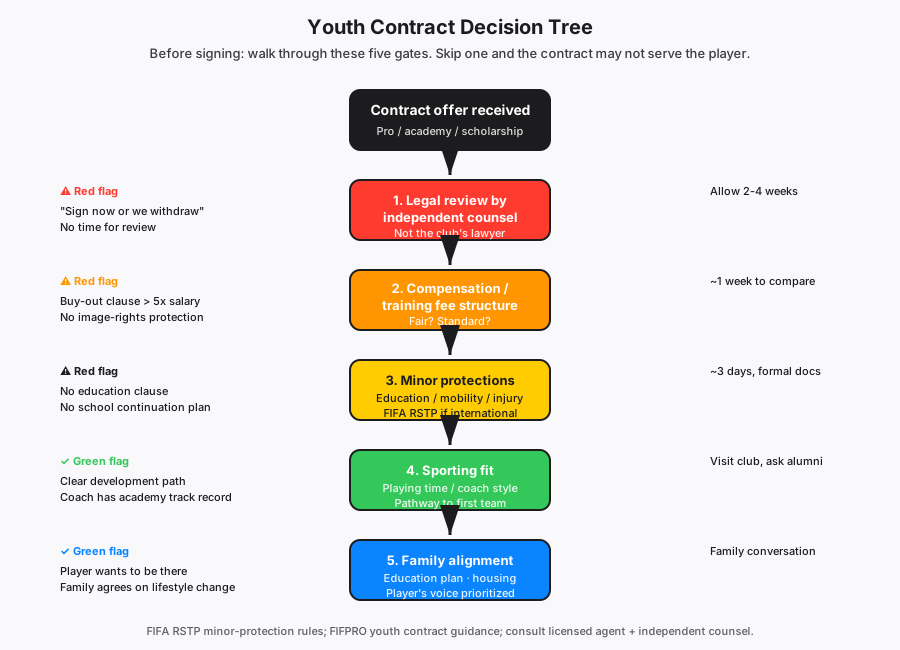
Under-18 contracts require parental consent. Same for agent contracts. Parents must understand what they are consenting to — formal signature without comprehension leaves voidability risk.
Parental consent — items to verify
- Contract length and early termination conditions
- Base salary and bonus formulas
- Transfer fee and buyout amounts
- Loyalty bonus trigger conditions
- Provisions covering school/study balance
- Compensation in case of injury
- Mental health support provisions
- Restrictions on social media and personal endorsements
Coach-as-parent conflict of interest
If a parent doubles as the coach, contract negotiation and performance evaluation become entangled. Footnote's permissions matrix (footnote-permissions-matrix.md) recommends that performance evaluations in such cases be entered by an independent neutral coach.
An ideal under-18 contract package is three documents: the contract, the parental consent letter, and a separate signed acknowledgment from the player. Missing any one of them leaves a void/voidable risk.
Linking IDPs to Contracts — Development Plans Inside the Deal
An Individual Development Plan (IDP) makes a player's growth goals explicit. Tying it to the contract makes "investment in development" a concrete, enforceable element rather than an abstract promise.
An IDP, set by the club for each player, lays out goals across technical / tactical / physical / mental dimensions, plus KPIs and target dates. Footnote ships IDP as a Tier Pro / Club account feature, with coaches authoring them and players viewing progress.
Examples of IDP-to-contract integration
- Development bonus: trigger payouts when IDP KPIs (e.g. monthly evaluation score, PVS growth rate) hit targets
- Tiered contract: salary and term step up as IDP milestones are met
- Education compensation on transfer: link IDP investment costs to FIFA RSTP Article 20 solidarity contributions
- Mental health support: "4 sport-psychology consultations per year" as a contracted benefit, structured into the IDP
Without an IDP, "developmental investment" is fuzzy and the value exchange is unclear. Documenting the IDP in Footnote is foundational to a fair contract design that benefits both club and player.
Comparing the Four Paths at 18 — Pro, College, Abroad, Retire
The major choices at high-school graduation: domestic professional, university (4-year deferral with another shot), overseas, or retirement. Calmly comparing the long-term expected value of each is the key to a regret-free decision.

Photo by Shawn on Unsplash
What each path offers
- Domestic pro (J1-J3) — immediate income; J3 realistic salary ¥1-2.5M/year; high-quality training environment; injury and pressure are highest
- University + retry: degree + 4 years of physical and cognitive development; pro entry rate from college J-League draft is 3-5% per year (under half the high-school rate), but the degree provides career insurance
- Abroad (18+) — possible at European lower divisions from age 18; salary typically €5,000-30,000 (~$5-30K/year); cost of living and visa management add complexity
- Retire / alternative path — sometimes the most rational choice. Pivots into related industries (coaching, data analysis, media) are growing
Reardon et al. (2019) on mental health risk
The IOC's consensus statement on mental health in elite athletes finds elevated rates of depression, eating disorders, and burnout in this population versus the general public. Forcing yourself onto the pro-only path raises mental health risk; keeping multiple options is research-supported.
"If I don't make it pro, my life is over" is a dangerous coaching narrative. Long-term wellbeing and performance are both better served by keeping multiple paths open past 18.
Conclusion — Data and Legal Literacy Build Negotiating Power
Youth contract and transfer decisions require literacy in both law and numbers. Players who understand FIFA RSTP, civil-law fundamentals, and how performance clauses are computed — and who can speak with their own Footnote data — hold the leverage in their own careers.
A pro contract is not "an opportunity" — it is "an investment." The club invests in you and expects a return. You invest your time and body and require a return (income, development, career). Both perspectives must be in the room for a fair contract.
Footnote provides three pillars to support that perspective: continuous recording (a data asset), IDP integration (an explicit development plan), and PVS (an objective relative-value metric). These give you the numbers you need to negotiate from strength.
References
- [1] Fédération Internationale de Football Association (FIFA) (2024). “Regulations on the Status and Transfer of Players (RSTP)” FIFA Legal Documents. Link
- [2] Government of Japan (2022). “Civil Code Articles 4 (Adulthood), 5 (Minors' Legal Acts), 6 (Authorization for Business)” e-Gov Legal Database.
- [3] European Court of Justice (Bosman Ruling) (1995). “Union Royale Belge des Sociétés de Football Association ASBL v. Jean-Marc Bosman” Case C-415/93.
- [4] Reardon, C. L., Hainline, B., Aron, C. M., et al. (2019). “Mental health in elite athletes: International Olympic Committee consensus statement” British Journal of Sports Medicine.
- [5] Calvin, M. (2017). “No Hunger in Paradise: The Players. The Journey. The Dream.” Century.
- [6] Roderick, M. (2006). “The Work of Professional Football: A Labour of Love?” Routledge.
- [7] Japan Football Association (JFA) (2024). “JFA Transfer Regulations and Player Registration Rules” JFA Regulations.
Related Articles
The Complete Tryout Guide — 7 Evaluation Criteria Top Academies Look For and How to Prepare
15 min read
The Complete Guide to Choosing a Youth Soccer Club — 7 Evaluation Criteria and How to Make the Right Decision
14 min read
PVS (Player Value Score) — Complete Guide to Footnote's Composite Player Metric
7 min read
U-12 / U-15 / U-18 — Age-Specific Development Roadmap for Soccer Players
7 min read
A Parent's Guide to the Soccer Journal — How to Support Your Child's Growth the Right Way
7 min read
Track Your Growth with Footnote
Just record your matches — AI analyzes every 5 games. Visualize growth with PVS Score. All features free during beta.
30-second signup · No credit card required
Last updated: 2026-05-09 ・ Footnote Editorial