Injury Prevention Guide for Junior Soccer Players — FIFA 11+ Kids and Evidence-Based Prevention Programs
Approximately 50% of injuries in junior soccer can be prevented with proper prevention programs. A large-scale RCT by Soligard et al. (2009) demonstrated that implementing the FIFA 11+ warm-up program reduced injury rates by 32-72%. Young athletes in their growth phase have vulnerable growth plates (epiphyseal plates) and epiphyseal cartilage, exposing them to risks that differ from those faced by adults. By dedicating just 20 minutes before every training session to evidence-based prevention exercises, you can significantly reduce the risk of injury and protect a player's long-term soccer career.
The Reality of Junior Soccer Injuries — Incidence Rates, Affected Areas, and Severity Statistics
In junior soccer, 2-7 injuries per 1,000 hours of play are reported, with approximately 60% concentrated in the lower extremities. Injuries during matches occur 3-5 times more frequently than during training, and the tendency toward more severe injuries increases with age.

Photo by Quan-You Zhang on Unsplash
Soccer is a contact sport involving diverse movements such as running, jumping, kicking, and colliding, which makes the risk of injury relatively high compared to other sports. However, injuries in the junior age group have characteristics that differ from those in adults, and understanding these differences is essential for implementing effective prevention strategies.
Injury Incidence by Body Part
- Ankle — Accounts for approximately 20-25% of all injuries and is the most common site. Sprains make up the majority, with inversion sprains being particularly prevalent
- Knee — Approximately 15-20%. Ligament injuries (ACL and MCL) increase with age and are a leading cause of long-term absence
- Thigh — Approximately 15%. Hamstring strains are the primary concern, most commonly occurring during sprinting
- Lower leg (shin) — Approximately 10%. Shin splints (medial tibial stress syndrome) frequently occur during the growth phase
- Foot — Approximately 8%. Includes Sever's disease (calcaneal apophysitis), which is specific to the growth phase
Severity Classification and Time Lost
Injury severity is classified by time lost from play. Mild injuries (1-3 days lost) account for approximately 40% of all injuries, moderate (4-28 days) for approximately 35%, and severe (29+ days) for approximately 25%. The proportion of severe injuries is around 10% for players under 10 years of age but exceeds 30% for those aged 13 and above. A systematic review by Rossler et al. (2014) noted that the risk of severe injury peaks when rapid physical changes coincide with increased training volume during the growth phase.
The defining feature of junior soccer injuries is the high proportion of overuse injuries. Beyond acute trauma (sprains, fractures), injuries caused by chronic load accumulation account for 30-50% of all injuries. These are among the most preventable types of injury.
Matches vs. Training — Understanding the Difference in Risk by the Numbers
The injury rate during matches reaches 10-15 per 1,000 hours, compared to 2-5 during training — a significant gap. Matches involve more all-out effort under pressure and higher-intensity contact. However, overuse injuries during training are cumulative in nature, making them easy to overlook when simply comparing incidence rates. Prevention programs not only directly reduce match-related injury risks but also help mitigate chronic load accumulation during training.
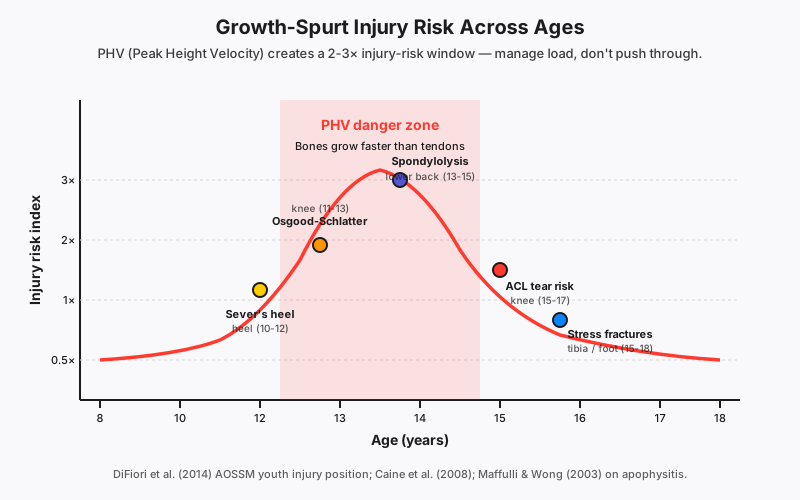
Growth-Related Injuries — Causes and Management of Osgood-Schlatter Disease, Sever's Disease, and Lumbar Spondylolysis
Young athletes in their growth phase have open growth plates (epiphyseal plates), which puts them at risk for injuries that do not occur in adults. Osgood-Schlatter disease, Sever's disease, and lumbar spondylolysis are three conditions that occur with high frequency in junior soccer players.
Growing bones contain cartilaginous areas called growth plates (epiphyseal plates), from which bone elongation occurs. This cartilage is physically weaker than mature adult bone and is prone to inflammation and damage from repetitive traction forces (the pulling force of muscles on bone). During PHV (Peak Height Velocity) — the period of most rapid height gain — bone growth outpaces the flexibility of muscles and tendons, increasing mechanical stress on the epiphyseal regions.
Osgood-Schlatter Disease — Pain Below the Knee
This condition develops when repetitive traction from the quadriceps is applied to the tibial tuberosity (the bony prominence just below the knee). It commonly affects soccer players aged 10-14, with kicking being a direct source of stress. Complete activity cessation is not necessary; the standard approach involves adjusting activity levels based on pain, quadriceps stretching, and icing.
Sever's Disease (Calcaneal Apophysitis) — Heel Pain
This condition develops when the Achilles tendon exerts traction on the growth plate of the calcaneus (heel bone). It most commonly affects children aged 8-12 and tends to occur more frequently in teams that train primarily on hard ground. Effective measures include using shock-absorbing insoles, calf stretching, and post-training icing. Adjusting training volume during periods when the ground is hard (winter and summer) is also important.
Lumbar Spondylolysis — Stress Fracture of the Lower Back
This is a stress fracture of the pars interarticularis in the lumbar spine (lower back) caused by repetitive extension and rotation. In soccer, kicking motions, arching the back during headers, and trunk extension during throw-ins are contributing factors. It most commonly occurs in players aged 12-15. If detected early, bone healing can be expected, but delayed diagnosis may result in a permanent defect. Any lower back pain lasting more than two weeks warrants an orthopedic consultation.
Risk Management During the Growth Spurt
- Regular height measurements — Measure height every 3 months. A rapid increase (3 cm or more in 6 months) may indicate the PHV phase
- Temporary reduction in training volume — During the PHV phase, reducing training to 70-80% of the usual volume is recommended
- Focused flexibility checks — Flexibility drops sharply during the PHV phase. Check quadriceps, hamstring, and calf flexibility weekly
- Encourage early pain reporting — Repeatedly communicate to players that enduring pain is not toughness — it is a path to worsening injury
Growth-related injuries require more than just rest to heal. Rehabilitation and training load adjustment to prevent recurrence are essential. After obtaining a medical diagnosis, it is important to implement a gradual return-to-play program.
The FIFA 11+ Kids Program — An Evidence-Based Warm-Up
FIFA 11+ Kids is an injury prevention program developed by FIFA's Medical and Research Centre (F-MARC) for players aged 7-13. Consisting of approximately 20 minutes of exercises across 7 movement categories, research by Rossler et al. has demonstrated that it reduces the risk of injury by 48%.

Photo by Jeffrey F Lin on Unsplash
FIFA 11+ Kids is an adaptation of the adult FIFA 11+ program tailored to children's developmental stages. While the adult version focuses on strength training, the Kids version emphasizes learning neuromuscular control (how to use the body) through play-based activities. All exercises can be performed without any special equipment and are designed to be integrated as a pre-training warm-up.
The 7 Exercise Categories
- Running exercises — Basic movement patterns including straight-line running, side-stepping, and backpedaling. Focus on correct posture and foot strike
- Tumbling (rolling movements) — Forward rolls, backward rolls, and lateral rolls to develop falling techniques and spatial body awareness. Skills for distributing impact force during falls
- Balance exercises — Single-leg stance and balance on unstable surfaces. Improves ankle stability and proprioception (the sense of body position)
- Jumping & landing — Single-leg and double-leg jumps with correct landing form (preventing the knees from collapsing inward). A core element for ACL injury prevention
- Core stabilization — Core exercises including planks, side planks, and bird dogs. Stabilizing the body's center improves the precision of limb movements
- Fair play elements — Proper tackling technique and how to receive body contact. Reduces intentional fouls and prevents injuries during contact situations
- Speed exercises — Agility runs, change of direction, and reaction drills. Develops the ability to maintain correct form while moving at full speed
Key Points for Implementation
- 20 minutes before every training session — Benefits are proven with implementation at least twice per week. Once per week is insufficient
- Follow the sequence — Progress in order from running to tumbling, balance, jumping, core, fair play, and finally speed exercises, gradually increasing intensity
- Prioritize fun — The defining feature of the Kids version is that it can be approached in a play-like manner. Incorporate competitive elements and game formats to keep players engaged
- Coaches should demonstrate — Modeling correct form is essential. Video teaching materials can also be used as a resource
Scientific Evidence — Proven Injury Prevention Outcomes
Soligard et al. (2009) conducted an RCT (randomized controlled trial) involving 1,892 female soccer players aged 15-17 in Norway and reported that the group implementing FIFA 11+ had a 32% lower injury rate compared to the control group. Notably, a 45% reduction was observed in severe injuries (28+ days lost).
Furthermore, a meta-analysis by Rossler et al. (2014), which examined exercise-based intervention programs in youth sports overall, concluded that warm-ups incorporating neuromuscular training reduce injury risk by an average of 46%. This effect is consistent across sex, age, and sport. Greater adherence to the program (how faithfully it is implemented) produces larger effects, indicating that "how correctly you do it" matters more than "whether you do it or not."
The greatest strength of FIFA 11+ Kids is that it requires no special equipment or facilities whatsoever and can be adopted immediately by any team. There is no reason not to implement a program that costs nothing and can cut injuries in half.
— Rossler et al., 2014
Prevention Training Menu — Hamstrings, Balance, and Proprioception
The three pillars of injury prevention training are hamstring strengthening, balance/proprioception training, and learning correct landing mechanics. Emery et al. (2015) reported that these neuromuscular training methods can reduce knee and ankle injuries by up to 60%.
The purpose of injury prevention training extends beyond simply "building muscle." The essence is to enhance the ability of muscles, tendons, ligaments, and the nervous system to work together to stabilize joints. For junior athletes in particular, improving neuromuscular control (how the body is used) has a more direct impact on injury prevention than raw strength alone.
Hamstring Strengthening — Preventing Strains and Knee Ligament Injuries
The hamstrings (back of the thigh) are the most commonly strained muscle group in soccer. During the swing phase of sprinting (the moment the leg swings forward), significant eccentric contraction (producing force while being lengthened) occurs, which is the primary mechanism of injury. Read et al. (2016) also reported that eccentric hamstring strength is a risk factor for ACL injuries.
- Nordic hamstring curls (U-13 and above) — A partner holds the ankles while the player kneels and slowly leans forward. Effectively develops eccentric hamstring strength. Aim for 6-10 repetitions, twice per week
- Bridges (all ages) — Lie on the back with knees bent and lift the hips. Progress to single-leg variations. A fundamental exercise that activates both the hamstrings and glutes simultaneously
- Sliding leg curls (U-12 and above) — Place feet on a towel and perform knee flexion and extension while lying on the back. Trains both the lengthening and shortening capacity of the hamstrings
Balance and Proprioception Training — Preventing Ankle Sprains
Proprioception is the ability to sense the position and movement of your body even with your eyes closed. When ankle proprioception is diminished, maintaining balance on uneven surfaces becomes difficult and the risk of sprains increases sharply. A review by Emery et al. (2015) demonstrated that balance training reduces ankle sprain recurrence by 35-50%.
- Single-leg stance (all ages) — Progress stepwise: 30 seconds with eyes open, then 15 seconds with eyes closed, then 30 seconds on an unstable surface (cushion)
- Star excursion balance test (U-10 and above) — Stand on one leg and reach the other foot forward, sideways, and backward. Regularly measure balance and reach distance to track improvement
- Balance catch (all ages) — Pass and receive a ball while standing on one leg. An engaging, play-based exercise with high relevance to soccer-specific movements
Correct Landing Mechanics — The Key to Preventing ACL Injuries
ACL (anterior cruciate ligament) injuries occur when the knee collapses inward (knee valgus) during landing from a jump or sudden deceleration. This movement pattern can be corrected through neuromuscular training. By repeatedly coaching "keep the knees aligned over the toes," "absorb impact through the hips," and "land softly," correct landing patterns become ingrained at a subconscious level.
- Double-leg squat jumps — Start by rehearsing the landing form only. Confirm that the knees are directly above the toes each time
- Single-leg hop and stick — Hop forward on one leg and hold for 2 seconds after landing. The goal is to stop without losing balance
- Lateral jump and land — Jump side to side over a line. A practical drill that simulates the change-of-direction movements in soccer
- Heading jump and land — Jump and land with a heading motion. An integrated exercise that simulates match situations
Prevention training is often skipped because it seems unglamorous, but the data from Emery et al. (2015) is clear. Fifteen minutes of neuromuscular training twice a week can reduce knee and ankle injury risk by 40-60%. This is an investment with no reason to skip.
Signs and Management of Overtraining — Excessive Practice as the Greatest Injury Risk
A large-scale review by DiFiori et al. (2014) demonstrated that the primary risk factors for overuse injuries in junior sports are excessive training volume and insufficient rest. When weekly training hours exceed the player's age multiplied by one hour, the risk of injury increases sharply.
"To get better, practice more" — this belief is one of the most dangerous misconceptions, especially at the junior level. In their comprehensive review of overuse injuries and burnout in junior athletes, DiFiori et al. (2014) warned that early specialization (concentrating on a single sport from a young age) and excessive training volume not only increase the risk of injury but also lead to premature dropout from sport.
Scientific Guidelines for Training Volume
- The age-in-hours rule — Total weekly training hours should not exceed the player's age in hours (e.g., a 10-year-old should train no more than 10 hours per week)
- At least one full rest day per week — A minimum of one day per week with no organized sports activities at all
- At least 3 months of off-season per year — Rather than playing the same sport year-round, dedicate at least 3 months to activities other than soccer or free play
- Avoid sudden load increases — Training volume should not increase by more than 10% per week (based on the Acute:Chronic Workload Ratio concept)
Early Signs of Overtraining — A Checklist to Catch It Before It's Too Late
Overtraining does not develop overnight. It occurs when gradually accumulating fatigue exceeds a threshold. When multiple signs from the following list are present, a review of training volume is warranted.
- Performance plateau or decline — Skills fail to improve despite increased training volume, or previously mastered skills deteriorate
- Chronic fatigue — Tiredness persists despite adequate sleep, or waking up in the morning becomes difficult
- Decreased motivation — The player begins feeling that soccer is "no fun" or "I don't want to go"
- Sleep disturbances — Difficulty falling asleep, frequent nighttime awakenings, or nightmares
- Changes in appetite — Appetite decreases or increases dramatically
- Frequent illness — Immune function declines, making the player more susceptible to infections
- Abnormal heart rate — Resting heart rate remains 5-10 bpm above normal for an extended period
Distinguishing Chronic Fatigue from Overtraining
Temporary fatigue resolves with 1-2 days of rest, whereas overtraining syndrome may require weeks to months of recovery. The critical difference is that rest does not lead to recovery. If fatigue or performance decline does not improve after two weeks of complete rest, consulting a sports medicine physician is strongly recommended.
The most effective method of injury prevention is proper training load management. Skilled players are not those who "trained the most" but those who "trained at high quality in appropriate amounts and recovered fully."
In Japanese junior soccer, there is a deeply ingrained culture of equating rest with laziness. However, the science is clear — rest is part of training, and there is no growth without recovery.
What Parents and Coaches Can Do — A Practical Injury Prevention Checklist
The responsibility for injury prevention lies not with individual players but with parents and coaches. Checking ground conditions, choosing appropriate equipment, and creating an environment where players feel safe reporting pain are the most effective prevention measures.
Junior athletes have not yet fully developed the ability to accurately assess and articulate their physical condition. Behaviors such as enduring pain, hiding injuries, and saying "I'm fine" while continuing to play are not uncommon. This is precisely why adults need to take a proactive role in injury prevention.
Pre-Training Injury Prevention Checklist
- Check players' physical condition — Ask all players about their condition before training begins. Confirm whether any pain from the previous session persists
- Conduct a warm-up — Implement the FIFA 11+ Kids program or an equivalent neuromuscular training routine for a minimum of 15 minutes
- Inspect ground conditions — Check for holes, stones, glass fragments, appropriate turf condition, and slippery conditions after rain
- Prepare for hydration — Develop a hydration plan based on temperature and schedule water breaks every 15-20 minutes
- Inspect equipment — Verify that shin guards are properly fitted and that boot studs are not excessively worn
Choosing the Right Boots — Fit Over Price
Expensive boots do not necessarily prevent injuries. What matters is how well they fit the foot shape and whether the sole stiffness is appropriate for the player's age. Growing feet change size every 6-12 months, and continuing to wear boots that have become too tight is a direct cause of foot injuries.
- Stud shape — Round studs (HG/AG compatible) are safer for players up to U-10. Replaceable studs (SG) place greater stress on the ankle joint and should be considered only from U-13 onward
- Sole flexibility — The sole should flex moderately when bent by hand. Overly stiff soles place excessive stress on growing feet
- Size allowance — Ensure 5-10 mm of room at the toe. Buying oversized boots to accommodate growth should also be avoided, as the foot sliding inside the boot increases sprain risk
- Insole replacement — If the stock insole is thin, consider replacing it with a sports insole that offers greater shock absorption
Creating an Environment Where Players Can Report Pain
The most critical element of injury prevention is creating an environment where players feel safe reporting pain or discomfort. In teams where players fear losing their starting spot for reporting pain, or where enduring pain is equated with toughness, early warning signs are ignored until minor issues become serious injuries.
- Praise pain reporting — Communicate that being able to accurately sense and report what your body feels is a sign of an excellent player
- Clearly outline the return-to-play protocol — Inform players and parents in advance that proper recovery steps will be followed after any injury
- Share information with parents — Report any pain complaints during training to parents the same day. Actively receive health information from parents as well
- Coaches must be willing to pull players — Even if a player says "I'm fine," the coach must have the judgment to stop training when something looks wrong in their movement
Injury prevention is not something extraordinary. A 20-minute warm-up before training, appropriate training volume, adequate rest, proper equipment management, and an environment where players can report pain freely. Committing to these fundamentals is the best way to protect a player's long-term soccer career.
References
- [1] Soligard, T., Myklebust, G., Steffen, K., Holme, I., Silvers, H., Bizzini, M., Junge, A., Dvorak, J., Bahr, R. & Andersen, T. E. (2009). “Comprehensive warm-up programme to prevent injuries in young female footballers: cluster randomised controlled trial” BMJ.
- [2] Rossler, R., Donath, L., Verhagen, E., Junge, A., Schweizer, T. & Faude, O. (2014). “Exercise-based injury prevention in child and adolescent sport: a systematic review and meta-analysis” Sports Medicine.
- [3] Emery, C. A., Roy, T. O., Whittaker, J. L., Nettel-Aguirre, A. & van Mechelen, W. (2015). “Neuromuscular training injury prevention strategies in youth sport: a systematic review and meta-analysis” British Journal of Sports Medicine.
- [4] DiFiori, J. P., Benjamin, H. J., Brenner, J. S., Gregory, A., Jayanthi, N., Landry, G. L. & Luke, A. (2014). “Overuse injuries and burnout in youth sports: a position statement from the American Medical Society for Sports Medicine” British Journal of Sports Medicine.
- [5] Read, P. J., Oliver, J. L., De Ste Croix, M. B. A., Myer, G. D. & Lloyd, R. S. (2016). “Neuromuscular risk factors for knee and ankle ligament injuries in male youth soccer players” Sports Medicine.
Related Articles
The Truth About the Golden Age — Neuroscience Reveals Optimal Training by Age Group
11 min read
Soccer Training to Get Faster — 5 Methods Proven by Sprint Science
14 min read
Flexibility and Mobility — The Science Behind How Yoga, Ballet, and Gymnastics Prevent Soccer Injuries
10 min read
The Science of Core Training for Kids — Age-Specific Programs and Their Impact on Soccer
15 min read
The Complete Match Day Preparation Guide for Soccer — From the Night Before to Post-Match Recovery
11 min read
Track Your Growth with Footnote
Just record your matches — AI analyzes every 5 games. Visualize growth with PVS Score. All features free during beta.
30-second signup · No credit card required
Last updated: 2026-05-06 ・ Footnote Editorial