The Science of Proper Kicking — Biomechanics Behind Instep and Inside Kicks
Kicking a soccer ball is far more than simply striking it with your foot. As the review by Lees & Nolan (1998) revealed, a kick is a precision kinetic chain in which force is transferred sequentially from the hip to the knee to the ankle. The initial ball speed of an instep kick can exceed 100 km/h, with roughly 40% of that propulsion generated by knee extension and about 15% by ankle stabilization. By understanding the science behind proper kicking mechanics and applying age-appropriate coaching progressions, any player can reliably improve both power and accuracy.
Kick Biomechanics Fundamentals — The True Source of Kicking Power
Kicking power does not originate from the toes or the ankle. It is produced by a kinetic chain that transfers force sequentially from the hip to the knee to the ankle. The efficiency of this chain determines both the power and accuracy of the kick.

Photo by Edoardo Busti on Unsplash
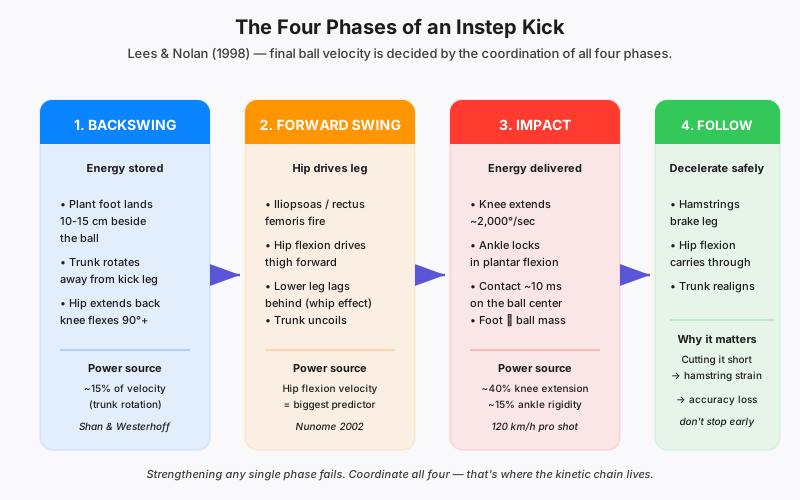
From a biomechanical perspective, the soccer kick can be divided into four phases: the backswing (take-back), the forward swing, impact, and follow-through. The review by Lees & Nolan (1998) demonstrated that the final ball velocity is determined by the coordination of all four phases. Strengthening just one part of the movement will not improve the overall quality of the kick.
The Kinetic Chain Principle
The kinetic chain in kicking refers to the sequential mechanism of force transfer through the trunk, hip, thigh, knee, lower leg, ankle, and foot. A full-body 3D kinematic analysis by Shan & Westerhoff (2005) showed that players who kick harder exhibit smoother force transfer from trunk rotation into the lower limbs. In other words, kicking power is generated not by the foot alone but through whole-body coordination.
The Role and Positioning of the Plant Foot
The position of the plant foot is one of the most critical factors affecting kick quality. As a general rule, the plant foot should be placed 10-15 cm beside the ball with the toes pointing toward the target. If the plant foot is too far from the ball, the kicker tends to strike the underside and the ball floats upward; if it is too close, the cramped position reduces power. Kellis & Katis (2007) reported that plant-foot positioning directly influences the swing path of the kicking leg and the ball's launch angle at contact.
Using the Upper Body (Trunk)
- Forward lean — Leaning the upper body slightly forward over the ball makes it easier to strike the top half, producing a low-trajectory shot. Conversely, leaning backward tends to cause the foot to strike under the ball, sending it skyward
- Trunk rotation — During the backswing, the upper body twists in the opposite direction of the kicking leg; during the forward swing, that rotation reverses, transferring rotational energy from the hips into the kicking leg. Shan & Westerhoff (2005) showed that this trunk rotation contributes roughly 10-15% of kick velocity
- Arm balance — Extending the arm opposite the kicking leg wide helps maintain balance and stabilizes the rotational axis of the trunk. Without this arm movement, kick consistency drops significantly
Kicking power is not generated by the leg swing alone. Maximum force is transmitted to the ball only when every stage of the kinetic chain works in concert: trunk rotation, hip flexion, knee extension, and ankle lock.
The Science of the Instep Kick — Anatomy of a Power Shot
The instep kick (striking the ball with the top of the foot) is the most powerful kicking technique in soccer. According to 3D analysis by Nunome et al. (2002), the instep kick of professional players can produce initial ball speeds exceeding 120 km/h, with the majority of propulsion dependent on knee extension speed and ankle rigidity.

Photo by Hoseung Han on Unsplash
The instep kick is used in situations that demand maximum ball speed, such as shooting, long feeds, and free kicks. The review by Kellis & Katis (2007) comprehensively analyzed the mechanical characteristics of the instep kick, revealing what separates players who can generate high ball speed from those who cannot.
Hip Flexion — The Origin of Power
The kinetic chain of the instep kick begins with hip flexion. The kicking leg, drawn back during the backswing, is driven forward by the hip flexor muscles (iliopsoas and rectus femoris). The greater the angular velocity of this hip flexion, the more energy is transferred to the subsequent knee extension. Research by Nunome et al. (2002) reported that the most significant difference between high and low ball-speed groups was the angular velocity of hip flexion.
Knee Extension — The Biggest Factor in Ball Speed
After the thigh is driven forward by hip flexion, the knee joint extends explosively. This "whip-like snap" is the core mechanism of the instep kick. According to Kellis & Katis (2007), knee extension generates approximately 40% of the initial ball speed, making it the single largest contributor. Crucially, the timing of knee extension matters: the knee begins to accelerate precisely as the hip motion decelerates, creating a sequential acceleration pattern that enables efficient force transfer.
Ankle Lock — The Final Key to Transferring Force to the Ball
Locking the ankle (holding the ankle joint in a plantarflexed position) is essential for efficiently transferring the energy generated by knee extension to the ball. Impact mechanics analysis by Shinkai et al. (2009) showed that when the ankle is not locked, the impact force is absorbed by the ankle joint, resulting in up to a 20% reduction in ball speed. Locking the ankle firmly and striking the center of the ball with the slightly medial part of the dorsum (around the laces area) is crucial for achieving both power and accuracy.
Follow-Through — Accuracy and Injury Prevention
The follow-through after impact serves a dual purpose: it improves directional accuracy toward the target and distributes the load from sudden deceleration across the knee and hip joints. Swinging the kicking leg straight through toward the target stabilizes the ball's flight path. A short or laterally deviated follow-through causes unstable ball spin and reduced accuracy.
Instep kick checklist: (1) Approach angle of 30-45 degrees (2) Plant foot 10-15 cm beside the ball (3) Full hip extension during backswing (4) Explosive knee extension (5) Ankle locked in plantarflexion (6) Strike the ball center with the dorsum of the foot (laces area) (7) Follow through toward the target
"Lock your ankle" is the single most important instruction in kick coaching. Striking the ball with a loose ankle not only causes power to be absorbed at the ankle joint but also increases the risk of ankle sprains.
The Science of the Inside Kick — The Mechanics of Accuracy and Control
The inside kick (striking the ball with the medial side of the foot) is the most frequently used kicking technique in soccer. Analysis by Nunome et al. (2002) showed that while the inside kick produces approximately 30% less ball speed than the instep kick, its larger contact area results in significantly greater directional consistency.
The inside kick is the technique of choice whenever accuracy takes priority, including passing, short-range shots, and controlled finishes. Approximately 70-80% of passes in a match are inside kicks, making the accuracy of this technique a decisive factor in a team's overall passing quality. The 3D analysis by Nunome et al. (2002) detailed the mechanical differences between inside and instep kicks.
Creating the Kicking Surface
The accuracy of the inside kick depends on how precisely you create a flat surface with the medial side of the foot. The ankle is externally rotated (abducted), and the ball is struck with the broad medial surface — the area spanning from the arch to the first metatarsal head. The wider this surface, the longer the contact time with the ball (Shinkai et al., 2009), which stabilizes force transfer and minimizes directional deviation.
Body Orientation and Alignment
- Face the target squarely — In the inside kick, aligning the upper body and pelvis directly toward the target is the key to accuracy. Facing sideways and simply flicking the ball with the foot drastically reduces directional consistency
- Plant-foot toe direction — Point the toes of the plant foot toward the target. When the plant foot is misaligned, the pelvis rotation angle changes, which in turn affects the angle of the kicking surface
- Knee over the ball — At impact, the knee of the kicking leg should be directly above or slightly ahead of the ball. If the knee trails behind, the ball tends to lift off the ground
Ball Contact Point — Controlling Trajectory
Where the foot meets the ball determines the trajectory. Striking the center of the ball from slightly above produces a low-trajectory ground pass, while striking slightly below center lofts the ball. As Lees & Nolan (1998) noted, the relationship between foot contact position and ball flight characteristics in the inside kick is extremely sensitive — a shift of just 1-2 cm can dramatically alter the trajectory.
Common Mistakes in the Inside Kick
- Loose ankle — The kicking surface becomes unstable, causing the ball direction to scatter. Lock the ankle firmly and keep the surface as rigid as a wall
- Steering with the foot only — Adjusting the pass direction by changing the ankle angle without reorienting the entire body reduces accuracy. Turn the whole body toward the target
- Short follow-through — Stopping at impact results in insufficient force transfer. Swing the foot through toward the target to achieve both strength and accuracy in the pass
- Plant foot too far away — When the plant foot is too far from the ball, the kicking leg cannot swing fully, resulting in a weak, toe-poke-like contact
The accuracy of the inside kick is determined not by the shape of the foot but by the orientation of the body. Square your body to the target, point the plant-foot toes toward it, and the foot will naturally form the correct kicking surface.
Other Kicking Techniques — The Mechanics of Outside Kicks, Toe Pokes, and Volleys
Soccer demands a diverse range of kicking techniques for different situations. Outside kicks, toe pokes, volleys, and headers each have distinct mechanical characteristics, and knowing when to deploy each one is critical to match performance.
The Outside Kick — A Weapon of Deception and Spin
The outside kick, struck with the lateral side of the foot (near the base of the little toe), allows the player to send a pass in a direction different from body orientation, making it a valuable tool for wrong-footing opponents. Mechanically, the ankle is internally rotated (adducted) at contact, naturally imparting an outspin curve to the ball. Although the narrower contact area reduces accuracy compared to the inside kick, the minimal telegraphing of the motion provides a practical advantage in match situations.
The Toe Poke — An Underrated Match Skill
The toe poke — striking the ball with the tip of the toes — has traditionally been regarded as biomechanically inefficient. In recent years, however, its practical value for getting a quick shot off in tight spaces has been re-evaluated. Inside the penalty area, crowded conditions frequently make a full instep swing impossible. Because the toe poke requires minimal backswing to transfer force to the ball, it is an important technique for capitalizing on fleeting chances in front of goal.
The Volley — Striking the Ball in the Air
The volley (kicking the ball directly out of the air) demands even greater timing and body positioning than a ground-ball kick. Unlike a stationary ball, an airborne ball is constantly changing position, requiring the player to instantaneously adjust foot timing, body tilt, and impact height. The fundamental approach is to lean the upper body slightly backward, raising the peak of the leg swing to match the height of the ball. The ankle is locked, and the center of the ball is struck with the instep or the inside of the foot.
Body Mechanics for Heading
- Neck stabilization — The power of a header is not generated by the neck muscles; rather, the neck transmits force produced by the trunk. Keep the neck rigid and strike the ball with the forehead (around the hairline)
- Trunk flexion — For a power header, arch the upper body backward in the air and then flex forward into the ball. This bow-and-snap trunk motion is the primary driver of heading power
- Keep your eyes open — Closing the eyes at the moment of impact shifts the contact point, causing the header direction to become unstable. Watching the ball all the way to contact is a prerequisite for accuracy
- Jump timing — For a jumping header, take off at the moment when you can meet the ball at your own maximum height, not at the ball's highest point. Jumping too early results in heading the ball while descending, which saps power
All of these techniques are applications of the same kinetic chain principles underlying the instep and inside kicks. Mastering these two foundational kicks before progressing to situational variations is the most efficient path to overall improvement.
The foundation of every kicking technique is ankle lock and body-orientation control. When either of these breaks down, both accuracy and power suffer regardless of the kick type. Mastering the basics is the ultimate shortcut.
Age-Based Kick Coaching Progression — A Roadmap from U-8 to U-12
Coaching kicking technique requires a progressive approach matched to the player's age and developmental stage. Demanding precise form at U-8 is counterproductive, while still letting players kick freely without guidance at U-12 leads to stagnation. Defining what to teach — and what not to teach — at each stage is essential.
U-8 (Ages 7-8): Prioritize the Joy of Kicking
The most important goal at this age is to let players experience the pure joy of kicking the ball. Correcting form or providing detailed technical instruction is likely to be counterproductive. Children naturally learn which part of the foot sends the ball farthest or makes it curve simply by kicking freely. The role of coaches and parents is not to teach the correct technique but to maximize kicking opportunities.
- Guarantee free kicking time — Dedicate at least 30% of practice time to letting players kick however they want
- Use a variety of balls — Kicking tennis balls, rubber balls, balloons, and other objects of different sizes, weights, and bounce characteristics develops foot sensitivity
- Use game-based formats — Design activities where kicking occurs naturally: target shooting, bowling games, mini-matches, and similar play
- Minimize form correction — Limit instructions to basic cues like "try not to kick with your toes" and avoid detailed form coaching
U-10 (Ages 9-10): Build the Foundation of Proper Form
As players enter the golden age of motor learning, intentional coaching of basic kick form should begin. The goal is not perfection of form but rather embedding the correct feel in the body's muscle memory. Key elements — plant-foot positioning, ankle lock, and squaring the body to the target — are reinforced through repeated drill-based experiences.
- Plant-foot positioning — Use cues like "place your foot next to the ball before you kick" to develop awareness of the plant foot
- Ankle lock — Communicate with concrete imagery such as "make a fist with your foot and keep it tight" or "lift your heel and stretch the top of your foot flat"
- Inside kick form — Introduce the basics of facing the target and striking with the flat medial surface of the foot
- Introducing the instep kick — Start with "try kicking with the laces part of your shoe" and teach the basic form in combination with ankle lock
U-12 (Ages 11-12): Evolve into Decision-Based Kicking
At U-12, where the fundamentals of form are established, practice should integrate decision-making about which kick to use in each situation. This is a pivotal stage where training transitions from kicking a stationary ball to making decisions while kicking on the move. As Lees & Nolan (1998) pointed out, opportunities to kick in an ideal body position are rare in actual matches, and the ability to maintain accuracy in imperfect positions is essential.
- Kicking under pressure — Shooting with defenders present, pass decision-making within time constraints
- Kicking on the move — Introduce shooting off the dribble, one-touch passing, and direct play
- Kick selection — Design drills that force players to decide: "Inside or instep in this situation?"
- Weak-foot awareness — Gradually introduce weak-foot kicking for players whose dominant-foot form has stabilized
- Introducing the curve kick — Begin teaching intentional ball-spin control, starting with the inside curve
The golden rule of coaching: U-8 focuses on kicking volume, U-10 on kicking quality, and U-12 on kicking decisions. Coaching that skips developmental stages may appear effective in the short term but ultimately hinders long-term growth.
5 Practice Drills for Better Kicking — Science-Based Training Menus
Improving kicking technique requires more than repeating proper form. Practice must integrate decision-making, pressure, and a variety of kick types. The following five drills are designed on biomechanical principles and can be adapted for any age group.
Drill 1: Wall Pass Drill
The simplest and most effective kicking exercise. Kick the ball against a wall, control the rebound, and kick again. The biggest advantage is that it can be done solo and generates a high number of repetitions. The initial goal is to maintain a rhythm of inside kick, inside trap, inside kick for three minutes straight. As proficiency develops, progress to instep kicks and one-touch wall passes. Alternating feet on each kick also serves as weak-foot training.
Drill 2: Target Accuracy Drill (Cone Targets)
Set up 3-4 cones at a distance of 5 meters and try to knock them down with inside kicks. Recording the number of hits and aiming to beat personal bests keeps motivation high. The focus on precision naturally corrects plant-foot orientation, body alignment, and follow-through direction. Gradually increasing the distance to 7 m, then 10 m, progressively improves both kicking power and accuracy.
Drill 3: Running Shot Drill
Practice shooting while dribbling forward. Plant-foot placement, body orientation, and timing all differ between stationary kicks and kicks on the move. Repeat the pattern of dribbling into the penalty area from the corner and shooting, from both left and right sides. Once comfortable, add one defender to train shooting accuracy under pressure.
Drill 4: Long Kick Distance Challenge
A progressive drill for increasing instep kick distance. Place a target zone at the 10 m mark (a 3 m-wide gate made from two cones) and practice kicking the ball through it. After succeeding, extend the distance to 15 m, then 20 m. If distance is not improving, check ankle lock and plant-foot positioning. The key mindset is "distance increases as a result of correct technique," not "kick harder."
Drill 5: One-Touch Finishing
Practice shooting with a direct, one-touch strike from a partner's lateral pass. Kicking without time to trap the ball demands rapid decisions on body orientation, plant-foot positioning, and impact timing — skills that directly translate to match-day finishing ability. Vary the speed, angle, and height of the pass to develop adaptability to different situations.
Tips for higher-quality practice: (1) Decide on just one focus point for each kick (2) Prioritize quality over quantity (rest when focus fades) (3) Always train both feet (4) Stretch before and after practice to maintain range of motion
The most common mistake in kick training is mindless repetition. Simply picking one thing to focus on per kick — plant-foot position, ankle lock, or follow-through — makes the same 100 kicks vastly more effective for improvement.
References
- [1] Lees, A. & Nolan, L. (1998). “The biomechanics of soccer: A review” Journal of Sports Sciences.
- [2] Kellis, E. & Katis, A. (2007). “Biomechanical characteristics and determinants of instep soccer kick” Journal of Sports Science and Medicine.
- [3] Nunome, H., et al. (2002). “Three-dimensional kinetic analysis of side-foot and instep soccer kicks” Medicine and Science in Sports and Exercise.
- [4] Shinkai, H., et al. (2009). “Ball impact dynamics of instep soccer kicking” Medicine and Science in Sports and Exercise.
- [5] Shan, G. & Westerhoff, P. (2005). “Full-body kinematic characteristics of the maximal instep soccer kick by male soccer players” Journal of Sports Sciences.
Related Articles
Soccer Training to Get Faster — 5 Methods Proven by Sprint Science
14 min read
The Science of Dribbling Mastery — The Fastest Learning Method Proven by Motor Learning Theory
14 min read
The Truth About the Golden Age — Neuroscience Reveals Optimal Training by Age Group
11 min read
The Complete Soccer Practice Guide for Elementary-Age Kids — Science-Based Programs by Age Group and Objective
15 min read
The Complete Guide to Solo Soccer Training — 40 Drills Organized by Purpose
16 min read
Track Your Growth with Footnote
Just record your matches — AI analyzes every 5 games. Visualize growth with PVS Score. All features free during beta.
30-second signup · No credit card required
Last updated: 2026-05-06 ・ Footnote Editorial