The Science of Dribbling Mastery — The Fastest Learning Method Proven by Motor Learning Theory
Improving your dribbling does not require endless "grit-based" repetition of touching the ball. The three-stage model of motor learning proposed by Fitts & Posner (1967) — the cognitive stage, the associative stage, and the autonomous stage — proves that skill acquisition demands a different approach at each stage. Research by Williams & Hodges (2005) on soccer skill acquisition further demonstrated that practice **design** matters more than practice **volume** in determining the rate of improvement. With a scientifically grounded practice design, players of any age can steadily improve their dribbling technique.
The Motor Learning Theory Behind Dribbling Mastery — Fitts & Posner's Three-Stage Model
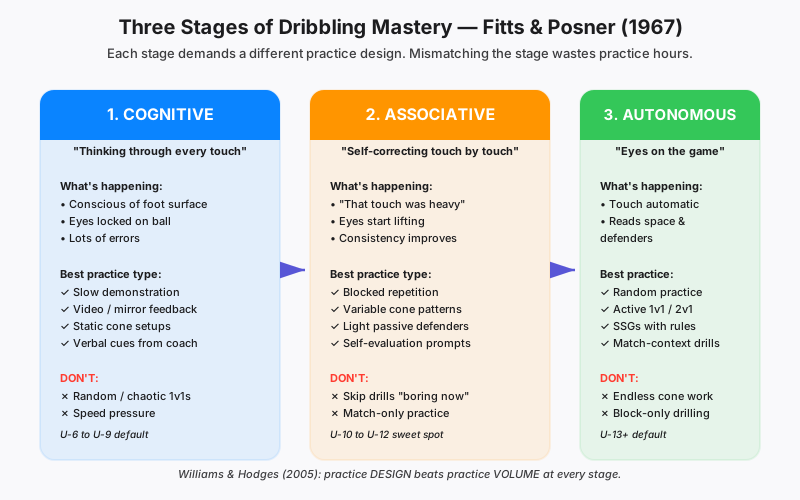
Fitts & Posner's (1967) motor learning theory revealed that all motor skill acquisition progresses through three stages: the cognitive stage, the associative stage, and the autonomous stage. The optimal practice for dribbling differs entirely depending on which stage you are currently in.

Photo by Nigel Msipa on Unsplash
When we watch a skilled dribbler, we tend to think "they're just naturally talented." However, motor learning science proves that it is the result of a staged learning process. Fitts & Posner (1967) identified three distinct stages in motor skill acquisition, each involving different challenges for the brain and body.
Stage 1: The Cognitive Stage
This is the stage where beginners first start dribbling. They move while consciously thinking about where to touch the ball and which part of the foot to use. At this stage, movements are clumsy and mistakes are frequent — and that is perfectly normal. The key is to "understand" the correct form. This is the phase where the brain receives input about proper movement through coach demonstrations and video analysis.
Stage 2: The Associative Stage
At this stage, the player understands the basic movements and becomes able to self-correct errors. The feel of ball touches gradually becomes ingrained in the body, and the player can recognize on their own that "that touch was too heavy." Repetitive practice is most effective at this stage. Repeating the same movement strengthens neural pathways, improving the precision and consistency of the action.
Stage 3: The Autonomous Stage
This is the stage where dribbling movements can be executed without conscious thought. The player can carry the ball without looking at their feet and can observe the surrounding situation while playing. The reason professional players' dribbling looks "effortless" is because they have reached the autonomous stage through thousands of hours of practice. At this stage, simple repetition is no longer sufficient — random practice involving decision-making in game-like situations becomes most effective.
Knowing your current stage is the first step. Assigning random practice to a player in the cognitive stage only causes confusion. Having an autonomous-stage player do nothing but cone dribbling will not help them grow. Choosing practice that matches each stage is the shortest path to dribbling mastery.
Ball Mastery Fundamentals — First Touch and the Three Contact Surfaces
The foundation of all dribbling technique is "ball mastery." The quality of your first touch — the ability to freely switch between the sole, inside, and outside of the foot — fundamentally determines your dribbling success rate in matches.

Photo by Jannik on Unsplash
Before discussing dribbling itself, you first need to develop the ability to "make the ball your own" — ball mastery. Ford et al. (2012), in their analysis of youth practice activities, reported that players who reached elite level had spent significantly more time on ball mastery during their early years. Before flashy feints, the fundamental ability to freely manipulate the ball at your feet is essential.
First Touch — Your Dribble Is Decided in the Very First Step
The first touch — the moment you receive a pass or pick up a loose ball — determines the quality of the entire dribble that follows. If the first touch is too heavy, the opponent will steal the ball; if it is too soft, the next action is delayed. The ideal first touch places the ball in the optimal position for the next play. This does not simply mean stopping the ball at your feet — it means intentionally directing control toward the direction you want to go next.
Sole of the Foot — The Most Precise Control Surface
The sole of the foot provides the largest contact area with the ball, making it ideal for precise control. It excels in tight-space ball retention, sharp changes of direction, and sudden stops after feints. Players with futsal backgrounds tend to be excellent with sole touches because they grew up in an environment where sole usage was unavoidable on small courts. In practice, start with sole rolls and sole taps, then gradually increase the speed.
Inside of the Foot — The Stable Surface for Ball Retention
The inside of the foot offers a wide contact area and is ideal for keeping the ball close to the body. It is especially useful for retaining the ball while facing a defender head-on and for carrying the ball while changing body orientation. When using the inside touch, the key is to lock the ankle and strike the center of the ball just below the ankle bone.
Outside of the Foot — The Speed-Maintaining Driving Surface
The outside touch uses the outer edge of the foot and is the surface that best maintains speed during a running dribble. Using the inside requires the body to open up, which causes deceleration, but the outside allows you to carry the ball without breaking your running form. It is particularly effective during counter-attack speed dribbles and wing breakthroughs.
The key is to instinctively know "when to use" each surface. Tight spaces = sole, retention = inside, penetration = outside. Once this selection becomes automatic, your range of dribbling options expands dramatically.
Dribbling That Works in Matches — 1v1 Moves and Game-Tested Techniques
When the dribbling you can do in practice does not work in matches, the missing piece is "situational awareness." Beating a defender in a 1v1 requires more than feint technique — it demands the ability to read distance, timing, and body positioning holistically.
Williams & Hodges (2005), in their research on soccer skill acquisition, pointed out that the greater the gap between the practice environment and the match environment, the lower the skill transfer. In other words, dribbling practice against cones alone cannot reproduce the same movements against a live defender in a match. To develop dribbling that works in games, practice in situations with an opponent is essential.
1v1 Moves — Principles of Distance and Timing
The first principle for beating an opponent in a 1v1 is to initiate your move at the right distance. Too far gives the opponent time to react; too close eliminates your space to maneuver. Generally, approximately 1.5 to 2 meters in front of the defender is considered the optimal distance to initiate a feint. At this distance, a change of pace (alternating between slow and fast) creates opportunities to shift the defender's center of gravity.
The Scissors — A Fundamental Move to Wrong-Foot Your Opponent
The scissors involves swinging one foot over the ball from outside to inside, making the opponent believe you are heading in that direction before bursting the opposite way. The key to success is not the speed of the step-over itself, but the acceleration afterward. The scissors motion can be performed slowly. The moment the defender reacts to the feint and shifts their weight, you explode in the opposite direction to blow past them.
The Step-Over — A Full-Body Deception Feint
Similar to the scissors, the step-over differs in that the foot sweeps from inside to outside over the ball. By using exaggerated upper-body weight transfer, it becomes a more convincing feint. Famously used by a young Cristiano Ronaldo, the important thing is not to copy the "form" but to develop the ability to initiate the move while reading the opponent's reaction.
Change of Pace — The Simplest Yet Most Effective Technique
Among all dribbling techniques, the most effective in actual matches is the change of pace. A player dribbling slowly who suddenly accelerates — that alone puts the defender on the back foot. It has higher reproducibility than flashy feints and can be learned by players at any level. In practice, repeat the rhythm of "three slow steps then one explosive burst" until it becomes second nature.
- Distance — Initiate your move 1.5 to 2 meters from the defender
- Change of pace — Use speed variation to shift the defender's center of gravity
- Change of direction — Unsettle the defense with cut-ins and cut-outs
- Body feint — Use upper-body movement to disguise your intended direction
- Eye feint — Glance in the opposite direction to delay the opponent's decision
Feints are not about how many tricks you know, but about the precision of a single move and the situational awareness to deploy it. Even a single scissors, when used with the right distance, timing, and acceleration, can beat a professional defender.
Scientific Practice Design — The Optimal Balance of Blocked vs. Random Practice
The "contextual interference effect" discovered by Shea & Morgan (1979) revealed a paradox: the method that produces lower performance during practice yields higher long-term learning outcomes. Here is how to apply this finding to dribbling practice design.
There are two broad approaches to dribbling practice: blocked practice (repeating the same movement consecutively) and random practice (switching between multiple movements in random order). Motor learning research provides a clear answer to the question of which is more effective.
Blocked Practice — Ideal for Building Foundations
Performing 30 consecutive scissors, then 30 consecutive step-overs — this intensive repetition of a single technique is blocked practice. For players in the cognitive to associative stages of the Fitts & Posner model, blocked practice is effective for encoding the basic movement pattern in the brain. Use blocked practice during the initial stage of learning a new technique.
Random Practice — Maximizing Transfer to Matches
Practicing a scissors, then a cut-in, then a step-over, then a roulette — mixing different techniques in varied order is random practice. Shea & Morgan's (1979) experiments showed that while random practice produces lower performance during the practice session itself compared to blocked practice, the random practice group was overwhelmingly superior in both retention tests (tests after a time delay) and transfer tests (tests in new situations).
What Is the Contextual Interference Effect?
The reason random practice is superior in the long term is that "interference" drives the brain toward deeper processing. Each time you switch between different techniques, the brain must discard the previous action plan and generate a new one. This cognitively demanding processing is precisely what forms stronger motor memories. Feeling like you "can't get it right" during practice may actually be evidence that the brain is learning more deeply.
Practical Guidelines for Practice Design
- When learning a new technique (cognitive stage) — Use blocked practice to repeat the correct form (15-20 minutes per session)
- When movements become stable (associative stage) — Transition to serial practice, alternating between 2-3 techniques
- When basic movements are ingrained (autonomous stage) — Advance to random practice incorporating decision-making during dribbling
- Pre-match preparation — Sharpen match instincts with random practice in 1v1 formats
A high frequency of errors during practice does not mean the practice quality is low. Rather, moderate failure in random practice is what promotes long-term learning.
— Based on Shea & Morgan's (1979) Contextual Interference research
The question is not "which is better" — blocked or random practice — but "when to use each." Blocked in the early stages, random after proficiency is achieved — making this switch at the right moment is where a coach's expertise truly shows.
Age-Specific Dribbling Practice — Coaching Tailored to Developmental Stages from U-8 to U-12
Research by Huijgen et al. (2009) showed that ball skill development in talented youth players progresses at different rates depending on age. Practice that does not match the developmental stage for a given age not only hinders growth but also risks causing young players to lose interest in soccer altogether.
Children's motor abilities do not develop uniformly. The period surrounding the Golden Age (ages 9-12), when neural development is most pronounced, is the most suitable window for acquiring dribbling techniques. However, "suitable" does not mean forcing advanced techniques. Practice design must be tailored to the physical and cognitive developmental stage of each age group.
U-8 (Ages 5-8) — The Stage of Play with the Ball
At this age, the very concept of "dribbling practice" is unnecessary. The top priority is making friends with the ball. Tag games, ball-based chase games, and free dribbling play — maximize opportunities to touch the ball through play. Ford et al. (2012) reported that most elite players developed their ball sense through "unstructured play" during early childhood. Keep coaching instructions minimal and create an environment where children discover on their own.
- Ball tag (dribbling while chasing or being chased)
- Free dribbling (running freely around the pitch with the ball)
- Ball touch play (sole taps, alternating left-right touches, etc., in a playful context)
- Game-based formats (2v2, 3v3 small-sided games to increase ball contact)
U-10 (Ages 9-10) — The Golden Window for Skill Acquisition
This age, when neural development is approaching its peak, is the most efficient period for acquiring dribbling technique. Systematically introduce ball mastery drills (sole rolls, alternating inside-outside touches, V-pulls, etc.) and add basic feints (scissors, body feints) to training. At this stage, training both feet equally is crucial. Bias toward the dominant foot becomes difficult to correct in later stages.
U-12 (Ages 11-12) — The Stage of Decision-Based Dribbling
At this age, when fundamental technique is approaching the autonomous stage, practice should center on developing the judgment of "when to dribble." 1v1 and 2v1 exercises against live opponents, game formats that include "dribble or pass" decisions, and dribbling practice involving spatial awareness are all effective. Huijgen et al.'s (2009) research showed that ball skill at this age is one of the strongest predictors of reaching elite level in the future.
Choosing age-appropriate practice also means protecting a child's feeling that "soccer is fun." Practice that is too difficult breeds frustration; practice that is too easy breeds boredom. Only practice at the right difficulty level can draw out a child's desire to grow.
5 Common Dribbling Practice Mistakes — Points You Can Fix Starting Today
There are certain practice "mistakes" that many players and coaches make without realizing it. These not only slow down improvement but also risk ingraining dribbling habits that are unusable in actual matches.
You are putting serious effort into dribbling practice yet do not feel any improvement — the cause almost always lies in "how" you practice. Here, we explain five common mistakes and how to fix them, backed by scientific evidence.
Mistake 1: Dribbling with Your Eyes Glued to the Ball
Feeling uneasy without looking at the ball is natural during the cognitive stage of motor learning. However, if you do not intentionally incorporate practice aimed at "being able to touch the ball without looking at it," you will never learn to keep your head up. The improvement should be gradual: start with ball touches while stationary without looking down, then progress to walking, and finally to running. Drills where a coach signals with colors or gestures, requiring the player to react while dribbling, are also effective.
Mistake 2: Practicing with the Dominant Foot Only
It is not uncommon to see a right-footed player endlessly practicing dribbling with only their right foot. However, if both feet are not trained equally through the U-10 stage, the weak foot's development may be permanently delayed. While neural plasticity is high during the Golden Age, it is essential to make weak-foot ball touches a habit. From U-12 onward, shift the focus to further refining the dominant foot while maintaining a baseline level of competence with the weak foot.
Mistake 3: Being Satisfied with Cone Dribbling Alone
Cone dribbling is effective as repetitive practice during the foundational stage, but cones do not move. Match defenders shift their weight, close distances, and react to feints with movement. As Williams & Hodges (2005) pointed out, the greater the gap between the practice and match environments, the lower the skill transfer. Once you have built your foundation with cone dribbling, always combine it with live opponent practice.
Mistake 4: Chasing Speed Alone
If you evaluate dribbling solely by "speed," accuracy and control are sacrificed. As a fundamental principle of motor learning, first ensure accuracy, then increase speed. Begin by focusing on accurate touches even if slow, and gradually increase the tempo as the movements stabilize. "If you cannot do it slowly and accurately, you cannot do it accurately at speed" — this is an iron rule of motor learning.
Mistake 5: Practicing for Too Long
"The more you practice, the better you get" is half right and half wrong. Adequate rest is essential for neural learning. Practicing while fatigued risks encoding inaccurate movement patterns in the brain. Aim for 15 to 20 minutes per dribbling session, performing high-quality repetitions while concentration is at its peak. Research has shown that four to five short sessions per week are more effective for learning than two long sessions.
- Eyes glued to the ball -> Gradually introduce touch drills while keeping your head up
- Dominant-foot bias -> Consciously practice both feet equally through U-10
- Cone dribbling only -> Always combine with live opponent drills
- Speed obsession -> Secure accuracy first, then increase tempo
- Overly long sessions -> Switch to 15-20 minute sessions, 4-5 times per week
The day you notice a mistake is the day your improvement accelerates. You do not need to have the perfect practice routine from day one. Fix things one by one, and the quality of your practice will steadily transform.
References
- [1] Fitts, P. M. & Posner, M. I. (1967). “Human Performance” Brooks/Cole.
- [2] Williams, A. M. & Hodges, N. J. (2005). “Practice, instruction and skill acquisition in soccer: Challenging tradition” Journal of Sports Sciences, 23(6).
- [3] Shea, J. B. & Morgan, R. L. (1979). “Contextual interference effects on the acquisition, retention, and transfer of a motor skill” Journal of Experimental Psychology: Human Learning and Memory, 5(2).
- [4] Ford, P. R., Yates, I. & Williams, A. M. (2012). “An analysis of practice activities and instructional behaviours used by youth soccer coaches during practice: Exploring the link between science and application” Journal of Sports Sciences, 30(15).
- [5] Huijgen, B. C., Elferink-Gemser, M. T., Post, W. & Visscher, C. (2009). “Soccer skill development in professionals and talented youth players: A longitudinal study” International Journal of Sports Medicine, 30(8).
Related Articles
Soccer Training to Get Faster — 5 Methods Proven by Sprint Science
14 min read
The Truth About the Golden Age — Neuroscience Reveals Optimal Training by Age Group
11 min read
The Complete Guide to Solo Soccer Training — 40 Drills Organized by Purpose
16 min read
The Complete Soccer Practice Guide for Elementary-Age Kids — Science-Based Programs by Age Group and Objective
15 min read
The Science of Proper Kicking — Biomechanics Behind Instep and Inside Kicks
15 min read
Track Your Growth with Footnote
Just record your matches — AI analyzes every 5 games. Visualize growth with PVS Score. All features free during beta.
30-second signup · No credit card required
Last updated: 2026-05-06 ・ Footnote Editorial