The Complete Soccer Practice Guide for Elementary-Age Kids — Science-Based Programs by Age Group and Objective
The most effective soccer practice sessions for elementary-age children are designed to be **age-appropriate in content, calibrated in intensity, and fun throughout**. The LTAD (Long-Term Athlete Development) model proposed by Canadian sport scientist Balyi divides the elementary school years into three stages — FUNdamentals (having fun), Learning to Train (building skills), and Training to Train (beginning to condition) — and shows that optimal training content differs at each stage. This article uses that scientific framework to lay out the best practice menus and weekly plans for early, mid, and upper elementary players, along with the session-design mistakes coaches most commonly fall into.
The Science of Age-Based Approaches — Three Developmental Stages from the LTAD Model
Balyi (2004) warns in the LTAD model that treating children as "miniature adults" in training is the single greatest factor that destroys talent. Understanding the three stages that span the elementary years is the starting point for all session design.

Photo by Nigel Msipa on Unsplash
Canadian sport scientist Istvan Balyi systematized the LTAD (Long-Term Athlete Development) model in 2004. The model divides athlete development from childhood through adulthood into seven stages and scientifically organizes "what," "how much," and "how" athletes should train at each stage. The six years of elementary school span three of those stages.
Stage 1: FUNdamentals (Ages 6–8 / Early Elementary)
As the name suggests, the top priority at this stage is fun. Rather than focusing solely on soccer, children should experience a broad range of fundamental movement skills — running, jumping, throwing, rolling — through play. Cote et al. (2007) showed that many elite athletes went through a "sampling" period in early childhood, participating in multiple sports.
Stage 2: Learning to Train (Ages 8–11 / Mid to Early Upper Elementary)
This stage corresponds to the first half of the so-called Golden Age. The emphasis shifts to acquiring core soccer techniques with correct form. Because the nervous system is reaching peak development, repetitive drills for dribbling, passing, and first touch embed most efficiently into the body at this age. However, as Ford et al. (2009) point out, pairing deliberate practice with deliberate play is essential for long-term growth.
Stage 3: Training to Train (Ages 11–13 / Upper Elementary to Middle School Entry)
Physical growth accelerates at this stage, and endurance and strength foundations as well as tactical understanding enter the picture. Yet Myer et al. (2015) stress that "what fills a 60-minute session" matters far more than volume, and excessive loading during growth periods dramatically increases injury risk.
Key takeaway: The elementary years are not a single stage — they encompass three stages with markedly different developmental characteristics. Giving first graders and sixth graders the same drills is the single most avoidable mistake in session design.
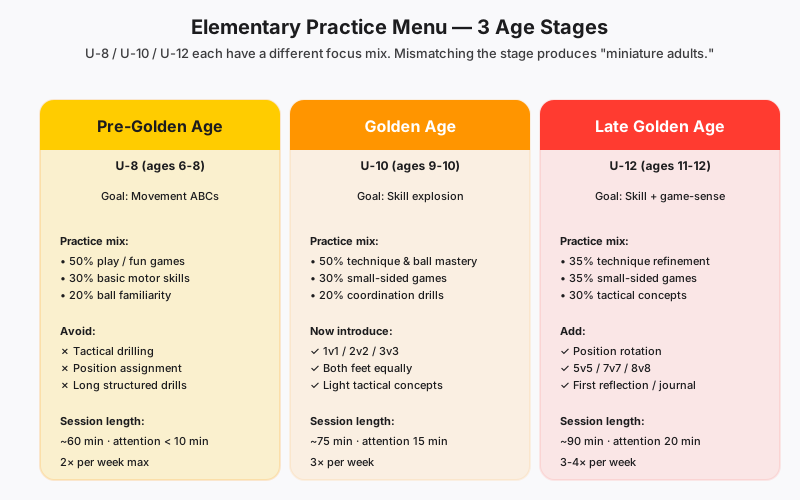
The sections below present specific practice menus optimized for each of these three stages. Every menu follows a "play -> technique -> decision-making -> game" flow, with the weighting of each element shifting according to the developmental stage.
Practice Menu for Early Elementary (U-8) — Building a Movement Foundation Through Play
The most important goal at U-8 is nurturing the feeling that "soccer is fun." Keep technical instruction to a minimum and use play that includes a wide variety of movements to develop the fundamental motor skills that underpin all future sports ability.

Photo by Md Mahdi on Unsplash
Practice sessions for early elementary players should last no more than 60 minutes. Children ages 6–8 can sustain concentration for only 15–20 minutes, so each activity should be switched after 10 minutes at most. As the research by Cote et al. (2007) demonstrates, deliberate play outperforms deliberate practice at this age in both intrinsic motivation and long-term participation rates.
Recommended Session Structure (60 Minutes)
- Warm-Up Games (10 min) — Tag variations (tail tag, freeze tag, color tag). These naturally incorporate changes of direction, acceleration, and deceleration
- Ball Play (15 min) — Ball-touch games (sole-touch counting, ball-carry relay). The aim is not technical instruction but helping kids "make friends with the ball"
- Mini-Game 1 (10 min) — 2v2 or 3v3 on a small pitch (15 m x 10 m) to maximize touches on the ball
- Challenge Time (10 min) — Individual challenges (juggling count, cone-dribble time trial). Competing against personal records
- Mini-Game 2 (10 min) — A game with modified rules (four goals, hand passes allowed, etc.) to spark creativity
- Cool-Down (5 min) — Light stretching and sharing "what was fun today"
Five Tag-Game Variations
- Tail Tag — Players tuck a bib into their waistband and dribble while protecting it. Develops ball control and peripheral vision simultaneously
- Ball Freeze Tag — Tagged players freeze; teammates unfreeze them by passing a ball through their legs. Creates a natural incentive to pass
- Color Tag Dribble — The coach calls a color and players dribble to the matching cone. Builds reaction speed and ball control
- Treasure Grab — Balls are placed in the center of the field; teams race to dribble them back to their own zone. Gives dribbling a practical, game-like purpose
- Island Crossing — Players dribble from one end line to the other while avoiding taggers. Encourages direction changes and feints in a natural way
"Don't Do" List for Early Elementary
- Lap running (running around the field) — Boring and motivation-killing. Embed running into tag games instead
- Drills with lines and waiting turns — Zero wait time is the target. Design activities so every player is moving at all times
- Long explanations or tactical meetings — Keep each instruction under 15 seconds. The pattern is "demonstrate, then let them try"
- Fixing positions — There is no reason to lock any player (except GK rotation) into a single position at this age. Everyone should experience every role
- Scolding over results — Punishing mistakes makes children stop taking risks. "Nice try!" is the baseline feedback at this age
The number-one reason children quit a sport is that it stops being fun — not because they cannot win, and not because they are not improving.
— Cote, Baker, & Abernethy, 2007
The true success metric for an early-elementary session is whether the child asks about the next practice on the car ride home. Technical improvement follows as a natural byproduct.
Five Session-Design Mistakes Coaches Fall Into — Pitfalls Flagged by Science
Even well-intentioned practice sessions can include elements that, in the light of sport science, hinder a child's growth. The five mistakes below are the ones observed most frequently.
Many youth coaches are volunteer parents with limited access to formal coaching education. Yet as Balyi (2004) repeatedly stresses, practice that ignores developmental stages amounts to treating children as miniature adults and undermines long-term growth. Below are five common design mistakes, each paired with its scientific basis and a practical correction.
Mistake 1: Running a Scaled-Down Version of an Adult Session
This happens when a coach watches professional training footage and applies it directly to elementary-age players — 11v11 on a full-size field, long physical conditioning blocks, complex tactical whiteboard sessions. For players U-12 and below, these are cognitively and physically overwhelming. Small-Sided Games (SSGs) are the optimal format: adjusting player count and field size to suit the age group maximizes ball touches and decision-making opportunities.
Mistake 2: Over-Relying on Repetition Drills and Eliminating Play
The belief that "repetition is the only path to improvement" is deeply ingrained, but research by Cote et al. (2007) provides clear counter-evidence. Excessive deliberate practice before age 12 is strongly correlated with early burnout. Deliberate play, on the other hand, raises intrinsic motivation and improves long-term sport participation rates. A useful guideline for the ratio of deliberate practice to play: 2:8 at early elementary, 4:6 at mid-elementary, and 5:5 at upper elementary.
Mistake 3: Early Specialization Driven by a Win-at-All-Costs Mentality
When winning becomes the top priority, only the best players get game time, positions become fixed, and training tilts toward short-term results. Ford et al. (2009), however, show that players who sampled multiple sports ultimately reached a higher level than those who specialized early. Through U-12, equal playing time for all and experience at every position are foundational development principles.
Mistake 4: Physical Loading That Ignores Age
Excessive physical stress on growing children increases the risk of growth-plate (epiphyseal) injuries. Myer et al. (2015) demonstrated that the breakdown of exercise content — the balance of aerobic, anaerobic, and neuromuscular training — affects both injury prevention and long-term performance. For players U-10 and below, strength training should be bodyweight-only, and distance running should be embedded within games and tag activities rather than run as standalone laps.
Mistake 5: Neglecting the Quality of Feedback
Outcome-focused feedback like "try harder" or "why can't you do that?" has virtually no learning effect on children. As O'Sullivan et al. (2009) demonstrate, effective feedback targets the process, is specific, and reinforces positive behavior. "Great job using the outside of your left foot on that dribble — next time try lifting your eyes up" is the kind of concrete, progressive feedback that most reliably accelerates skill development in elementary-age players.
Children are not miniature adults. They require programs suited to their developmental stage — physically, cognitively, and emotionally.
— Balyi & Hamilton, 2004
These mistakes arise not from bad intentions but from gaps in knowledge. Investing in coaches' understanding of basic sport science is the single most impactful thing we can do to protect children's growth.
Sample Weekly Plans — A Three-Session Model Schedule
Below are age-specific model schedules built around three sessions per week. Each day targets a different theme so that technique, tactics, and physical fitness are all covered within a single week. Including rest days is essential — both for neural consolidation and for injury prevention.
Myer et al. (2015) note that growing children need at least two complete rest days per week. Practicing every day may look efficient on the surface, but neural consolidation (memory encoding) requires sleep and rest; overtraining is counterproductive. The three-session plans below balance training days and rest days according to the scientific evidence.
Early Elementary (U-8): 3 Sessions x 60 Minutes
- Tuesday — "Run and Jump" Day — Tag-game warm-up -> coordination without the ball -> ball play -> 2v2 game
- Thursday — "Play with the Ball" Day — Ball-touch challenges -> dribble games -> juggling attempts -> 3v3 game
- Saturday — "Play Together" Day — Team relay games -> mini-tournament format -> awards ceremony (give every player a role, not just an MVP)
Mid-Elementary (U-10): 3 Sessions x 75 Minutes
- Tuesday — "Individual Technique" Day — Agility warm-up -> dribbling drills -> 1v1 -> themed mini-game
- Thursday — "Passing and Combination" Day — Passing warm-up -> triangle passing -> rondo (4v2) -> possession game
- Saturday — "Apply It in a Match" Day — Technical warm-up -> review of the week's theme -> 5v5 conditioned game
Upper Elementary (U-12): 3 Sessions x 90 Minutes
- Tuesday — "Attack" Day — 11+ Kids warm-up -> first touch and finishing -> 2v1 / 3v2 breakdowns -> attacking-themed game
- Thursday — "Defense and Build-Up" Day — Ball-circulation warm-up -> defensive positioning -> build-up drills -> defensive-themed game
- Saturday — "Integration and Game" Day — Weekly review -> positional training -> 8v8 full game -> video review session
How to Spend Rest Days
Rest days should not be "do-nothing" days but rather "do-something-other-than-soccer" days. According to the sampling theory of Cote et al. (2007), playing other sports and engaging in unstructured outdoor activity broadens neural pathways and feeds back positively into soccer performance.
- Monday, Wednesday, Friday (Rest Days) — Swimming, cycling, playground activity, or another sport. Provides a neural reset from soccer-specific repetition
- Sunday — Match day when games are scheduled. Otherwise, full rest or family recreation
The best weekly plan is not one that repeats the same routine every week, but one that maintains a consistent structure while rotating the theme. Aim for sessions that make players think, "I wonder what we're doing today."
References
- [1] Balyi, I. & Hamilton, A. (2004). “Long-Term Athlete Development: Trainability in Children and Adolescents” Canadian Sport Centres.
- [2] Côté, J., Baker, J., & Abernethy, B. (2007). “Practice and play in the development of sport expertise” Handbook of Sport Psychology, 3rd Edition.
- [3] Ford, P. R., Ward, P., Hodges, N. J., & Williams, A. M. (2009). “The role of deliberate practice and play in career progression in sport” Journal of Sports Sciences, 27(5), 547-555.
- [4] O'Sullivan, M., MacPhail, A., & Tannehill, D. (2009). “A career in teaching: Decisions of the heart and matters of the mind” Journal of Teaching in Physical Education, 28(2), 184-200.
- [5] Myer, G. D., et al. (2015). “Sixty minutes of what? A developing brain perspective and the exercise dose–response relationship for children” British Journal of Sports Medicine, 49(23), 1510-1516.
Related Articles
The Complete Soccer Journal Guide for Elementary-Age Players — Age-Appropriate Templates and Tips for Building the Habit
6 min read
The Truth About the Golden Age — Neuroscience Reveals Optimal Training by Age Group
11 min read
A Parent's Guide to the Soccer Journal — How to Support Your Child's Growth the Right Way
7 min read
Traits of Kids Who Excel in Soccer — 5 Growth Factors Backed by Sports Science
16 min read
Why Coaches Should Have Players Keep Soccer Journals — and How to Implement Them
8 min read
Track Your Growth with Footnote
Just record your matches — AI analyzes every 5 games. Visualize growth with PVS Score. All features free during beta.
30-second signup · No credit card required
Last updated: 2026-05-06 ・ Footnote Editorial