The Complete Match Day Preparation Guide for Soccer — From the Night Before to Post-Match Recovery
Match-day performance is not determined the instant the referee blows the whistle. The quality of your sleep and meals the night before, your morning routine, and your warm-up all form a chain that shapes every minute of the 90. Bangsbo et al. (2006) showed that top-level soccer players cover 10 to 13 km per match and perform over 200 high-intensity actions, underscoring that systematic preparation is essential to meet these physical demands. This article uses scientific evidence to cover every stage from the day before through post-match recovery, helping you build the optimal match-day routine.
The Day Before — Sleep, Nutrition, and Packing
How you spend the day before a match has a major impact on the next day's performance. Securing 8 to 10 hours of sleep, carbohydrate loading, and packing your bag in advance — committing to these three steps creates a calm, confident start on match day.

Photo by Quan Jing on Unsplash
Sleep: Aim for 8 to 10 Hours
For growing athletes, sleep is the single most important recovery tool. Get at least 8 hours of sleep the night before a match — ideally 10 hours. Turn off smartphones and game screens at least one hour before bed; eliminating blue light exposure significantly improves sleep onset quality.
- Keep a consistent bedtime — Trying to go to bed early only on the night before a match rarely works. Build a regular sleep schedule every day.
- Keep the room temperature between 18 and 22 °C — A room that is too hot or too cold degrades sleep quality.
- Avoid overthinking the match — If anxiety strikes, write down the next day's schedule in a notebook to "make it visible" and ease your mind.
Nutrition: Carbohydrate Loading to Top Off Your Fuel Stores
Research by Burke et al. (2011) demonstrated that consuming 7 to 10 g of carbohydrates per kilogram of body weight the day before a match maximizes muscle glycogen stores. Junior players do not need a strict carbo-loading protocol, but dinner the night before should be built around carbohydrates.
- Recommended menu — A generous portion of rice, pasta, udon noodles, or rice cakes — easily digestible carbohydrate sources.
- Foods to avoid — Fried foods, raw foods, and anything you have not eaten before (risk of gastrointestinal issues).
- Start hydrating the day before — Drinking water only on match day is too late. Sip fluids consistently throughout the prior day.
Packing: Prepare Everything the Night Before
Scrambling to pack on match morning creates unnecessary mental and time pressure. Make it a habit to put all your gear in your bag the night before and leave it by the front door. Forgotten items steal focus.
Packing tip: Create a checklist on your phone or on paper and follow the same sequence every time. The familiarity of "same routine, every time" builds confidence and keeps your mind settled on match day.
Match Morning — Meals, Mental Preparation, and Making the Most of Travel Time
On match morning, "same as always" is the strongest routine. Finish your main meal 3 to 4 hours before kickoff, choose easy-to-digest foods to keep your stomach comfortable, and use travel time to shift your mind and body into game mode.

Photo by Fayas S on Unsplash
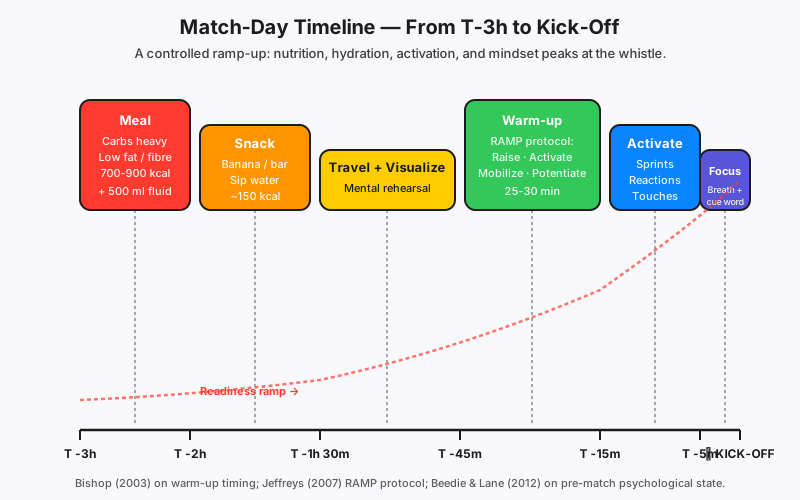
Meals: Finish Eating 3 to 4 Hours Before Kickoff
The most important factor in your match-day meal is timing. Eat your main meal 3 to 4 hours before kickoff to allow adequate digestion. Intense exercise on a partially digested meal increases the risk of abdominal pain and nausea.
- Go-to breakfast options — White rice with miso soup and grilled fish; toast with a banana and yogurt.
- Foods to avoid — High-fiber vegetables (slow to digest) and large amounts of dairy.
- Top-up snack 1 to 2 hours before kickoff — A banana, a rice ball, or an energy gel.
Burke et al. (2011) recommend a low-fat, high-carbohydrate combination as the final pre-match meal. For junior players, familiar foods work perfectly well. Establishing a "this is what I always eat on match day" menu eliminates decision fatigue.
Mental Preparation: Making Nerves Work for You
Pre-match nerves are a natural response and actually benefit performance. The goal is not to eliminate nervousness but to channel it. Use the morning hours to steady your mindset with the following techniques.
- Three deep breaths — Inhale for 4 seconds, hold for 4 seconds, exhale for 8 seconds. This rebalances the autonomic nervous system.
- Set one specific performance goal for the day — For example, "Keep my first touch clean and in front of me."
- Positive self-talk — Say out loud: "I'm prepared. I can do this."
Making the Most of Travel Time
Travel time is your transition window into match mode. What you can do in a car or on a train is limited, but use this time deliberately to direct your mind and body toward the game.
- Use music to build motivation — Many players find that up-tempo tracks raise their energy level.
- Review opponent information — If the coach has shared tactical notes, give them a quick read.
- Stretch regularly during long trips — Sitting for extended periods stiffens muscles.
Avoid getting absorbed in games or videos during the trip. Eye fatigue can affect spatial awareness and ball tracking. Listening to music while mentally visualizing match scenarios is the ideal use of travel time.
Pre-Match Warm-Up — A Science-Based Approach Built on the FIFA 11+ Program
Using the FIFA 11+ program — whose effectiveness was validated in a BMJ paper by Soligard et al. (2009) — as a foundation, this 30- to 40-minute warm-up progressively raises intensity in stages. It is an approach that simultaneously prevents injuries and maximizes performance.
A warm-up is far more than simply "getting the body hot." In research published in the BMJ, Soligard et al. (2009) reported that teams using the FIFA 11+ program reduced injury risk by approximately 30 to 50 percent. A properly structured warm-up is a scientific tool for preventing injuries while maximizing performance.
Phase 1: Running (8 to 10 Minutes)
Start by raising core body temperature at a jogging pace. For the first five minutes, run at a conversational pace, then gradually increase speed. No sprinting during this phase.
- Straight-line jog -> zigzag runs -> side shuffles -> backpedals.
- Swing your arms fully to promote circulation throughout the body.
- Pair up and exchange light passes while running to reawaken technical feel.
Phase 2: Dynamic Stretching and Core Activation (10 to 12 Minutes)
Static stretching (holding a stretch in place) is not recommended before matches. Dynamic stretching expands joint range of motion while increasing muscular reaction speed — and that is what matters pre-match.
- Leg swings — Swing each leg forward-and-back and side-to-side (10 reps each direction).
- High knees — Drive the thighs high while advancing (20 m x 2 sets).
- Heel kicks (butt kicks) — Bring heels up to the glutes while advancing (20 m x 2 sets).
- Walking lunges — Take large steps forward and sink deep (10 steps x 2 sets).
- Plank hold — Stabilize the core for 30 seconds (2 sets).
Phase 3: Progressive Intensity Build-Up (8 to 10 Minutes)
As Bangsbo et al. (2006) demonstrated, matches demand repeated maximal sprints and sharp changes of direction. In the final warm-up phase, replicate match-intensity movements.
- 70% -> 80% -> 90% sprints — Build intensity in three stages (20 m x 2 at each level).
- Agility drills — Quick turns around cones, reaction-based dashes.
- Rondo (keep-away) — 3v1 or 4v2 to sharpen decision speed toward match tempo.
- Shooting practice — 5 to 10 shots, doubling as the goalkeeper's warm-up.
Final Tactical Briefing
Coaches typically deliver the key tactical messages at the end of the warm-up. Listen with full concentration during this time and lock in your specific role — this is the final piece of optimal match preparation.
In the last five minutes before kickoff, keep moving with a light jog to maintain body temperature. Sitting too long after the warm-up lets your muscles cool down, increasing injury risk.
Making the Most of Halftime — Maximizing 15 Minutes
Halftime is not a "rest period" — it is preparation time for the second half. Fluid and energy intake, absorbing the coach's instructions, and a mental reset — how you use these 15 minutes shapes your second-half performance.
In a Sports Medicine review, Nédélec et al. (2012) documented the relationship between body-temperature drop and muscular performance during soccer matches. Simply sitting and resting during halftime risks starting the second half at a lower performance level than where the first half ended.
First 5 Minutes: Physical Care
- Rehydrate — Drink a sports drink or water as soon as you reach the bench. Sip steadily rather than gulping.
- Refuel — Take in a small amount of quickly absorbed energy: an energy gel, orange slices, or a banana.
- Dry off and adjust your gear — Wipe away sweat and, if needed, put on a windbreaker to prevent the body from cooling.
- Check your feet — Re-tie your boot laces and inspect any taping.
Middle 5 Minutes: Absorb the Coach's Instructions
This is when the coach delivers a first-half analysis and second-half tactics. Stop all side conversations and give 100 percent of your focus to the coach's words.
- Mentally note instructions relevant to you — From the team-wide message, extract what applies to your position.
- Ask questions if anything is unclear — Realizing mid-half that you did not understand is too late.
- Coordinate with nearby teammates — Confirm adjustments like "Let's push the defensive line higher" with the players beside you.
Final 5 Minutes: Reset for the Second Half
Carrying first-half mistakes into the second half is the biggest risk at halftime. Consciously tell yourself: "The first half is over. The second half is a new game."
- Three deep breaths — Calm your emotions and sharpen your focus.
- Set one goal for the second half — Something specific, such as "Speed up my defensive transitions."
- Light jog to maintain body temperature — Start moving 2 to 3 minutes before heading back onto the pitch.
Do not criticize teammates or call out mistakes at halftime. A negative atmosphere drags everyone's second-half performance down. Leave the analysis to the coach. Between players, talk only about "what we do next."
The most important thing at halftime is not forgetting first-half failures, but vividly picturing second-half success.
— Bangsbo, J. (2006)
Post-Match Care — Cool-Down, Nutrition, and Reflection
Recovery research by Nédélec et al. (2012) shows that the first 30 minutes after a match are the golden window for physical recovery. Establish a post-match routine built on three pillars: cool-down, nutrition, and a reflective journal entry.
Cool-Down: 10 to 15 Minutes of Low-Intensity Movement
Rather than sitting down immediately after the final whistle, gradually lower your heart rate with light jogging and stretching — this is the first step of recovery. Stopping exercise abruptly can pool blood in the lower body, causing dizziness or muscle stiffness.
- Light jog (5 minutes) — Run at a pace just slightly faster than walking to maintain whole-body circulation.
- Static stretching (10 minutes) — Focus on the hamstrings, quadriceps, calves, and hip flexors, holding each stretch for 20 to 30 seconds.
- Deep breathing to relax — Deliberately deepen your breath during stretches to release tension in both body and mind.
Nutrition: The 30-Minute Golden Window After the Match
Nédélec et al. (2012) reported that ingesting carbohydrates and protein within 30 minutes of exercise significantly accelerates muscle glycogen replenishment. This "30-minute rule" applies equally to junior players.
- Quick options — A rice ball, a banana, 100% orange juice, or a protein bar.
- Meal after arriving home — Protein from meat or fish, carbohydrates from rice or pasta, and vitamins from vegetables.
- Rehydration — Aim to consume roughly 1.5 times the body weight lost during the match in fluids.
Reflection: Turning Every Match into a Growth Asset with a Soccer Journal
A match is not over just because the whistle has blown — it only becomes a source of growth when you reflect on it. Memories of the game fade quickly, so record your thoughts in a soccer journal on the same day or, at the latest, the following day.
We recommend the "3-2-1 Format": three things you did well, two areas for improvement, and one goal for the next match. It is short enough to maintain consistently, and because the ratio leans positive, it helps sustain motivation.
- Three things you did well — Acknowledge yourself. Even small successes count as "things I accomplished."
- Two areas for improvement — Be specific. Not "try harder" but "place my first touch in front of my body."
- One goal for the next match — Pick one improvement area and make it the focus of your next game.
Write your journal not in the heat of the moment right after the final whistle, but after you have cooled down and eaten — when you are calm. A clear head turns emotional venting into constructive learning.
Complete Match Day Packing Checklist — Zero Forgotten Items, Full Focus
Forgetting an item on match day chips away at your concentration and creates stress that directly affects performance. We have compiled a full list of essentials, nice-to-haves, and items for parents. Run through this checklist the night before and head to the match with confidence.
Essential Items
- Full uniform set — Jersey, shorts, and socks (team-issued; confirm both home and away kits).
- Cleats — Clean off dirt the night before and check the condition of the laces.
- Shin guards — Required by the rules; you cannot take the field without them.
- Water bottle (1 L or larger) — Ideally carry two: one with a sports drink and one with water.
- Towels — Two are convenient: one for match use and one for wiping sweat.
- Change of clothes — Underwear, a T-shirt, and shorts to change into after the match.
- Copy of health insurance card — Always carry one in case of injury.
Nice-to-Have Items
- Athletic tape and adhesive bandages — For preventing and treating blisters.
- Sunscreen — Practically essential for outdoor summer matches.
- Rain jacket or windbreaker — Be prepared for sudden weather changes.
- Snacks (banana, rice ball, energy gel) — For refueling at halftime or between games in a tournament.
- Plastic bags — For storing dirty uniforms or wet towels.
- Soccer journal and a pen — For post-match reflection.
- Warm layers — Keep your body warm during winter matches or long waits at tournaments.
Items for Parents
- Folding chair or ground sheet — For comfort during long spectating sessions.
- Parasol and hat — Protecting yourself from heat stroke matters too.
- Post-match snacks for your child — Rice balls, bananas, energy gels, etc.
- First aid kit — Antiseptic, cooling spray, adhesive bandages, and an ice bag.
- Tournament guide and venue map — Check parking locations and assembly times in advance.
Save your checklist on your phone or on paper and follow the same verification sequence before every match. The act of checking itself becomes part of your routine and doubles as mental preparation for the game.
The most commonly forgotten items are shin guards and water bottles. Keep them somewhere visible — hang them on the front-door handle or place them on top of your bag — so they catch your eye.
References
- [1] Bangsbo, J., Mohr, M., & Krustrup, P. (2006). “Physical and metabolic demands of training and match-play in the elite football player” Journal of Sports Sciences, 24(7), 665-674.
- [2] Burke, L. M., Hawley, J. A., Wong, S. H., & Jeukendrup, A. E. (2011). “Carbohydrates for training and competition” Journal of Sports Sciences, 29(sup1), S17-S27.
- [3] Nédélec, M., McCall, A., Carling, C., Legall, F., Berthoin, S., & Dupont, G. (2012). “Recovery in soccer: Part I — post-match fatigue and time course of recovery” Sports Medicine, 42(12), 997-1015.
- [4] Soligard, T., Myklebust, G., Steffen, K., Holme, I., Silvers, H., Bizzini, M., ... & Andersen, T. E. (2009). “Comprehensive warm-up programme to prevent injuries in young female footballers: cluster randomised controlled trial” BMJ, 338, b95.
Related Articles
Mental Training and the Soccer Notebook Habit — The Science of Writing Your Way to a Stronger Mind
9 min read
Nutrition Guide for Junior Soccer Players — An Evidence-Based Plan for Optimal Growth
16 min read
The Complete Tryout Guide — 7 Evaluation Criteria Top Academies Look For and How to Prepare
15 min read
The Complete Parent Communication Guide for Youth Soccer — Words That Build Up and Words That Break Down, According to Psychology Research
18 min read
The Complete Guide to Soccer Journals — How Pros Build the Habit of Reflection
7 min read
Track Your Growth with Footnote
Just record your matches — AI analyzes every 5 games. Visualize growth with PVS Score. All features free during beta.
30-second signup · No credit card required
Last updated: 2026-05-06 ・ Footnote Editorial