The Complete Guide to Solo Soccer Training — 40 Drills Organized by Purpose
Solo training is not merely a "supplement" to team practice — it is an **independent training environment** that determines a player's growth trajectory. The concept of Deliberate Practice proposed by Ericsson et al. (1993) demonstrated that the essence of improvement lies in identifying one's weaknesses, repeating targeted exercises, and receiving immediate feedback. While team practice requires everyone to follow the same drills, solo training allows you to focus exclusively on your own challenges. This guide presents 40 drills across four categories — ball mastery, kicking, physical conditioning, and cognitive development — along with purpose-driven weekly plans, all supported by scientific evidence.
Why Solo Training Is Just as Important as Team Practice
The deliberate practice theory of Ericsson et al. (1993) and the Self-Determination Theory (SDT) of Deci & Ryan (2000) demonstrate that solo training is indispensable for both skill acquisition and intrinsic motivation. Practice that you choose and commit to on your own produces the deepest learning.

Photo by Ruben Leija on Unsplash
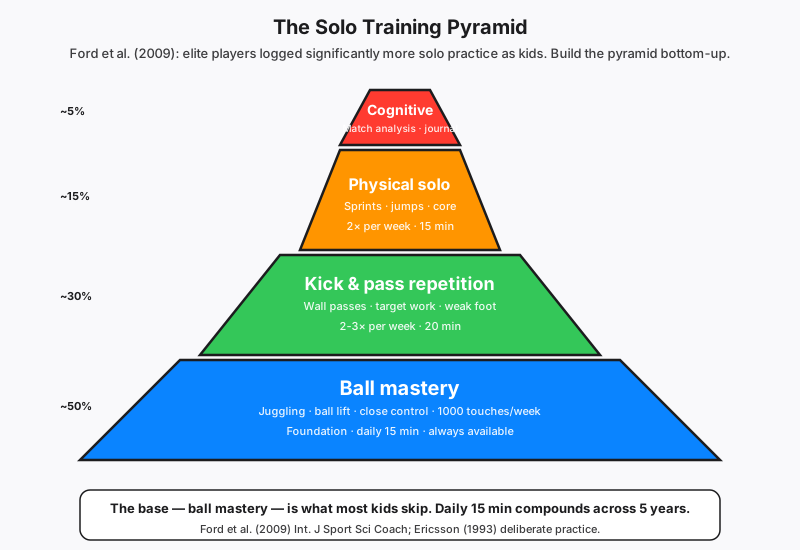
Team practice is essential for tactical understanding and building team chemistry, but it has inherent limitations as an environment for intensively developing individual skills. A study by Ford et al. (2009) examining the career paths of professional soccer players found that players who reached the elite level had significantly more hours of self-directed practice during their formative years compared to non-elite players. This was no coincidence.
Why Deliberate Practice Works Best in Solo Training
Deliberate practice, as defined by Ericsson et al. (1993), requires four conditions: (1) a clear goal, (2) immediate feedback, (3) a difficulty level slightly beyond current ability, and (4) opportunities for repetition. In team practice, coaches must oversee the entire group, limiting the immediate feedback available to each individual. In solo training, however, you can write your goals in a soccer journal, focus on repeating a single skill, and review your form on video — constructing the complete cycle of deliberate practice.
Self-Determination Theory (SDT) and Intrinsic Motivation
Deci & Ryan's (2000) Self-Determination Theory identifies three basic psychological needs that drive human motivation: Autonomy, Competence, and Relatedness. Solo training is an ideal opportunity to satisfy "autonomy" in particular. When you decide for yourself what to practice and how many repetitions to do, training shifts from something you "have to do" to something you "want to do."
- Autonomy — You choose the drills. You have the freedom to focus on the skills you struggle with most
- Competence — You gain a tangible sense of growth every day: "I can do today what I couldn't yesterday"
- Relatedness — Sharing goals with coaches and parents through a soccer journal builds connection
The greatest value of solo training lies in the act of choosing for yourself. Simply repeating drills your coach assigned will not unlock the real benefits. The habit of analyzing your own weaknesses and building your own menu to overcome them is what develops true autonomy as a player.
The 10,000-hour rule is widely misunderstood. What matters is not the length of time, but the quality of practice — focused, deliberate repetition toward a clear goal.
— Ericsson et al., 1993 (paraphrased)
10 Ball Mastery Drills — Sharpen Your Touch
Ball mastery is the foundation of every soccer skill. All you need is a space the size of a few square meters, and just 10 minutes of daily repetition will reliably improve your touch. The following 10 drills are listed in order of difficulty.

Photo by Ruben Leija on Unsplash
Ball mastery refers to the overall ability to manipulate the ball at will. It underpins every technique — dribbling, first touch, turning, and more. Research by Ward et al. (2007) found that the most pronounced difference between elite and non-elite players was in this very area of ball manipulation. Its greatest advantage is that it requires minimal space and can be done entirely on your own.
Beginner Drills (Recommended for U-8 to U-10)
- Sole Taps — Place the sole of each foot alternately on top of the ball in a simple rhythmic drill. Gradually increase tempo to develop a sense of rhythm. Target: 50+ touches in 30 seconds
- Toe Taps (Alternating Inside Touch) — Roll the ball side to side using the inside of both feet. This simultaneously trains weight transfer and ankle flexibility. Target: 40+ touches in 30 seconds
- Pull-Push — Pull the ball back with the sole of your foot, then push it forward with the instep of the same foot. The key is the speed of the back-and-forth switch. Target: 20 reps per foot x 3 sets
Intermediate Drills (Recommended for U-10 to U-12)
- V-Turn — Pull the ball diagonally backward with the sole, then cut it in the opposite direction with the inside of the same foot. Focus on tracing a V-shaped path. Target: 15 reps per side in 30 seconds
- L-Turn — Pull the ball sideways with the sole, then push it forward with the inside. A foundational skill for changing direction. Target: 12 reps per side in 30 seconds
- Scissors (Feint) — Perform continuous step-over motions around the ball. Add upper-body movement to turn it into a match-realistic feint. Target: 10 m forward x 5 reps
- Outside Roll — Roll the ball outward with the outside of your foot, then bring it back with the inside of the same foot. This drill improves ankle range of motion. Target: 20 reps per foot x 3 sets
Advanced Drills (Recommended for U-12 and Above)
- La Croqueta (Ronaldinho Turn) — Step over the ball with one foot and change direction using the outside of the opposite foot. An advanced feint technique effective in match situations. Target: 10 consecutive successes alternating sides
- Elastico — Push the ball outward with the outside of your foot, then instantly cut it back with the inside. Ankle snap speed is the key. Target: 10 reps per foot x 3 sets
- Blind Touch Sequence — Perform sole taps, toe taps, and V-turns in succession while keeping your head up (without looking at the ball). This trains both field awareness and ball feel simultaneously. Target: 30 seconds with zero mistakes
There are no shortcuts to ball mastery. The accumulation of "10 minutes a day x 365 days = over 60 hours per year" is what produces automated technique — the ability to handle the ball in a match without conscious thought. What matters is not practicing for long stretches, but practicing every single day.
Weekly Solo Training Plans by Purpose — Choose from 3 Templates
Effective solo training is not just about what you do, but when and in what combination you do it. Here are three weekly plans — technique-focused, physical-focused, and balanced. Choose the one that matches your needs and stick with it for 4–6 weeks.
To maximize the impact of solo training, the sequencing of drills and the balance of rest are essential. The following three plans are designed around a typical youth team schedule with 3–4 team practices per week. Use them by fitting solo sessions into the days without team practice (or the time before and after). Each plan assumes 20–30 minutes per day.
Plan A: Technique-Focused — For Players Struggling with Ball Touch
- Monday (No team practice): Ball mastery 15 min + Inside kick wall pass 10 min + Soccer journal 5 min
- Tuesday (After team practice): Weak-foot ball mastery 10 min + Video analysis 10 min
- Wednesday (No team practice): Advanced ball mastery (blind touch, etc.) 15 min + Moving kick 10 min + Mental imagery 5 min
- Thursday (After team practice): Stretching 10 min + Soccer journal 5 min (recovery priority)
- Friday (No team practice): Ball mastery test (personal best attempts for each drill) 20 min + Goal-setting sheet update 10 min
- Sat–Sun: Match or team practice → Match video analysis 15 min
Plan B: Physical-Focused — For Players Struggling with Being Outrun or Outmuscled
- Monday (No team practice): Ladder drills 10 min + Cone drills 10 min + Core training 10 min
- Tuesday (After team practice): Stretching 15 min + Soccer journal 5 min (fatigue management)
- Wednesday (No team practice): SAQ combined drills 15 min + Bodyweight exercises 10 min + Mental imagery 5 min
- Thursday (After team practice): Light ball mastery 10 min + Stretching 10 min (active recovery)
- Friday (No team practice): Shuttle run timed test 15 min + Bounding 10 min + Goal-setting sheet update 5 min
- Sat–Sun: Match or team practice → Video analysis (focus on own work rate and positioning) 15 min
Plan C: Balanced — For Players Looking for All-Around Improvement
- Monday (No team practice): Ball mastery 10 min + Wall pass 10 min + Soccer journal 5 min
- Tuesday (After team practice): Cognitive drill (video analysis or mental imagery) 15 min
- Wednesday (No team practice): Agility drills 10 min + Kicking accuracy 10 min + Core 5 min
- Thursday (After team practice): Stretching 10 min + Soccer journal 5 min (light day)
- Friday (No team practice): Weak-foot focus day (ball mastery + kicking) 15 min + Physical 10 min + Goal check 5 min
- Sat–Sun: Match or team practice → Match video analysis 15 min + Weekly review 10 min
Choose your plan based on the area that needs the most improvement right now. "I lose the ball too often in matches" → Plan A. "I can't keep up with sprints in the second half" → Plan B. "I need an all-around boost rather than fixing a specific weakness" → Plan C. After 4–6 weeks on the same plan, switch to a different one to introduce fresh stimulus and create a continuous growth cycle.
Important: Regardless of the plan you choose, ensure at least one full rest day per week. Accumulated fatigue is the leading cause of both injury and motivational burnout.
A solo training plan is not meant to be followed perfectly. Adapt it flexibly based on weather, physical condition, and the content of team practice. What matters is never having a day where you do nothing at all. Even on rest days, writing in your soccer journal or watching a few minutes of video — just 5 minutes of cognitive training — creates the accumulation that will transform you six months from now.
References
- [1] Ericsson, K. A., Krampe, R. T. & Tesch-Römer, C. (1993). “The role of deliberate practice in the acquisition of expert performance” Psychological Review, 100(3).
- [2] Deci, E. L. & Ryan, R. M. (2000). “The 'what' and 'why' of goal pursuits: Human needs and the self-determination of behavior” Psychological Inquiry, 11(4).
- [3] Ford, P. R., Ward, P., Hodges, N. J. & Williams, A. M. (2009). “The role of deliberate practice and play in career progression in sport: the early engagement hypothesis” Journal of Sports Sciences, 27(5).
- [4] Ward, P., Hodges, N. J., Starkes, J. L. & Williams, A. M. (2007). “The road to excellence: deliberate practice and the development of expertise” International Journal of Sport Psychology, 38(2).
- [5] Côté, J., Baker, J. & Abernethy, B. (2007). “Practice and play in the development of sport expertise” Handbook of Sport Psychology, 3rd ed..
Related Articles
The Complete Soccer Practice Guide for Elementary-Age Kids — Science-Based Programs by Age Group and Objective
15 min read
The Science of Dribbling Mastery — The Fastest Learning Method Proven by Motor Learning Theory
14 min read
Mental Training and the Soccer Notebook Habit — The Science of Writing Your Way to a Stronger Mind
9 min read
The Complete Guide to Soccer Journals — How Pros Build the Habit of Reflection
7 min read
The Science of Proper Kicking — Biomechanics Behind Instep and Inside Kicks
15 min read
Track Your Growth with Footnote
Just record your matches — AI analyzes every 5 games. Visualize growth with PVS Score. All features free during beta.
30-second signup · No credit card required
Last updated: 2026-05-06 ・ Footnote Editorial