Science-Based Training to Expand Your Field Vision — Scanning Technique and Peripheral Vision Development
Field vision in soccer is not a talent — it is a trainable skill. Dr. Geir Jordet's Premier League research revealed that top-level players scan (turn their heads to gather information) once every six seconds on average, and that scanning frequency directly correlates with pass completion rate and success at turning on the first touch. This article systematically covers the science behind scanning, the mechanics of peripheral vision, and age-appropriate practice drills. Expanding your field of awareness is one of the most impactful skills for players in every position.
What Is Scanning — The Science of Gathering Information by Turning Your Head
Scanning is the act of turning your head to survey your surroundings before receiving the ball. Dr. Jordet's research found that top Premier League performers scan once every six seconds — more than twice as often as the average player — continuously refreshing their picture of the playing environment.

Photo by Matt Benson on Unsplash
Scanning refers to the act of turning your head to check the space around you while not looking directly at the ball. Recent research has shown that this seemingly simple action is a decisive factor separating top-level players from the rest.
Dr. Jordet's Premier League Research
Dr. Geir Jordet of the Norwegian University of Science and Technology analyzed the scanning behavior of 64 Premier League players during the ten seconds before they received the ball. The results demonstrated that players who scanned more frequently had significantly higher pass completion rates, greater success turning on the first touch, and a higher proportion of forward passes.
Defining and Classifying Scanning
- Head movement — The physical act of taking your eyes off the ball and turning your head over your shoulder or to the side
- Information-gathering scan — A visual search aimed at mapping the positions of teammates, opponents, and open space
- Confirmation scan — A brief re-check to verify whether previously gathered information has changed
- Anticipatory scan — A forward-looking visual action taken before the ball arrives, intended to plan the next move
Xavi Hernandez recorded approximately 850 scans per match — more than double the average for a Premier League player. This is why he was described as someone who 'could see everything on the pitch.'
Crucially, scanning is not merely turning your head — it encompasses the entire process of converting the information gathered into a decision. If you turn your head without knowing what to look for, it becomes an empty gesture. Elite players extract instant answers from every scan: 'Who is free?' 'Where is the space?' 'Which direction is pressure coming from?'
A good player thinks after receiving the ball. A great player has already seen everything before the ball arrives.
— Johan Cruyff
The Science of Vision — Central Vision, Peripheral Vision, and Anticipatory Gaze Behavior
The human visual field consists of a high-resolution central zone (approximately 2 degrees) and a surrounding low-resolution area that excels at detecting motion (peripheral vision). Expert players use peripheral vision efficiently, processing more information with fewer fixations.

Photo by Izuddin Helmi Adnan on Unsplash
Having 'wide vision' in soccer does not simply mean having a larger anatomical visual angle. It is a composite skill encompassing the efficiency of visual information processing, the allocation of attention, and the ability to integrate that information into decisions. The gaze-tracking work of Williams & Davids (1998) revealed qualitative differences between the visual behavior of experts and novices.
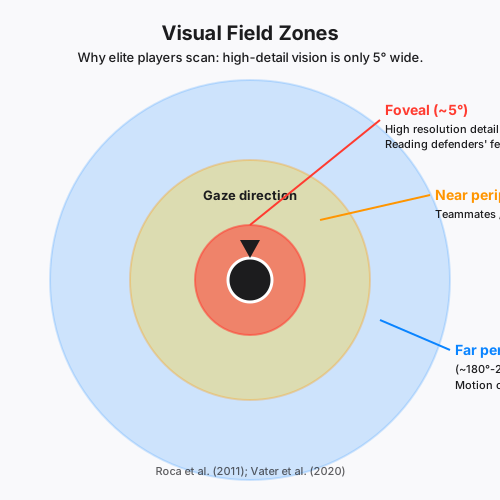
The Division of Labor Between Central and Peripheral Vision
- Central vision (approximately 2 degrees) — High resolution for identifying detail: ball spin, shirt numbers, the orientation of a player's feet
- Parafoveal vision (2–5 degrees) — Moderate resolution for gauging the relative positions of nearby teammates and opponents
- Peripheral vision (5–90 degrees) — Low resolution but exceptionally sensitive to motion, detecting distant player movement and the emergence of open space
Williams & Davids (1998) found that skilled soccer players exhibited fewer fixations of longer duration. In other words, experts do not 'look everywhere.' Instead, they select tactically important areas to fixate on and fill in the rest with peripheral vision — an efficient visual strategy.
What Is Anticipatory Gaze Behavior?
Vaeyens et al. (2007) reported that youth players who made superior decisions displayed more 'anticipatory gaze behavior' — shifting their gaze toward events that had not yet occurred. Specifically, these players would move their eyes to a potential pass receiver before the pass was played, or scan the space where a gap was about to open as a defender slid across.
What gaze-tracking data tells us: elite players do not 'see more' — they 'see smarter.' The essence of wide field vision is the ability to extract maximum information from a limited number of fixations.
Automating Visual Processing
Beginners use most of their central vision to track the ball, missing peripheral information. Experts, by contrast, delegate ball tracking to peripheral vision and devote central vision to gathering tactical information. This 'automation of visual processing' becomes possible only when ball handling has been drilled to the point of being unconscious. In other words, technical practice itself lays the foundation for wider field vision.
Five Scanning Drills — Integrating Cognition and Action
Scanning ability does not improve just by telling a player to 'look around.' It requires progressively increasing cognitive load while repeatedly practicing the conversion of observed information into on-ball action. The following five drills have demonstrated effectiveness with players U-10 and older.
A systematic review by McGuckian et al. (2018) concluded that improving scanning behavior requires practicing the three-step sequence of 'see, decide, execute' as a single integrated task. The drills below are designed on that principle.
Drill 1: Color-Cone Cognitive Pass
Place four different-colored cones around the player. The coach calls out a color. Before receiving the ball, the player scans to locate the designated cone and uses their first touch to move the ball in that direction. This is a foundational drill for building the habit of gathering information before the ball arrives.
Drill 2: Behind-the-Passer Check
A coach stands behind the player who is about to pass and holds up a number of fingers. The receiving player must scan before the pass to see the number, then call it out after receiving the ball. This drill naturally promotes shoulder checks (scanning over the shoulder).
Drill 3: Number-Recognition Rondo
A standard rondo (keep-away) with a cognitive twist. Outer players wear numbered bibs and randomly swap positions. The player on the ball must instantly answer when asked, 'Which number is free right now?' A high-load drill that simultaneously demands passing decisions and scanning.
Drill 4: Shadow Scan Drill
A 3v3+GK game on a half pitch. Attackers must perform a shoulder check before every pass and choose their action based on the information gathered. Defenders press whenever an attacker fails to scan. A game-format drill that makes players feel the real-game consequences of scanning.
Drill 5: Video Freeze & Recall
Show 3–5 seconds of match footage, then pause. Ask the players: 'Where was the unmarked teammate?' 'What shape was the defensive line?' This is a cognitive training exercise that can be done off the pitch — ideal for rainy days or recovery sessions. Eldridge et al. (2013) confirmed its effectiveness with youth players.
- Run each drill 2–3 times per week for 15–20 minutes. Daily sessions are not necessary
- Even if success rates are low at first, scanning frequency typically increases by 30–50% after 4–6 weeks of consistent practice
- Having players verbalize what they saw further improves scanning quality
- The Video Freeze drill can be practiced individually using match footage on YouTube or similar platforms
The key question is not 'Did you turn your head?' but 'What did you see?' Asking 'What did you notice just now?' after every scan transforms empty head-turning into genuine information gathering.
Peripheral Vision Training — Physically Widening Your Visual Field
Peripheral vision is a visual subsystem specialized for detecting motion. In soccer, it is essential for 'sensing' a teammate's run or an opponent's press. Scientific evidence shows that training can improve peripheral sensitivity and information-processing speed.
Peripheral vision is trained by assigning a task to central vision while requiring reactions to events occurring in the periphery. This 'dual-task' format most faithfully replicates match conditions — controlling the ball while detecting movement around you.
Basic Visual Training
Stand facing a wall and fixate on a single point straight ahead. Without moving your eyes, identify stimuli presented to the left and right in your periphery (colored cards, number of fingers, etc.). Start with your hands at roughly shoulder width and gradually widen the angle. With five minutes of daily practice, cases have been reported where the responsive angle expands by 10–15 degrees within four weeks.
Multi-Task Practice
Dribble a ball while reacting to signals from a coach in the surrounding area (hand gestures, colored flags, etc.). This creates a practical dual task of managing the ball with central vision while detecting environmental changes with peripheral vision. Difficulty can be adjusted progressively by varying dribbling speed and signal complexity.
Visual-Field Expansion Exercises
- Wide-focus practice — Consciously create a 'soft focus' state where you view the entire scene rather than fixating on one point. Switch into this visual mode during matches when the ball is far away
- Sports vision board — Arrange numbers or symbols on a large board and read peripheral information while fixating on the center. This technique is used in athletic visual-training facilities
- Juggling practice — Track multiple balls within your visual field simultaneously. This directly strengthens peripheral motion-tracking ability
- Mirror drill — Two players face each other; one moves randomly while the other mirrors those movements using only peripheral vision
The most important mistake to avoid in peripheral vision training is moving your central gaze to 'look' at the target. The goal is to improve information processing while keeping your eyes fixed. The moment you shift your gaze, the exercise turns into scanning practice instead.
The key to peripheral vision training: when something feels invisible, resist the urge to look directly at it — keep practicing 'sensing' it in place. Even if the information is vague at first, consistent practice will sharpen your peripheral sensitivity over time.
Note that prolonged close-range, narrow-focus activities such as smartphones and video games reduce opportunities to use peripheral vision, potentially stunting its development. Make a conscious effort to spend time outdoors looking into the distance, and manage daily screen time to maintain a healthy balance.
Age-Specific Approaches — Vision Training Aligned with Developmental Stages
Starting vision training early is beneficial, but age-inappropriate methods risk being ineffective and draining the fun out of soccer. The ideal progression is: at U-8, build awareness through play; at U-10, introduce deliberate practice; at U-12, transition to tactical scanning.
Research by Eldridge et al. (2013) on youth players showed that while scanning frequency and quality improve naturally with age, intentional training interventions significantly accelerate that development. However, the approach must be tailored to each age group's cognitive stage.
U-8 (Early Elementary): Play-Based Approach
- Tag games and tail-snatching — Chasing an opponent and spotting open space naturally require 'looking around'
- Dribble + rock-paper-scissors — Players dribble and play rock-paper-scissors when they meet an opponent, a first step in taking their eyes off the ball
- 'How many did you see?' game — Look around briefly and count how many players are wearing a particular bib color
- Coaching tip: Do not tell players to 'look around.' Instead, design games where scanning is a built-in necessity
U-10 (Mid Elementary): Introducing Deliberate Scanning Practice
- Pre-pass routine — Make it a habit to 'check once before the ball arrives, and once more as you receive it'
- Color-cone drill — Use Drill 1 (above) as a regular staple
- 'What did you see?' verbalization — Have players say out loud what they noticed after scanning, reinforcing the link between cognition and action
- Coaching tip: First praise the effort to look — regardless of outcome — then gradually sharpen what they notice
U-12 (Upper Elementary): Transitioning to Tactical Scanning
- Position-specific scan patterns — CBs learn to scan sideways and behind; fullbacks scan diagonally; midfielders develop a full 360-degree scan
- Integrating scan, decision, and execution — Players choose their action based on what they saw and explain the reasoning
- Introducing video analysis — Review personal match footage to check scanning timing and frequency, gaining objective feedback
- Coaching tip: Ask players to explain 'Why did you make that choice?' in tactical terms, making the causal link between scanning and decision-making explicit
The cardinal rule by age group: U-8 — 'enjoy looking,' U-10 — 'look on purpose,' U-12 — 'look and decide.' Skipping these stages risks embedding superficial head-turning that carries no real informational value.
Across all age groups, one principle holds: asking 'What did you learn from looking?' is far more effective than telling a player to 'Look!' Instructions produce passive behavior; questions foster active information seeking. Coaches and parents who cultivate the habit of asking — rather than commanding — unlock the greatest training gains.
Applying Scanning in Matches — Position-Specific Scanning and Real-Game Integration
Translating scanning skills from training to match day requires knowledge of position-specific priority scanning zones, preparatory movements before receiving the ball, and a mental model that connects scan results directly to on-ball decisions.
Dr. Jordet's research revealed that not only the frequency but also the timing of scans strongly influences match performance. The most effective window is 'while the ball is traveling toward you' — information gathered 0.5–2 seconds before receiving the ball is most directly used in decision-making.
Position-Specific Priority Scanning Zones
- GK — Space between the defensive and midfield lines; movement of opposing forwards. During build-up, check for the free player out wide
- CB — Space behind (forward runs in behind); cover positions to the side. The position requiring the most scans per match
- Fullback — Opposing winger on the diagonal; central spaces. Before joining the attack, confirm cover behind you
- Central midfielder — Full 360-degree scan. Forward passing lanes, pressure from behind, lateral support. The position with the highest scanning frequency
- Winger — Space for cutting inside; the opposing fullback's weight distribution; overlapping runs on the far side
- Center forward — Space behind the defensive line; near post and far post; layoff targets when dropping deep
Preparatory Actions Before Receiving the Ball
- 2–3 seconds before the pass is played — Shoulder check behind you to gauge the distance and angle of the nearest opponent
- The moment the pass is played — Track the ball's trajectory with peripheral vision while making a final check of your intended playing direction
- Just before the ball arrives — Adjust your body shape to face your intended direction. Receive with an open body
- First touch — Control the ball in the optimal direction based on the information gathered from your scan
This entire sequence starts as a conscious effort, but after months of repetition it becomes an automated 'pre-play routine'. Once automated, the cognitive load drops and the player can devote more mental resources to higher-level tactical decisions.
Linking Scan Information to Play Selection
The ultimate purpose of scanning is not 'to see' but 'to choose the right action'. For example, if a scan reveals space behind you, turn immediately. If it reveals close pressure, release the ball with one touch. Preparing these 'if-then' patterns in advance minimizes the lag between scanning and action.
- Space behind, no pressure → Turn and dribble or play a forward pass
- Pressure from behind → One-touch layoff to a supporting player
- Space to the side → Open body to switch play
- Teammate making a run ahead → Direct through ball
- Pressure from all directions → Hold possession or play a safe back pass
Three questions to ask yourself in every match: (1) Before the ball arrives — 'What can I see?' (2) At first touch — 'Is my touch direction based on what I saw?' (3) After the action — 'Can I explain why I chose that?' When all three answers are clear, scanning is fully integrated into your play.
References
- [1] Jordet, G., Bloomfield, J., & Heijmerikx, J. (2013). “The hidden foundation of field vision in English Premier League soccer players” MIT Sloan Sports Analytics Conference.
- [2] Williams, A. M. & Davids, K. (1998). “Visual search strategy, selective attention, and expertise in soccer” Research Quarterly for Exercise and Sport, 69(2).
- [3] Vaeyens, R., Lenoir, M., Williams, A. M., & Philippaerts, R. (2007). “Mechanisms underpinning successful decision making in skilled youth soccer players” Journal of Motor Behavior, 39(5).
- [4] McGuckian, T. B., Cole, M. H., & Pepping, G. J. (2018). “A systematic review of the technology-based assessment of visual perception and exploration behaviour in association football” Journal of Sports Sciences, 36(8).
- [5] Eldridge, D., Pulling, C., & Robins, M. T. (2013). “Visual exploratory activity and resultant behaviour in youth soccer players” Journal of Human Sport and Exercise, 8(3).
Related Articles
How to Develop Decision-Making in Soccer — What Cognitive Science Reveals About 'Smart Players'
14 min read
Metacognition Training — The Science Behind 'Thinking Soccer' and How to Develop It Through Journaling
12 min read
Spatial Cognition — The Science of Reading Space, Trained Through Team Sports
10 min read
The Complete Soccer Practice Guide for Elementary-Age Kids — Science-Based Programs by Age Group and Objective
15 min read
The Science of Dribbling Mastery — The Fastest Learning Method Proven by Motor Learning Theory
14 min read
Track Your Growth with Footnote
Just record your matches — AI analyzes every 5 games. Visualize growth with PVS Score. All features free during beta.
30-second signup · No credit card required
Last updated: 2026-05-06 ・ Footnote Editorial