How to Develop Decision-Making in Soccer — What Cognitive Science Reveals About 'Smart Players'
Decision-making in soccer is the ability to process vast amounts of information instantaneously during a match and select the optimal play. According to Williams & Ward (2007), expert players hold a decisive advantage over novices in **perceptual-cognitive skills** — and the gap lies not in physical ability but in how they read information. Klein's (1993) Recognition-Primed Decision Making (RPD) model demonstrates that experts make rapid decisions based on pattern recognition rather than analytical reasoning. This article draws on cognitive science to explain how soccer decision-making can be systematically developed across age groups.
The Cognitive Science of Decision-Making — What Happens Inside a 'Smart Player's' Brain
Soccer decisions follow three stages: perception, decision, and action. Experts already hold an advantage at the perception stage, reaching optimal solutions in under 0.5 seconds through Recognition-Primed Decision Making.

Photo by Jens Lelie on Unsplash
During a soccer match, players face a decision roughly every 3 to 4 seconds. Pass, dribble, or shoot? In cognitive science, this process is explained through an information-processing model consisting of three stages: Perception, Decision, and Action.
The Three-Stage Information-Processing Model
- Perception — Acquiring visual information about the positions of teammates, opponents, the ball, and available space. This is the stage of understanding 'where everything is.'
- Decision — Integrating the acquired information, generating and evaluating options, and selecting the best play. This is the stage of determining 'what to do.'
- Action — Executing the chosen play as a physical movement. This is the stage of carrying out 'how to do it.'
According to Williams & Ward's (2007) comprehensive review, the greatest difference between expert and novice players lies at the perception stage. Experts predict what will happen next by reading bodily cues before the ball is even kicked — the angle of the kicker's plant foot, the rotation of the torso, and similar pre-contact signals. This anticipation is what creates the appearance of 'fast decision-making.'
The Recognition-Primed Decision Making (RPD) Model
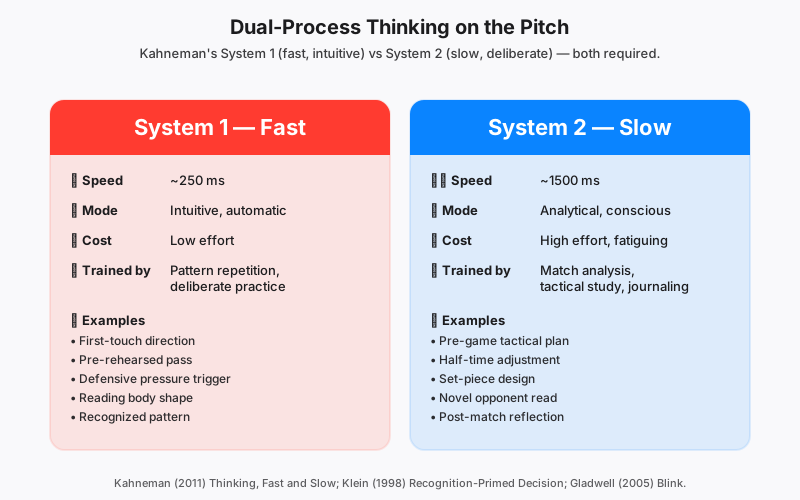
The RPD model, proposed by Klein (1993), is one of the most influential theories explaining expert decision-making. According to this model, experts recognize a situation and instantly match it against patterns from past experience, executing the 'first solution that comes to mind' without going through analytical reasoning.
- Pattern recognition: Experts rapidly search a mental library of situational patterns — built through thousands of hours of practice — to find the closest match to the current situation
- Mental simulation: They run a high-speed mental simulation of whether the chosen action will succeed, and if no problems are detected, execute immediately
- The nature of intuition: Expert 'intuition' is not irrational judgment — it is the result of pattern matching grounded in vast experience
Players who decide quickly are not 'thinking faster' — they are 'seeing more information.' The essence of decision-making training is improving the quality of perception.
Roca et al. (2011) experimentally demonstrated that skilled soccer players integrate visual search patterns, anticipation skills, and option generation in dynamic situations. Crucially, these cognitive skills are trainable through practice. They are not innate talents; anyone can improve them given a well-designed training environment.
Perception-Action Coupling — Reading Information from the Environment
The foundation of decision-making is the ability to read environmental information. Through the lens of affordance theory, players perceive the 'action possibilities' that the environment offers. Training designed according to representative design principles cultivates this ability.

Photo by Leo_Visions on Unsplash
Passos, Araujo, & Davids (2013) showed that perception-action coupling is the core of the self-organization process in invasion team sports like soccer. Rather than being two separate processes, 'seeing' and 'moving' function as a unified system through interaction with the environment.
Affordance Theory and Soccer
Affordance, a concept introduced by J.J. Gibson, refers to the 'action possibilities' that an environment offers to an agent. In soccer, the available space, teammates' movements, and opponents' positions afford possibilities such as 'playing a through ball,' 'beating a defender with a dribble,' or 'taking a shot.'
- Space affordances: Gaps between defensive lines signal the possibility of a through ball
- Teammate movement affordances: A teammate's running line signals the existence of a passing lane
- Opponent posture affordances: An opponent's weight shift signals an opportunity to wrong-foot them
- Time affordances: The time before pressure arrives defines the range of what is possible
Elite players perceive multiple affordances simultaneously and select the most effective one. While novices watch only the ball, experts read the 'relationships' surrounding it.
The Principle of Representative Design
The principle of representative design, proposed by Pinder et al. (2011), revolutionized how training environments are structured. The idea is straightforward: the more closely a training drill reproduces the information structure of a real match, the more effectively the perceptual-action skills developed in training will transfer to competition.
Decision-making learned through drills can only be used in drills. Decision-making that transfers to matches is developed only in practice that reproduces the informational structure of the game.
— Araujo & Davids (2011)
When cones stand in for opponents, the match-specific information sources — postural changes, weight shifts, gaze direction — are absent. As a result, the decision-making skills developed in such settings do not function well in actual matches. This is the scientific explanation for the problem of players who 'look great in practice but can't make decisions in games.'
If you want to develop decision-making, design practices that require decisions. Drills with predetermined correct answers will not build decision-making ability.
Five Evidence-Based Methods for Training Decision-Making
Scientifically grounded decision-making training methods fall into five categories: small-sided games (SSGs), constraints manipulation, the freeze-replay method, video simulation, and a questioning approach to coaching. All share the common principle of strengthening perception-action coupling.
1. Small-Sided Games (SSGs)
SSGs are the gold standard for decision-making training. By reducing numbers (3v3 to 5v5) and shrinking the pitch, the number of touches and decisions per player increases dramatically. Price et al. (2020) reported that SSGs are the most effective application of Nonlinear Pedagogy in practice.
- Decision frequency increases roughly 3 to 5 times compared to 11v11
- The informational structure of the game (teammates, opponents, space) is preserved
- Difficulty can be progressively adjusted through changes in pitch size, player numbers, and rules
2. Constraints Manipulation
Constraints manipulation involves deliberately varying rules, player numbers, space, and time within the training environment to promote the development of specific decision-making skills. It is grounded in the Constraints-Led Approach developed by Davids and colleagues.
- Touch restrictions (two-touch / one-touch) — forces players to scan and decide before receiving the ball
- Numerical imbalances (3v2, 4v3) — teaches decision-making patterns in overload and underload situations
- Zone restrictions (play limited to certain areas) — elicits creative solutions in confined spaces
- Time limits (must shoot within 10 seconds) — trains decision-making under time pressure
3. Freeze-Replay Method
In the freeze-replay method, the coach calls 'Stop!' during practice, freezing all players in position, then facilitates analysis of the situation at that moment. The coach asks questions like 'Where is the open space right now?' and 'How many passing options do you see?' to heighten perceptual awareness.
An important caveat: freezing play too frequently disrupts the flow of the game and can actually hinder the development of perception-action coupling. Using it only two or three times per session — at moments of highest coaching value — is recommended.
4. Video Simulation
This method involves pausing match footage at specific moments and asking players to decide 'what should happen next.' Williams & Ward's (2007) review confirmed that video-based perceptual training significantly improves anticipation accuracy.
- Pause match footage and ask: 'What should this player do?'
- Occlusion method: hide the remainder of a sequence and ask players to predict the outcome
- Using footage from the team's own matches links analysis directly to improvement
- Serves as a complement to field training — can be done on rainy days or during travel
5. Questioning Approach to Coaching
Rather than providing answers, the coach poses questions to stimulate the player's own thinking. Prompts such as 'Why did you pass there?', 'What other options did you have?', and 'What would you do differently next time?' promote the autonomous development of decision-making.
All five methods share a single principle: increase the number of opportunities for players to think and decide for themselves. The key is reducing how often the coach provides the answer and ensuring players have time to experiment through trial and error.
Age-Specific Decision-Making Development — Staged Growth from U-8 to U-12
Decision-making develops in stages according to age. At U-8, players choose between two options. At U-10, they compare three to four options. By U-12, multi-step tactical thinking becomes possible. Matching cognitive load to each age group's developmental level is essential.
The development of decision-making is tightly linked to cognitive development — the expansion of working memory capacity, maturation of attentional control, and acquisition of abstract thinking. Drawing on Piaget's stages of cognitive development, here is how soccer-specific decision-making ability progresses by age.
U-8 (Ages 6-8): A World of Two Choices
At this age, working memory capacity is limited, and children can process only two to three items simultaneously. Decisions should therefore be framed as simple binary choices — 'pass or dribble?' Presenting too many options overwhelms their processing capacity, leading to confusion and hesitation.
- Use scenarios with strong numerical advantage (2v1, 3v1) to practice 'pass or dribble' decisions
- Prioritize frequent success so players learn to enjoy the act of deciding
- Never criticize mistakes — trial and error is the learning process itself
- Keep rules simple and focus on a single decision point at a time
U-10 (Ages 8-10): Expanding to Three or Four Options
Working memory expands, allowing players to hold three to four pieces of information at once. This is the stage where choosing among 'pass, dribble, or shoot' — and even deciding 'which teammate to pass to' — becomes feasible.
- Use numerical advantages (3v2, 4v3) to encourage comparison of multiple options
- Evaluate by 'how many options did you spot?' rather than 'did you pick the best one?'
- Begin building the habit of scanning (looking up to check surroundings before receiving the ball)
- Start simple post-play reflections: 'Why did you choose that?'
U-12 (Ages 10-12): Reading Multiple Moves Ahead
Players begin entering the formal operational stage, enabling conditional reasoning: 'If I do X, the opponent will do Y, and then I can do Z.' This period — the latter half of the Golden Age (ages 9-12) — is when decision-making development accelerates most rapidly.
- Use 5v5 and 7v7 formats to create match-like complexity
- Coach 'next-next' plays (e.g., the third player's movement in a wall pass sequence)
- Encourage perspective-taking: 'What is the opposing center-back looking at right now?'
- Introduce match-video analysis to enable reflections that extend beyond the moment of play
- Establish the habit of verbalizing decision rationale in a soccer journal
If a player's decisions seem slow, first check whether the practice is set at the right complexity for their age. Asking a U-8 player to choose among four options is a mismatch with their developmental stage.
These developmental stages are guidelines, and individual variation is natural. Players with extensive soccer experience may progress to the next stage earlier than the average for their age. The key is to set challenges that are just beyond the player's current reach — what Vygotsky called the Zone of Proximal Development.
Coaching Approaches That Develop Decision-Making
Directive coaching raises short-term accuracy but undermines the long-term autonomous development of decision-making. The three pillars that genuinely build decision-making are a questioning approach, an environment that allows safe failure, and progressive pressure in training.
From Directive to Questioning Coaching
Commands like 'Pass right!' or 'Shoot!' strip players of the opportunity to decide for themselves. In the moments when the coach's voice cannot reach them — which is virtually every moment of live play — players who have been directed will be unable to decide on their own.
A questioning approach replaces commands with reflective prompts after the play: 'Why did you pass there?', 'What other options did you see?', 'What would you do if that situation came up again?' These questions foster introspection (metacognition) and drive the autonomous development of decision-making.
- Before the play: 'What do you see right now?' / 'What are your options?'
- During the play: Withhold instructions. Wait for the player's own decision
- After the play: 'Why did you make that choice?' / 'What do you think, looking at the result?'
- During review: 'If the same situation comes up again, what would you change?'
Creating an Environment Where Failure Is Safe
A psychologically safe environment is essential for decision-making to develop. When mistakes are punished, players avoid risky decisions and default to safe options — hoofing the ball forward, playing a short pass to the nearest teammate — every time.
Failure is an essential nutrient in decision-making training. Without failure, decision-making cannot grow.
The coach's role is not to 'provide the right answer' but to 'maintain an environment where players keep thinking.' When a through ball does not connect, saying 'Great attempt. What did you see that made you choose that pass?' encourages the player to try another ambitious decision next time.
Progressive Pressure in Decision-Making Practice
In matches, time pressure, physical pressure, and psychological pressure converge simultaneously. Decision-making skills developed without pressure transfer poorly to competition, so training must introduce pressure in progressive stages.
- Low pressure: 2v1 against a passive defender (one who does not chase). Players learn foundational decision patterns
- Medium pressure: 3v2 against active defenders, with a time limit (e.g., must shoot within 5 seconds)
- High pressure: Match-format SSGs under fatigue, training players to maintain decision quality when tired
Results from decision-making training are not visible overnight. With three to six months of consistent practice, you will see changes such as 'they now spot multiple options' and 'their decision speed has improved.'
Verbalization and Decision-Making — The Power of Putting Plays into Words
Post-play verbalization (reflection) is the bridge between decision-making and metacognition. Recording the decision-making process in a soccer journal converts tacit knowledge into explicit knowledge, enabling intentional improvement in future performances.
Decision-making and verbalization may seem unrelated, but from a cognitive science perspective they are closely connected. According to Vygotsky's theory of inner speech, thought is structured by language. The very act of articulating 'why I chose that play' improves the quality of the decision-making process itself.
Structuring Post-Play Reflection
Effective reflection requires structure. Vague statements like 'today was good' or 'today was bad' do nothing to improve decision-making. By following three guiding questions, players can analytically verbalize their decision-making process.
- What did I perceive? — At that moment, how did I read the positions of teammates, opponents, and available space?
- Why did I decide that? — Among the options I saw, why did I choose that particular one?
- What did I learn from the outcome? — Based on whether the play succeeded or failed, what would I do differently next time?
How to Use a Soccer Journal
A soccer journal functions as 'external memory' for decision-making. While match decisions are often made unconsciously, the act of writing them down converts tacit knowledge into explicit knowledge. Once decision patterns become explicit, they can be deliberately applied in the next match.
- Record decision points: 'I passed right in that situation, but space was open on the left'
- Build a library of successful patterns: 'A through ball works when the center-back steps up'
- Self-assess decision speed: 'I hesitated three times today — what caused the hesitation?'
- Combine with video: Write journal analysis while reviewing specific moments from match footage
Connecting to Metacognition
Verbalization is the gateway to metacognition — the ability to monitor one's own cognitive processes. A player who realizes 'I tend to lose peripheral vision when attacking from the right side' can consciously increase their scanning frequency next time. This is the profile of a player who can improve their own decision patterns independently — a truly self-developing player.
Improving decision-making is not only about making more good decisions — it accelerates when players learn to objectively evaluate their own choices and run a continuous cycle of correction. Verbalization is the engine that powers that cycle.
Footnote's soccer journal feature is designed to capture this 'decision reflection' in a structured format. By answering three prompts after each match — what you perceived, why you decided as you did, and what you will carry forward — players naturally practice metacognitive training.
References
- [1] Williams, A. M., & Ward, P. (2007). “Anticipation and decision making: Exploring new horizons” Handbook of Sport Psychology, 3rd edition.
- [2] Klein, G. (1993). “A recognition-primed decision (RPD) model of rapid decision making” Decision Making in Action: Models and Methods, 5(4).
- [3] Passos, P., Araújo, D., & Davids, K. (2013). “Self-organization processes in field-invasion team sports” Sports Medicine, 43(1), 1-7. Link
- [4] Price, A., Collins, D., Stoszkowski, J., & Pill, S. (2020). “Learning to play soccer: Applying a nonlinear pedagogy approach” Physical Education and Sport Pedagogy, 25(5), 485-501. Link
- [5] Roca, A., Ford, P. R., McRobert, A. P., & Williams, A. M. (2011). “Identifying the processes underpinning anticipation and decision-making in a dynamic time-constrained task” Cognitive Processing, 12(3), 301-310. Link
Related Articles
Science-Based Training to Expand Your Field Vision — Scanning Technique and Peripheral Vision Development
13 min read
Metacognition Training — The Science Behind 'Thinking Soccer' and How to Develop It Through Journaling
12 min read
The Science Behind How Verbalization Improves Soccer — How 'Writing' and 'Thinking' Connect in the Brain
6 min read
The Complete Soccer Practice Guide for Elementary-Age Kids — Science-Based Programs by Age Group and Objective
15 min read
How to Review a Match --- What Pro Scouts Look For and Proven Recording Techniques
7 min read
Track Your Growth with Footnote
Just record your matches — AI analyzes every 5 games. Visualize growth with PVS Score. All features free during beta.
30-second signup · No credit card required
Last updated: 2026-05-06 ・ Footnote Editorial