The Science of First Touch (Trapping) -- The 0.5-Second Skill That Determines Your Next Move
In soccer, the first touch is the single most important skill that determines the quality of your next action. According to Pulling et al. (2018), 86% of professional players rated the first touch as "the most critical skill that influences match outcomes." In the roughly 0.5 seconds between receiving the ball and initiating the next action (pass, dribble, or shot), the quality of your touch dictates both the number of options available and the precision of execution. This article explains how to scientifically improve your first touch, drawing on biomechanical insights and age-appropriate coaching methods.
Why First Touch Decides Everything -- The Science Behind a 0.5-Second Advantage
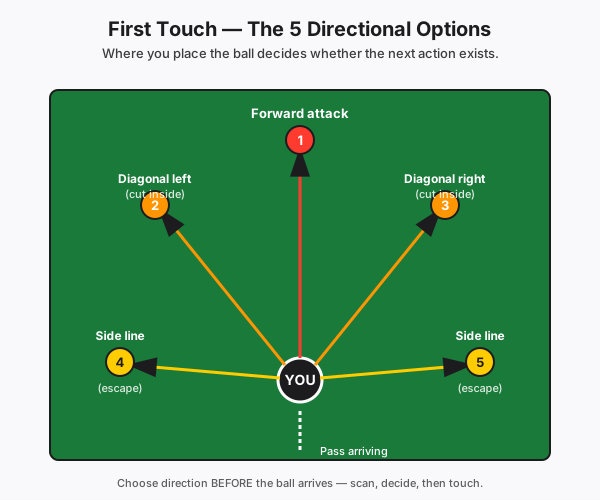
The quality of your first touch determines whether you triple your options for the next play or reduce them to just one. Top-level players have an average of 50 to 70 touch opportunities per match, and research shows that players with a higher rate of accurate first touches have significantly better pass completion and dribble success rates.

Photo by Alex Rizzardi on Unsplash
When you watch a soccer match, you'll notice that the best players seem to "accelerate" the game the moment they receive the ball. This is because their first touch minimizes the transition time to the next action. Ali (2011) reported in a review that first touch accuracy has the strongest correlation with match performance among all soccer skills.
The 0.5-Second Advantage -- The Time Edge Created by Your Touch
In modern soccer, the average time before an opponent's pressure reaches you after receiving the ball is 1.5 to 2.0 seconds. If an accurate first touch lets you transition to the next action 0.5 seconds faster, it means you can make decisions and execute before the opponent's defense is set. This 0.5-second difference is the tipping point between having a passing lane open or closed, between having a shooting chance or not.
Touch Accuracy Data from Top Players
Pulling et al. (2018) surveyed Premier League players on "the importance of each component of the first touch." The results showed that touch direction (placing the ball in the optimal position for the next play) was rated most important, followed by touch distance (keeping it close enough to the body) and touch softness (preventing the ball from bouncing away). The essence lies not merely in "stopping" the ball, but in "where and with how much force" you place it.
The Relationship Between Touch Placement and Available Options
- Ball stops within 1m in front of the body -- All three options (pass, dribble, shot) are available. This is the ideal touch
- Ball rolls more than 1.5m to the side -- You need to chase it, eliminating all options except dribbling
- Ball bounces behind the body -- Requires turning around, losing 1-2 seconds. Maximum risk of losing possession
- Ball stopped dead at your feet -- Safe, but zero forward momentum. Easier for opponents to close you down
A "perfect first touch" does not mean stopping the ball dead at your feet. It means placing the ball in the optimal position and angle for your next action. Depending on the situation, "controlling the ball while moving it" is often the better choice.
The Biomechanics of First Touch -- The Physics of Shock Absorption
The essence of the first touch is "shock absorption." A ball traveling at 40-80 km/h carries kinetic energy that must be absorbed through foot and body movement, placing the ball at the intended location. Understanding this physical process clarifies "why the ball bounces off" and "how to achieve a soft touch."
The mechanics of the first touch can be fundamentally explained by collision physics. When a ball (mass approximately 420g) strikes the foot, if the foot moves in the same direction as the ball, contact time increases and force is distributed. Asai et al. (2002) analyzed the contact mechanics between the ball and foot in detail, demonstrating that longer contact time leads to greater ball controllability.
The Three Principles of Shock Absorption
- Withdrawing foot (cushioning) -- At the moment the ball reaches your foot, pull your foot back in the direction the ball is traveling. This extends the contact time and distributes the impact. It's the same principle as pulling your hand back when catching an egg
- Adjusting the contact angle -- Instead of positioning the contact surface perpendicular to the ball's trajectory, tilt it slightly to apply a downward force that brings the ball to the ground. Too steep an angle pops the ball up; too shallow sends it rolling forward
- Center of gravity control -- Keep your center of gravity slightly forward so the ball's impact doesn't push your body backward. Placing too much weight on the standing leg causes you to lose balance on impact
Ankle Angle -- When to Lock vs. Relax
Ankle technique for first touch is the opposite of kicking. When kicking, you lock (fix) the ankle to transfer force, but when trapping, you moderately relax the ankle to absorb impact. However, this does not mean going completely limp. If the ankle is too loose, the ball's momentum will overpower it and send the ball in an unintended direction. "Forming a surface while keeping it soft" -- this delicate balance is the hallmark of an advanced player.
Body Orientation and Open Control
Another key factor that determines first touch quality is body orientation before receiving the ball. Dicks et al. (2009) showed, through their research on representative task design, that information-seeking behavior (adjusting body orientation to scan the surroundings) is directly linked to decision-making quality. By opening your body to a half-turn position when receiving, most of the field enters your field of vision, allowing you to develop play forward simultaneously with your touch.
- Closed control -- Facing directly toward the ball. Safe but limits your field of vision, requiring a turning motion
- Open control -- Receiving with the body half-turned. Wide field of vision, enabling an immediate transition to the next play
- Back-to-pressure -- Receiving with a defender on your back. An advanced technique where you shield the opponent with your body while controlling the ball
The most effective way to improve your first touch is not "refining foot technique" but "improving pre-touch body preparation." Body orientation, center of gravity, and scanning your surroundings determine 80% of your touch quality.
Types of Touch and When to Use Each -- Optimal Control for Every Situation
There are multiple first touch techniques, and the optimal touch varies depending on ball height, speed, distance from opponents, and intended next action. Ideally, you should be able to switch among five types -- inside, outside, sole, chest, and thigh -- based on the situation.
Williams & Hodges (2005) demonstrated that in soccer skill acquisition, the ability to select the right technique for the situation is equally or more important than technical accuracy alone. The same applies to first touch -- rather than using "inside trap for every situation," the mark of improvement is being able to choose the optimal touch method based on circumstances.
Inside Touch -- The Most Stable Fundamental Technique
This is the most basic touch, receiving the ball with the inside of the foot (from the arch to the ankle area). It offers the largest contact surface area and the highest control stability. Used for trapping ground passes, receiving short passes, and as the starting point for turns. Approximately 60% of professional players' touches are inside touches.
Outside Touch -- Control Without Losing Speed
This touch uses the outside of the foot to receive the ball. Its greatest advantage is controlling the ball without breaking stride. It excels when receiving passes while running or when touching the ball while evading an opponent. Although the contact surface is narrower than the inside touch, making it more difficult, mastering it dramatically increases your playing speed.
Sole Touch -- Precision Control in Congested Areas
This touch presses the ball from above using the sole of the foot. It is frequently used when you want to stop the ball completely, for directional changes in tight spaces, and as a fundamental technique in futsal. While it offers the advantage of full control over the ball, the drawback is that your body leans over the ball, making you vulnerable to pressing.
Chest Trap -- The Most Reliable Response to Aerial Balls
This technique uses the broad surface of the chest to receive the ball. It is used for processing high balls and long feeds. The key is to start with the chest pushed out, then draw it back (concave it) at the moment of impact to absorb the shock. It is important to practice the "chest-to-feet" sequence -- receiving with the chest and dropping the ball to your feet -- as a single fluid motion.
Thigh Trap -- Handling Mid-Height Balls
This technique uses the broad surface of the thigh to receive balls arriving between waist and chest height. Shock is absorbed by raising the knee and then lowering the leg as the ball arrives. The drawback is that it takes time, as you need to let the ball drop to your feet before making the next play.
Summary: Optimal Touch Selection by Situation
- Ground pass -> Inside (prioritizing stability) or outside (maintaining speed)
- Receiving while running -> Outside (no need to stop)
- Receiving in a congested area -> Sole (full control)
- Long feed -> Chest (reliable handling of high balls)
- Mid-height aerial ball -> Thigh (using the surface area for absorption)
- Pressure is close -> Far-side foot (placing the ball away from the opponent)
7 Drills for Improvement -- Training You Can Do Solo Every Day
Repetitive practice is essential for improving your first touch. Williams & Hodges (2005) identified the quality and volume of "deliberate practice" as key conditions for skill acquisition. The seven drills below provide progressive coverage from solo exercises using a wall or a single ball to game-realistic training under pressure.

Photo by Emma Benedict on Unsplash
The order of practice matters. First, learn to control accurately while stationary, then add movement, and finally add pressure. Following this three-stage progression of "static -> dynamic -> pressure" ensures you develop a genuine touch that works in matches.
Drill 1: Basic Wall Pass (Inside Foot Alternation)
Stand 3-5m from a wall and kick the ball with your inside foot, then control the return with your inside foot. Kick with the right foot and stop with the left -> kick with the left and stop with the right, alternating continuously. Aim for 50 repetitions per set, 3 sets per day. As you improve, increase the distance to the wall and the ball speed.
Drill 2: Wall Pass with Direction Change
Kick the ball against the wall, and instead of stopping the return, use your touch to change direction. Designate three directions -- 45 degrees right, 45 degrees left, and straight behind -- and redirect the ball with one touch before kicking it back to the wall. This drill practices first touch that "stops and moves" simultaneously.
Drill 3: Aerial Ball Self-Toss
Toss the ball above your head and control the falling ball with a single touch using the top of the foot -> inside -> thigh -> chest, one body part at a time. Receive the ball so it doesn't bounce more than twice. Varying the height develops your ability to handle balls arriving at different angles.
Drill 4: Moving Control
While jogging lightly, receive a pass from a partner (or a wall rebound) and place the ball in your direction of travel with your first touch. This requires an entirely different skill set from receiving while stationary. It is the best drill for improving outside touch accuracy.
Drill 5: Trap Under Pressure
Face a partner in a 1v1 setup and receive a pass from a third player. As the pass is played, the partner closes in. Under this pressure, use the far foot for your first touch -> turn -> dribble past the opponent. This is a game-realistic drill that builds decision speed for the "touch-and-evade" sequence.
Drill 6: Random Feed Response
Have a partner randomly deliver ground balls, aerial balls, fast balls, and slow balls, and control every one of them with a single touch into a designated area. This develops your ability to respond to unpredictable balls. It is a drill based on the representative task design advocated by Dicks et al. (2009).
Drill 7: Target Zone Control
Set up a 1m-square zone with four cones on the ground, and practice placing the ball inside that zone with your first touch from passes delivered at various angles. This drill lets you quantify your "placement accuracy." Once you can land 8 out of 10 touches inside the zone, progress to the next difficulty level (make the zone smaller or increase the passing distance).
Coaching reports suggest that practicing wall passes for 15 minutes a day over 30 days improves first touch success rate by an average of 20-30%. The key is "a little every day" -- 15 minutes daily is more effective than 2 hours once a week.
Age-Appropriate Touch Coaching -- A Progressive Approach Aligned with Development
First touch coaching must progress in stages aligned with children's motor and cognitive development. At U-8, the focus is "the joy of stopping the ball"; at U-10, "directional touch"; and at U-12, "control with decision-making." The coaching focus differs at each age level.
Williams & Hodges (2005) showed through their research on skill acquisition that age-appropriate practice design is the key to long-term technical development. Demanding advanced techniques that ignore developmental stages risks ingraining incorrect form and causing children to lose interest in soccer. Below are coaching guidelines by age group.
U-8 (Ages 6-8): The Joy of Stopping -- Building Successful Experiences
- Goal: Let children feel a sense of accomplishment simply from being able to stop the ball with their feet
- Ball used: Lightweight balls (size 3 or lightweight size 4) to eliminate fear
- Practice content: Stopping a hand-tossed ball with the feet / stepping on a slowly rolled ball with the sole
- What to avoid: Detailed instructions like "softer" or "think about the direction." At this age, successful experiences and fun are the top priorities
- Coaching tip: Give enthusiastic praise when they stop the ball. Use game formats (e.g., target hitting) to keep the play element alive
U-10 (Ages 8-10): Directional Touch -- From Stopping to Moving
- Goal: Develop awareness of not just "stopping" but "placing the ball in the direction of the next play"
- Technical elements: Improving inside trap accuracy, introducing open control (receiving with the body half-turned)
- Practice content: Wall passes (with direction changes), pairs drill of "receive -> turn -> pass" in continuous motion
- What to avoid: Forcing use of the weaker foot. Adding the weak foot while the "good feel" on the dominant foot is still unstable creates confusion
- Coaching tip: Center your verbal cues around "try looking around before the ball arrives." This is the stage to plant the seeds of decision-making
U-12 (Ages 10-12): Control with Decision-Making -- See, Decide, Touch
- Goal: Be able to decide "where and with what kind of touch" to place the ball before it arrives
- Technical elements: Switching between open and closed control, outside touch, aerial ball handling
- Practice content: 3v1 rondo (constant touch decisions under pressure), random feed response drill
- What to avoid: Evaluating only results (success/failure). At this age, the decision-making process should be evaluated
- Coaching tip: Ask "why did you place it there?" and have players verbalize the intent behind their touch. This promotes metacognition
U-14 and Above: Match Adaptation -- Integrating Speed and Decision-Making
From U-14 onward, the challenge shifts from technical "quality" to "speed" and "integration with decision-making." Deciding touch direction within 0.5 seconds under heavy pressure and executing it. Repetitive practice at match speed and density, aiming for a state where the correct touch comes out unconsciously (automatization).
The Golden Age (ages 9-12) is when neural development peaks and skill acquisition speed is the fastest in a lifetime. Embedding the "correct feel" of the first touch into the body during this period determines the upper limit of future technical ability.
Top Player Touch Analysis -- Learning from Messi, De Bruyne, and Takefusa Kubo
The first touch of world-class players shares common characteristics. Messi's "ball sticks to the foot" touch, De Bruyne's "the attack starts the moment he receives" touch, and Takefusa Kubo's "never loses the ball even in tight spaces" touch. We analyze the distinctive features of each and identify the key takeaways for youth development.
When observing top players' touches, the crucial thing is to watch not just the foot movement but "the movement before the ball arrives." As Ali (2011) pointed out, measuring soccer skills should evaluate not just the moment of execution but the entire process including the preparatory phase. Here, we analyze the characteristics of three players.
Messi -- Zero-Bounce Control with a Low Center of Gravity
The defining feature of Messi's first touch is that the ball settles with virtually zero bounce the instant it meets his foot. This is achieved by keeping his center of gravity low and using an extremely soft ankle to fully absorb the impact. Additionally, he tilts his body slightly forward over the ball at the moment of touch, physically preventing the ball from bouncing up.
- Low center of gravity -- He receives the ball with bent knees and lowered hips. The low center of gravity stabilizes the contact angle between foot and ball
- Ankle flexibility -- Rather than locking his ankle, his "flowing with the ball's momentum" movement is exceptionally smooth
- Instant acceleration -- His next step is already underway at the same time as his touch. The time lag between touch and movement is virtually zero
De Bruyne -- Launching Attacks with a Forward Touch
The hallmark of De Bruyne's first touch is that he doesn't "stop" the ball but "moves it to a position that creates the next passing lane." Before receiving, he scans his surroundings by checking over his shoulders multiple times, and by the moment of touch, the trajectory of the next pass is already mapped in his mind. His touch always places the ball forward and on the line of the intended pass, so his second touch becomes an instant assist pass.
- Pre-touch scanning -- He checks his surroundings with 2-3 shoulder checks before the ball arrives, determining the direction of his touch
- Forward touch -- He rarely stops the ball at his feet, consistently placing it 1-2m ahead
- One-step pass -- His second stride after the touch links directly into his passing motion. Receiving and delivering form one continuous flow
Takefusa Kubo -- Technical Problem-Solving in Congested Areas
The defining feature of Takefusa Kubo's first touch is his ability to accurately retain possession in tight spaces even when surrounded by opponents. Developed while compensating for a smaller physique, his skills stand out: using the far foot from the defender to touch the ball, precise control using the sole extensively, and the adaptability to instantly switch touch types based on split-second judgment.
- Far-side touch -- He receives the ball with the foot on the opposite side from the opponent's pressure, using his body as a shield
- Extensive use of the sole -- He momentarily stops the ball with his sole, reads the opponent's movement, then decides the direction -- a "delayed decision" approach
- Rapid switching -- Consecutive touches shifting from inside to outside to sole that break the opponent's predictions
The Laws of First Touch Shared by All Three Players
- Body orientation is set before the ball arrives -- The direction of the touch is determined before contact
- Soft ankles -- They absorb impact and "mold" the ball rather than "blocking" it
- They see the next play -- The touch is a means, not an end. Their focus is on the next action, not on the touch itself
- Stable center of gravity -- Their body doesn't shift from the ball's impact. Core strength and a low center of gravity form the foundation
- Minimal touches -- No unnecessary extra touches. One touch places the ball in the optimal position for the next play
When analyzing footage of professional players, the most valuable thing to study is not "the moment of the touch" but "the 2 seconds before the touch." Body orientation, shoulder checks, subtle positional adjustments -- that's where the real difference lies. The younger the player, the more emphasis should be placed on "preparation before contact."
References
- [1] Pulling, C., Eldridge, D., Lomax, J., & Robins, M. T. (2018). “Football players' perceptions of the relative importance of each component of the first touch” International Journal of Performance Analysis in Sport.
- [2] Asai, T., Carre, M. J., Akatsuka, T., & Haake, S. J. (2002). “The curve kick of a football” Sports Engineering.
- [3] Williams, A. M. & Hodges, N. J. (2005). “Practice, instruction and skill acquisition in soccer” Journal of Sports Sciences.
- [4] Dicks, M., Davids, K., & Button, C. (2009). “Representative task designs for the study of perception and action in sport” International Journal of Sport Psychology.
- [5] Ali, A. (2011). “Measuring soccer skill performance: A review” Scandinavian Journal of Medicine and Science in Sports.
Related Articles
The Science of Dribbling Mastery — The Fastest Learning Method Proven by Motor Learning Theory
14 min read
The Science of Proper Kicking — Biomechanics Behind Instep and Inside Kicks
15 min read
The Complete Guide to Solo Soccer Training — 40 Drills Organized by Purpose
16 min read
Science-Based Training to Expand Your Field Vision — Scanning Technique and Peripheral Vision Development
13 min read
The Complete Soccer Practice Guide for Elementary-Age Kids — Science-Based Programs by Age Group and Objective
15 min read
Track Your Growth with Footnote
Just record your matches — AI analyzes every 5 games. Visualize growth with PVS Score. All features free during beta.
30-second signup · No credit card required
Last updated: 2026-05-06 ・ Footnote Editorial