Endurance Training for Junior Soccer Players — Age-Specific, Science-Backed Approaches
Soccer endurance is not simply the ability to run for a long time. As Bangsbo (1994) demonstrated, soccer is an "intermittent exercise" involving repeated bursts of high-intensity sprints, jogs, and stops over 90 minutes. Total match running distance reaches 10-13 km, but that includes over 1,000 changes of action. In other words, soccer endurance is the integrated ability to recover quickly after a sprint and prepare for the next all-out effort — a combination of "Repeated Sprint Ability (RSA)" and "aerobic recovery capacity." Growing children are not small adults, and the optimal approach differs by age.
What Is Soccer Endurance? — A Hybrid of Aerobic and Anaerobic Capacity
Soccer endurance is not pure aerobic capacity. According to Stolen et al. (2005), aerobic energy systems supply 90% of the energy during a match, yet decisive moments (sprints, jumps, duels) rely on anaerobic systems. "Intermittent endurance" — the integration of both energy systems — is what defines soccer fitness.

Photo by Miguel A Amutio on Unsplash
The endurance of a marathon runner and that of an elite soccer player are qualitatively different. Marathons demand "continuous endurance" — maintaining a steady pace — while soccer demands "intermittent endurance" — repeatedly switching between high and low intensities. Bangsbo's (1994) landmark study revealed that soccer players perform 150-250 short sprints during a match, recovering in between with low-intensity jogs and walking.
Match Running Distance and Intensity Distribution
- Total running distance — 10-13 km per match for top-level adult players. Estimated at 5-8 km per match for juniors (U-12)
- High-intensity running (above 15 km/h) — Only 8-12% of the total, yet this is what decides matches. Over 80% of goals originate from situations involving high-intensity sprints
- Changes of action — 1,000-1,400 changes in speed and direction over 90 minutes. Movement changes roughly every 4-6 seconds
- Positional differences — Central midfielders cover the most distance (12-13 km), center-backs the least (9-10 km). Wingers have a higher proportion of high-intensity running
The Three Components of Intermittent Endurance
Breaking down soccer endurance reveals three key abilities. First, aerobic base (VO2max) — a high maximum oxygen uptake accelerates recovery during low-intensity activity and limits performance decline throughout the match. Second, anaerobic threshold (AT) — the ability to sustain high-intensity movement over extended periods while keeping lactate accumulation in check. Third, Repeated Sprint Ability (RSA) — the capacity to sprint repeatedly with short recovery periods, which determines late-game decisiveness.
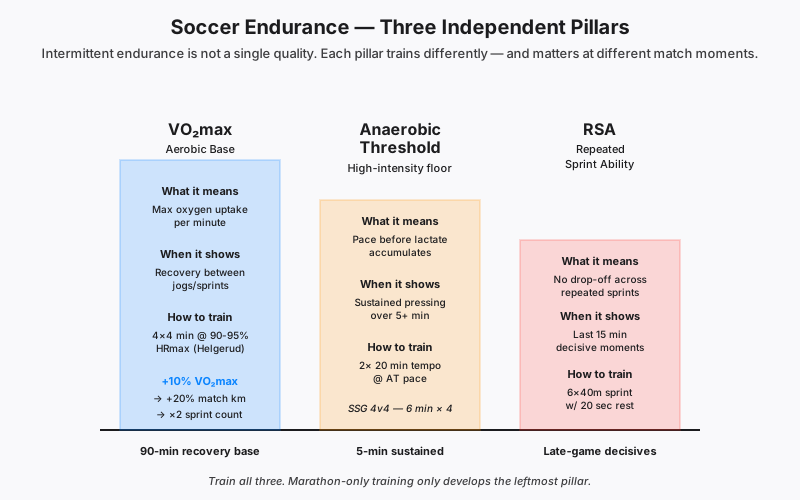
"Good at distance running" does not equal "good soccer fitness." Soccer endurance is the ability to recover quickly after a sprint and deliver the next all-out effort. It is fundamentally different from a marathon runner's fitness.
Helgerud et al. (2001) reported in a groundbreaking study that soccer players who improved their VO2max by 10% increased their in-match running distance by 20%, doubled their sprint count, and had more involvement with the ball. Improving aerobic capacity elevates not just stamina but overall match performance.
Growth-Stage Physiology — Children Are Not "Small Adults"
Armstrong & McManus (2011) comprehensively reviewed how children's energy metabolism differs qualitatively from that of adults. Children have a higher reliance on aerobic systems, underdeveloped anaerobic systems, and faster recovery. Simply scaling down adult training programs yields limited results.
A child's body is not a miniature version of an adult's. Energy supply systems, cardiorespiratory function, thermoregulation, and recovery characteristics all change according to developmental stage. Armstrong & McManus (2011) emphasized that "biological age" matters more than chronological age when designing training programs for youth athletes.
VO2max Development Patterns
Children's VO2max (maximum oxygen uptake per unit of body weight) is roughly equal to — or in some cases even higher than — that of adults. However, this does not mean their aerobic capacity is fully developed. Children have lower cardiac output, which they compensate for with a higher heart rate. Their blood hemoglobin concentration is also lower, resulting in less efficient oxygen transport. The reason their relative VO2max remains high is their smaller body size and greater metabolic efficiency.
PHV (Peak Height Velocity) and Energy Systems
- Pre-PHV (boys around 10-12 years) — Aerobic system is dominant. Anaerobic glycolytic enzyme activity is low, with lactate production capacity at 60-70% of adult levels. High-intensity exercise duration is short but recovery is extremely fast
- PHV phase (boys around 12-14 years) — The "window of sensitivity" for aerobic capacity. Training during this period improves VO2max most efficiently. A period of significant cardiac volume growth
- Post-PHV (boys around 14-16 years) — Anaerobic systems develop rapidly with increasing testosterone. Lactate tolerance improves and responsiveness to high-intensity interval training increases
Age-Specific Adaptation Characteristics
Understanding the physiological characteristics unique to children makes it clear why adult training methods should not be applied as-is. Children recover faster from short, high-intensity exercise (due to faster lactate clearance) but have a lower capacity to sustain a given absolute intensity. This means the format best suited to children's physiology is "short bursts of high intensity + short rest periods" repeated in succession.
- Recovery speed — Children's heart rate recovery after high-intensity exercise is 30-50% faster than adults. They can adapt even with shorter interval rest periods
- Thermoregulation — Children have a higher body surface area-to-weight ratio and immature sweat function. Prolonged training in hot environments carries a high dehydration risk
- Perceived exertion — For the same physiological load, children perceive less effort in game-based formats. The play context reduces the perceived discomfort of exercise
- Bone and cartilage vulnerability — Before growth plates close, repetitive impact loading (such as long-distance running) poses an injury risk
The most important principle for children's endurance training: "Short duration, high frequency, game-based format." Long, monotonous distance running is unsuitable for children both physiologically and psychologically.
U-8 to U-10 Approach — "Play" Is the Best Endurance Training
At this age, the greatest measure of success in endurance development is ensuring children don't realize they are doing endurance training. By embedding aerobic stimuli within fun activities — tag games, relays, multidirectional games — endurance foundations are built as a byproduct of play.
For the U-8 to U-10 age group, structured endurance training (interval runs, tempo runs, etc.) is not recommended. There are two reasons. First, the aerobic system at this age is already relatively well-developed, and daily activities provide sufficient stimulus without specialized training. Second, monotonous running drills create a negative impression that "soccer is grueling," contributing to long-term dropout.
Play-Based Aerobic Activities
- Chain tag (Zombie tag) — Tagged players become taggers, continuing until only one player remains free. Since everyone is constantly moving, this naturally produces 5-10 minutes of continuous aerobic exercise. Run 2-3 rounds with rest in between
- Island tag — Set up 3-4 "safe zones (islands)" on the court. Adding a rule that players can only stay on an island for 3 seconds ensures sustained movement. Develops change of direction and decision-making simultaneously
- Color relay — Scatter four colors of cones and have players touch the cone matching the color the coach calls, then return. Making it a team competition naturally creates a pattern of all-out running + short recovery intervals
- Ball collection race — Players carry balls one at a time from outside the area to their team's zone. Variations of carrying by hand or dribbling integrate technical practice with endurance work
- Continuous 1v1 battles — 30-second 1v1 bouts with a different opponent for 5-6 rounds straight. The competitive game context naturally draws out high exercise intensity
Design Principles for Coaches
- Keep each activity to 3-5 minutes — Match the children's attention span. Switch to the next activity before boredom sets in
- Keep everyone moving — Avoid drills that create "waiting in line." Time spent standing in a queue = zero aerobic stimulus
- Include competition but don't let outcomes be fixed — Rotate teams and use handicaps so every child experiences success. Repeated losses destroy motivation
- Don't measure heart rates or times — Numerical monitoring is unnecessary at this age. If children are breathing hard and laughing, that is optimal endurance training
The key is to not reveal the coach's intention of "building endurance" to the children. The moment you announce "Today is fitness training," children tense up. Say "Let's play a new tag game!" and they'll sprint with everything they have. The same physiological stimulus, delivered in a different psychological context, maximizes both exercise volume and enjoyment.
Success criteria for U-8 to U-10 endurance development: "Are the children saying 'I want to do more!' after practice?" There is absolutely no need to make them run with strained faces. Fun is the best training prescription.
U-10 to U-12 Approach — Integrating SSGs with Structured Training
Impellizzeri et al. (2006) demonstrated that Small-Sided Games (SSGs) produce aerobic improvements equal to or greater than traditional running training. At U-10 to U-12, SSGs serve as the foundation while gradually introducing structured interval training.
The U-10 to U-12 age range is known as the "Golden Age" — the optimal window for technical skill acquisition — but it is also a period of heightened sensitivity for aerobic capacity development. The key at this age is to "build endurance while using the ball." An integrated approach that does not separate soccer-specific movements from endurance training is the most efficient.
Building Endurance Through SSGs (Small-Sided Games)
Impellizzeri et al. (2006) reported that SSGs (small-number games of 3v3 to 5v5) deliver VO2max improvements equivalent to interval running while also developing technical and tactical elements simultaneously. The greatest advantage of SSGs is the ability to control exercise intensity through adjustments to pitch size, player numbers, and rules.
- 3v3 (20m x 15m) — Elicits the highest heart rate response. High ball-touch frequency also promotes technical development. 4 min x 4 sets, 2 min rest
- 4v4 (30m x 20m) — Frequent attack-to-defense transitions naturally create an intermittent exercise pattern. 5 min x 3 sets, 2 min rest
- 5v5 (40m x 30m) — Adds more match-like tactical elements. Stimulates both positioning and endurance. 6 min x 3 sets, 3 min rest
- Rules to increase intensity — Touch limits (2-touch or less), goal conditions (all players must be in the opponent's half before shooting), adding a free player to promote numerical superiority in attack
Gradual Introduction of Interval Runs
From U-11 to U-12, soccer-specific interval runs can be introduced once per week at most. However, rather than monotonous "running between cones," it is important to incorporate changes of direction and decision-making elements — creating "soccer-style intervals."
- 30-30 intervals — 30 seconds running + 30 seconds walking/light jog. Target 85-90% of maximum heart rate during running bouts. Start with 6-8 reps and increase to 10-12 as adaptation develops
- Pitch shuttle runs (soccer-style) — Penalty area to halfway line to opponent's penalty area and back, combined with ball dribbling. Dribble on the way out, free run on the way back
- Shuttle runs (graduated distances) — 10m, 20m, 30m, 20m, 10m with progressively changing distances. Sprint each segment at full effort; the jog back to the start line serves as the recovery period
Integration with Soccer-Specific Movement
What should be avoided most at this age is completely separating "soccer practice" from "fitness training." The more time spent running without a ball, the more motivation drops and the connection to soccer-specific movement patterns is lost. Ideally, SSGs and game-based drills should deliver over 80% of the endurance stimulus within the overall practice session, with the remaining 20% supplemented by running-based exercises.
At U-10 to U-12, minimize the "being forced to run" feeling as much as possible. Reaching 85% of maximum heart rate within an SSG without even realizing it — that is the ideal form of endurance training.
5 Specific Training Methods — Building Soccer Endurance Through Science
Helgerud et al. (2001) demonstrated that High-Intensity Interval Training (HIIT) improves aerobic capacity more efficiently than moderate continuous running. The following five methods are the most effective menus for developing the intermittent endurance required in soccer matches.

Photo by Hannah Coleman on Unsplash
Method 1: SSGs (Small-Sided Games) — Train with the Ball
The most recommended soccer endurance training method. In Impellizzeri et al. (2006), the SSG training group showed VO2max improvements equivalent to the interval running group while also significantly improving technical test scores. Reducing the number of players (3v3 is the highest) increases exercise intensity.
- How to implement — 3v3 to 5v5, with a target pitch size of 50-100 sqm per player. 4-6 min x 3-5 sets, 2-3 min rest between sets
- Intensity adjustment — Control heart rate response through touch limits, goal size changes, presence/absence of a goalkeeper, and frequency of coach ball delivery
- Caution — In 3v3 or smaller, skill differences can overly determine outcomes. Adjust with ability-based grouping or handicap rules
Method 2: Interval Runs — Directly Stimulate VO2max
The Helgerud et al. (2001) "4 x 4-minute" protocol improved soccer players' VO2max by over 10% and dramatically enhanced in-match performance. For junior players, time and repetitions are adjusted accordingly.
- U-12 protocol — 3-minute run (85-90% of max heart rate) + 2-minute recovery jog. 4-5 reps. Once per week
- U-14+ protocol — 4-minute run (90-95% of max heart rate) + 3-minute recovery jog. 4 reps. 1-2 times per week
- Introduction guideline — Start with 2 reps and add one rep every 4 weeks. The right intensity is "you can finish but the last rep is tough"
Method 3: Fartlek — Varying Intensity in a Natural Setting
"Speed play" originating from Sweden. Rather than fixed intervals, running speed varies freely based on terrain and mood. On an undulating course, you might "sprint uphill, jog on flat ground, coast downhill." It is ideal for players who struggle with structured intervals or as a mental refresher.
- How to implement — 15-25 minutes, with jog as the base and 30-second to 2-minute high-intensity bursts inserted at will. A group version where the coach's whistle signals all-out sprinting and the next whistle signals jogging is also effective
- Soccer adaptation — Fartlek while dribbling. Sprint dribble on the coach's signal, jog dribble on the next signal. Trains ball control and endurance simultaneously
Method 4: Circuit Training — Simultaneous Whole-Body and Muscular Endurance
A format of performing 6-10 exercises consecutively with no rest (or very short rest). It stimulates aerobic capacity and muscular endurance simultaneously, making it especially effective for junior teams with limited practice time. Incorporating soccer-specific movements also ensures sport specificity.
- Station example (30 sec each, 10 sec transition) — (1) Ladder run, (2) Push-ups, (3) Cone dribbling, (4) Squat jumps, (5) Pass & move, (6) Plank, (7) Shuttle run, (8) Burpees
- Circuit design principles — Alternate upper and lower body to avoid local fatigue. 2-3 rounds totaling 12-20 minutes is appropriate. 1-minute rest between rounds
- Age-specific adjustments — U-10: 20 sec x 6 stations, U-12: 30 sec x 8 stations, U-14: 40 sec x 10 stations
Method 5: Tempo Runs — Efficiently Building an Aerobic Base
Tempo runs involve running at a moderate intensity of 65-75% of maximum heart rate for a set duration. They can be positioned as "recovery days" between high-intensity training sessions or used for aerobic base building early in the season. To prevent monotony, pair runs with teammates, pace runs set to music, and course variations are important.
- How to implement — U-12: 10-15 minutes of continuous jogging. U-14: 15-20 minutes. At a pace where "you can hold a conversation but are slightly out of breath"
- Caution — Schedule this on the "easiest day" of the week. The ideal weekly structure places SSG or interval high-intensity days the day after a tempo run
- Soccer adaptation — Inserting light ball work during the jog (juggling, turns, etc.) reduces boredom and doubles as technical practice
None of these five methods is superior to the others. Use SSGs as the foundation for "training while playing soccer," intervals to raise the aerobic ceiling, fartlek for variety, circuits for whole-body conditioning, and tempo runs for recovery and base building — combining them within a weekly plan is the optimal solution.
Recovery and Nutrition — Maximizing the Benefits of Endurance Training
Training adaptations happen during rest. Without proper recovery and nutrition, even the best training program will fail to deliver results. For growing athletes, recovery strategies are even more critical than for adults.
After endurance training, the body is undergoing beneficial changes: mitochondrial biogenesis, capillary growth, and cardiac adaptations. However, these adaptations require adequate nutrient supply and sufficient rest. Junior athletes in particular must secure enough energy for both growth and recovery from training.
Post-Training Recovery Timeline
- Immediately to 30 minutes after (golden window) — The period when glycogen resynthesis rate is highest. Consume carbohydrates and protein in a 3:1 ratio. A rice ball with milk, or a banana with yogurt are convenient options
- 30 minutes to 2 hours — Replenish energy with a proper meal centered on carbohydrates. Easily digestible carbohydrate sources like rice, pasta, and noodles are ideal
- That evening — Securing 7-9 hours of sleep is the top priority. Growth hormone is secreted during deep sleep, promoting muscle repair and aerobic capacity adaptation
- The next day — Light aerobic exercise (jog, stretching, pool) promotes blood flow and accelerates recovery. "Active recovery" is faster than complete rest
The Science of Hydration
Dehydration of just 2% of body weight has been reported to reduce aerobic performance by 10-20%. Children are more sensitive to dehydration than adults and tend to be less aware of thirst. "Drinking when thirsty" is too late, making time-based hydration schedules essential.
- Before exercise — Drink 200-300 mL of water 30 minutes before practice
- During exercise — Sip 150-200 mL every 15-20 minutes. For intense exercise lasting over 60 minutes, consider a sports drink (4-8% carbohydrate + electrolytes)
- After exercise — Replenish 1.5 times the weight lost through sweat over 2 hours. Weighing before and after is the most accurate method to assess dehydration
Daily Nutrition That Supports Endurance
The primary fuel depleted during endurance training is muscle glycogen (carbohydrates stored in muscles). Repeated training in a carbohydrate-depleted state leads to chronic fatigue from glycogen depletion. For growing soccer players, 5-7 g of carbohydrates per kg of body weight is recommended. For a 30 kg player, that is 150-210 g per day — roughly equivalent to 5-7 rice balls.
- Carbohydrates (energy source) — Rice, bread, pasta, noodles, potatoes. On training days, aim for 1-2 extra servings of rice compared to usual
- Protein (repair and growth) — Meat, fish, eggs, soy products, dairy. A palm-sized portion per meal is a good guide. Also consume within 30 minutes after training
- Iron (oxygen transport) — Lean red meat, liver, spinach, leafy greens. A mineral directly linked to endurance that is especially prone to deficiency during growth periods
- Vitamin D (bones and muscles) — Fish, mushrooms, egg yolks + sunlight exposure. Involved in muscle strength and immune function; consciously consume during winter when indoor training is frequent
Warning Signs of Overtraining
"The more you run, the fitter you get" is a dangerous misconception. Accumulated training without adequate recovery leads to overtraining syndrome, resulting in performance declines lasting weeks to months. Junior athletes who belong to multiple sports teams are particularly at risk of excessive total training load.
- Physical signs — Lingering fatigue the day after training, elevated resting heart rate (+5 bpm or more), frequent colds, loss of appetite, weight loss
- Psychological signs — Reluctance to attend practice, increased irritability, difficulty concentrating, poor sleep quality
- Performance signs — Stagnation or worsening of times, loss of sharpness in movements during practice, slower decision-making
- Countermeasures — Schedule at least one full rest day per week. Include a "deload week" each month where training load is reduced to 50%. If symptoms persist for more than 2 weeks, consult a medical professional
"Training + Recovery + Nutrition = Growth." If any one of these three elements is missing, endurance will not improve. Growing athletes especially must understand that "rest is also training."
References
- [1] Stolen, T., Chamari, K., Castagna, C. & Wisloff, U. (2005). “Physiology of soccer: an update” Sports Medicine, 35(6).
- [2] Armstrong, N. & McManus, A. M. (2011). “The elite young athlete” Medicine and Sport Science, 56.
- [3] Helgerud, J., Engen, L. C., Wisloff, U. & Hoff, J. (2001). “Aerobic endurance training improves soccer performance” Medicine and Science in Sports and Exercise, 33(11).
- [4] Impellizzeri, F. M., Marcora, S. M., Castagna, C., Reilly, T., Sassi, A., Iaia, F. M. & Rampinini, E. (2006). “Physiological and performance effects of generic versus specific aerobic training in soccer players” International Journal of Sports Medicine, 27(6).
- [5] Bangsbo, J. (1994). “The physiology of soccer — with special reference to intense intermittent exercise” Acta Physiologica Scandinavica Supplementum, 619.
Related Articles
Soccer Training to Get Faster — 5 Methods Proven by Sprint Science
14 min read
The Truth About the Golden Age — Neuroscience Reveals Optimal Training by Age Group
11 min read
The Science of Core Training for Kids — Age-Specific Programs and Their Impact on Soccer
15 min read
Injury Prevention Guide for Junior Soccer Players — FIFA 11+ Kids and Evidence-Based Prevention Programs
16 min read
The Complete Match Day Preparation Guide for Soccer — From the Night Before to Post-Match Recovery
11 min read
Track Your Growth with Footnote
Just record your matches — AI analyzes every 5 games. Visualize growth with PVS Score. All features free during beta.
30-second signup · No credit card required
Last updated: 2026-05-06 ・ Footnote Editorial