How to Develop On-Field Communication in Soccer — The Science of Words That Move a Team
Soccer is an information battle played by eleven players moving simultaneously, and on-field communication is the foundational skill that underpins performance. In Lausic et al.'s (2009) study of intrateam dialogue in doubles tennis, winning pairs recorded roughly twice the volume of communication compared to losing pairs. Sullivan & Feltz (2003) developed a scale for effective communication in team sports, demonstrating that vocal communication is directly linked to collective efficacy and team cohesion. In most cases, the reason a player does not speak up is not shyness — it is simply not knowing what to say. With structured, step-by-step training, this skill can be reliably developed in any player.
Why Soccer Demands Communication — Information-Sharing Speed Determines Team Coordination
A soccer match is an information battle requiring over 1,000 decisions in 90 minutes. Voice communication supplements what vision alone cannot process, dramatically improving both the speed and accuracy of decision-making.

Photo by Omar Ramadan on Unsplash
A soccer player's field of vision covers roughly 120 degrees, yet the pitch is a 360-degree arena of information. Pressure from behind, an unmarked teammate on the far side, the offside line — there is always critical information that vision alone cannot cover. Communication from teammates fills this 'blind-spot gap.'
Lausic et al.'s (2009) study of doubles tennis found that winning pairs generated approximately twice the volume of intrateam communication compared to losing pairs. Even more revealing was the difference in communication quality. Winning pairs produced more 'information-sharing' and 'emotional support' messages, while losing pairs relied disproportionately on 'directive' messages.
Three Risks of Insufficient Communication
- Marking handoff errors — Without a simple 'I've got him' or 'He's yours,' two players collapse on the same attacker or no one picks up the mark at all
- Defensive block collapse — The defensive line is held together by the goalkeeper's and center-backs' voices. Without them, the line becomes ragged and the team gets caught behind
- Breakdown in attacking cohesion — If the passer and receiver are not aligned in intent, even technically gifted players produce 'mismatched' passes
While developing the Scale for Effective Communication in Team Sports (SECS), Sullivan & Feltz (2003) demonstrated that the quality of intrateam communication significantly predicts collective efficacy. In other words, teams that communicate vocally find it easier to share the belief that 'we can win' — and that belief translates into actual performance.
Communication in soccer is not a personality trait — it is a skill. Like any technical ability, it can be learned by anyone through proper practice.
Using conversation analysis methods, LeCouteur & Feo (2011) examined real-time communication in team sports and showed that players' vocal exchanges function not merely as information transfer but as a 'synchronization device' that aligns the timing and intent of plays. Voice is just as vital a connector as the pass itself.
Three Types of Communication — Mastering Directives, Information Sharing, and Encouragement
On-pitch vocal communication falls into three broad categories. Understanding the purpose and appropriate context of each eliminates the 'I don't know what to say' barrier.

Photo by Jeffrey F Lin on Unsplash
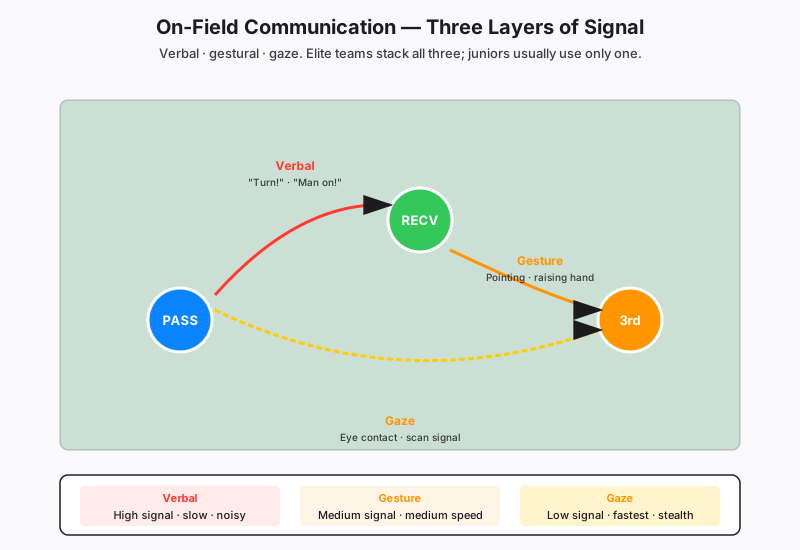
1. Directive Communication — 'Mark up!' 'Switch right!'
Directive communication aims to change a teammate's action directly. In defense: 'Mark up!' 'Tuck in!' 'Hold the line!' In attack: 'Switch right!' 'One-two!' 'Shoot!' These calls must be short, specific, and immediately actionable.
- Defensive examples: 'Pick up 10!' 'Slide across!' 'Don't step up!' 'I'm covering!'
- Attacking examples: 'Turn!' 'One touch!' 'In behind!' 'Hold it!'
- Set-piece examples: 'Near post!' 'Zone three!' 'Five in the wall!'
2. Information-Sharing Communication — 'Man on!' 'You're free!'
Information-sharing communication conveys what a teammate cannot see. Because the ball carrier is focused forward, information about threats from behind or openings on the far side can only come from teammates' voices. Phrases like 'Man on!', 'Cutting left!', 'You're free!', and 'Time! Time!' fall into this category.
As LeCouteur & Feo's (2011) research shows, this type of communication is most effective when delivered before the moment of action. Hearing 'Man on!' after the ball has already arrived is often too late. When the information reaches a player before or at the instant of receiving the ball, it transforms the quality of the first touch.
3. Encouragement Communication — 'Great ball!' 'Let's go!'
Encouragement communication maintains or restores the team's psychological state. Phrases like 'Great play!', 'Shake it off!', 'We're fine!', and 'Keep going!' may have no direct tactical effect, but they form the emotional bedrock of the team.
The 'emotional support' communication that Lausic et al. (2009) found to be more prevalent in winning teams corresponds precisely to this encouragement category. In particular, whether a teammate receives vocal support immediately after conceding a goal or making an error has a substantial impact on performance over the following five minutes, a pattern widely reported by coaches at the grassroots level.
You do not need to master all three types at once. Starting with type 2 — information sharing — is the easiest entry point. A single 'Man on!' can dramatically change a teammate's play.
Reaching the Quiet Player — Change the Environment, Not the Personality
'My child is too quiet to speak up on the field' — this assumption is usually wrong. The real barriers are not personality but environment: not knowing what to say and fearing the consequence of saying the wrong thing.
In many youth development settings, coaches repeatedly issue the vague instruction 'Communicate!' Yet telling players to 'use their voice' without teaching them specific phrases is like telling them to 'play better' without technical coaching. The instruction itself is insufficient.
The Three Real Reasons Players Stay Silent
- 'I don't know what to say' — They have never been taught specific communication phrases. They do not even know the distinction between directive, information-sharing, and encouragement types
- 'I'll get in trouble if I say the wrong thing' — In environments where only correct answers are rewarded, players cannot take the risk of speaking up. A climate that punishes mistakes silences voices
- 'Someone else will say it' — When a team has one vocal leader, other players become dependent. This is a structural problem in teams that lack a culture of universal communication
A Step-by-Step Training Approach to Unlock Voice
Drawing on Sullivan & Feltz's (2003) communication research, vocal skills should be built in stages. Rather than demanding that players speak up in matches, a gradual approach that accumulates small successes in a psychologically safe environment is far more effective.
- Step 1: Learn the phrases — Create a list of situation-specific phrases such as 'Man on!', 'You're free!', and 'Mark up!' and have players memorize them
- Step 2: Practice in pairs — Pass and move in pairs while calling out. With only one partner, the psychological barrier is minimal
- Step 3: Apply in small groups — Introduce a communication rule in 3v3 or 4v4 small-sided games. Fewer players mean every voice is heard
- Step 4: Embed in full-team training — Set a rule that everyone communicates during scrimmages. Never scold silence; always praise any attempt at speaking up
Replace 'Speak up!' with 'Try saying: Man on!' Giving a concrete phrase is often all it takes for a quiet player to start communicating.
Cotterill & Fransen's (2016) athlete leadership research demonstrates that leadership behavior is not innate but develops through the right environment and training. The same is true for vocal communication. By creating the right conditions, teaching specific methods, and providing success experiences, coaches can develop communication skills in players of every temperament.
The most rewarding moment as a coach is when a quiet player finds their voice. The job is not to change their personality — it is to create an environment where they feel safe to speak up.
— Youth soccer coach interview
Five Communication Drills — Training Menus You Can Use Tomorrow
Communication is not developed by simply telling players to 'talk more' during matches. It must be structurally embedded into practice sessions so that speaking up becomes second nature.
Drill 1: Blind Pass
The player on the ball closes their eyes (or looks down) and passes solely based on teammates' voices. The receivers must call out 'Here!', 'Right, 45 degrees!', or 'Wait — now!' to complete the pass. This drill structurally makes voice communication a necessity.
- Arrange 4–6 players in a circle; the player in the center closes their eyes and receives passes
- Surrounding players communicate the receiver's name and direction
- As players improve, add constraints: two-touch, then one-touch
Drill 2: Mandatory Back-Pass Call Game
In this small-sided game, any back pass requires the receiver to call out their name plus 'Free!' before play can continue. Because silence halts the game, vocal communication is enforced as habit.
The key is not to punish silence but to celebrate every successful vocal connection — the whole team says 'Nice!' when a call leads to a completed pass. Positive reinforcement lowers the psychological barrier to speaking up.
Drill 3: Rotating Captain
In a scrimmage, rotate the captain every five minutes so that every player experiences the role. The acting captain is responsible for directing the defensive line, organizing communication, and rallying the team. Players who are normally quiet often find it easier to speak up when a defined role gives them permission to do so.
Drill 4: Player-Led Halftime Meeting
At the midpoint of a scrimmage, players conduct a halftime meeting entirely on their own. The coach stays silent. Players identify the problems from the first half and decide how to adjust — building off-pitch communication skills alongside on-pitch ones.
Cotterill & Fransen's (2016) research shows that athlete leadership develops not only on the pitch but also through dialogue in the locker room and in meetings. The player-led halftime meeting is a direct application of this insight.
Drill 5: Communication Count Competition
During a small-sided game, a coach or substitute player tallies each player's communication attempts, and the player with the highest count is recognized. The goal is to increase quantity before refining quality. Adding a competitive element makes building the vocal habit enjoyable.
The common thread across all five drills is designing situations where play cannot proceed without voice. Rather than relying on willpower, effective training design structurally draws out communication.
Age-Appropriate Communication Coaching — A Progressive Path from U-8 to U-12
The complexity and sophistication of communication should be raised in step with a child's cognitive development. Asking U-8 players for tactical communication is futile. This section outlines the appropriate coaching stage for each age group.
U-8 (Early Elementary): Calling a Name Is Enough
At this age, children have not yet developed a full concept of 'team,' and the 'swarm ball' phase — everyone chasing the ball — is a natural stage of development. The only communication to expect at this stage is calling a teammate's name.
- Call a teammate by name to ask for the ball — This is the starting point of all communication
- Say 'Nice!' or 'Awesome!' to praise a teammate — The foundation of encouragement communication
- High-five after a goal — Nonverbal communication is an equally important lesson at this age
The one thing to never do at this age is scold a child for not speaking up. If vocal communication becomes associated with a negative experience, it plants a fear of speaking that will persist through later development stages.
U-10 (Mid-Elementary): Making Calls Specific
By U-10, spatial awareness has developed enough for players to verbalize the situation around them. This is the right time to begin coaching information-sharing communication.
- 'Man on!' — Communicating information in a teammate's blind spot
- 'Switch right!' — Pointing out passing options with voice
- 'You can turn!' or 'Hold it!' — Providing information that helps a teammate choose the right action
The key message for this age group is 'It's okay to be wrong.' If a player calls 'Switch right!' but a defender is actually there — that is not a problem. Praise the act of communicating; accuracy will improve over time.
U-12 (Late Elementary): Tactical Communication
U-12 is the stage of rapid cognitive development, making tactical, context-aware communication possible. Coaching can now address defensive line control, pressing triggers, and transition calls that are integrated with team tactics.
- 'Push up!' or 'Stay compact!' — Organized defensive communication
- 'Transition!' or 'Get back!' — Calls during attacking-to-defending transitions
- 'Switch the play!' or 'Reset positions!' — Build-up phase communication
- 'Slow it down!' or 'Pick up the tempo!' — Calls that read the flow of the match
The key to age-appropriate coaching is 'not too early, not too late.' Demanding tactical communication from U-8 players is pointless, but if U-12 players can still only call names, coaching has fallen short.
Sullivan & Feltz's (2003) team-sport communication research shows that effective communication requires two components: 'acceptance' and 'distinctness.' At younger ages, 'acceptance' — a safe environment where players feel free to speak — carries more weight. As players mature, 'distinctness' — specific and accurate information delivery — becomes increasingly important.
Developing Leadership — It Is Not Just the Captain's Job
'Communication is the captain's responsibility' — this misconception stifles a team's communication culture. Drawing on Cotterill & Fransen (2016), this section explains how to build a team where everyone speaks up.
In their paper published in the International Review of Sport and Exercise Psychology, Cotterill & Fransen (2016) concluded that leadership in sports teams should not be concentrated in a single captain but distributed across multiple players fulfilling different leadership roles — a model called 'shared leadership' — which produces the most effective outcomes.
Four Leadership Roles
Cotterill & Fransen (2016) identified four distinct leadership roles within team sports. No single player needs to fill all of them; ideally, the roles are shared across the entire team.
- Task Leader — Issues tactical instructions and organizes the team's movement. Responsible for calls like 'Push up!' and 'Switch the play!'
- Motivational Leader — Lifts team morale and rallies the group during difficult periods. Owns calls like 'Shake it off!' and 'We've got this!'
- Social Leader — Maintains healthy relationships within the team and mediates conflict. Active in post-training conversations and locker-room dialogue
- External Leader — Manages the team's relationships with outside parties (referees, opponents, parents). This role is most commonly filled by the captain
Applying this framework to youth development means that 'speaking up' is not the captain's exclusive job — every player can communicate through the leadership role that suits them best. Even a quiet player can serve as a 'social leader,' offering a word of encouragement to a teammate after training.
The Link Between Vocal Communication and Soccer IQ
Speaking up on the pitch requires a sophisticated cognitive process: scanning the surroundings, filtering relevant information, and verbalizing it at the right moment. In other words, communication training simultaneously builds soccer IQ.
To call 'Man on!' a player must track a teammate's action while monitoring an opponent's run, then prioritize the threat. Players who habitually communicate are, by necessity, players who habitually think while they play.
Good players play. Great players play and make their teammates play.
— Johan Cruyff
Speaking up is the simplest and most valuable contribution a player can make to their team. Regardless of technical skill or physical stature, anyone can start using their voice today. That single call can raise the level of the entire team.
References
- [1] LeCouteur, A. & Feo, R. (2011). “Real-time communication during play: Analysis of team-mates' talk and interaction” Research on Language and Social Interaction, 44(2).
- [2] Lausic, D., Tennenbaum, G., Eccles, D., Jeong, A., & Johnson, T. (2009). “Intrateam communication and performance in doubles tennis” Research Quarterly for Exercise and Sport, 80(2).
- [3] Sullivan, P. J. & Feltz, D. L. (2003). “The preliminary development of the Scale for Effective Communication in Team Sports” Journal of Applied Social Psychology, 33(8).
- [4] Cotterill, S. T. & Fransen, K. (2016). “Athlete leadership in sport teams: Current understanding and future directions” International Review of Sport and Exercise Psychology, 9(1).
Related Articles
Mental Training and the Soccer Notebook Habit — The Science of Writing Your Way to a Stronger Mind
9 min read
The Complete Parent Communication Guide for Youth Soccer — Words That Build Up and Words That Break Down, According to Psychology Research
18 min read
Why Coaches Should Have Players Keep Soccer Journals — and How to Implement Them
8 min read
Science-Based Training to Expand Your Field Vision — Scanning Technique and Peripheral Vision Development
13 min read
How to Develop Decision-Making in Soccer — What Cognitive Science Reveals About 'Smart Players'
14 min read
Track Your Growth with Footnote
Just record your matches — AI analyzes every 5 games. Visualize growth with PVS Score. All features free during beta.
30-second signup · No credit card required
Last updated: 2026-05-06 ・ Footnote Editorial