The Modern DM (#6 Role) — Destroyer, Deep-Lying Playmaker, and Single Pivot: Defensive Midfielder Evolution
The DM (Defensive Midfielder, #6) has evolved from the Claude Makelele 'destroyer' archetype into the single-pivot deep-lying playmaker embodied by Sergio Busquets and Rodri. Bradley & Ade (2018)'s Premier League analysis shows the modern DM averages 90-110 match touches with 90%+ pass completion — the engine of attacking build-up. Pep Guardiola's Rodri at Manchester City posted unprecedented numbers in 2023-24: 102 touches per match, 93% pass completion, 2.8 interceptions per match — and won the 2024 Ballon d'Or. This article defines three archetypes (destroyer, deep-lying playmaker, single pivot), maps four functions (screen, intercept, circulation, tempo control), explains five metrics, and outlines youth development priorities.
Evolution of the DM — From Destroyer to Deep-Lying Playmaker
The 1990s DM was the Makelele/Vieira destroyer. The late 2000s reintroduced the regista (Pirlo/Xabi Alonso). The 2010s standardized the single-pivot model with Busquets carrying both attacking and defensive engines. The 2020s Rodri completed the unified all-functional DM.

Photo by Salah Regouane on Unsplash
1990s — The Destroyer Era (Makelele / Vieira / Davids)
Claude Makelele, Patrick Vieira, and Edgar Davids defined the 1990s DM: their first job was to break attacks. Pass accuracy was secondary; they intercepted between CB and AM and played simple to safety. Real Madrid's 2003-06 collapse the moment Makelele left ('the Makelele Role') symbolized DM importance.
2000s — The Regista Returns (Pirlo / Xabi Alonso / Demetrio Albertini)
Andrea Pirlo, converted from AM to DM at AC Milan, redefined the regista as a deep-lying playmaker. Xabi Alonso fired 50m+ long balls at Liverpool, Real Madrid, and Bayern Munich, dictating tempo. They presented a new DM image: 'progression first, defense second.'
2010s — The Busquets Single-Pivot Era
At Pep Guardiola's Barcelona, Sergio Busquets perfected the single pivot — one DM carrying the defensive screen, build-up origin, and tempo control simultaneously. Match touches over 100, pass completion 93%, interceptions 2.5: an attacking-defending dual-engine line that became standard. Tiki-Taka's symbolic figure, Busquets played 14 years as Barcelona's #6.
2020s — Rodri Completes the Form
Rodri at Manchester City inherited the single pivot and completed it with aerial duels, long-range shooting, and PK responsibility. 2023-24 Premier League: 8 goals, 9 assists — CMF-level goal contribution while maintaining 70% tackle success and 93% pass completion. The 2024 Ballon d'Or symbolized that the DM is now soccer's most important position.
The modern DM single-handedly carries "attacking origin + defensive screen + tempo control + leadership." Pure destroyers in 2025 are nearly extinct in the top leagues — late-career Casemiro is the rare survivor.
Three Archetypes — Destroyer, Deep-Lying Playmaker, Single Pivot
Modern DMs split into three archetypes by attack/defense balance and system placement: destroyer (defense-heavy), deep-lying playmaker (attack-heavy), and single pivot (fused).
1. Destroyer
- Placement — defensive half of a 4-2-3-1 double pivot, or 3-5-2 DMF
- Movement — stays in front of the CBs, breaks attacks
- Required skills — tackling, interception, aerial, tactical fouling
- Examples — late-career Casemiro (Manchester United), N'Golo Kanté (Chelsea), Idrissa Gueye
- Profile — destruction over distribution, limited attacking participation
2. Deep-Lying Playmaker (Regista)
- Placement — anchor in 4-3-3, or regista in 3-4-1-2
- Movement — drops between CBs to start build-up
- Required skills — long balls, vision, tempo control, two-footedness
- Examples — Toni Kroos (Real Madrid), Jorginho (Chelsea), late-career Pirlo
- Profile — high attacking value, defense via division of labor
3. Single Pivot (All-Round DM)
- Placement — solo anchor in 4-3-3
- Movement — in front of CBs defensively, becomes a CMF in attack, sometimes penetrates the box
- Required skills — elite at both ends, leadership, aerial
- Examples — Rodri (Manchester City), peak Sergio Busquets, Declan Rice (Arsenal)
- Profile — top-tier across the board, market value at its peak
Single-pivot DMs command soaring market value: Rodri's current valuation sits at €130M+, and Declan Rice's €116.6M move to Arsenal is the highest DM transfer in Premier League history.
Four Functions — Screen / Intercept / Circulation / Tempo Control
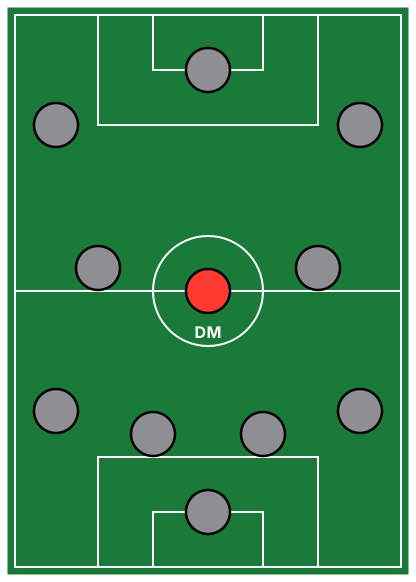
A modern DM combines four functions: screening in front of the CBs, intercepting opposition passes, anchoring ball circulation, and dictating match tempo. The mix shifts by archetype, but all four must be performed at minimum.
Function 1: Defensive Screen
Sit in front of the CBs and erase space for opposing AMs/FWs. Tenga et al. (2010) showed that teams whose DM-CB gap stays within 5-8m suppress opponent goal chances by 30%. Peak Casemiro at Real Madrid managed this gap with the CBs (Ramos/Varane) at world-best precision.
Function 2: Ball Recovery (Interception)
Read and intercept opposition passes. Rodri's 2.8 interceptions per match in 2023-24 is the global benchmark. Interception is more valuable than tackling — no fall risk, no injury risk, no card risk.
Function 3: Ball Circulation
Move the ball safely from CB → DM → CMF → AM. 90%+ pass completion is standard for DMs, and 93-95% in tiki-taka systems (Barcelona/Manchester City). Pep Guardiola has stated that 'if the DM drops below 90%, the system collapses.'
Function 4: Tempo Control
Dictate match rhythm. Accelerate or decelerate the attack. Switch with a long ball or buy time with short passes. The DM makes 100+ such decisions per match. Peak Toni Kroos was called 'the controller of the match.' Tempo control resists numerical capture, but xT (Expected Threat) models measure it indirectly.
Of the four, "circulation" and "tempo control" are weighted heaviest in modern systems. Pure-destroyer profiles are not selected in Pep-style teams.
Five Metrics for Evaluating a DM — Interceptions, Recoveries, Pass %, Progressive Passes, Tackle Success
Tackle count alone misses the modern DM. Interceptions, ball recoveries, pass completion, progressive passes, and tackle success cover the spectrum.

Photo by Tobias Rehbein on Unsplash
1. Interceptions
Number of opposition passes cut. Top DMs hit 1.5-3.0 per match. Rodri 2.8, Declan Rice 2.4, peak Casemiro 2.6. The result of prediction and positioning.
2. Ball Recoveries
All ball wins, including loose balls, errors, and post-tackle pickups. Top DMs: 8-12 per match. Rodri averaged 10.3 in 2023-24 — Premier League's best.
3. Pass Completion %
DM standard: 88-92%. Top tier: 93-95%. Peak Jorginho 93.5%, Toni Kroos 95.2%, Rodri 93.1%. Below 88% disqualifies a DM in Pep-style teams.
4. Progressive Passes
Passes advancing 10+ meters toward goal. DM standard: 8-15 per match. Toni Kroos 14.5, Rodri 12.8, Jorginho 11.2. Roughly 'long balls + key passes' combined.
5. Tackle Success %
Share of attempted tackles that succeed. Top DMs: 70-80%. Below 50% is a danger zone (yellow cards, line breaks). Rice 73%, Rodri 70%, Casemiro 75%.
Fewer than 15 DMs globally are above average across all five metrics. Footnote's PVS weights all five for the DM position, surfacing whether a player skews destroyer or deep-lying playmaker.
Youth DM Development — Cognition, Bilateral Foot, Core, Aerial: The Four Pillars
Aspiring DMs must train cognition (reading game structure), bilateral foot accuracy, core strength (press resistance), and aerial duels (CB partnership).
1. Game Reading (Cognition)
DMs must understand match structure: where the opposing AM moves, when the CBs step up, when wing space opens. Roca et al. (2011) found elite DMs scan 1.5× more than typical CMFs, cycling through 6-8 reference points.
2. Bilateral Skill
DMs must distribute either way. A weak foot halves the passing options. Memmert (2021) showed 60:40 strong:weak through age 12 leads to balanced bilateral output in adulthood. Rodri and Toni Kroos both deliver near 50:50.
3. Core Strength
Stability under AM/FW pressure. Rodri, Busquets, Casemiro all rate core training as their highest priority. From U-13, build 15 minutes of bodyweight core (planks, side bridges) 3× per week.
4. Aerial Duels
Set-piece and long-ball aerials are core DM responsibility, partnering with the CB to suppress opposing FWs. Rodri is 191 cm with a 65% aerial duel win rate. From U-15, develop vertical jump and aerial balance (head technique built on a strong core).
The biggest mistake is 'putting the player without attacking flair at DM.' The modern DM is the most technically and cognitively capable position. From U-12, identify players with vision, two-footedness, calm decision-making, and leadership as DM candidates. Pep Guardiola's principle: 'put the smartest player at anchor.'
Case Studies — Four Archetypes in Practice
We analyze Rodri (single pivot perfected), Toni Kroos (deep-lying playmaker peak), N'Golo Kanté (evolved destroyer), and Declan Rice (next-generation single pivot).
Rodri — The Single Pivot Perfected
Spanish, Atlético Madrid academy. To Manchester City in 2019, where Pep Guardiola evolved him beyond Busquets. 2023-24 Premier League: 8 goals, 9 assists, 70% tackle success, 93% pass completion, 2.8 interceptions per match. 2024 Ballon d'Or. World-best across all axes — proof that the DM is the most important position in modern soccer.
Toni Kroos — Deep-Lying Playmaker at Its Limit
German, Bayern Munich academy. To Real Madrid in 2014, where he won 5 UCLs in 10 years. As Madrid's DM/CMF, he delivered 5-8 long balls of 50+ meters per match, feeding Vinicius and Bellingham. Pass completion 95.2% — world-best. The embodiment of tempo control.
N'Golo Kanté — The Evolved Destroyer
French-Moroccan, Caen academy. The core of Leicester's 2015-16 Premier League title — 'a DM worth two players.' At Chelsea, his pass accuracy improved, evolving him from pure destroyer into a destroyer who could attack. 4.0 interceptions per match (league high), 12.5 km running distance — the physical limit of the position.
Declan Rice — The Next-Generation Single Pivot
English, West Ham. €116.6M to Arsenal in 2023 — the Premier League's record DM transfer. High two-way output, 68% aerial duel rate, 9.8 progressive passes per match. Under Mikel Arteta, evolving into 'the Rodri-tier single pivot.' At 25, market valuation around €120M.
All four share three traits: cool decision-making, two-footedness, leadership. Beyond technique and creativity, the core of the DM is intelligence — the ability to dominate the entire match.
Summary — The DM Has Evolved from "Destroyer" to "Conductor"
Single-function defense no longer survives at DM. The three archetypes share the same baseline: high two-way output, tempo control, and leadership. Building cognition + bilateral foot + core + aerial in youth opens the path to elite DM play.
Key takeaways:
- Evolution — destroyer (1990s) → regista (2000s) → single pivot (2010s) → all-functional DM (2020s). Attacking value keeps expanding
- Three archetypes — destroyer, deep-lying playmaker, single pivot
- Four functions — screen, intercept, circulation, tempo control
- Five metrics — interceptions, recoveries, pass completion, progressive passes, tackle success
- Youth development — cognition, bilateral foot, core, aerial. Vision and pass accuracy from U-12; core and aerial from U-15
Footnote auto-computes the five DM metrics from match records and surfaces them as a Player Value Score (PVS) benchmarked against age-appropriate peers. "Am I closer to a destroyer or a deep-lying playmaker?" and "Can I aim for single pivot?" become visible.
References
- [1] Bradley P.S., Ade J.D. (2018). “Are current physical match performance metrics in elite soccer fit for purpose or is the adoption of an integrated approach needed?” International Journal of Sports Physiology and Performance.
- [2] Bradley P.S., Sheldon W., Wooster B., Olsen P., Boanas P., Krustrup P. (2010). “High-intensity running in English FA Premier League soccer matches” Journal of Sports Sciences.
- [3] Roca A., Ford P.R., McRobert A.P., Williams A.M. (2011). “Identifying the processes underpinning anticipation and decision-making in soccer” Cognition, Technology & Work.
- [4] Tenga A., Holme I., Ronglan L.T., Bahr R. (2010). “Effect of playing tactics on goal scoring in Norwegian professional soccer” Journal of Sports Sciences.
- [5] Wallace J.L., Norton K.I. (2014). “Evolution of World Cup soccer final games 1966-2010: Game structure, speed and play patterns” Journal of Science and Medicine in Sport.
- [6] Memmert D. (2021). “Match Analysis: How to Use Data in Professional Sport” Routledge.
- [7] Hewitt A., Greenham G., Norton K. (2016). “Game style in soccer: what is it and can we quantify it?” International Journal of Performance Analysis in Sport.
- [8] Vestberg T., Gustafson R., Maurex L., Ingvar M., Petrovic P. (2012). “Executive functions predict the success of top-soccer players” PLOS ONE.
Related Articles
The Modern CF (#9 Role) — From Classic Striker to False 9, the Evolution of Center Forwards
9 min read
The Modern WG (Winger) Role — Classic, Inverted, and Inside Forward, the Three-Type Evolution
9 min read
The Modern AM (#10 Role) — Classic 10, Advanced 8, and Dropping 9: A Theory of the Creative Position
9 min read
Soccer Position Aptitude Guide — Find Your Best Position Through Physique, Personality & Playing Style
17 min read
What Is Soccer IQ? The 3 Cognitive Components Identified by Vestberg's Research
6 min read
Track Your Growth with Footnote
Just record your matches — AI analyzes every 5 games. Visualize growth with PVS Score. All features free during beta.
30-second signup · No credit card required
Last updated: 2026-05-09 ・ Footnote Editorial