The Modern CB (#4 Role) — Classic Stopper, Ball-Playing CB, and the Modern Libero Revival
The CB (Center Back, #4) has transformed from the classic stopper embodied by Cannavaro, Maldini, and Nesta into the ball-playing CB represented by Virgil van Dijk and John Stones. The 2020s have brought a libero revival — Antonio Rüdiger and Marquinhos pushing forward into central zones. Bradley & Ade (2018)'s Premier League analysis shows top CBs averaging 70-90 match touches with 90%+ pass completion, anchoring build-up. The modern CB benchmark: 65%+ aerial duel rate and 8-12 progressive passes per match. This article defines three archetypes (stopper, ball-playing, modern libero), maps four functions (marking, aerial, build-up, leadership), explains five metrics, and outlines youth development priorities.
Evolution of the CB — 30 Years from Stopper to Libero
The 1990s CB was the Maldini/Cannavaro/Nesta stopper. The 2010s saw Pep redefine the CB as a ball-playing builder. The 2020s have brought the libero revival — Rüdiger and Marquinhos at the world's top. The CB has gone from 'wall' to 'conductor' in 30 years.

Photo by Kenny Webster on Unsplash
1990s — The Classic Stopper Era (Maldini / Cannavaro / Nesta)
Paolo Maldini, Fabio Cannavaro, and Alessandro Nesta defined the Italian CB. Defense first, attack via simple passes only. Aerials, 1v1, and line management were the three core functions; build-up participation was minimal. Cannavaro's 2006 Ballon d'Or symbolized the classic stopper at its peak.
2000s — Carles Puyol / Rio Ferdinand — The Transition
Carles Puyol (Barcelona) and Rio Ferdinand (Manchester United) maintained the stopper template while raising ball quality. Ferdinand under Sir Alex Ferguson became 'the CB who delivers long balls,' bridging into the build-up era to come.
2010s — The Ball-Playing CB (van Dijk / Stones / Laporte)
Pep Guardiola at Manchester City established "the CB as the build-up origin." John Stones and Aymeric Laporte exhibited CMF-grade pass quality from CB. Liverpool's Virgil van Dijk paired defensive stability with long-ball precision; central to the 2018-19 UCL win and runner-up to Messi for the 2019 Ballon d'Or — extraordinary recognition for a CB.
2020s — The Libero Revival (Rüdiger / Marquinhos / Beraldo)
Antonio Rüdiger (Real Madrid), Marquinhos (PSG), and Lucas Beraldo (PSG) define the 2020s CB: defensive stability + build-up precision + occasional penetrations beyond the box. Rüdiger received MVP-level recognition at the 2023-24 UCL final for both decisive defensive interventions and box-edge offensive contributions.
The CB has transformed from "defensive wall" into "build-up engine + defensive leader + match conductor." Pure stoppers in 2025 are a minority profile, and the role keeps expanding as inverted fullbacks (FBs entering the midfield) push more responsibility onto the CB.
Three Archetypes — Stopper, Ball-Playing, Modern Libero
Modern CBs split into three archetypes by attack/defense balance and movement: stopper (defense-heavy), ball-playing (fused), modern libero (attacking participation).
1. Stopper
- Placement — CB in 4-4-2 / 4-2-3-1 / 5-3-2
- Movement — stays around the box, suppresses opposing FWs
- Required skills — aerials, 1v1, line management, tactical reading
- Examples — Pepe (Porto), peak Diego Godín, certain Atlético Madrid CBs
- Profile — defense-specialized, simple distribution
2. Ball-Playing CB
- Placement — CB in 4-3-3 / 3-4-3
- Movement — covers from the box back to mid-pitch, joins build-up
- Required skills — long passing, progressive passing, CMF-grade ball control, aerials
- Examples — Virgil van Dijk (Liverpool), John Stones (Manchester City), William Saliba (Arsenal)
- Profile — elite at both ends, build-up origin
3. Modern Libero
- Placement — central CB in a back three, or one side of a back four
- Movement — advances from the box, occasionally beyond the penalty area
- Required skills — dribbling, long shots, aerials, leadership
- Examples — Antonio Rüdiger (Real Madrid), Marquinhos (PSG), Achraf Hakimi (when deployed at CB)
- Profile — defense + build-up + attacking participation in one player
Ball-playing CB market value has soared. van Dijk's €84.65M move (then-record CB transfer) and Saliba's €80M+ valuation symbolize the CB's reframing as a core team asset.
Four Functions — Marking / Aerials / Build-Up / Leadership
A modern CB combines four functions: marking opposing FWs, dominating aerials, anchoring attacking build-up, and leading the back line. Mix shifts by archetype, but all four must be performed at minimum.
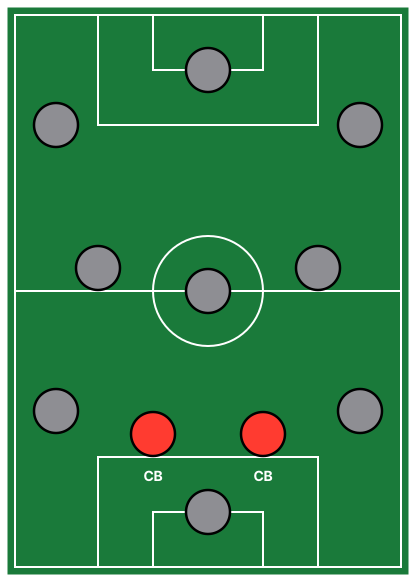
Function 1: Marking
Suppress opposing FWs in 1v1 situations. Positioning, movement prediction, and body insertion are the three building blocks. Top Premier League CBs hit 70-80% in 1v1s. van Dijk's 76% in 2018-19 UCL-winning season was league-best.
Function 2: Aerial Duels
Dominate set pieces, long balls, and crosses. CB standard is 5-10 aerials per match at 60-70% win rate. Rüdiger 73%, Saliba 72%, peak van Dijk 78%. Below 60% is below CB-survival threshold.
Function 3: Build-Up
Receive from GK, distribute to CMFs and FBs. Ball-playing CB pass completion: 90-95%, progressive passes: 8-12 per match. John Stones posted 95.1% pass completion in 2023-24 — CMF-grade.
Function 4: Leadership
Command the back line, unify the offside line, coordinate with FBs. The CB is the loudest voice in defense. van Dijk, Marquinhos, Sergio Ramos — all archetypal captain CBs. Hard to quantify, but it shows up directly in goals conceded.
Of the four, build-up is the function rising fastest in evaluation weight. Even stoppers must hit 85%+ pass completion as a minimum; pure-defense specialists are not selected in Pep-style teams.
Five Metrics for Evaluating a CB — Aerial %, 1v1 %, Pass Completion, Progressive Passes, Blocks
Clean sheets alone miss the modern CB. Aerial win rate, 1v1 win rate, pass completion, progressive passes, and blocks together cover the spectrum.

Photo by Dan Roizer on Unsplash
1. Aerial Duel Win %
Share of contested headers won. CB standard: 60-70%. Top tier: 70-80%. Rüdiger 73%, peak van Dijk 78%, Saliba 72%. Below 50% is fatal at CB.
2. 1v1 Win %
Share of 1v1 defensive engagements won (defender keeps the FW from beating them or shooting). CB standard: 65-75%. van Dijk 76%, Ruben Dias 74%, Saliba 73% — league-best tier.
3. Pass Completion %
CB standard: 85-92%. Ball-playing CB: 92-95%. Stones 95.1%, Laporte 94.3%, Rüdiger 92.5%. Below 90% disqualifies in Pep-style teams.
4. Progressive Passes
Passes advancing 10+ meters toward goal. CB standard: 5-10 per match. Ball-playing CB: 10-15. Saliba 11.2, van Dijk 9.8, Stones 10.5. CMF-comparable level.
5. Blocks
Number of opponent shots/passes physically blocked. CB standard: 2-5 per match. Marquinhos 4.2, Rüdiger 3.8, Dias 3.5. The willingness to throw the body in front matters as much as the tackle.
About 20 CBs globally are above average across all five metrics simultaneously. Footnote's PVS weights all five for the CB position, surfacing whether a player skews stopper, ball-playing, or libero-modern.
Youth CB Development — Aerial, Bilateral Foot, Cognition, Sprint: The Four Pillars
Aspiring CBs must train aerial dominance (height + jump + technique), bilateral foot accuracy, cognition (predicting opponent movement), and sprint capacity (recovering against runs in behind).
1. Aerial Strength
185 cm+ is preferred. Beyond height, vertical jump (60+ cm), aerial balance (core stability), and heading technique (striking the ball with the centerline) are needed. van Dijk (193), Rüdiger (190), Saliba (192) lead the elite. From U-15, train jump and aerial balance deliberately.
2. Bilateral Skill
CBs must distribute to either FB. A weak foot lets opposing FWs read passing lanes. Memmert (2021) showed that 60:40 strong:weak through age 12 leads to balanced bilateral output in adulthood. Saliba and Stones deliver close to 50:50.
3. Game Reading (Cognition)
Predict opposing FW movement. As the back-line anchor, the CB needs full-pitch awareness and pattern recognition. Roca et al. (2011) found elite CBs scan 1.4× more than typical CBs. From U-12, build the habit of 'predicting one move ahead of the FW.'
4. Sprint Recovery
Sprint to recover against runs in behind. CB max-speed standard: 32-34 km/h. van Dijk 33.5, Saliba 34.2, Rüdiger 33.8. From U-15, develop acceleration (10m sprint). Rumpf et al. (2016) showed that age 12-15 max-speed training is the strongest predictor of adult max speed.
The biggest mistake is 'evaluating CBs only on physical traits.' The modern CB is a complete position requiring technique, cognition, and leadership. From U-12, identify CB candidates by vision, two-footedness, and calm decision-making — not just height and jump.
Case Studies — Four Archetypes in Practice
We analyze Virgil van Dijk (ball-playing CB perfected), William Saliba (next-generation), Antonio Rüdiger (modern libero), and Marquinhos (leader CB).
Virgil van Dijk — The Ball-Playing CB Perfected
Dutch, from Groningen via Celtic and Southampton, then to Liverpool in 2018 (€84.65M, then-record CB transfer). Under Klopp, fused defensive stability with long-ball quality, central to the 2018-19 UCL win. 2019 Ballon d'Or runner-up (behind Messi) — extraordinary for a CB. Aerial 78%, 1v1 76%, pass completion 90.2% at his peak.
William Saliba — The Next-Generation Symbol
French, from Saint-Étienne, to Arsenal in 2019. Returned from loan to anchor Arsenal in 2022-23, blossoming under Arteta as 'a young CB at world-best level on both sides of the ball.' Aerial 72%, 11.2 progressive passes per match. €80M+ valuation at 24. Widely seen as van Dijk's heir.
Antonio Rüdiger — The Modern Libero
German, from Stuttgart via Roma and Chelsea, then Real Madrid in 2022. Under Ancelotti, evolved into 'the CB who attacks,' earning MVP-level recognition at the 2023-24 UCL final for decisive defensive interventions and edge-of-box offensive contributions. Aerial 73%, 3.8 blocks per match, libero-style penetrations 2-3 times per month.
Marquinhos — The Leader CB
Brazilian, from Corinthians via Roma to PSG in 2013. Captained PSG for over 10 years. Aerial 70%, 4.2 blocks per match (league-leading), pass completion 92.0%. Evaluated more on leadership and defensive command than attacking output — the other ideal of the modern CB.
All four share three traits: cool decision-making, two-footedness, leadership. Beyond physical attributes, the core of the modern CB is intelligence — the ability to dominate the entire match.
Summary — The CB Has Evolved from "Wall" to "Conductor"
Single-function defense no longer survives at CB. The three archetypes share the same baseline: high two-way output, build-up participation, and leadership. Building aerial + bilateral foot + cognition + sprint in youth opens the path to elite CB play.
Key takeaways:
- Evolution — stopper (1990s) → transition (2000s) → ball-playing (2010s) → modern libero (2020s). Attacking role keeps expanding
- Three archetypes — stopper, ball-playing, modern libero
- Four functions — marking, aerial, build-up, leadership
- Five metrics — aerial %, 1v1 %, pass completion, progressive passes, blocks
- Youth development — aerial, bilateral foot, cognition, sprint. Weak foot and pass accuracy from U-12; aerial and sprint from U-15
Footnote auto-computes the five CB metrics from match records and surfaces them as a Player Value Score (PVS) benchmarked against age-appropriate peers. "Am I closer to a stopper, ball-playing CB, or modern libero?" becomes visible.
References
- [1] Bradley P.S., Ade J.D. (2018). “Are current physical match performance metrics in elite soccer fit for purpose or is the adoption of an integrated approach needed?” International Journal of Sports Physiology and Performance.
- [2] Bradley P.S., Sheldon W., Wooster B., Olsen P., Boanas P., Krustrup P. (2010). “High-intensity running in English FA Premier League soccer matches” Journal of Sports Sciences.
- [3] Roca A., Ford P.R., McRobert A.P., Williams A.M. (2011). “Identifying the processes underpinning anticipation and decision-making in soccer” Cognition, Technology & Work.
- [4] Tenga A., Holme I., Ronglan L.T., Bahr R. (2010). “Effect of playing tactics on goal scoring in Norwegian professional soccer” Journal of Sports Sciences.
- [5] Wallace J.L., Norton K.I. (2014). “Evolution of World Cup soccer final games 1966-2010: Game structure, speed and play patterns” Journal of Science and Medicine in Sport.
- [6] Memmert D. (2021). “Match Analysis: How to Use Data in Professional Sport” Routledge.
- [7] Rumpf M.C., Lockie R.G., Cronin J.B., Jalilvand F. (2016). “Effect of different sprint training methods on sprint performance over various distances: A brief review” Journal of Strength and Conditioning Research.
- [8] Hewitt A., Greenham G., Norton K. (2016). “Game style in soccer: what is it and can we quantify it?” International Journal of Performance Analysis in Sport.
Related Articles
The Modern DM (#6 Role) — Destroyer, Deep-Lying Playmaker, and Single Pivot: Defensive Midfielder Evolution
9 min read
The Modern CF (#9 Role) — From Classic Striker to False 9, the Evolution of Center Forwards
9 min read
The Modern WG (Winger) Role — Classic, Inverted, and Inside Forward, the Three-Type Evolution
9 min read
Soccer Position Aptitude Guide — Find Your Best Position Through Physique, Personality & Playing Style
17 min read
What Is Soccer IQ? The 3 Cognitive Components Identified by Vestberg's Research
6 min read
Track Your Growth with Footnote
Just record your matches — AI analyzes every 5 games. Visualize growth with PVS Score. All features free during beta.
30-second signup · No credit card required
Last updated: 2026-05-09 ・ Footnote Editorial