The Modern GK (#1 Role) — Shot-Stopper, Sweeper-Keeper, and Ball-Playing Keeper: Goalkeeper Evolution
The GK (Goalkeeper, #1) has evolved from the pure shot-stopper embodied by Lev Yashin, Peter Schmeichel, and Gianluigi Buffon into the sweeper-keeper revolutionized by Manuel Neuer at Bayern Munich and Germany, and now into the ball-playing keeper represented by Ederson and Alisson. Sentas et al. (2018) shows the modern top GK posts 80-90% pass completion, with touch counts approaching CB levels. Pep Guardiola established 'the GK is the build-up origin' as tactical doctrine; Ederson now distributes 35+ passes per match — CMF-comparable. This article defines three archetypes (shot-stopper, sweeper-keeper, ball-playing keeper), maps four functions (shot-stopping, sweeper actions, build-up, defensive leadership), explains five metrics, and outlines youth development priorities.
Evolution of the GK — 70 Years from Shot-Stopper to Ball-Playing Keeper
Since Lev Yashin (the "Black Spider") in the 1950s, the GK was "the last line on the goal line." The 2010s saw Manuel Neuer revolutionize the role as a sweeper-keeper. The 2020s have brought Ederson and Alisson — ball-playing keepers performing CMF-grade build-up. The GK has gone from "shot-stopper" to "build-up origin."

Photo by Vidar Nordli-Mathisen on Unsplash
1950s-1990s — Shot-Stopper Era (Yashin / Banks / Schmeichel)
Lev Yashin (Soviet, 1963 Ballon d'Or — the only GK winner ever), Gordon Banks (England, the legendary save vs Pelé in 1970), and Peter Schmeichel (Denmark, Manchester United legend) define the pure shot-stopper. Goal-line defense, aerials, and PK saves were the core functions. Build-up participation was virtually nil; distribution meant long kicks.
2000s — Buffon / Casillas — The Transition
Gianluigi Buffon (Juventus) and Iker Casillas (Real Madrid) maintained the shot-stopper template while raising foot-skill quality. Casillas, central to Spain's 2010 World Cup win, was rated 'the proto-modern GK' for his composed ball control. Touch counts of 25-30 per match — half of today's modern GK (40-50).
2010s — The Manuel Neuer Revolution
Manuel Neuer joined Bayern Munich from Schalke 04 in 2011 and, under Pep Guardiola, made the 'sweeper-keeper' a global concept: actions outside the penalty area, high-line management with the CBs, accurate distribution. As the core of Germany's 2014 World Cup victory, he completely rewrote the GK ideal.
2020s — Ederson / Alisson — The Ball-Playing Keeper Era
Ederson (Manchester City) and Alisson (Liverpool) inherited Neuer's legacy and pushed foot-skill to its limit. Ederson posted 88% pass completion and 60% long-pass accuracy in 2023-24 — CMF-grade. Alisson combined high-line management with build-up technique to anchor Liverpool's 2018-19 UCL win.
Modern top clubs do not select GKs only on shot-stopping. Pep Guardiola has stated, 'A GK who cannot participate in build-up with their feet is not selected at my club.' GK foot quality is now demanded at CMF level.
Three Archetypes — Shot-Stopper, Sweeper-Keeper, Ball-Playing Keeper
Modern GKs split into three archetypes by defensive position and foot quality: shot-stopper (defense-focused), sweeper-keeper (high-line defense), ball-playing keeper (attacking participation).
1. Shot-Stopper
- Placement — goal-line centered, defends inside the penalty area
- Movement — almost no actions outside the box
- Required skills — shot reaction, aerials, PK saves, line management
- Examples — Thibaut Courtois (Real Madrid), peak David de Gea (Manchester United), Gianluigi Donnarumma
- Profile — defense-specialized, baseline foot quality
2. Sweeper-Keeper
- Placement — sweeps outside the penalty area, manages the high line with the CBs
- Movement — advances 25-30m to match the high line, clears outside the box when needed
- Required skills — running, decision-making, two-footed ball control, aerials
- Examples — peak Manuel Neuer (Bayern), Marc-André ter Stegen (Barcelona), Mike Maignan (Milan)
- Profile — broad defensive coverage; supports the high line
3. Ball-Playing Keeper
- Placement — goal line + build-up origin
- Movement — limited PA-exit actions, but maximum build-up participation
- Required skills — 85%+ pass completion, long-pass accuracy, two-footed ball control, cognition
- Examples — Ederson (Manchester City), Alisson (Liverpool), Yann Sommer
- Profile — GK with CMF-grade build-up accuracy
The three archetypes are not fixed. Modern top GKs are typically "sweeper-keeper + ball-playing keeper" hybrids — Ederson, ter Stegen, Maignan all combine both functions. Pure shot-stoppers are not selected in Pep-style teams.
Four Functions — Shot-Stopping / Sweeper Actions / Build-Up / Leadership
A modern GK combines four functions: foundational shot-stopping, sweeper actions outside the penalty area, build-up participation, and back-line leadership. Mix shifts by archetype, but all four must be performed at minimum.
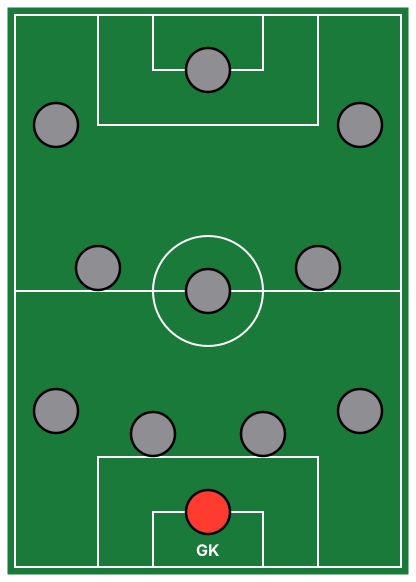
Function 1: Shot-Stopping
The GK's foundational function. Sentas et al. (2018) shows top Champions League GKs at 70-80% Save% and +3 to +8 Goals Saved Above Expected (GSAA). Courtois posted 9 saves and GSAA +2.5 in the 2021-22 UCL final vs Liverpool, becoming the first GK to win the final's MVP since 1989.
Function 2: Sweeper Actions
Advance outside the penalty area to clear opposition long balls. Peak Neuer averaged 5-8 PA-exit actions per match — league-leading. The benchmark is 'clearance/intervention 30+ meters from goal' — essential for high-line tactics.
Function 3: Build-Up Distribution
Initiate build-up from the GK. Pep-style teams require 85%+ GK pass completion. Ederson 88%, ter Stegen 87%, Alisson 86%, Maignan 84%. Long-pass accuracy (30m+) also matters: Ederson 60% — league-leading.
Function 4: Defensive Leadership
Command the back line, unify the offside line, organize CK/FK setups. With full-pitch view from the back, the GK is positioned to lead. Schmeichel, Buffon, and van der Sar were archetypal captain GKs. Hard to quantify, but it shows up directly in goals conceded.
Of the four, build-up is rising fastest in evaluation weight. Shot-stopping alone disqualifies a GK in Pep-style teams: 'a GK who cannot build with their feet' is not selected.
Five Metrics for Evaluating a GK — Save%, GSAA, Sweeper Actions, Pass Completion, Catch %
Goals conceded alone misses the modern GK. Save%, GSAA (Goals Saved Above Expected), sweeper actions, pass completion, and high-ball catch rate cover the spectrum.

Photo on Unsplash
1. Save% (Save Percentage)
Share of shots saved. GK standard: 70-78%. Top tier: 78-85%. Courtois 2023-24: 79%, Donnarumma: 78%, Alisson: 77%. Below 70% is below survival threshold.
2. GSAA (Goals Saved Above Expected)
Difference between Post-Shot xG predicted goals conceded and actual goals conceded. Larger positive = stopping shots above expectation. Top GKs: +5 or higher per season. Courtois 2023-24: +8.5, Mike Maignan: +6.2, Alisson: +5.8.
3. Defensive Actions Outside Penalty Area
Defensive actions outside the box (long-ball clearances, FW challenges). High-line teams: 1-3 per match standard. High-tier sweeper-keepers: 3-6. ter Stegen 4.5, Maignan 4.2, peak Neuer 5.8.
4. Pass Completion %
GK standard: 70-80%. Ball-playing keeper tier: 85-92%. Ederson 88%, ter Stegen 87%, Alisson 86%. Below 85% disqualifies in Pep-style teams.
5. High Ball Catch %
Share of high balls (crosses, CKs) caught (not punched). GK standard: 60-75%. Maignan 78%, ter Stegen 72%, Onana 68%. The result of physical strike zone and decision speed.
Roughly 10 GKs globally are above average across all five metrics. Footnote's PVS weights all five for the GK position, surfacing whether a player skews shot-stopper, sweeper-keeper, or ball-playing keeper.
Youth GK Development — Reaction, Bilateral Foot, Cognition, Aerial: The Four Pillars
Aspiring GKs must train shot reaction (foundational), bilateral foot accuracy (essential for build-up), cognition (reading match structure), and aerial strength (cross handling).
1. Shot Reaction
The GK's foundational function. Reilly et al. (2000) showed elite GK shot reaction times of 0.18-0.22 seconds — 30% faster than typical GKs. From U-12, train cognitive reaction sequences ('predict the shot → set position → react to ball') to lock in adult reaction speed.
2. Bilateral Skill
The modern GK must distribute with both feet. A weak foot stalls build-up under pressure. Memmert (2021) showed that 60:40 strong:weak through age 12 leads to balanced bilateral output. Ederson distributes near-equally with both feet — central to Pep's tactics.
3. Game Reading (Cognition)
As back-line anchor, the GK reads the entire pitch and decodes opposing attack patterns. Roca et al. (2011) showed elite GKs scan 1.5× more than typical GKs. From U-13, build the habit of scanning three reference points (inside, outside, behind) before receiving.
4. Aerial Strength
Set-piece and cross aerials are essential. 188+ cm preferred (Courtois 200, Donnarumma 196, Maignan 191, Alisson 191). From U-15, develop vertical jump and aerial balance (core-stable body posture in the air).
The most overlooked youth GK priorities are foot quality and cognition. Many parents and coaches still believe "GKs only stop shots," but in modern soccer foot skill and cognition are the GK's primary tools. Build bilateral foot from U-12, aerial and decision speed from U-15, build-up integration from U-18.
Case Studies — Four Archetypes in Practice
We analyze Manuel Neuer (sweeper-keeper revolutionary), Ederson (ball-playing keeper perfected), Thibaut Courtois (evolved shot-stopper), and Mike Maignan (next-generation hybrid).
Manuel Neuer — The Sweeper-Keeper Revolutionary
German, Schalke 04 academy, then Bayern Munich in 2011. Under Pep Guardiola, made 'the GK who acts outside the penalty area' a global concept. As the core of Germany's 2014 World Cup victory, he posted a combined 8 PA-exit actions in the Argentina and Brazil knockout games. Lothar Matthäus said: 'The GK world is divided into before and after Neuer.'
Ederson — The Ball-Playing Keeper Perfected
Brazilian, via Benfica (Portugal), then Manchester City in 2017. Under Pep, became 'the GK with the highest foot-skill in history.' 88% pass completion and 60% long-pass accuracy in 2023-24 — league-best. The joke that 'Ederson plays through-balls 50m from DMF' is barely a joke — his build-up output is CMF-comparable.
Thibaut Courtois — Evolved Shot-Stopper
Belgian, Genk academy, via Atlético Madrid and Chelsea, then Real Madrid in 2018. Limited sweeper-keeper role, but world-best shot-stopping leveraging 200 cm height. 9 saves and GSAA +2.5 in the 2021-22 UCL final vs Liverpool — first GK to win the final's MVP since 1989. Proof that a shot-stopper can still be the world's best.
Mike Maignan — The Next-Generation GK
French international, PSG academy, via Lille, then AC Milan in 2021. Sweeper-keeper + ball-playing keeper hybrid. Anchored Milan's 2021-22 Serie A title with GSAA +6.2, 4.2 sweeper actions per match, 84% pass completion. As Lloris's France successor, the embodiment of the modern GK ideal.
All four share three traits: bilateral foot accuracy, calm decision-making, and leadership. Beyond physical tools, tactical understanding and cognition are the core of the modern GK.
Summary — The GK Has Evolved from "Last Line" to "Build-Up Origin"
Single-function shot-stopping no longer survives at GK. The three archetypes share the same baseline: bilateral foot accuracy, calm decision-making, and leadership. Building reaction + bilateral foot + cognition + aerial in youth opens the path to elite GK play.
Key takeaways:
- Evolution — shot-stopper (1950-90s) → transition (2000s) → sweeper-keeper (2010s) → ball-playing keeper (2020s). Role expanded into attacking origin
- Three archetypes — shot-stopper, sweeper-keeper, ball-playing keeper
- Four functions — shot-stopping, sweeper actions, build-up, leadership
- Five metrics — Save%, GSAA, sweeper actions, pass completion, catch %
- Youth development — reaction, bilateral foot, cognition, aerial. Bilateral foot from U-12, aerial from U-15, build-up integration from U-18
Footnote auto-computes the five GK metrics from match records and surfaces them as a Player Value Score (PVS) benchmarked against age-appropriate peers. "Am I closer to a shot-stopper, sweeper-keeper, or ball-playing keeper?" becomes visible.
References
- [1] Sentas A.G., Stathis P., Patikas D.A., et al. (2018). “Goalkeeping in elite football: technical and tactical analysis” International Journal of Performance Analysis in Sport.
- [2] Reilly T., Bangsbo J., Franks A. (2000). “Anthropometric and physiological predispositions for elite soccer” Journal of Sports Sciences.
- [3] Bradley P.S., Sheldon W., Wooster B., Olsen P., Boanas P., Krustrup P. (2010). “High-intensity running in English FA Premier League soccer matches” Journal of Sports Sciences.
- [4] Roca A., Ford P.R., McRobert A.P., Williams A.M. (2011). “Identifying the processes underpinning anticipation and decision-making in soccer” Cognition, Technology & Work.
- [5] Memmert D. (2021). “Match Analysis: How to Use Data in Professional Sport” Routledge.
- [6] Wallace J.L., Norton K.I. (2014). “Evolution of World Cup soccer final games 1966-2010: Game structure, speed and play patterns” Journal of Science and Medicine in Sport.
- [7] Bradley P.S., Ade J.D. (2018). “Are current physical match performance metrics in elite soccer fit for purpose or is the adoption of an integrated approach needed?” International Journal of Sports Physiology and Performance.
- [8] Hewitt A., Greenham G., Norton K. (2016). “Game style in soccer: what is it and can we quantify it?” International Journal of Performance Analysis in Sport.
Related Articles
The Modern CB (#4 Role) — Classic Stopper, Ball-Playing CB, and the Modern Libero Revival
9 min read
The Modern DM (#6 Role) — Destroyer, Deep-Lying Playmaker, and Single Pivot: Defensive Midfielder Evolution
9 min read
The Modern SB (#2/#3 Role) — Classic Full-Back, Attacking Wing-Back, and Inverted Full-Back: Side-Back Evolution
9 min read
Soccer Position Aptitude Guide — Find Your Best Position Through Physique, Personality & Playing Style
17 min read
What Is Soccer IQ? The 3 Cognitive Components Identified by Vestberg's Research
6 min read
Track Your Growth with Footnote
Just record your matches — AI analyzes every 5 games. Visualize growth with PVS Score. All features free during beta.
30-second signup · No credit card required
Last updated: 2026-05-09 ・ Footnote Editorial