Box-to-Box Midfielder Role — All-Round CMF Complete Guide and Modern Evolution
The Box-to-Box (B2B) midfielder covers the full pitch from one penalty area to the other across 90 minutes — the all-round CMF. The role has evolved from the power-archetype Yaya Touré, Steven Gerrard, and Patrick Vieira to the modern Jude Bellingham, Aurélien Tchouaméni, and Federico Valverde. Bradley et al. (2009)'s Premier League analysis shows the B2B covers 12.5 km with 60+ sprints — the highest workload of any midfielder. Defensively the B2B suppresses opposing AMs in front of the DM; offensively the B2B penetrates into the box for finishing — 'two players' worth of work.' This article defines three archetypes (power, technical, defensive), maps four functions (coverage, transition, build-up support, box arrival), explains five metrics, and outlines youth development priorities.
Evolution of the B2B — From Power to Modern All-Round
The 1990s B2B was Vieira/Gerrard — physical-archetype. The 2000s saw Yaya Touré establish 'the B2B who attacks.' The 2010s saw Naby Keïta and Paul Pogba bring technical-type B2B. The 2020s Bellingham/Valverde represent the all-round B2B at world-best level on every axis.

Photo by Dominik Hofbauer on Unsplash
1990s — Power-Archetype B2B (Vieira / Keane / Davids)
Patrick Vieira (Arsenal), Roy Keane (Manchester United), and Edgar Davids (Juventus) defined the 1990s B2B: the physical archetype. Total distance 11.5 km, aerial duel rate 60%, 4-5 tackles per match — 'the warriors of the midfield.' Attacking participation was limited; the weapon was un-knockable ball retention and long running.
2000s — Steven Gerrard / Yaya Touré Era
Steven Gerrard (Liverpool) and Yaya Touré (Manchester City) made 'the B2B who attacks' a global concept. Gerrard scored Liverpool's comeback assist in the 2004-05 UCL final; Yaya Touré scored 20 goals in Manchester City's 2013-14 league win. They established 'the CMF who arrives in the box.'
2010s — Technical B2B (Naby Keïta / Arturo Vidal / Paul Pogba)
Naby Keïta, Arturo Vidal, and Paul Pogba combined physicality with refined ball control and decision speed as technical B2Bs. Pogba played 'complete CMF' at Manchester United and anchored France's 2018 World Cup victory.
2020s — Bellingham / Valverde / Tchouaméni — Modern All-Round
Jude Bellingham (Real Madrid), Federico Valverde (Real Madrid), and Aurélien Tchouaméni (Real Madrid) define the 2020s B2B with world-best output on defense, attack, and running. Bellingham 2023-24 La Liga: 19 goals, 6 assists, 65% tackle success. Valverde: 65 sprints/match, 9.5 progressive passes. 'The world's strongest B2Bs are concentrated at Real Madrid.'
The modern B2B cannot survive on physicality alone. Defense, attack, running, technique, and cognition all must be elite. Real Madrid's three-man midfield (Bellingham, Valverde, Tchouaméni) all carry B2B baseline functions while specializing toward AM-leaning, WG-leaning, and DM-leaning balances.
Three Archetypes — Power, Technical, Defensive
Modern B2Bs split into three archetypes by attack/defense balance and movement: power (physical-heavy), technical (ball-control heavy), defensive (defense-heavy).
1. Power B2B
- Placement — left/right IH in 4-3-3 or attacking pivot in 4-2-3-1
- Movement — runs box-to-box on linear vertical lines
- Required skills — sprint, aerial, physicality, long shooting
- Examples — Federico Valverde (Real Madrid), Bruno Guimarães (Newcastle), Adrien Rabiot
- Profile — sustains high-tempo for 90 minutes with stamina and explosive power
2. Technical B2B (Mezzala)
- Placement — mezzala (the modern IH), or left/right CMF in 3-5-2
- Movement — operates in the half-space, both for build-up and box arrival
- Required skills — ball control, vision, two-footedness, box penetration
- Examples — Jude Bellingham (Real Madrid), Aurélien Tchouaméni (Real Madrid), Pedri
- Profile — physicality + technique combined at world-best level
3. Defensive B2B
- Placement — defense-leaning IH in 4-3-3, or defensive pivot in 4-2-3-1
- Movement — man-marks opposing AMs in front of the DM, limited attacking participation
- Required skills — tackling, interception, tactical reading, running
- Examples — peak Casemiro (Real Madrid), Rodrigo Bentancur, Allan
- Profile — channels B2B stamina into defense
The three archetypes are not fixed. Modern top B2Bs are typically hybrids. Bellingham is technical + power; Valverde is power + technical elements. Real Madrid's midfield trio carries B2B baseline while specializing in different balances.
Four Functions — Coverage / Transition / Build-Up Support / Box Arrival
A modern B2B combines four functions: defensive coverage, transition running, build-up support, and box arrival. Mix shifts by archetype, but all four must be performed at minimum.
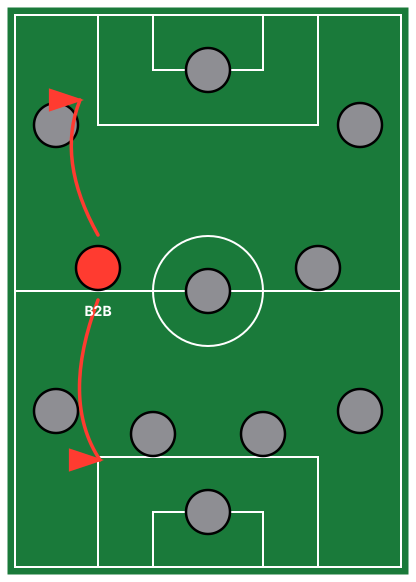
Function 1: Defensive Coverage
Man-mark opposing AMs/WGs in front of the DM, or cover the space behind the SB. Top B2Bs hit 3-5 tackles and 1.5-2.5 interceptions per match. Valverde's 4.2 tackles and Tchouaméni's 4.8 tackles per match are MF-best.
Function 2: Transition
Vertical running on transitions is the B2B's core. Reach the box within 5 seconds of recovery, or sprint back to the defensive third on losses. Bradley et al. (2009) shows B2Bs run 1.5-2.0 km in transition phases per match — the most of any midfielder.
Function 3: Build-Up Support
Receive from the DM/CB, distribute to WG/AM/FW. B2B pass completion: 85-90%. Progressive passes: 6-10 per match. Bellingham 9.2, Valverde 9.5, Tchouaméni 8.8. Sits between CMF and AM.
Function 4: Box Arrival
Run into the box for finishing. Of Bellingham's 19 goals in 2023-24, 13 were in the box, mostly from late runs. 'Entering the box without the ball at the right moment' is the timing skill that defines B2B finishing.
Box arrival is the function rising fastest in evaluation weight. Since Bellingham, the B2B evaluation now includes 'goals scored,' with 5-10 goals/season as standard and 10+ as world-best.
Five Metrics for Evaluating a B2B — Distance, Tackle Success, Progressive Passes, xG+xA, Sprints
Goal count alone misses the modern B2B. Total distance, tackle success, progressive passes, xG+xA, and sprint count cover the spectrum.

Photo by Salah Regouane on Unsplash
1. Total Distance
B2B standard: 11.5-13.0 km per match. Top tier: 12.5-13.5. Valverde 12.8, Bellingham 12.3, Tchouaméni 12.0, peak Casemiro 11.8. The physical core of the B2B.
2. Tackle Success %
Share of attempted tackles that succeed. B2B standard: 60-70%. Top tier: 70%+. Bellingham 65%, Tchouaméni 68%, Valverde 67%.
3. Progressive Passes
Passes advancing 10+ meters toward goal. B2B standard: 6-10 per match. Valverde 9.5, Bellingham 9.2, Tchouaméni 8.8. Between CMF and AM levels.
4. xG+xA (Combined Attacking Output)
Sum of expected goals and expected assists. B2B standard: 0.30-0.55 per 90. Top tier: 0.55-0.80. Bellingham 0.78 (B2B-best), Valverde 0.52, Tchouaméni 0.32.
5. Sprint Count (≥25 km/h)
High-speed runs. B2B standard: 50-70 per match. Top tier: 60-75. Valverde 65, Bellingham 60, Tchouaméni 58. Comparable to WG and SB workloads.
Roughly 15 B2Bs globally are above average across all five metrics. Footnote's PVS weights all five for the B2B position, surfacing whether a player skews power, technical, or defensive.
Youth B2B Development — Sprint, Core, Bilateral Foot, Cognition: The Four Pillars
Aspiring B2Bs must train sprint endurance (90-minute high-intensity), core strength (press resistance + aerial), bilateral foot accuracy, and cognition (instant transitional decision-making).
1. Sprint Endurance
B2Bs run 12-13 km and 60+ sprints per match. By U-15, develop both max speed (10m sprint) and middle-distance capacity (YoYo Test L19+). Rumpf et al. (2016) shows that age 12-15 max-speed training is the strongest predictor of adult max speed. Bompa's LTAD also identifies aerobic capacity peak development at 12-16.
2. Core Strength
The physical foundation for press resistance and aerials. The B2B must hold the ball under pressure from opposing AMs/DMs. From U-13, build 15 minutes of bodyweight core (planks, side bridges, hangs) 3× per week. Bellingham, Valverde, and Tchouaméni all rate core training as their highest priority.
3. Bilateral Skill
B2Bs must distribute either way. A weak foot halves the passing options. Memmert (2021) showed that 60:40 strong:weak through age 12 leads to balanced bilateral output. Bellingham shoots near-equally with both feet, which fuels his variety in box finishing.
4. Game Reading (Cognition)
Instant transitional decision-making is the B2B's core. Decide 'attack or defend' within 1 second of regaining the ball. Roca et al. (2011) showed elite B2Bs scan the entire pitch once per second, cyclically updating attack/defense state.
The biggest mistake is 'building physicality and neglecting technique and cognition.' The modern B2B is a complete position requiring technique, cognition, running, and physicality. From U-12, build weak-foot accuracy; from U-15, sprint and core; from U-18, deliberate transition decision-making.
Case Studies — Four Archetypes in Practice
We analyze Jude Bellingham (technical type perfected), Federico Valverde (modern power), Aurélien Tchouaméni (balanced), and Yaya Touré (legacy power).
Jude Bellingham — Technical-Type B2B Perfected
Birmingham City academy. To Borussia Dortmund at 17, then Real Madrid at 20 for €103M. La Liga 2023-24: 19 goals, 6 assists, 65% tackle success — B2B-historical best. World-best on defense, attack, and running. Annual Ballon d'Or candidate. Combines AM-style attacking with B2B-style defending — the next-generation profile.
Federico Valverde — Modern Power B2B
Uruguayan international, Peñarol academy, then Real Madrid in 2017. 185 cm power-type B2B. Anchored Madrid's 2021-22 UCL win under Carlo Ancelotti. 65 sprints/match, 9.5 progressive passes per match, 65% aerial win rate — world-best. Real Madrid's right CMF, called 'the locomotive' for two-way work rate.
Aurélien Tchouaméni — Balanced B2B
French international, AS Monaco, then Real Madrid in 2022 for €100M. Defense-leaning balanced B2B, designated as Casemiro's heir. 68% tackle success, 2.4 interceptions per match, 8.8 progressive passes per match. Stands out for the defense-attack balance — 'the next Casemiro.'
Yaya Touré — The Legacy Power B2B
Ivorian international, from the Beveren academy, via Barcelona to Manchester City. 191 cm and elite running redefined the power B2B. 20 goals (including penalties) in Manchester City's 2013-14 league win — among the most ever for a CMF. Created 'the B2B who arrives in the box,' the original of the modern type.
All four share three traits: instant transitional decision-making, two-footedness, and physicality + technique. The 'physicality-only' B2B is over; all-round is now standard.
Summary — The B2B Has Evolved from "Midfield Warrior" to "All-Round Best Midfielder"
Single-function B2B play no longer survives. The three archetypes share the same baseline: high two-way output, 90-minute high-intensity running, and bilateral foot accuracy. Building sprint + core + bilateral foot + cognition in youth opens the path to elite B2B play.
Key takeaways:
- Evolution — power (1990s) → transition (2000s) → technical (2010s) → all-round (2020s). Physicality alone no longer survives
- Three archetypes — power, technical, defensive
- Four functions — coverage, transition, build-up support, box arrival
- Five metrics — total distance, tackle success, progressive passes, xG+xA, sprint count
- Youth development — sprint, core, bilateral foot, cognition. Weak foot from U-12, sprint and core from U-15, decision speed from U-18
Footnote auto-computes the five B2B metrics from match records and surfaces them as a Player Value Score (PVS) benchmarked against age-appropriate peers. "Am I closer to power, technical, or defensive?" becomes visible.
References
- [1] Bradley P.S., Sheldon W., Wooster B., Olsen P., Boanas P., Krustrup P. (2010). “High-intensity running in English FA Premier League soccer matches” Journal of Sports Sciences.
- [2] Bradley P.S., Ade J.D. (2018). “Are current physical match performance metrics in elite soccer fit for purpose or is the adoption of an integrated approach needed?” International Journal of Sports Physiology and Performance.
- [3] Roca A., Ford P.R., McRobert A.P., Williams A.M. (2011). “Identifying the processes underpinning anticipation and decision-making in soccer” Cognition, Technology & Work.
- [4] Memmert D. (2021). “Match Analysis: How to Use Data in Professional Sport” Routledge.
- [5] Rumpf M.C., Lockie R.G., Cronin J.B., Jalilvand F. (2016). “Effect of different sprint training methods on sprint performance over various distances: A brief review” Journal of Strength and Conditioning Research.
- [6] Wallace J.L., Norton K.I. (2014). “Evolution of World Cup soccer final games 1966-2010: Game structure, speed and play patterns” Journal of Science and Medicine in Sport.
- [7] Tenga A., Holme I., Ronglan L.T., Bahr R. (2010). “Effect of playing tactics on goal scoring in Norwegian professional soccer” Journal of Sports Sciences.
- [8] Vestberg T., Gustafson R., Maurex L., Ingvar M., Petrovic P. (2012). “Executive functions predict the success of top-soccer players” PLOS ONE.
Related Articles
The Modern DM (#6 Role) — Destroyer, Deep-Lying Playmaker, and Single Pivot: Defensive Midfielder Evolution
9 min read
The Modern AM (#10 Role) — Classic 10, Advanced 8, and Dropping 9: A Theory of the Creative Position
9 min read
The Modern CF (#9 Role) — From Classic Striker to False 9, the Evolution of Center Forwards
9 min read
Soccer Position Aptitude Guide — Find Your Best Position Through Physique, Personality & Playing Style
17 min read
What Is Soccer IQ? The 3 Cognitive Components Identified by Vestberg's Research
6 min read
Track Your Growth with Footnote
Just record your matches — AI analyzes every 5 games. Visualize growth with PVS Score. All features free during beta.
30-second signup · No credit card required
Last updated: 2026-05-09 ・ Footnote Editorial