High Press vs Low Block — The Two Defensive Tactical Streams of Modern Soccer
Modern soccer's defensive tactics split into two dominant streams: "high press" (pressure in the opposition third) and "low block" (compressed defense in the defensive third). Klopp's Liverpool and Pep's Manchester City refined the high press to its limit; Diego Simeone's Atlético Madrid and Mourinho's 2009-10 UCL-winning Inter dominated Europe with low blocks. Bradley & Ade (2018)'s Premier League analysis shows successful high-press teams average PPDA (Passes Per Defensive Action) below 6; successful low-block teams hold xG against per match below 0.8. The two appear opposite, but share a common core: collective decisions about "when, where, and how to win the ball." This article unpacks both, with theory, implementation, evaluation metrics, and youth development implications.
Definitions — Two Poles of Defensive Tactics
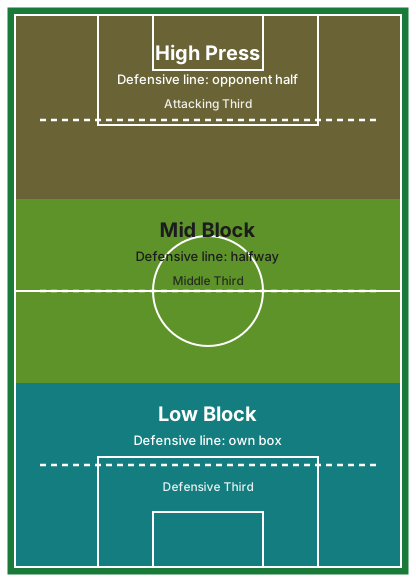
High press applies pressure within 30-40m of the opposition penalty area to break build-up and feed short counters within 5 seconds of recovery. Low block stations 9 players within 25-30m of the defender's own penalty area, denying time and space, then springs long counters. The two are opposites in placement, line height, and running intensity.

Photo by Omar Ramadan on Unsplash
High Press
Press the opposition during build-up (when their GK/CB has the ball), targeting recovery within 30-40m of the opposition penalty area. Klopp's gegenpressing, Pep's positional press, and Bielsa's high line all fit here. The defensive line is pushed up to at least the halfway line, and a high line is required to manage long balls.
Low Block
Compress 9 players (GK + 8) within 25-30m of the defender's own penalty area, denying penetration. Diego Simeone's Atlético Madrid, Mourinho's 2009-10 Inter, and Sean Dyche's Burnley typify this. The defensive line is set at 18-25m from goal; CMFs and WGs drop back as well. Attacks pivot around long balls and counters.
Mid Block — The Middle Path
Between high press and low block. Defensive line at the halfway line, pressure starting once the opposition crosses midfield. Carlo Ancelotti's Real Madrid, mid-period Simeone, and many conservative modern teams use mid block. Less running than high press, more attacking range than low block.
High press and low block look opposed but modern top teams switch between them. Pep's Manchester City defaults to high press but shifts to mid block when leading late. Mourinho's peak Inter showed high-press elements during attacking phases.
Theoretical Foundations — Why Both Coexist
Both tactics are different solutions to the risk/reward trade-off. High press: "win the ball in their third = high reward (immediate chance)" but "behind the line on a long ball = high risk." Low block: "compressed at home = low risk" but "attack origin is far = low reward."
High Press Theory — "The 5 seconds after recovery" maximizes xG
Bradley et al. (2010) and Tenga et al. (2010) data show that short counters within 5 seconds of recovery produce the highest xG: 60% retention rate, 35% box penetration rate, roughly 2× the xG of other match phases. Klopp's quote 'Gegenpressing is the best playmaker' is grounded in this. Recovering in the opposition third dramatically increases the probability of creating a chance before the defense reorganizes.
Low Block Theory — "Box-Adjacent Compression" minimizes xG against
Pollard & Reep (1997)'s classic study showed 80% of goals come from inside-the-box shots. Low block structurally erases the opposition's chance to take inside-the-box shots by stationing 9 players around the box. Simeone's Atlético averages 0.7-0.9 xG against per match (vs the league average 1.1-1.3) — direct empirical proof.
Mid Block Theory — "Risk/Reward Balance"
Mid block compromises between high-press post-recovery xG and low-block xG-against. Carlo Ancelotti's Real Madrid (2021-24) won 2 Champions League titles via mid block. The essence is flexibility: 'press when it makes sense, drop when it doesn't.'
Tactical choice is a function of opponent quality + own team's traits + match state. Pep's Manchester City stays in high press even against elite opponents; Atlético defaults to low block against elite opponents. There is no single 'right' tactic — only the right tactic for the context.
Implementation — How High Press and Low Block Actually Work
Both tactics rest on three components: "when to trigger pressure," "who marks whom," and "how to maintain line height." Implementation precision translates directly into team results.
High Press Implementation — 4 Steps
- 1. Set press triggers — specific cues to start pressure, e.g., 'GK passes to a CB,' 'CB receives facing their own goal'
- 2. Manage press lines — CF on CB, WG on SB, CMF on DMF (for 4-3-3, a 3+3 wave press)
- 3. Sync the high line — push the defensive line within 25-30m of opposition CBs; CBs partner with CMFs to manage long balls
- 4. Switch on press break — when the opposition beats the press, immediately drop into low block, or have CMFs/SBs drop to form a mid block
Low Block Implementation — 4 Steps
- 1. Set the block line — defensive line 25-30m from own goal; CMFs and WGs drop to 30-35m
- 2. Assign zones — each player covers a zone (zonal, not man-marking). Atlético's 4-4-2 is the classic example
- 3. Activate pressing triggers — start pressing when the opposition enters 18-25m around the box, with CBs and CMFs arriving as a pair
- 4. Long counter — on recovery, transition immediately with a long ball into the opposition third; CFs and WGs sprint. Peak Atlético's Griezmann–Costa link is canonical
Tactical Meaning of Line Height
High press: line at 30-40m (from own goal, viewed conventionally as box-distance). Low block: 18-25m. A 5-meter shift in line height roughly doubles the space available to the opposition. Bielsa's Leeds 2020-21 led the league at 38m average line height; peak Atlético hit 22m, the league's lowest.
Implementation precision depends on training volume and inter-player communication. Klopp has said gegenpressing requires '6 months of focused training.' Atlético's low block took Simeone four full seasons (2011-15) to perfect.
Evaluation Metrics — PPDA, xG Against, Line Height, Sprint Distance, Recovery Position
Both tactics are measured by multiple metrics. PPDA, xG against, line height, sprint distance, and ball recovery position cover the spectrum.
1. PPDA (Passes Per Defensive Action)
How many opposition passes complete per defensive action (tackle/interception/foul) by the home team. High-press teams have low PPDA (the opposition meets defense fast = pressure intensity is high). Pep Manchester City 5.2, Klopp Liverpool 5.8, Bielsa Leeds 5.5; low-block Atlético 12.8 — clearly higher.
2. xG Against (Expected Goals Against)
Total chance quality conceded. Low-block teams are low here (compressed around the box). Atlético 0.85 per match, Manchester City 0.95, Liverpool 1.05, Burnley 1.15. xG against under 1.0 is world-best.
3. Defensive Line Height
Average line position (meters from own goal). High press 35-45m, mid block 25-35m, low block 18-25m. Bielsa Leeds 38m, Manchester City 36m, Liverpool 34m, Atlético 22m.
4. Sprint Distance
Total high-intensity running (>20 km/h). High-press teams cover 110-130 km per match (team total); low-block teams 90-110. Peak Liverpool 125 km/match, Atlético 95 km/match.
5. Ball Recovery Zone
Average position of recoveries (meters from own goal). High press 50m+, low block 25m or less. Pep Manchester City 55m, Klopp Liverpool 53m, Atlético 28m, Burnley 22m.
The 5-metric combination defines a team's tactical identity. Pep Manchester City: low PPDA + medium xG-against + high line + high running + high recovery position. Atlético: high PPDA + low xG-against + low line + medium running + low recovery position. Footnote auto-derives these metrics from U-15+ match data.
Historical Cases — Klopp's Liverpool vs Simeone's Atlético
We compare the high-water marks of both tactics: Jürgen Klopp's Liverpool (2018-22) and Diego Simeone's Atlético Madrid (2014-16). They competed simultaneously at the European peak.
Klopp's Liverpool — Gegenpressing at Its Peak
Klopp arrived at Liverpool in 2015 and spent four years perfecting gegenpressing. The 2018-19 UCL-winning team posted PPDA 5.4, line height 36m, and 128 km sprint distance per match — league-best. The Salah/Mané/Firmino front three triggered the press; Henderson/Wijnaldum/Fabinho covered behind; van Dijk/Robertson/Trent supported the high line.
Simeone's Atlético — The Low Block Textbook
Simeone took Atlético in 2011 and won the league in 2013-14 (their first in 18 years), reaching the UCL final. The 2015-16 final team posted PPDA 13.2, line height 21m, and 0.78 xG against per match — league-lowest. Godín/Miranda formed the wall, Filipe Luís/Juanfran the SBs, Koke/Saúl the CMFs, Griezmann/Costa the FWs — a complete 4-4-2.
When the Two Met — UCL Quarter-Final 2014-15
Atlético and Real Madrid (Carlo Ancelotti, high-press leaning) drew 0-0/0-0 (PK loss for Atlético) in the 2014-15 UCL quarter-final. Atlético's 90-minute low block stymied Real Madrid — a defining match symbolizing the equilibrium of the two streams. Hewitt et al. (2016) analyzes this game in detail as 'a historical case of modern defensive tactics.'
Current Trend — Carlo Ancelotti's Mid Block
In 2025, top clubs have shifted away from extremes toward Carlo Ancelotti's mid block (Real Madrid 2021-24): switching tactics flexibly with match state. 'Lean low-block against elite opponents, lean high-press against weaker ones' is now the standard.
Tactical choice is a function of manager philosophy + squad composition + opponent. Klopp's high press at Liverpool and Pep's at Manchester City implement differently; Simeone's low block and Mourinho's at Inter differ in attacking rhythm. There is no 'correct tactic' — only 'the tactic that fits your team.'
Application to Youth Development — Which to Learn?
For youth players and coaches, which to learn — high press or low block? The answer is "both," but priorities depend on age and developmental stage.

Photo by Raymond Yeung on Unsplash
U-12 and Below — Learn High-Press Basics
In the Golden Age and below, building 'actively chasing the ball' is essential. Côté et al. (2009) showed that players who experience active defending in youth develop higher tactical understanding as adults. Low-block-style 'waiting defense' is not recommended at U-12 — it builds passivity.
U-15 — Learn Both Tactical Foundations
Tactical understanding develops fastest at U-15, so both should be experienced. Press triggers, zonal defensive coverage, line management — learn all step by step. FIFA / JFA coaching guidelines also recommend tactical diversity from U-15.
U-18 — Learn to Switch by Match State
U-18 is the stage to learn 'lean low-block when leading, lean high-press when chasing,' i.e., switching by match state. Pros switch tactics multiple times within a single match — it's important to acclimate during the final youth year.
Recommendations for Coaches
Avoid attaching to a single tactic. Klopp-disciple "only gegenpressing" or Simeone-disciple "only low block" stances narrow players' tactical understanding. World-class youth development requires mastering the theory and implementation of both, then applying them to age, ability, and opponent.
Footnote auto-computes PPDA, xG against, and line height from team match data, surfacing whether a youth team is "high-press type, low-block type, or mid-block type." From U-15+, deepen tactical understanding objectively.
Summary — The Two Tactics Are Complementary, Not Opposed
High press and low block look opposed but are now used as a context-dependent toolkit. Mastering theory, implementation, and metrics for both broadens tactical understanding and improves adaptability at the professional level.
Key takeaways:
- Definitions — high press: pressure 30-40m in the opposition third; low block: compressed defense 25-30m in own third; mid block: between the two
- Theory — high press maximizes xG via the 5 seconds after recovery; low block minimizes xG against via box-adjacent compression
- Implementation — three components: press triggers, line management, zonal assignment
- Metrics — PPDA, xG against, line height, sprint distance, ball recovery position
- Youth application — high-press fundamentals at U-12, both at U-15, switching by state at U-18
Footnote auto-derives both tactical streams' metrics from match data, visualizing which tactic a team is closer to. From U-15+, players and coaches can deepen tactical understanding with objective data.
References
- [1] Bradley P.S., Ade J.D. (2018). “Are current physical match performance metrics in elite soccer fit for purpose or is the adoption of an integrated approach needed?” International Journal of Sports Physiology and Performance.
- [2] Bradley P.S., Sheldon W., Wooster B., Olsen P., Boanas P., Krustrup P. (2010). “High-intensity running in English FA Premier League soccer matches” Journal of Sports Sciences.
- [3] Tenga A., Holme I., Ronglan L.T., Bahr R. (2010). “Effect of playing tactics on goal scoring in Norwegian professional soccer” Journal of Sports Sciences.
- [4] Pollard R., Reep C. (1997). “Measuring the effectiveness of playing strategies at soccer” Journal of the Royal Statistical Society.
- [5] Hewitt A., Greenham G., Norton K. (2016). “Game style in soccer: what is it and can we quantify it?” International Journal of Performance Analysis in Sport.
- [6] Memmert D. (2021). “Match Analysis: How to Use Data in Professional Sport” Routledge.
- [7] Wallace J.L., Norton K.I. (2014). “Evolution of World Cup soccer final games 1966-2010: Game structure, speed and play patterns” Journal of Science and Medicine in Sport.
- [8] Côté J., Lidor R., Hackfort D. (2009). “ISSP position stand: To sample or to specialize? Seven postulates about youth sport activities” International Journal of Sport and Exercise Psychology.
Related Articles
The First 5 Seconds After Losing the Ball — Soccer Transition Theory and Youth Implementation
6 min read
What Is Soccer IQ? The 3 Cognitive Components Identified by Vestberg's Research
6 min read
Decision Speed in Soccer — How Pros Decide in 0.5 Seconds, and How to Train It
5 min read
The Modern DM (#6 Role) — Destroyer, Deep-Lying Playmaker, and Single Pivot: Defensive Midfielder Evolution
9 min read
The Modern CB (#4 Role) — Classic Stopper, Ball-Playing CB, and the Modern Libero Revival
9 min read
Track Your Growth with Footnote
Just record your matches — AI analyzes every 5 games. Visualize growth with PVS Score. All features free during beta.
30-second signup · No credit card required
Last updated: 2026-05-09 ・ Footnote Editorial