Possession vs Counter-Attack — The Two Streams of Modern Attacking Philosophy
Modern soccer attacking tactics split into two streams: "possession" (retain and break down) and "counter" (strike when the opposition attacks). Pep Guardiola's Barcelona/Manchester City defined Tiki-Taka and Positional Play; early Klopp at Dortmund, peak Mourinho, and Simeone's Atlético defined high-speed counter. Tenga et al. (2010)'s Norwegian Premier League analysis shows 45% of all goals come from counters (shots within 15 seconds of recovery) and 35% from possession sequences (10+ pass build-ups). The two stem from a fundamental philosophical difference: "win by holding the ball" vs "win by exploiting the opposition's hold." This article unpacks the theoretical foundations, implementations, evaluation metrics, and tactical-choice frameworks of both.
Definitions — Possession vs Counter
Possession-style: target 60%+ ball possession with 600+ passes per match and 8+ pass average per attacking sequence. Counter-style: target box arrival within 15 seconds of recovery. The core difference: "hold the ball to win" vs "let them hold to win."

Photo by Lukáš Parničan on Unsplash
Possession Football
Originating with Pep Guardiola's 2008-12 Barcelona "Tiki-Taka," possession football maintains 60%+ ball possession to break down the defense. 600-800 passes per match (Manchester City 2017-18 averaged 720), 8-12 passes per sequence. Pep's evolved "Positional Play" divides the pitch into 18 zones and assigns the optimal player to each.
Counter-Attack
Reach the opposition's penalty area within 15 seconds of recovery. Early Klopp Dortmund's "Heavy Metal Football," peak Mourinho Inter's long counters (2009-10 UCL), Simeone's Atlético "low block + counter" (2013-14 league win) define the type. Bradley et al. (2010) showed 65% of high-intensity match running concentrates in counter phases.
Hybrid
Most modern top clubs use both adaptively. Carlo Ancelotti's Real Madrid (2021-24) wins counters with Vinicius/Bellingham individual quality and possesses with Modrić/Kroos technique — the hybrid type. There is no 'right' tactic; only context-appropriate ones.
Both tactics are different solutions to the risk/reward trade-off. Possession is "risk management — never lose the ball"; counter is "reward maximization — strike when defense is shifted." The right choice depends on context.
Theoretical Foundations — Why Both Coexist
Pollard & Reep (1997)'s classic, Tenga et al. (2010)'s modern, and Bradley et al. (2010)'s physical data each show that the two tactics carry different probabilistic advantages.
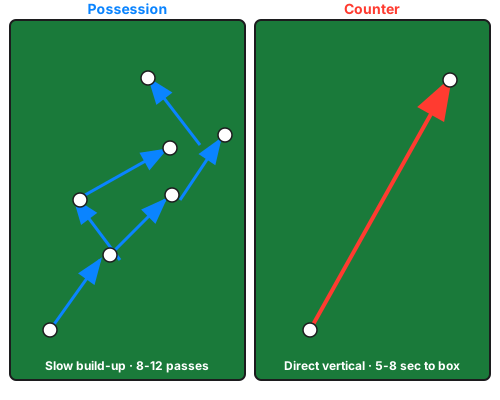
Possession Theory — "Avoid conceding when the opposition has the ball"
At 60%+ possession, the opposition only attacks 40% of the match — mathematically reducing their chance count. Pep's 2017-18 Manchester City (100-point league win) had 65% possession and 1.6 chances against per match (league-low). Numerical proof of the classic dictum, "the best defense is offense."
Counter Theory — "The 15 seconds before the defense reorganizes"
Tenga et al. (2010) showed counter attacks (within 15 seconds of recovery) generate chances at 2× the standard attack rate. The defensive shape is shifted forward at the moment of recovery, so the distance to a box shot is shorter and block probability is lower. Mourinho's Inter 2009-10 won the UCL semifinal (vs Barcelona) with 45% possession via two long counters.
Goal Origins — Tenga 2010's Key Finding
Tenga et al. (2010) analyzed 1,688 Norwegian Premier League goals and found "45% from counters, 35% from possession sequences, 20% from set pieces." A critical counterpoint to the "possession is correct" orthodoxy — possession dominance is not a precondition for victory.
Modern Synthesis — Pep's Evolution
Pep Guardiola himself has shifted toward a hybrid at Manchester City: 'high press + possession + opportunistic counter at restart.' His 2022-23 UCL-winning Manchester City combined possession stability (65%) with gegenpressing-style box-adjacent counter from recoveries.
"100% possession" or "100% counter" teams do not exist in modern soccer. The ratio differs, but every top club uses both. Pick a primary tactic that fits your team's traits, then use both flexibly — that is the modern standard.
Implementation — How Possession and Counter Actually Work
Both rest on three components: "ball circulation pattern," "attacking tempo," and "player positioning." Implementation precision translates directly into team results.
Possession Implementation — 4 Principles
- 1. Divide the pitch into 18 zones — the foundation of positional play. 5 horizontal × 4 vertical zones, with the optimal player assigned to each (Pep at Barcelona/City)
- 2. Use the half-spaces — the 5m corridor between center and flank, used in coordination by CMF, WG, and SB. Statistically the highest-assist-yielding zone
- 3. Recreate Rondos in the match — the Barcelona academy's 'cage' on the pitch. Three players surround one, maintaining safe passing lanes
- 4. Don't rush (Tempo Control) — wait for the chance until late in the attack. Manchester City makes 10-15 'pace changes' per match
Counter Implementation — 4 Principles
- 1. Vertical pass within 3 seconds of recovery — a 20m+ pass toward the opposition box. Klopp's Dortmund 2010-13 'pass to Lewandowski' is canonical
- 2. Sprinting FWs/WGs — at the moment of recovery, the CF and WGs run behind the defensive line, leveraging Mbappé/Vinicius-grade max speed
- 3. Simple finishing — once in the box, shoot in 1-2 touches. The opposite of possession's 'build the goal' patient attacks
- 4. Everyone joins the counter — SBs and CMFs sprint forward. Atlético's counters depend on Filipe Luís/Juanfran SBs
Hybrid Implementation — Switching by State
Carlo Ancelotti's Real Madrid (2021-24) implements three modes: (1) build-up phases use possession, (2) recovery in the central zone triggers counters, (3) leading late games use possession to consume time. The state judgment is delegated to experienced CMFs (Modrić/Kroos). 'Player decision-making' takes precedence over 'manager's tactical box.'
Implementation precision needs 6-24 months of training. Pep perfected Tiki-Taka in his first Barcelona season because he inherited a 25-year Cruyff-era tradition. New introductions need three seasons of patience.
Evaluation Metrics — Possession %, Total Passes, Tempo, xG/Shot, Counter Success %
Both tactics are measured by multiple metrics. Possession %, total passes, attack tempo, xG per shot (chance quality), and counter success rate cover the spectrum.
1. Possession %
Share of match time the team holds the ball. Possession-style: 60%+. Counter-style: 45-55%. Manchester City 2022-23 65%, Barcelona 2010-11 73% (league all-time high), Atlético 2013-14 47%, Mourinho Inter 2009-10 45%.
2. Total Passes
Completed passes per match. Possession-style: 600-800. Counter-style: 300-450. Pep Manchester City 720, Barcelona 2010-11 850 (league-most), Atlético 380, Mourinho Inter 350.
3. Attack Tempo (Direct Speed)
Average time from recovery to shot. Possession-style: 25-35 seconds. Counter-style: 8-15 seconds. Manchester City 28s, Atlético 12s, Klopp Liverpool 18s (mid).
4. xG per Shot
Expected goal value per shot. Counter-style: fewer shots, higher quality. Possession-style: more shots, slightly lower quality. Atlético 0.13/shot, Manchester City 0.11/shot. Quality edge to counter.
5. Counter Success %
Share of recoveries that produce a shot. Counter-style: 25-35%. Possession-style: 12-20%. Klopp Liverpool 32% (league-best), Mourinho Inter 30%, Manchester City 18%.
The 5-metric combination defines tactical identity. Manchester City: high possession + many passes + medium tempo + medium xG/shot + medium counter. Atlético: medium possession + few passes + fast tempo + high xG/shot + high counter. Footnote auto-derives these from U-15+ match data.
Historical Cases — Pep's Barcelona vs Mourinho's Real Madrid
We compare the high-water marks of both tactics: Pep Guardiola's Barcelona (2008-12) and José Mourinho's Real Madrid (2010-13) in El Clásico. The two competed simultaneously at the European peak.

Photo by Igor Batista on Unsplash
Pep's Barcelona — Possession Perfected
Took Barcelona in 2008. In four years won the league three times and the UCL twice (2008-09, 2010-11). 73% possession (league all-time high), 850 passes per match (league-most), 2.8 xG per match — the peak of possession football. Messi/Xavi/Iniesta/Busquets midfield rotation maximized untouchable time.
Mourinho's Real Madrid — The Counter Textbook
Took Real Madrid in 2010 and built the "anti-Tiki-Taka" tactical system to break the Barcelona blockade. Cristiano Ronaldo/Ozil/Di María/Higuain led vertical attacks, deliberately reducing possession to 50-55% while setting the league's record (2011-12: 121 goals). One league title (2011-12), three consecutive UCL semifinals.
El Clásico Tactical Showdown — 2010-11
The four 2010-11 El Clásicos (league + Copa del Rey + UCL semifinal) were a textbook possession-vs-counter showdown. Mourinho's Real Madrid suppressed possession to 35-45% and committed to long counters within 10 seconds of recovery. Ultimately Pep's Barcelona reached the UCL final, demonstrating possession's edge.
Lesson — Tactic Depends on Opponent Quality
Mourinho's counter tactic struggled against mid-tier opponents (who sat back, eliminating counter opportunities). Pep's possession was optimized for mid-tier opponents but couldn't fully beat Mourinho. The era proved historically that 'tactical choice depends on opponent quality.'
The 2010-13 four-year duel between Pep's Barcelona and Mourinho's Real Madrid is the theoretical and practical definitive of possession vs counter. Both have edges in different contexts; there is no absolute correct answer.
Application to Youth Development — Which to Learn?
For youth players and coaches, which to learn — possession or counter? The answer is "both," with priorities depending on age and developmental stage.
U-12 and Below — Learn Possession Basics
In the Golden Age, prioritize possession-style fundamentals: ball control, bilateral foot, vision. Counter-style emphasizes 'fast vertical pass + simple finish,' offering fewer technical learning opportunities. Côté et al. (2009) showed that players who experience possession-style in youth develop greater technical diversity as adults.
U-15 — Learn Both Tactical Foundations
Tactical understanding develops fastest at U-15, so both should be experienced. Possession via Rondos teaches passing and support; counter via repeated 'recovery vertical pass + sprinting run' teaches reactive attack. FIFA / JFA guidelines also recommend tactical diversity from U-15.
U-18 — Choose by Team Traits
U-18 is when the primary tactic is selected based on team characteristics (squad composition, physicality, technique). Pace-heavy teams lean counter; technique-heavy teams lean possession. The judgment is to fit tactic to strengths. Pros switch within matches, so acclimation in the final youth year matters.
Recommendations for Coaches
Avoid "Tiki-Taka disciple" or "counter disciple" attachment. Forcing 100% possession on a Pep-style basis produces players unable to adapt. Master the theory and implementation of both, then apply to age, ability, and opponent — that is world-class youth development.
Footnote auto-derives possession %, total passes, and attack tempo from match data, surfacing whether a youth team is "possession type, counter type, or hybrid." From U-15+, deepen tactical understanding objectively with data.
Summary — The Two Are Not Opposed; They Are Context-Dependent Choices
Possession and counter look opposed but are now used as a context-dependent toolkit. Mastering theory, implementation, and metrics for both broadens tactical understanding and improves adaptability at the professional level.
Key takeaways:
- Definitions — possession: 60%+ retention with many passes; counter: box arrival within 15 seconds of recovery
- Theory — possession structurally reduces conceding via retention time; counter exploits the unsettled defensive shape post-recovery
- Implementation — possession: 18-zone division + Rondos; counter: vertical pass post-recovery + sprinting runs
- Metrics — possession %, total passes, attack tempo, xG/shot, counter success %
- Youth application — possession basics at U-12, both at U-15, fit-to-team selection at U-18
Footnote auto-derives both tactical streams' metrics from match data, visualizing which tactic a team is closer to. From U-15+, players and coaches can deepen tactical understanding with objective data.
References
- [1] Tenga A., Holme I., Ronglan L.T., Bahr R. (2010). “Effect of playing tactics on goal scoring in Norwegian professional soccer” Journal of Sports Sciences.
- [2] Pollard R., Reep C. (1997). “Measuring the effectiveness of playing strategies at soccer” Journal of the Royal Statistical Society.
- [3] Bradley P.S., Sheldon W., Wooster B., Olsen P., Boanas P., Krustrup P. (2010). “High-intensity running in English FA Premier League soccer matches” Journal of Sports Sciences.
- [4] Bradley P.S., Ade J.D. (2018). “Are current physical match performance metrics in elite soccer fit for purpose or is the adoption of an integrated approach needed?” International Journal of Sports Physiology and Performance.
- [5] Hewitt A., Greenham G., Norton K. (2016). “Game style in soccer: what is it and can we quantify it?” International Journal of Performance Analysis in Sport.
- [6] Wallace J.L., Norton K.I. (2014). “Evolution of World Cup soccer final games 1966-2010: Game structure, speed and play patterns” Journal of Science and Medicine in Sport.
- [7] Memmert D. (2021). “Match Analysis: How to Use Data in Professional Sport” Routledge.
- [8] Côté J., Lidor R., Hackfort D. (2009). “ISSP position stand: To sample or to specialize? Seven postulates about youth sport activities” International Journal of Sport and Exercise Psychology.
Related Articles
High Press vs Low Block — The Two Defensive Tactical Streams of Modern Soccer
10 min read
The First 5 Seconds After Losing the Ball — Soccer Transition Theory and Youth Implementation
6 min read
What Is Soccer IQ? The 3 Cognitive Components Identified by Vestberg's Research
6 min read
Decision Speed in Soccer — How Pros Decide in 0.5 Seconds, and How to Train It
5 min read
The Modern AM (#10 Role) — Classic 10, Advanced 8, and Dropping 9: A Theory of the Creative Position
9 min read
Track Your Growth with Footnote
Just record your matches — AI analyzes every 5 games. Visualize growth with PVS Score. All features free during beta.
30-second signup · No credit card required
Last updated: 2026-05-09 ・ Footnote Editorial