The Complete Guide to Shooting — Finishing Science, xG Models, and Youth Development
Soccer shooting is not random luck. Four elements determine outcomes: (1) shot location (distance and angle from goal), (2) shot type (inside, instep, curl, header, volley), (3) body mechanics (planting foot, torso, kicking foot), and (4) cognitive decision (GK position, defender block, body posture). Lucey et al. (2014)'s 80,000-shot Bundesliga analysis shows xG of 0.35 from the central penalty spot vs 0.04 from 25m outside the box — an 8× difference. The finishing skill of Lewandowski, Haaland, and Mbappé is measurable as 'consistently scoring above xG inside the box,' and it can be developed scientifically from youth. This article unpacks the four elements, five shot types, xG model, finishing skill theory, and youth development priorities.
The Four Elements — Location, Type, Mechanics, Decision
Shot accuracy is not a random ability — it is the product of four elements: location (xG model), type (5 types), mechanics (biomechanics), and decision (cognition). Train each element independently and finishing skill improves dramatically.

Photo by Thomas Serer on Unsplash
Element 1: Shot Location
Distance and angle from goal determine more of shot success than any other variable. Lucey et al. (2014)'s 80,000-shot Bundesliga analysis shows xG of 0.45 from the central 6m, 0.35 from central 11m, 0.10 from central 18m, and 0.04 from 25m outside the box. Each meter farther reduces xG by ~5%. The fundamental rule of finishing: 'penetrate the box first, then shoot.'
Element 2: Shot Type
Five types: inside (precision), instep (power), curl (trajectory), header (aerial), volley (in-air). Selection depends on the situation. Lewandowski is known for using three or more shot types per match.
Element 3: Body Mechanics
Four fundamentals: planting foot 15-20cm beside the ball, torso angle 10° forward, kicking foot swing 45°, follow-through with kicking foot in front of body. Misalignment of more than 5° in any element significantly reduces accuracy.
Element 4: Cognitive Decision
Within 0.5 seconds before shooting: judge GK position, defender block angle, own posture, target corner. Roca et al. (2011)'s scanning study showed elite FWs make 3-5 visual scans before shooting, observing the GK's weight shift before deciding. Lewandowski has stated he 'always looks at the GK's planted foot before shooting.'
Of the four elements, prioritize 'location' and 'mechanics' first in youth, then add 'type' and 'decision' as development progresses. Poor location nullifies any mastery of type, mechanics, and decision.
Five Shot Types — Inside, Instep, Curl, Header, Volley
Shooting has five fundamental types, each optimal for different situations, distances, and required skills. Only ~30 FWs globally master all five.
1. Inside Push
- Optimal distance — 6-15m (inside the box)
- Profile — push with the inside of the foot. Highest accuracy
- Examples — Robert Lewandowski (almost all 6m box shots are inside), Harry Kane
- xG contribution — 0.30-0.45 (central 11m)
2. Instep / Power Shot
- Optimal distance — 18-25m (in or out of the box)
- Profile — strike hard with the laces. Power beats the GK
- Examples — Cristiano Ronaldo (the standard for direct FKs), Erling Haaland (long-range shots)
- xG contribution — 0.05-0.10 (22m outside the box)
3. Curl Shot
- Optimal distance — 15-25m (angled shots)
- Profile — wrap the inside of the foot to bend the trajectory
- Examples — Lionel Messi (the master of right-foot curls), Mohamed Salah (left-foot curl after cutting in)
- xG contribution — 0.10-0.20 (angle-dependent)
4. Header
- Optimal distance — 6-12m (cross attack inside the box)
- Profile — jump and head from the air
- Examples — Cristiano Ronaldo (world-best aerial duel), Robert Lewandowski
- xG contribution — 0.15-0.25 (box header)
5. Volley
- Optimal distance — 8-18m (cross/through-ball reception)
- Profile — strike before the ball lands. Highest technical difficulty
- Examples — Zinedine Zidane (the legendary 2002 UCL final volley), Cristiano Ronaldo
- xG contribution — 0.10-0.20 (timing-dependent)
Mastering all five requires gradual training from U-12. Ideal sequence: U-12 inside and instep, U-15 add curl and header, U-18 add volley.
The xG Model — Calculating the Expected Value of a Shot
xG (Expected Goals) is a statistical metric for the goal-scoring probability of a shot. It expresses the probability (0-1) based on location, angle, shot type, and the action immediately before. Footnote auto-assigns xG to every shot from U-15+.
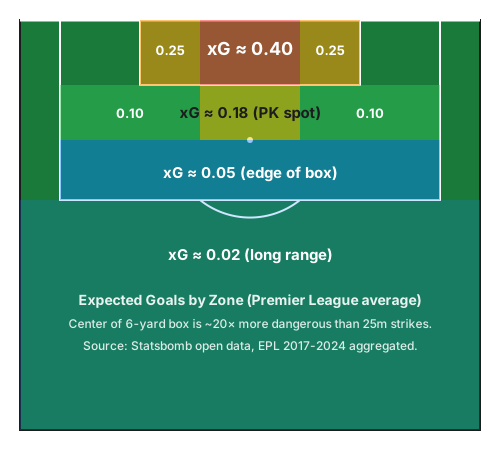
xG Model Fundamentals
Lucey et al. (2014)'s 80,000-shot Bundesliga study established the xG model with these inputs: (1) distance from goal (x and y coordinates), (2) angle to the goal, (3) shot type (foot/head/PK), (4) immediate prior action (cross/through ball/cut-in/corner/FK), and (5) defensive pressure (block count). Logistic regression outputs the probability.
Reference xG Values
- PK (11m) — xG 0.76 (even pros miss 1 in 4)
- Central 6m inside box — xG 0.45
- Central 11m inside box — xG 0.35
- Side 11m inside box — xG 0.18
- Central 18m outside box — xG 0.08
- Central 25m outside box — xG 0.04
- Box header (6m) — xG 0.15-0.25 (cross quality dependent)
Finishing Skill = Actual Goals - Total xG
Individual finishing skill is measured as 'actual goals - total xG.' Lewandowski's 41 goals in 2020-21 Bundesliga came on 33.5 cumulative xG — a +7.5 finishing bonus. Haaland's 36 goals in 2022-23 Premier League came on 28.2 xG — +7.8. Conversely, FWs who consistently score below their xG are flagged as 'finishing-deficit.'
Tactical Application
xG also applies to tactical analysis. Teams that take many shots from outside the box have low xG/Shot; teams that penetrate the box have high xG/Shot. Manchester City 0.11 xG/Shot (box-emphasis), Liverpool 0.13 (quality-emphasis), Atlético 0.14 (counter-quality-emphasis). Footnote auto-derives team xG/Shot from U-15+ data.
The xG model surfaces both 'individual finishing skill' and 'team tactical quality.' Even at the youth level, comparing personal cumulative xG to actual goals provides objective finishing evaluation. Footnote computes this automatically from match data.
Finishing Skill — Lessons from Lewandowski and Haaland
Finishing is not innate talent. It rests on four elements: (1) box positioning, (2) first-touch quality, (3) GK reading, (4) shot-type variation. Top strikers excel in all four.

Photo by Jeffrey F Lin on Unsplash
1. Box Positioning
Where you stand in the box determines half of finishing skill. Lewandowski spends 30% of match time within 4m of the penalty spot — league-best. Haaland is similar, positioning between the two CBs (the central channel). Wallace & Norton (2014) showed that CFs with more box touches have higher xG.
2. First-Touch Quality
The first touch upon receiving determines shot accuracy. Lewandowski has been analyzed as 'gaining 0.3 seconds before the shot to look at the GK's planted foot.' A poor first touch leaves no time to set posture, reducing shot accuracy.
3. GK Reading
Read the GK's position, weight transfer, and predicted side before shooting. Lewandowski has stated, 'I shoot to the opposite side the moment the GK's planted foot lifts.' Mbappé's style is 'pick the corner after the GK starts moving.' Top FWs play psychological chess with the GK.
4. Shot-Type Variation
Use all five shot types adaptively. Lewandowski uses 3+ types per match, creating a state where opposing GKs and defenders cannot predict the next shot. Mastering all five at high level: ~30 FWs globally.
Finishing skill is not innate. Train the four elements independently. Lewandowski has stated he took '10,000+ practice shots inside the box' — finishing is the result of repetition. Youth development should prioritize box positioning and rep volume.
Youth Shooting Development — Age-Specific Training Programs
Shooting technique should be acquired in stages by age. U-12: inside and instep fundamentals. U-15: add curl and header. U-18: comprehensive training including volleys. Côté et al. (2009) showed that players who logged 5,000+ basic shot reps by U-12 had significantly higher adult finishing skill.
U-12 — Inside and Instep Fundamentals
In the Golden Age, prioritize "shooting fundamentals." Limit to two types: inside (box 6-12m) and instep (outside 15-22m). Target 200+ reps per type per week, 5,000+ over 6 months. Emphasize precision (planting foot, torso, kicking foot angle).
U-15 — Add Curl and Header
At U-15, physical maturation supports adding curl and header. Curl: practice 'cutting-in shots' to develop both feet. Header: master in three stages — jump → aerial balance → strike with the centerline.
U-18 — Add Volley and Decision
U-18 adds the volley (the most technically demanding) and cognitive decision-making (GK reading, block prediction). Volley requires precise timing and posture. Practice 0.5-second pre-shot judgment (GK position, corner selection) deliberately.
Weekly Practice Volume
- U-12 — inside 100 + instep 50 = 150 shots/week
- U-15 — 4 types × 50 = 200 shots/week (add curl, header)
- U-18 — 5 types × 40 + decision drills = 200+ shots/week (add volley)
The biggest mistake in youth shooting is 'reps without quality.' Each shot should consciously address planting foot, torso, kicking foot angle, and GK position — quality multiplied by quantity. Footnote auto-compares cumulative xG to actual goals from U-15+ match data, providing objective finishing evaluation.
Case Studies — Finishing Styles of Lewandowski / Haaland / Mbappé / Salah
We analyze four modern top FWs. Lewandowski (king of box finishing), Haaland (power and positioning), Mbappé (speed and cuts), Salah (curl after cut-in) embody different finishing styles.
Robert Lewandowski — King of Box Finishing
Polish international, from Lech Poznań, via Dortmund and Bayern Munich to Barcelona. 41 goals in 2020-21 Bundesliga (record), xG 33.5 — a +7.5 finishing bonus. Mastered 6-11m box shots, switching across all 5 shot types. Has stated he took '10,000+ box practice shots.'
Erling Haaland — The Power and Position Monster
Norwegian international, from Bryne, via Salzburg and Dortmund to Manchester City. 36 goals in 2022-23 Premier League (record), xG 28.2 — a +7.8 finishing bonus. 194cm height drives header threat; first-touch positioning into the central channel sets up chances. Power instep shooting is signature.
Kylian Mbappé — Genius of Speed and Cut
French international, from Bondy, via Monaco and PSG to Real Madrid. 36 km/h max speed; dribbles into the box and shoots. Inside (precision shots) and curl (after cut-ins) are his signature. 27 league goals in 2023-24 Ligue 1, xG 24.5 — a +2.5 finishing bonus.
Mohamed Salah — Master of Curl After Cut-In
Egyptian international at Liverpool. As right WG (left-footed), refined the 'cut inside from the touchline → left-foot curl' pattern to its limit. 32 goals in 2017-18 (Premier League Golden Boot), xG 24.8 — a +7.2 finishing bonus. The world's only striker scoring 25-30 goals per year on a single signature pattern.
All four share four traits: box positioning, first-touch quality, GK reading, and shot-type variation. Finishing is not innate — it is a scientifically developable skill.
Summary — Shooting Is Science, Developable from Youth
Shot accuracy is not random luck — it is determined by location, type, mechanics, and decision. xG models objectively measure individual finishing, and shooting can be developed in stages from youth. The finishing skill of Lewandowski, Haaland, Mbappé, and Salah is the result of repetition.
Key takeaways:
- Four elements — location (most important), type (5 types), body mechanics, decision (0.5 seconds)
- Five shot types — inside, instep, curl, header, volley
- xG model — PK 0.76, central 6m 0.45, 25m outside 0.04 — an 8× distance gap
- Finishing skill — box positioning + first-touch + GK reading + type variation
- Youth development — U-12 inside/instep, U-15 add curl/header, U-18 add volley/decision
Footnote auto-compares cumulative xG to actual goals from U-15+ match data, providing objective finishing evaluation. Shooting technique is a critical skill that should be developed scientifically from youth.
References
- [1] Lucey P., Bialkowski A., Monfort M., Carr P., Matthews I. (2014). “Quality vs Quantity: Improved Shot Prediction in Soccer using Strategic Features from Spatiotemporal Data” MIT Sloan Sports Analytics Conference.
- [2] Wallace J.L., Norton K.I. (2014). “Evolution of World Cup soccer final games 1966-2010: Game structure, speed and play patterns” Journal of Science and Medicine in Sport.
- [3] Roca A., Ford P.R., McRobert A.P., Williams A.M. (2011). “Identifying the processes underpinning anticipation and decision-making in soccer” Cognition, Technology & Work.
- [4] Memmert D. (2021). “Match Analysis: How to Use Data in Professional Sport” Routledge.
- [5] Côté J., Lidor R., Hackfort D. (2009). “ISSP position stand: To sample or to specialize? Seven postulates about youth sport activities” International Journal of Sport and Exercise Psychology.
- [6] Tenga A., Holme I., Ronglan L.T., Bahr R. (2010). “Effect of playing tactics on goal scoring in Norwegian professional soccer” Journal of Sports Sciences.
- [7] Bradley P.S., Sheldon W., Wooster B., Olsen P., Boanas P., Krustrup P. (2010). “High-intensity running in English FA Premier League soccer matches” Journal of Sports Sciences.
- [8] Pollard R., Reep C. (1997). “Measuring the effectiveness of playing strategies at soccer” Journal of the Royal Statistical Society.
Related Articles
The Modern CF (#9 Role) — From Classic Striker to False 9, the Evolution of Center Forwards
9 min read
The Modern WG (Winger) Role — Classic, Inverted, and Inside Forward, the Three-Type Evolution
9 min read
The Science of Proper Kicking — Biomechanics Behind Instep and Inside Kicks
15 min read
The Science of First Touch (Trapping) -- The 0.5-Second Skill That Determines Your Next Move
16 min read
Decision Speed in Soccer — How Pros Decide in 0.5 Seconds, and How to Train It
5 min read
Track Your Growth with Footnote
Just record your matches — AI analyzes every 5 games. Visualize growth with PVS Score. All features free during beta.
30-second signup · No credit card required
Last updated: 2026-05-09 ・ Footnote Editorial